“Let us be guided by past harms to prevent future ones”
The following remarks were delivered by Molly McGinty, IPPNW Program Director, at the International Meeting on Victim Assistance and Environmental Remediation at the UN Headquarters on September 1, 2026.
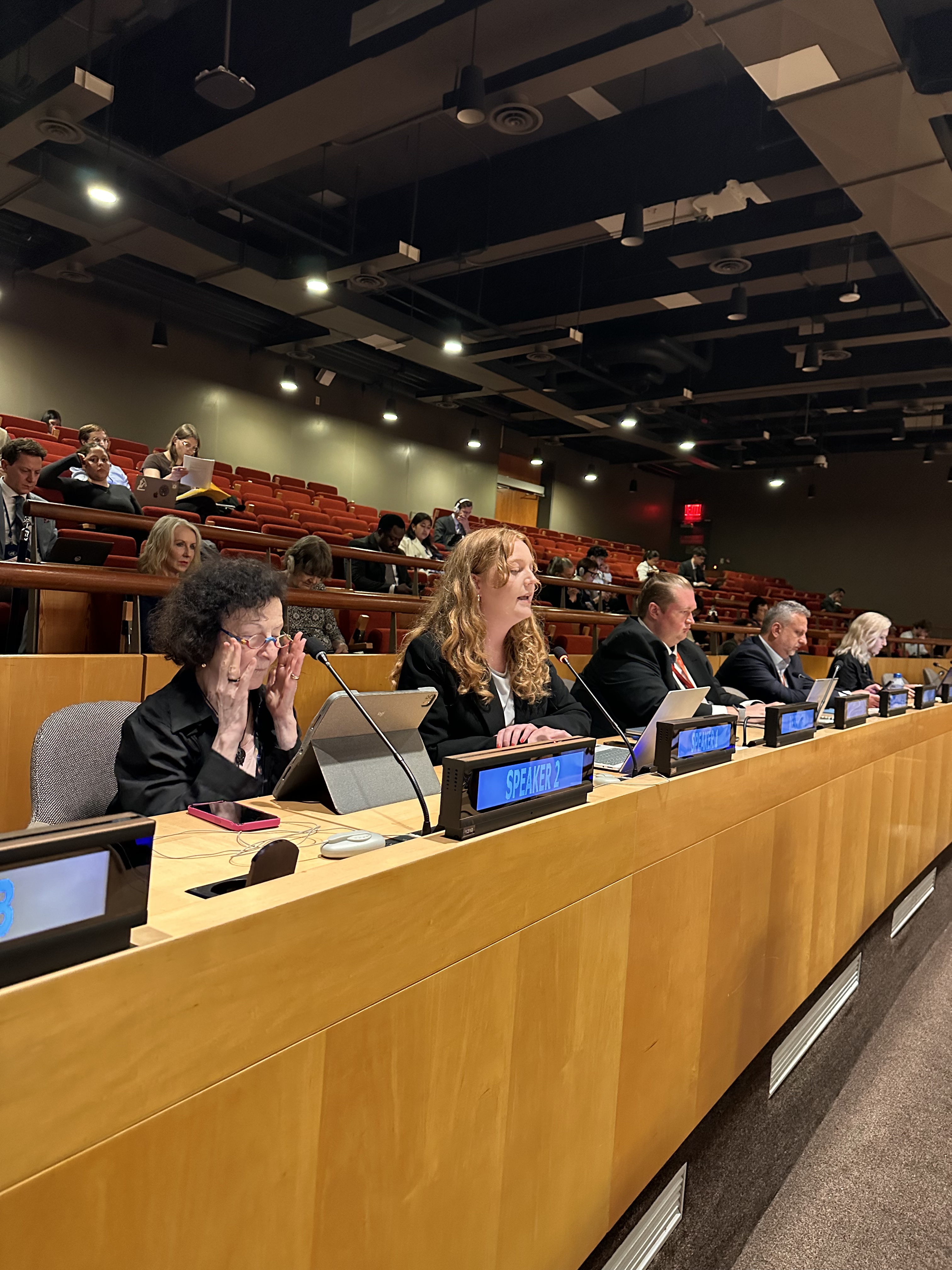
Distinguished Chair, delegates, and colleagues,
Since Trinity, the first nuclear detonation conducted 81 years ago in the desert of the Tularosa Basin of present-day New Mexico, nuclear weapons have had devastating and lasting impacts on human and planetary health. The entire nuclear weapons “life cycle” has imposed severe, long-term environmental costs and human suffering on innocent communities – spanning everything from the mining and milling of uranium and the storage of warheads to the constant threat of their use and their testing in the atmosphere, underwater, and underground.
In the name of national security, more than 2,000 nuclear weapons were detonated near people’s homes, hospitals, schools, places of worship, water supplies, fisheries, and farmland, without the consent of downwind communities.
Radioactive fallout knows no borders, poisons indiscriminately, and has fallen disproportionately on colonies, former colonies, and the territories of Indigenous Peoples and ethnic minorities: in the Marshall Islands, French Polynesia, and Kiribati; in Semipalatinsk, Kazakhstan; on traditional Western Shoshone land in Nevada; on Aboriginal lands in the Australian outback; on Nenets land in the Russian Arctic; in desert communities in Algeria; in the Uyghur region of China; and elsewhere.
The health impacts of these detonations include elevated rates of cancer and leukemia, thyroid disease, birth defects and reproductive complications, and other preventable harms, with women and children bearing a disproportionate burden of the harm. Entire communities were displaced and not able to return to their homelands. While these tests were halted in the 20th Century, their impacts are still felt today by the inhabitants and diaspora of affected nations.
Alarmingly, despite the widespread knowledge of these impacts and the decades’ long moratorium on nuclear testing, some nuclear weapon states have signaled their intention to resume this deadly and destabilizing practice as part of today’s renewed nuclear arms race.
We thank UN Member States participating in today’s first International Meeting on Victim Assistance and Environmental Remediation and make the following recommendations:
- Support the World Health Organization’s renewed mandate to study the health effects of nuclear weapons and war. Led by the Republic of the Marshall Islands, Samoa, and Vanuatu, the 2025 World Health Assembly overwhelmingly adopted a resolution to restore this mandate for the first time in three decades. With advances in radiation science and epidemiology since WHO’s last report over thirty years ago, this renewed study is a critical opportunity to document the full scope of harm and make recommendations on victim assistance and environmental remediation. We call on all WHO Member States to support this work with both expertise and funding.
- Ensure all recommendations and decisions made in this body, and in every discussion of nuclear weapon’s legacy, are made in consultation with affected communities. This should follow the Nuclear Truth Project’s protocols, centered on Rights, Respect, and Reciprocity. Anything short of this risks further harm, further exploitation, and an incomplete and inaccurate record. Affected communities offer essential lived experience, expertise, and insight. We regret that more of our esteemed colleagues from affected communities do not have a seat at this table.
- Re-evaluate and strengthen national, regional, and international victim assistance and environmental remediation programs, recognizing that all existing programs fall short of the scale of need and that the nuclear armed states bear special responsibility. Assistance must be sustained, adequately funded, and responsive to the complex and evolving needs of survivors. This includes support for the Treaty for the Prohibition of Nuclear Weapons’ ongoing work on victim assistance and environmental remediation, namely through the Treaty’s Articles 6 & 7.
As long as nuclear weapons still exist, so too does their threat. The abolition of nuclear weapons remains the only way to ensure that these disastrous impacts are not repeated, and we therefore call on all UN Member States to join the TPNW without delay.
Let us be guided by past harms to prevent future ones. Thank you.
Additional resources:
- The Devastating Consequences of Nuclear Testing: Effects of Nuclear Weapons Testing on Health and the Environment – IPPNW Germany, 2023.
- Protocols for Seeking Nuclear Truth with Integrity – Nuclear Truth Project, 2026.
- Radioactive Heaven & Earth: The health and environmental effects of nuclear weapons testing in, on, and above the earth – A report of the IPPNW International Commission to Investigate the Health and Environmental Effects of Nuclear Weapons Production and the Institute for Energy and Environmental Research, 1991.

 Bimal Khadka
 Bjorn Hilt
 Charles K. Johnson
 Dr. Ghassan Shahrour
 Gunnar Westberg
 IPPNW
IPPNW John Loretz
 Lawrence Wittner
 Maria Valenti
 mollymcgint
 Sue Wareham
 Tilman Ruff
 Tim Wright
 Xanthe Hall