30 years later: The Comprehensive Test Ban Treaty (CTBT)
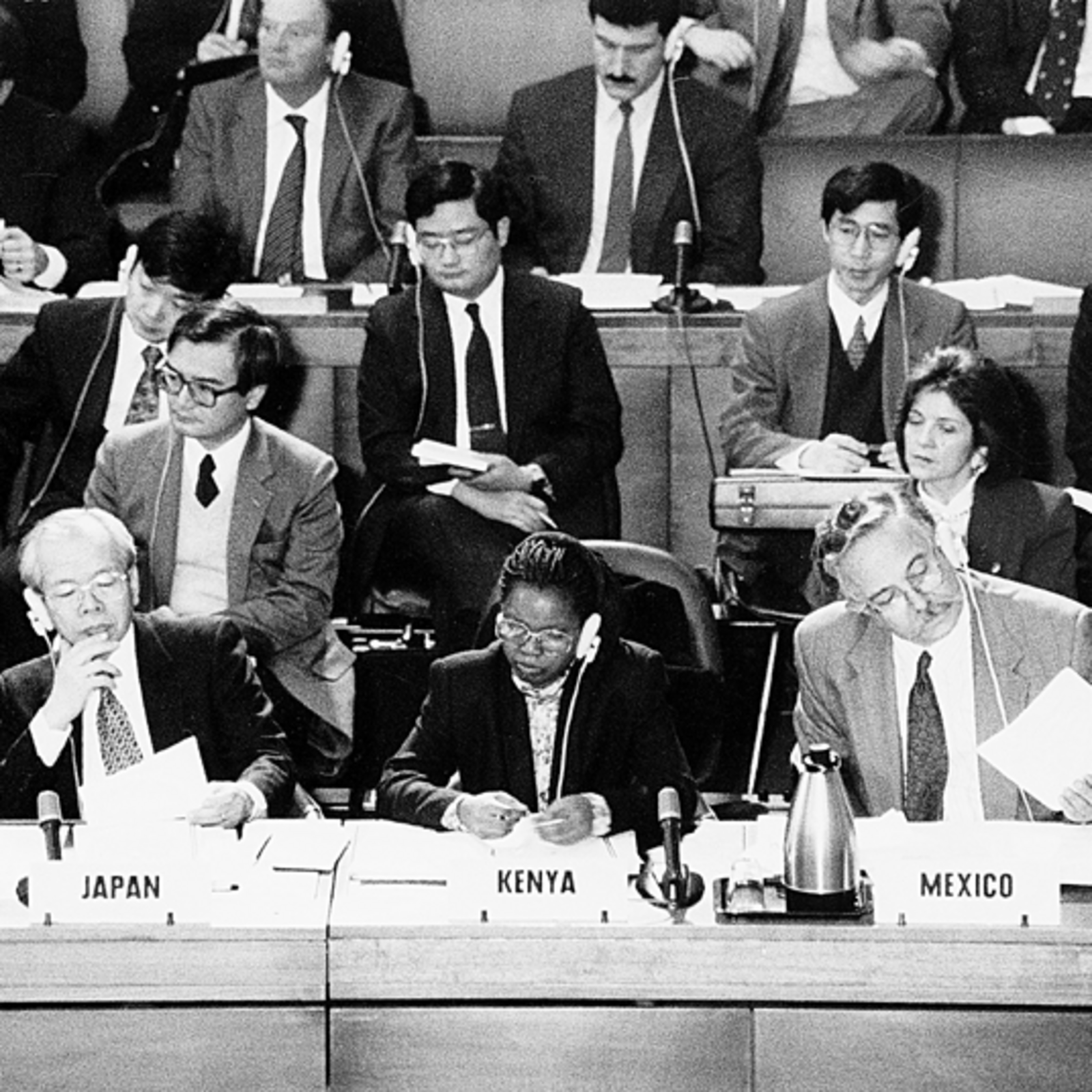
The Comprehensive Test Ban Treaty (CTBT) was adopted on this day — 10 September 1996 — by a vote in the United Nations General Assembly (UNGA). This was an unusual ending to the negotiation process that had lasted several years. Today, the CTBT is still functioning, as all signatory states are compliant with its provisions, but the treaty has still not officially entered into force.
Previously, it was normal for a multilateral disarmament treaty to be adopted in the Conference on Disarmament (CD), where it was also negotiated. However, the CD had a consensus rule and treaty negotiations ended on 9 August 1996 without unanimity.
Protests against the health and environmental effects of nuclear testing led to them being banned above-ground, underwater, and in space by the Partial Nuclear Test Ban Treaty in 1963. However, all of the Nuclear Weapons States continued to test underground in order to continue their development of new nuclear weapons. Pressure continued for nuclear testing to cease altogether, and a test moratorium was agreed which has held since 1992 for the US, Russia, France and the United Kingdom. China ended testing in 1996, India and Pakistan both conducted a short series of tests in 1998, and North Korea began testing in 2006 and has not tested since 2017.
On 19 November 1993, the UN General Assembly voted unanimously to mandate the CD in Geneva with negotiating a Comprehensive Test Ban Treaty (CTBT). The negotiations began on January 1994, and seriously progressed after the Non-Proliferation Treaty (NPT) was indefinitely extended in 1995. This was a period of positive progress for nuclear disarmament with the large nuclear powers — the USA and Russia — agreeing on real disarmament (START 1) and arms control.
Although the CTBT negotiations seemed to be making headway, the talks were put under strain by the announcements of both China and France that they needed to conduct more final tests in order to be able to have enough data to cease testing altogether.
By the summer of 1996, when the final draft of the treaty was presented by the Chair Jaap Ramaker, the controversial points had boiled down to these:
- The development of new technologies allowed the testing of nuclear weapons, like subcritical and hydrodynamic tests and computer simulations, to continue. The spirit of the treaty, to end or at least constrain the development and qualitative improvement of nuclear weapons, would be undermined by allowing these forms of testing.
- The treaty did not contain any direct commitment to the necessity for further nuclear disarmament.
- The requirement that all 44 states (listed in Annex 2) would need to ratify the treaty for it to enter into force would endanger the treaty itself.
- The treaty cemented the status quo regarding the level of development each NWS had reached .
The main argument for accepting the treaty as drafted was that it would represent an international legally-binding norm that could be used to stigmatise testing, despite its perceived weaknesses. However, some states continued to veto a consensus, in particular India. By the end of the final negotiating session in the CD, no consensus was reached, and the Australian Ambassador Richard Butler brought the Treaty to the United Nations for adoption.
When it came to voting on 10 September 1996 on the UN resolution A/RES/50/245, only three voted against the Treaty in the First Committee: India, Bhutan, and Libya. 158 States voted in favour. The CTBT was opened for signature on 24 September 1996. A Preparatory Commssion for the Comprehensive Test Ban Treaty Organisation (CTBTO) was adopted on 19 November 1996 (CTBT/MSS/RES/1) at a Meeting of States Signatories.
What is in the CTBT?
The text of the Treaty contains a preamble and 17 articles.
The Preamble lays out the intentions and the ‘spirit’ of the Treaty: to constrain development and therefore contribute as an effective measure towards nuclear disarmament and non-proliferation, and to protect the environment.
Article I lays out the obligations:
“Each State Party undertakes not to carry out any nuclear weapon test explosion or any other nuclear explosion”.
Moreover, the Treaty parties committed to prohibiting and preventing nuclear tests from taking place anywhere under their control, and to refrain from any kind of encouragement or assistance of others to test.
Article II established the CTBTO and its components:
The establishment of the Organisation to oversee the implementation and verification of the CTBT, and to assist consultation and cooperation was set out in Article II, A. The article also covered how the CTBTO was to be financed.
Article II B set out the composition, procedures and decision-making through regular Conferences of the State Parties, as the principal organ of the CTBTO.
How the Executive Council for the CTBTO was to be set up was detailed in Article II C. It would consist of 51 members from different geographical regions. Annex 1 listed these. The members of the Council would be elected by the Conference.
Article II D established a Technical Secretariat for the CTBTO which was to set up the International Monitoring System (IMS) and assist in establishing the monitoring stations in countries around the world. The Secretariat will be headed by a Director-General. Where appropriate, the Director-General can set up specific working groups of scientific experts.
Article III: National Implementation Measures
Legal and administrative steps were to be taken in order for the CTBT to be implemented on a national level and to facilitate cooperation and liaison with the CTBTO.
Article IV lays out the verification system:
The system to verify compliance with the CTBT was to consist of four elements:
B.) the International Monitoring System (IMS): providing seismological, radionuclide, and other data from the monitoring stations, as well as satellite monitoring, to the International Data Center of the CTBTO to give early warning of forbidden activities.
C.) consultation and clarification on compliance with the treaty. States are required to address the concerns of other states regarding a possible non-compliance, via the Director-General and the Executive Council.
D.) on-site inspections can be requested by any State Party to clarify where a nuclear explosion has taken place. An inspection team will be designated by the Director-General and will be allowed physical access to enable the team to gather facts necessary to ascertain whether there has been a violation of the Treaty. Information gathered by the inspection will then be reviewed by the Executive Council which will decide whether there exists a need for further action.
E.) confidence-building measures include the timely resolution of any compliance concerns.
Article V outlines sanctions and other measures to address violations, e.g. suspension or restriction of membership, loss of rights and privileges. Worst case, the issue may be brought “to the attention of the United Nations”, meaning the Security Council.
The settlement of disputes, amending the Treaty, and how the CTBT will be reviewed, are covered in Articles VI to VIII.
While the CTBT is of unlimited duration, withdrawal is allowed by giving six months notice, and an explanation of the reason, if a party decides that:
“extraordinary events related to the subject matter of the Treaty have jeopardized its supreme interests”
as set out in Article IX.
Articles X to XIII cover the status of the protocol and annexes, signature, ratification, and accession.
Probably the most important Article, other than Article I, is Article XIV which covers Entry into Force (EIF). The CTBT cannot enter into force until 180 days (six months) after all the countries listed in Annex 2 have signed and ratified the Treaty. Those states are all those that have a nuclear programme. Should EIF not be reached within three years, a Conference should be convened to address the issue each year until the Treaty enters into force.
There are three more articles outlining reservations, depositions and authentic versions of the Treaty text.
There is also a Protocol in three parts that goes into more detail about the roles and functions of the IMS, procedures for on-site inspections and confidence measures.
The Protocol has two annexes: Annex I lists the facilities that make up the IMS network, and Annex II defines parameters for standard event-screening.
What has and has not been achieved in the last 30 years?
188 of a total of 196 states have signed the CTBT, of which 179 have ratified. All of the States that have signed have adhered to the provisions of the Treaty.
The CTBTO was established in Vienna, Austria, in the United Nations. It is now staffed by more than 300 multidisciplinary experts and support staff and financed by the member states, costing about US$ 140 million annually.
The Preparatory Commission of all States Signatories and the Technical Secretariat have also taken up their work. The latter oversees the IMS, the International Data Centre (IDC) and the On-Site Inspection (OSI) Division.
The main achievement is the establishment of a global network of monitoring stations, the International Monitoring System (IMS) that is 90% complete and delivering data to the IDC. This system has already been used to detect all of the North Korean nuclear tests between 2006 and 2017. It also detected other events, such as the nuclear accident at Fukushima in 2011 and the Beirut explosion in 2020, as well as earthquakes, volcanic eruptions and meteor strikes.
The IMS uses various technologies to verify events: seismic, hydroacoustic, infrasound and radionuclide stations that can detect shockwaves, underwater soundwaves, ultra low frequency soundwaves in the atmosphere and radioactive particles and gases.
Of the 196 UN states, eight have not signed the treaty and 17 have not ratified.
It has not been possible for the CTBT to enter into force because nine of the 44 Annex 2 states have not ratified the Treaty and three have not even signed. North Korea, India, and Pakistan have not signed.The United States, China, Egypt, Israel and Iran have signed, but not ratified. Russia withdrew their ratification in 2023.
Will nuclear testing begin again?
Construction has been seen at several test sites in the past three years: at the Lop Nor test site in China, at the Russian Novaya Zemlya site, and at the US Nevada nuclear test site.
The Russian Foreign Minister Sergey Ryabkov alleged on 10 October 2023 that the US was preparing to resume testing in Nevada. This was followed on 2 November 2023 by Russian President Vladimir Putin officially rescinding ratification of the CTBT. He justified the move as a measure to address the imbalance caused by US failure to ratify the Treaty. Putin declared that Russia would not resume testing unless the US did so first.
On 30 October 2025, US-President Donald Trump declared on social media that his administration planned on carrying out new nuclear test explosions. He repeated this statement in an interview with the CBS programme “60 Minutes”, on 2 November 2025. He said that it was necessary in order to know if US nuclear weapons still worked, and because he believed that Russia was also planning to test. He claimed that other states, specifically mentioning North Korea, were constantly testing and the US was the only country that wasn’t. Despite the interviewer refuting this statement, Donald Trump remained insistent that it was true. The week after, Admiral Richard Correll, head of STRATCOM said that neither China or Russia were conducting nuclear tests. North Korea has also not conducted a nuclear test explosion since 2017.
Although it remains unclear whether the United States will resume testing, any uncertainty undermines confidence in the CTBT.
Thirty years ago, there was a choice to end nuclear testing and to make that commitment international law. The CTBT is almost universal, bar a few hold-outs who continue to threaten the security of the planet and its environment.
Documents verbatim:
► The Comprehensive Test Ban Treaty (CTBT), PDF, adopted 10 Sep 1996
► UN Resolution 50/245 Comprehensive Nuclear-Test-Ban Treaty, voted on 10 Sep 1996
Further Reading
Bugos S, Giveh M: Russia Withdraws Ratification of Nuclear Test Ban Treaty, Arms control Association, November 2023
CTBTO: Status of Signature and Ratification, Annex 2 states only, accessed on 10 Sep 2026
CTBTO: Text of the Treaty, The Comprehensive Nuclear-Test-Ban Treaty, no date given, accessed on 10 Sep 2026
Graham T: Comprehensive Nuclear-Test-Ban Treaty, Introductory Note, Audovisual Library of International Law, April 2009
O’Donnell N: President Trump on nuclear testing, the government shutdown, immigration, tariffs and U.S.-China relations, CBS 60 Minutes – Newsmakers, 02.11.2025

 Bimal Khadka
 Bjorn Hilt
 Charles K. Johnson
 Dr. Ghassan Shahrour
 Gunnar Westberg
 IPPNW
IPPNW John Loretz
 Lawrence Wittner
 Maria Valenti
 mollymcgint
 Sue Wareham
 Tilman Ruff
 Tim Wright
 Xanthe Hall


Trackbacks