20 years old: The Semey Treaty
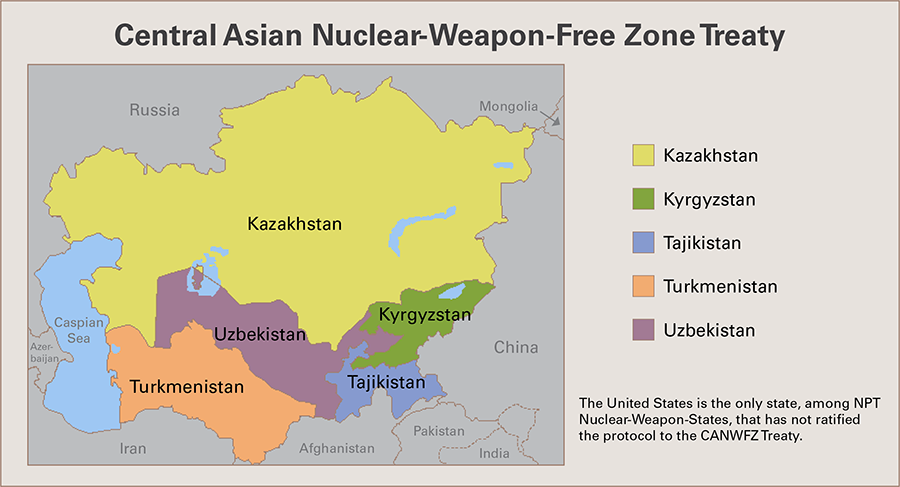
The Treaty on a Nuclear Weapon Free Zone in Central Asia (CANWFZ) is twenty years old on 8 September 2026. Despite being lauded by Kazachstan as: “ensuring security not only in Central Asia, but also beyond its borders”, the treaty’s protocol has still not been ratified by the United States. What does this treaty entail and why is it important?
The Treaty of Semey or Semipalatinsk is an international agreement to ban testing, deployment, and production of nuclear weapons in Central Asia. It was signed on 8 September 2006 by five states: Kazachstan, Kyrgyzstan, Tajikistan, Turkmenistan, and Uzbekistan, in the Kazakh city of Semey (formerly Semipalatinsk).
What is in the Treaty?
The Treaty states that the the five Central Asian states have decided to establish a nuclear weapon-free zone in Central Asia. The Treaty parties undertake to renounce the following
“research on, development, manufacture, stockpiling, acquisition, possession or control over any nuclear weapon or other nuclear explosive device.”
Furthermore, these states are not allowed to seek or receive assistance for any of the above activities, or to allow those activities to take place on their territory. They are also not permitted to carry out a nuclear test, in accordance with the Comprehensive Test Ban Treaty (CTBT). Nor are they allowed to let other states dispose of radioactive waste on their territory.
Article 6 covers environmental rehabilitation of past nuclear activities, in particular nuclear test sites and uranium tailings storage sites.
Article 7 echoes Article IV of the Non-Proliferation Treaty (NPT) and safeguards the rights of the parties the non-military use of nuclear energy.
Every party is required to sign a Comprehensive Safeguards Agreement and the Additional Protocol with the International Atomic Energy Agency (IAEA). A paragraph deals specifically with the ban on providing fissile material to states that have not concluded a comprehensive safeguards agreement and its Additional Protocol.
The physical protection of nuclear material and equipment to prevent unauthorised use is covered in article 9.
The treaty is of unlimited duration, but parties can withdraw, with 12 months notice, if:
“it decides that extraordinary events, related to the subject-matter of this Treaty, have jeopardized its supreme national interests..”
History of the treaty
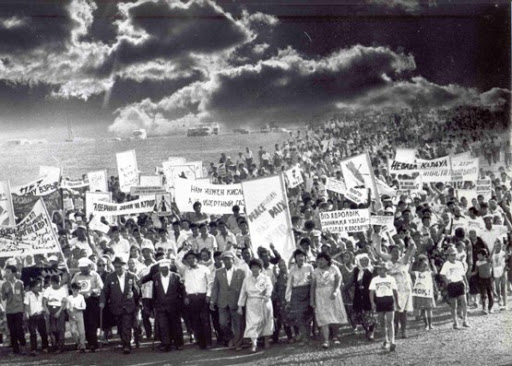
The first major step towards the establishment of a Nuclear Weapon Free Zone (NWFZ) in Central Asia began in May 1992 when Kazachstan committed to giving up the Soviet nuclear weapons on its territory in order to join the Non-Proliferation Treaty (NPT) as a sovereign state. On 19 May 1992, President Nursultan Nazarbayev sent a letter to US President George H.W. Bush giving a guarantee that the large stockpile of nuclear weapons would be eliminated within seven years. In the event, they were all returned to Russia by April 1995.
Not long after, President Punsalmaagin Ochirbat of Mongolia declared the country’s status as a single state NWFZ. This status was recognised by the UN on 4 December 1998.
Formally, it was the Uzbek President Islam Karimov that submitted a proposal to establish a NWFZ in Central Asia at the 48th session of the UN General Assembly, which was followed up in successive years by additional proposals by Uzbekistan and Kyrgyszstan in 1994-6. However, there was no consensus at that time.
On 27 February 1997, the Presidents of the five Treaty State parties issued the Almaty Declaration endorsing the creation of a regional NWFZ. It was followed by a conference entitled “Central Asia – a Zone free of Nuclear Weapons” which took place in Tashkent, Uzbekistan, followed by a resolution which was unanimously passed in the UN General Assembly calling for such a zone. A further resolution strengthening this call was passed in 2000.
At talks held in Samarkand, Uzbekistan, on 27 September 2002 experts from the five Central Asian states were able to agree on the text of a treaty, and on 8 February 2005 they adopted the final draft at a meeting in Tashkent. The Treaty was signed on 8 September 2006 in Kazachstan. It was signed in Semey because of its symbolic character: the Soviet nuclear testing ground of Semipalatinsk was nearby, which closed in 1991.
At first, Russia and the United States rejected the treaty. The US were against any binding restrictions on its military activities in the region. Eventually, Russia and China welcomed the initiative, but the Western nuclear powers insisted on an additional agreement, forbidding Russia from undermining the treaty by adopting other bilateral agreements. In particular, there was a concern that the 1992 Tashkent Collective Security Treaty would allow Russia to transport nuclear weapons through Central Asian countries or even deploy them in the region. The UN First Committee adopted resolution A/C.1/61/L.54/Rev.1. by a vote (128 to 3 with 36 abstentions) that welcomed the establishment of the CANWFZ while reflecting the controversy surrounding the Treaty.
The treaty entered into force on 21 March 2009. The Semey treaty is the first of a kind: it is the first multi-state NWFZ to include former Soviet republics and the first in the Northern hemisphere.
Protocol to the treaty
On 6 May 2014, all of the five officially recognised nuclear weapon states – China, France, Russia, the UK, and the US – signed the treaty protocol in New York. The protocol gives the legally binding assurance:
“ Each Party undertakes not to use or threaten to use a nuclear weapon or other nuclear explosive device against any Party to the Treaty on a nuclear-weapon-free zone in Central Asia.”
This undertaking is known as “negative security assurances”.
The parties also undertake not to:
“contribute to any act that constitutes a violation of the Treaty or of this Protocol by Parties to them.”
Although the Protocol is, like the treaty, of permanent duration, withdrawal with 12 months notice is allowed for the same reason as quoted above.
China, France, Russia, and the UK have ratified the protocol, but the United States still has not. Former US President Barack Obama transmitted the protocol to the US Senate for ratification on 27 April 2015 accompanied with a letter, stating:
“Ratification of the Protocol is in the best interest of the United States, as it will enhance U.S. security by furthering our objective of preventing the proliferation of nuclear weapons, (…) entry into force of the Protocol for the United States would require no changes in U.S. law, policy, or practice.”
Nevertheless, the Senate did not vote to ratify the agreement.
Both France and the UK submitted interpretive declarations on signing the treaty stating that they will not be bound to the undertaking outlined in Article 1 on negative security assurances if any party is in breach of its non-proliferation obligations. They also reserve the right to review that undertaking if the threat, development and proliferation of other weapons of mass destruction (such as chemical or biological) make it necessary. In such a case, they would only give three months notice to withdraw.
Current state of treaty and protocol
Yerzhan Ashikbayev, Kazachstan’s Ambassador to the United States said in a statement on the 10th anniversary of the treaty protocol’s adoption in 2014 that ratification by the United States of the protocol to the CANWFZ treaty would “finalize the institutionalization of the Treaty” and “formalize the structure and legal status of the Zone” in which nuclear weapons are prohibited.
The Kazach Ambassador expressed fears that the growing tensions between nuclear weapon possessor states, coupled with the expiry and withdrawal of major arms control agreements, including Russia’s withdrawal of ratification for the CTBT, were putting strain on the non-proliferation regime. The NPT recognises the importance of establishing nuclear weapon-free zones. He believed the US could strengthen the NPT by ratifying the CANWFZ Treaty
Kazachstan organised an event in Astana on 27/28 August 2024 where representatives of all existing treaties establishing nuclear weapon-free zones, Mongolia, the five nuclear weapon states, and non-governmental organisations came together. In their final report as Chair, Kazachstan stated that, among other things, representatives,
“emphasized the need for the signature and ratification of relevant protocols to all nuclear-weapon-free zone treaties by the nuclear-weapon States and for the removal of any interpretative declarations to those protocols, stressing that the provision of security assurances by the nuclear-weapon States was essential to the full implementation of the treaties.”
On 5 December 2024, a meeting of the States parties to the CANWZ Treaty took place in Ashgabat, Turkmenistan. Again, the meeting expressed the view that nuclear weapon states “that have not yet signed or ratified” should do so as “a matter of priority”.
At the start of NPT Review Conference in April 2026, Yerzhan Ashikbayev, now Kazach First Deputy Minister of Foreign Affairs, said:
“The contribution of the Semipalatinsk Treaty to ensuring security not only in Central Asia but also beyond its borders, is undeniable.”
It is unlikely that the deadlock over US signing of the CANWFZ Treaty Protocol will be broken any time soon, similarly to all nuclear disarmament and arms control initiatives and talks that are all presently at a standstill or have been ended. Twenty years after it was signed, the states of Central Asia still have no assurance from the United States that they will not be attacked with nuclear weapons.
Verbatim:
► Treaty on a Nuclear Weapon Free Zone in Central Asia, 08.09.2006
► Protocol to the Treaty, 06.05.2014
► Chargé d’affaires a.i. of the Permanent Mission of Turkmenistan: Letter to the United Nations addressed to the Secretary-General, A/79/698, 17.12.2024
Sources and further reading:
Kuramitsu S: The Case for Senate Action on the Protocol to the Central Asian Nuclear-Weapon-Free Zone, Issue Briefs, Vol. 16, Issue 2, Arms Control Association, 09.02.2024
NTI: The Central Asian Nuclear-Weapon-Free Zone (CANWFZ), accessed via Internet Archive on 03.09.2026, no publication date
Obama B: Message to the Senate — Protocol to the Treaty on a Nuclear-Weapon-Free Zone in Central Asia, 27.04.2015
Office of the Spokesperson, US Dept of State: United States Signs Protocol to Central Asian Nuclear-Weapon-Free Zone Treaty, Media Note, 06.05.2014
Shekinskaya N: Central Asia celebrates 20 years as a nuclear-weapon-free zone, UN News, 30.04.2026
UN Secretary-General: Comprehensive Study of the question of nuclear-weapon-free zones in all its aspects, United Nations General Assembly, A/79/950, 16.06.2025