Advisory Opinion of the International Court of Justice on Nuclear Weapons
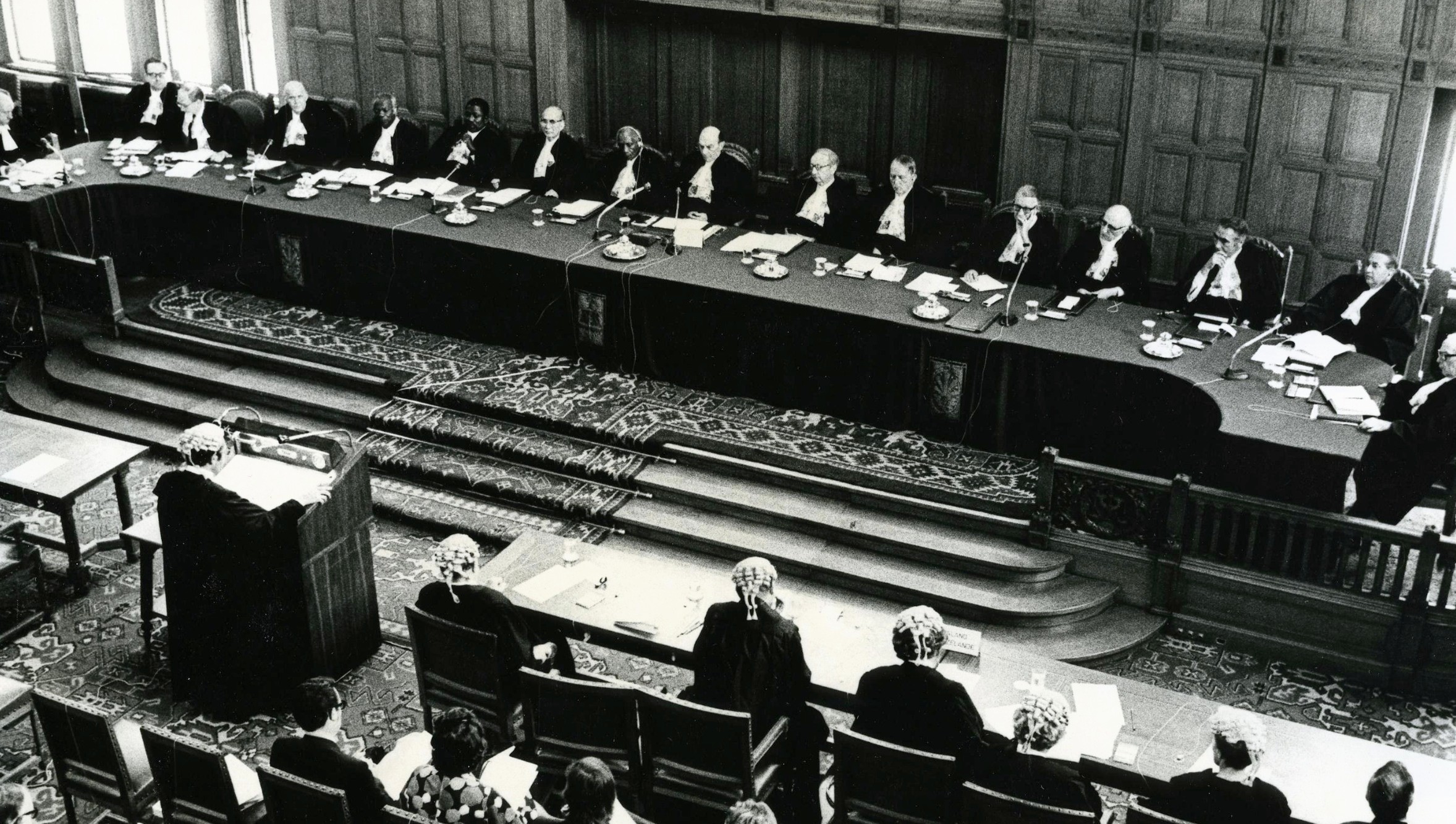
30 years ago, on 8 July 1996, a groundbreaking document was published: the Advisory Opinion of the International Court of Justice on the Legality of the Use and Threat of Use of Nuclear Weapons. It was the result of a civil society campaign, spearheaded by IPPNW, together with the International Lawyers Against Nuclear Arms (IALANA), and the International Peace Bureau (IPB). To mark the anniversary, I will—in three posts—give an overview of the Opinion, briefly cover the history and the process in which I was centrally involved, and share my conclusions about what it has changed in the past 30 years.
Part One: Overview
The International Court of Justice (ICJ) in The Hague is the principal judicial organ of the United Nations (United Nations Charter, Art. 92 et seq.).
It has two functions: it adjudicates disputes between states and serves as an advisory body on legal questions referred to it by authorised international organisations. The fifteen judges of the International Court of Justice are elected by the United Nations General Assembly and the Security Council.
In 1995, pursuant to Article 96 of the UN Charter, the UN General Assembly posed the following question to the ICJ: “Is the threat or use of nuclear weapons in any circumstance permitted under international law?” This question arose from a civil society initiative entitled “The World Court Project,” led by the Lawyers Committee on Nuclear Policy (LCNP), the International Association of Lawyers Against Nuclear Arms (IALANA), the International Peace Bureau (IPB), and the International Physicians for the Prevention of Nuclear War (IPPNW). Throughout 1995, written and oral submissions were read and heard at the ICJ.
On July 8, 1996, the International Court of Justice issued an advisory opinion on the question concerning the “Legality of the Threat or Use of Nuclear Weapons”.
In its decision, the ICJ unanimously stated that no customary or conventional international law specifically authorises the use of nuclear weapons. The court held by eleven votes to three (majority opinion) that there is also no customary or conventional law that comprehensively and universally prohibits the threat or use of nuclear weapons as such.
The judges unanimously and explicitly clarified that the following rules of International Humanitarian Law (the laws of war) must in all cases be regarded as applicable customary international law. The Court observed, however, that due to the specific characteristics of nuclear weapons, their use would be incompatible with IHL. Specifically:
• Any use of weapons must distinguish between combatants and the civilian population.
• Unnecessary cruelty and suffering must be avoided in any use of weapons.
• Uninvolved and neutral states must not be affected by the use of weapons.
The summary (dispositif) of the opinion states that, by a vote of seven to seven, with the presiding judge casting the deciding vote, the Court held that:
“…the threat or use of nuclear weapons would generally be contrary to the rules of international law applicable in armed conflict, and in particular the principle and rules of humanitarian law”. (1) E, §1
Three judges did not join the majority led by the President solely because they viewed the threat and use of nuclear weapons as prohibited without exception, not merely in principle or generally. In this respect, the decision on the merits, insofar as it denies the legality of the use of nuclear weapons and the threat thereof, was ultimately rendered by a majority of 10 to 4 votes.
The majority of the Court, however, did not consider itself definitively in a position to determine, either positively or negatively, whether there could be an exception under certain conditions to this fundamental illegality under international law of any threat or use of nuclear weapons. The relevant majority decision states:
“However, in view of the current state of international law, and of the elements of fact at its disposal, the Court cannot conclude definitively whether the threat or use of nuclear weapons would be lawful or unlawful in an extreme circumstance of self-defence, in which the very survival of a State would be at stake.” (1) E §2
In addition, the Court unanimously ruled:
“There exists an obligation to pursue in good faith and bring to a conclusion negotiations leading to nuclear disarmament in all its aspects under strict and effective international control.”
The finding of the court that no comprehensive and universal prohibition of nuclear weapons existed in 1995, along with the obligation enshrined in Article 6 of the Non-Proliferation Treaty to negotiate a legal agreement on nuclear disarmament, led to the passing of a further UN General Assembly resolution in 2016 to negotiate such an agreement. This in turn led to the adoption of the UN Treaty on the Prohibition of Nuclear Weapons (TPNW) on 7 July 2017, which entered into force on 22 January 2021.
Sources and further reading
Advisory Opinion on the Legality of the Threat or Use of Nuclear Weapons—International Court of Justice
Notes on a Misunderstood Decision: The World Court’s Near Perfect Advisory Opinion in the Nuclear Weapons Case—by Peter Weiss
Nuclear Weapons, the Military and the Law: Reflections on the World Court Decision—by Robert Green
ICJ, Nuclear Weapons Advisory Opinion—case study by International Committee of the Red Cross
World Court Project Archives— International Association of Lawyers Against Nuclear Arms (IALANA)

 Bimal Khadka
 Bjorn Hilt
 Charles K. Johnson
 Dr. Ghassan Shahrour
 Gunnar Westberg
 IPPNW
IPPNW John Loretz
 Lawrence Wittner
 Maria Valenti
 mollymcgint
 Sue Wareham
 Tilman Ruff
 Tim Wright
 Xanthe Hall


Trackbacks