From child to child: building a culture of humanitarian disarmament in schools
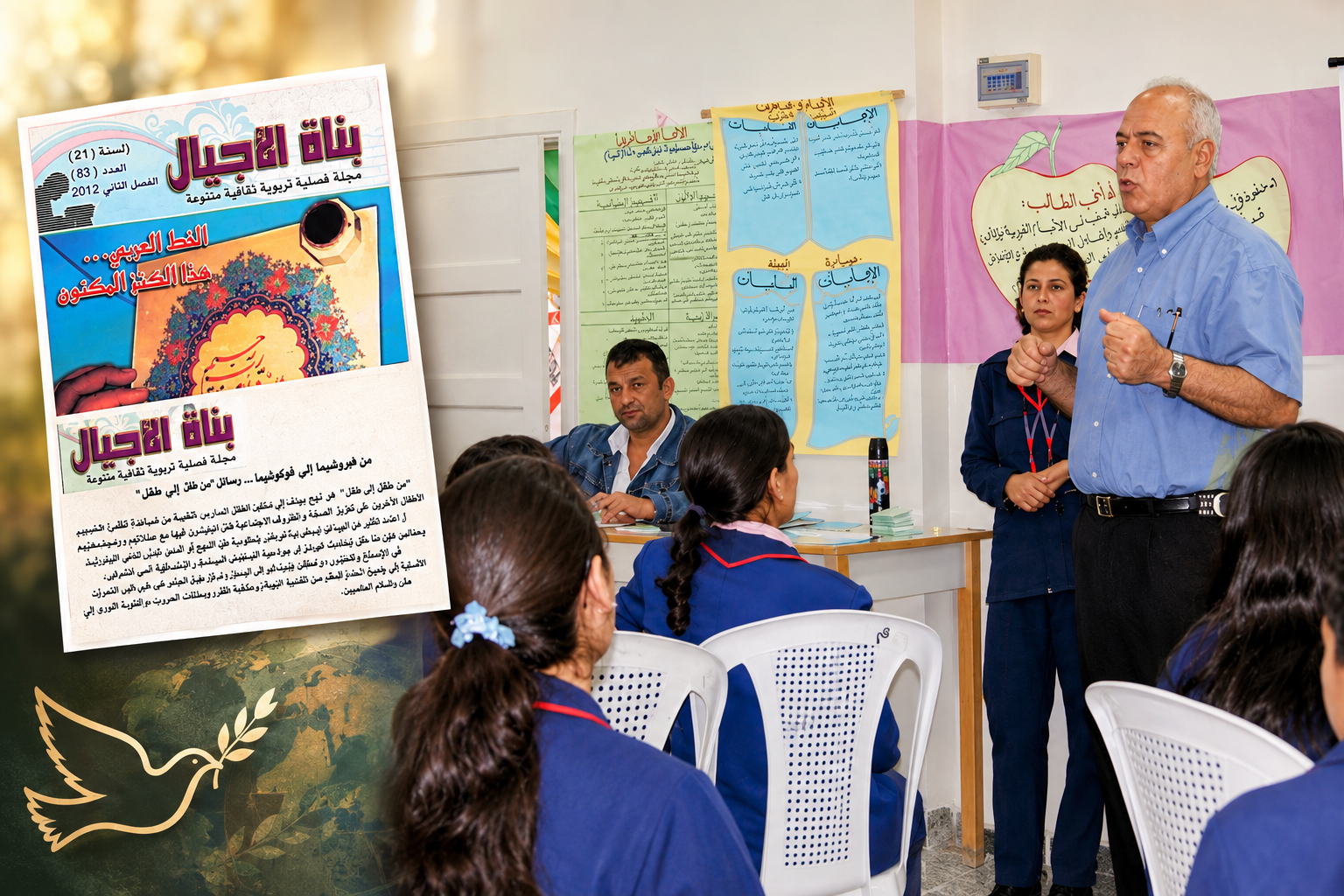
More than fifteen years ago, a pioneering initiative was launched in public schools in Syria to introduce humanitarian disarmament education through the child-to-child approach. I documented part of this experience in the national school magazine Bunat Al-Ajyal as part of a series of community awareness activities. The idea was simple: children should not be viewed only as recipients of peace education. With proper guidance, they can become active participants, peer educators, and contributors to a culture that values life, dignity, cooperation, and protection from weapons that cause unacceptable harm.
The program was later interrupted by civil conflict, but its lessons remain relevant. What stayed with me most was not only the structure of the initiative, but the human response of the children. Their drawings, questions, and simple messages showed that complex humanitarian ideas become understandable when they are connected to human life, suffering, and dignity. The experience demonstrated how schools can become spaces where humanitarian values are learned, shared, and carried beyond the classroom.
Why humanitarian disarmament belongs in schools
Schools are social environments where attitudes, values, and responsibility develop. Introducing humanitarian disarmament at an appropriate age does not mean exposing children to technical or political debates. It means helping them explore basic human questions: Why should civilians be protected? Why does human suffering matter? Why must weapons that cause unacceptable harm be prevented and eliminated? How can individuals contribute to peace?
These questions can be explored through stories, art, discussion, environmental activities, and peer learning. Peace is not only a topic for post-conflict reflection. It is a culture that can be nurtured before violence becomes normalized. Education offers something treaties alone cannot provide: prevention through understanding. Before children encounter violence directly, they can learn to question the normalization of harm and recognize that some weapons and practices should never be accepted as inevitable.
The child-to-child approach
The child-to-child approach, developed in 1978 at the University of London, enables children to learn from one another and share knowledge within their families and communities. Its strength lies in participation. Children are not passive listeners. They learn through experience, creativity, and interaction, and they communicate important messages to their peers in language that is accessible and meaningful.
Its principles of peer learning, empowerment, confidence building, and child leadership align with the 1989 Convention on the Rights of the Child, particularly its emphasis on participation, development, and protection from harm. These principles are highly relevant to humanitarian disarmament. A culture of disarmament cannot be created only through treaties and policies. It requires public understanding, ethical awareness, and shared responsibility. Children can become part of that foundation.
To make this approach practical, educators can implement simple peer-led activities: student art exhibitions highlighting civilian protection, guided discussions on empathy and nonviolence, and storytelling sessions where children interpret humanitarian concepts in their own words. These activities help transform abstract principles into lived experience.
From peace education to humanitarian disarmament
Peace education teaches dialogue, cooperation, nonviolence, and respect. Humanitarian disarmament adds another dimension: understanding the unacceptable human and environmental consequences of certain weapons and the responsibility to prevent such harm. Children can learn that protecting life is not only about avoiding violence. It is also about preventing weapons and practices that produce unnecessary suffering, lasting injury, environmental destruction, displacement, and long-term harm to communities.
Instead of beginning with technical terminology, education can begin with people: a child who loses a limb, a family displaced by conflict, a community living with contamination, or future generations facing the consequences of decisions made before they were born. In this way, humanitarian disarmament becomes understandable not simply as a policy field, but as a commitment to human dignity.
Hiroshima, Fukushima, and educational lessons
Hiroshima was included in the school experience as an important historical and humanitarian lesson. Through age-appropriate stories and survivor accounts, students learned about the destruction caused by the atomic bombing, the suffering of civilians, and the long-term consequences of radiation. Hiroshima was presented not only as a historical event, but as a human memory. It helped children understand that behind every weapon are human lives, families, and futures. In this way, memory became a form of prevention.
The Fukushima nuclear incident in March 2011 offered another reminder of the risks associated with nuclear technology. Together, Hiroshima and Fukushima show that nuclear risks are not confined to the past. Natural disasters, technical failures, or human error can threaten human life and the environment at any moment. For students, these lessons connect historical understanding with ethical responsibility and reinforce the idea that protecting human life must remain central to discussions about weapons and disarmament.
Putting child-to-child learning into practice
Motivated students were selected as child leaders and received guidance on communication, cooperation, and sharing information with peers. They were introduced to simplified concepts related to humanitarian disarmament, human suffering caused by weapons, environmental consequences of conflict, Hiroshima, technological risks, nonviolence, and peaceful cooperation.
Students created their own messages through drawings, short stories, and slogans. These were displayed in classrooms and corridors, creating a visible culture of peace. Child leaders facilitated peer discussions on empathy, respect, the consequences of war, environmental responsibility, and practical ways children could contribute to peace in daily life. The children were not merely repeating messages prepared by adults. They were interpreting them, expressing them, and sharing them in their own language.
The initiative culminated in a school exhibition titled:
from child to child… toward a world free of weapons that cause unacceptable harm.
Parents, teachers, and community members attended. A child’s drawing became a conversation at home. A classroom activity became a community discussion. A lesson became part of collective memory.
A personal reflection
There is a painful irony in this experience. An initiative designed to help children understand peace and the human consequences of weapons was later interrupted by civil conflict. Yet the interruption did not erase its meaning. It reinforced the very lesson the initiative sought to teach: peace education and humanitarian disarmament are most needed when violence threatens to become normalized.
Looking back, I see this experience as more than a school activity. It was an early expression of a conviction that continues to guide my work: humanitarian disarmament must become part of public culture, collective memory, and everyday responsibility, not remain confined to treaties and international conferences. What remains most important to me is the image of children learning from one another and discovering that they could contribute to something larger than themselves.
The child-to-child experience shows that humanitarian disarmament education can begin in a classroom. When children are empowered to understand, reflect, communicate, and act, they become participants in building a culture that rejects unacceptable harm and values human life. Humanitarian disarmament is not created only when governments sign treaties. It is also built when societies cultivate memory, responsibility, empathy, prevention, and moral limits on violence. Sometimes the culture of disarmament begins with a child speaking to another child. And sometimes, that simple conversation is where a larger human responsibility begins.
Dr. Ghassan Shahrour is a physician, humanitarian disarmament advocate, and author on health and disability. has contributed to international discussions on human dignity, environmental accountability, and restraint in armed conflict. A campaigner with the ICBL, CMC, and ICAN, he supports global humanitarian efforts and also volunteers with the Greater Triangle Area Chapter of the American Red Cross.

 Bimal Khadka
 Bjorn Hilt
 Charles K. Johnson
 Dr. Ghassan Shahrour
 Gunnar Westberg
 IPPNW
IPPNW John Loretz
 Lawrence Wittner
 Maria Valenti
 mollymcgint
 Sue Wareham
 Tilman Ruff
 Tim Wright
 Xanthe Hall