Note from the Laureates Summit

By Bjorn Hilt
Today I visited the ruins of the Hiroshima dome, the Hypocenter of the A-bomb detonation, the Children’s peace monument, and the Hiroshima Peace Memorial Museum. Truly an educational journey even for someone who thought himself educated about nuclear weapons. Testimonies, photos, and drawings are so strong that it is hard to digest. Go and see for yourself. Together with IPPNW co-president Vappu Taipale, I am here in Hiroshima to attend the yearly summit of the Nobel Peace Laureates who, together with Mayor Akiba of Hiroshima and many others, this time will discuss how we can proceed to finally free the world from nuclear weapons, in our lifetime. There will be presentations by many of the laureates and also by both Vappu and me. A Peace Summit Award will be given to somebody who is really worth it, and there will be a strong final declaration for everyone to read. Vappu and I will keep you updated.
The Haas peace award: IPPNW’s humanitarian message continues to resonate
I had the privilege of accepting the 2010 John and Chara Haas International Peace and Justice Award, which was given to IPPNW, the International Association of Lawyers Against Nuclear Arms, and the International Peace Bureau on November 8 in Philadelphia. The award, given by the Project for Nuclear Awareness, recognized the joint effort of our organizations to obtain an advisory opinion on the illegality of nuclear weapons from the International Court of Justice. The World Court Project, as it was known, not only succeeded in persuading the ICJ to generally condemn the use of nuclear weapons as a violation of International Humanitarian Law, but also laid the groundwork for the Nuclear Weapons Convention.
Cora Weiss of IPB and Peter Weiss of IALANA spoke eloquently about the grassroots organizing and legal analysis that were key to the Project’s success. If I can track down their talks, I’ll link to them here later. I had a chance to talk about IPPNW’s contribution to the World Court Project and its relevance to our work today, particularly ICAN.
____
I’d like to thank the Project for Nuclear Awareness for honoring IPPNW, IALANA, and IPB with this award, which is graced by the names of two people — John and Chara Haas — who have been major lifelong supporters of the civil society movement for a peaceful, nuclear-weapons-free world. IPPNW’s gratitude to the Haas’s for their support of our work, in particular, is enormous and heartfelt.
I also want to acknowledge the IPPNW doctors who led a truly global effort to persuade the World Health Organization to petition the International Court of Justice. The late Erich Geiringer of New Zealand was the chief strategist, who helped guide our affiliates through the often challenging process of lobbying their health and foreign ministries. Anne Marie Janson of Sweden and George Salmond of New Zealand understood the workings of the World Health Assembly as well as anyone, and lobbied successfully for the adoption of WHA resolution 46.40 in 1993. Many IPPNW activists invested a great of their time and energy in the project — no one more so than our executive director Michael Christ, who spent just about every waking hour (and, knowing Michael, probably a few that he should have been sleeping) on the project.
But Michael told me last week about Manasseh Phiri of IPPNW-Zambia, who unquestionably paid the highest price. As an official government advisor to the WHA, Dr. Phirie convinced the Zambian delegation to become the first resolution co-sponsor, gathered support from other delegates, agreed to formally introduce the resolution, and personally hand-delivered the draft to secretariat. When he returned home, Dr. Phiri was fired from his medical position after the US government sent a “demarche” to Lusaka and lodged a formal protest about the Zambian WHA delegation. Read more…
Attainment of health for all requires promotion of peace
[Dr. Wareham, the Immediate Past President of Medical Association for Prevention of War, IPPNW’s Australian affiliate, addressed the 63th annual UN Department of Public Information NGO Conference in Melbourne on August 30, 2010. The theme of this year’s conference was achieving the Millennium Development Goals in our changing world.]
I would like to pay my respects to the original inhabitants of this land.
I’ll start with a reflection from my work as a general practitioner, family physician, in Canberra. When I speak with my patients at work about what they want out of life, basically most people want peace. They want to live at peace in their relationships with those around them. They also want access to good health care. They want access to adequate food and clean water, which, fortunately, most people – but not all – in this country have. And they want some access to leisure time also, so that they can enjoy life. And if you ask Australians what gives them most security in life, often the answer will be their Medicare Card. The Medicare Card here gives us access to moderately equitable care – not totally equitable but moderately so – and that is very important to Australians.
I am going to remind us of a resolution from the World Health Organisation from 1981, which talks about the role of health workers and the promotion of peace, and I think this resolution is still as important today as it was nearly 30 years ago. The resolution stated that the role of health workers in the preservation and promotion of peace is the most significant factor in the attainment of health for all. We need to remind ourselves of that frequently. Read more…
IPPNW to share in 2010 Haas peace award
IPPNW, the International Association of Lawyers Against Nuclear Arms (IALANA) and the International Peace Bureau (IPB) will receive the John and Chara Haas Award for International Peace and Social Justice on November 8, 2010, at the Nuclear Futures Conference in Philadelphia.
The Haas award, sponsored by the Project for Nuclear Awareness, is being given to the three organizations for their work on the World Court Project and “for their joint efforts to establish global consensus on the illegality of nuclear weapons.”
The World Court Project was a worldwide campaign that resulted in an historic 1996 advisory opinion about the illegality of nuclear weapons from the International Court of Justice (ICJ). The ICJ concluded that the threat or use of nuclear weapons is generally illegal under International Humanitarian Law, and that states have an obligation to conclude negotiations on a global nuclear disarmament agreement to bring about their elimination.
According to PNA executive director Ed Aguilar, this year’s award is being given to the World Court Project “and those who participated as well in the drafting of the Model Nuclear Weapons Convention…to commemorate and honor the fact that the NWC and its basis in the ICJ Opinion of 1996 have been endorsed by the UN Secretary General and many nations since 2008, and in the NPT Review this May in New York.”
The previous recipients of the Haas Award, which honors those who have spent a lifetime in the cause of peace, safeguarding the environment, and in helping to reduce and end nuclear weapons, were author Jonathan Schell (2008) and Weapons of Mass Destruction Commission chair Hans Blix (2009).
No more ‘Little Boy’ and ‘Fat Man’
By Rebecca Johnson*
[originally posted at 50.50 Inclusive Democracy]
As a political instrument of power projection and status, nuclear weapons carry a peculiarly masculine symbolism. In the 1980s, Greenham women were at the forefront of challenging masculine ideologies of defence and security. We need to seize the initiative and again become the agents of security transformation.
October 31 was the tenth anniversary of the adoption of UN SCR 1325 [9] on Women Peace and Security. This was the first ever resolution to treat women not only as the victims of men’s aggression, wars and mistakes, but as agents for change. The resolution, the result of hard work and lobbying by women from a range of humanitarian and disarmament organisations, notably the Women’s International League for Peace and Freedom (WILPF), Amnesty International and Oxfam, was treated as a groundbreaking feminist success when it was adopted. Underlining the importance of incorporating “a gender perspective” into work on peace and security, it urges UN Member States “to ensure increased representation of women at all decision-making levels in national, regional and international institutions and mechanisms for the prevention, management, and resolution of conflict”.
Ten years later, the verdict [10] on how this resolution has affected women in conflict zones is “Must do better”. A common criticism, heard most recently at the Feminism in London conference [11] on October 23, was that in seeking to implement the letter but not the spirit of this resolution the UN system had spawned a layer of “femocrats” rather than empowering women living and working in the conflict zones. Read more…
Retire the Bomb! Int’l Peace Day in Melbourne
By Dimity Hawkins, ICAN Australia

ICAN in Melbourne marked the day at the State Library with a mock retirement party for the Bomb, which was also an opportunity for people to add their video messages to the One Million Pleas campaign.
For the International Day of Peace (September 21), ICAN Australia held a small action in the center of Melbourne to raise awareness of the 65th anniversary of the bomb by throwing a retirement party and collecting “pleas” for the MillionPleas campaign.
Photos from the action can be seen here.
Target X:50+ installations already
By Alex Rosen, IPPNW Germany
 Dear friends all around the world,
During the IPPNW Biking Aganst Nuclear Weapons Tour (BAN) this summer, we organized a number of Target installations all along our tour. You can view photos and descriptions of these events, as well as the more than 50 Target installations to date on our website: ippnw-students.org/Target. Organized by our colleagues in Canada, the US, Ecuador, El Salvador, Brazil, Peru, Finland, Sweden, Norway, the UK, France, the Netherlands, Estonia, Russia, Georgia, Switzerland, Germany, Portugal, Italy, India, Iran and Australia, these Target installations have helped bring the issue of nuclear abolition to the people on the street and stir public debate about the subject.

We are certain that events such as NWIP, Nuclear Weapons – my cup of tea, Target X and bike tours are valuable and effective ways to use our moral authority as doctors and medical students in order to influence discussion on a local and national level. By documenting and showcasing these events, we even attempt to create some international leverage – similar to the Million Pleas Campaign. All of these activities neatly fit under the umbrella of ICAN – our wonderful international campaign, which we try to make more known through our activities.
For the future, we hope for may more successful Target installations – especially in the nuclear weapon states, but also in places that people would not normally associate with nuclear abolition. We’ve had a number of very successful events at universities in Latin America – showing that students there share the rest of the world’s concerns about nuclear proliferation and the immense weapon stockholds of Russia and the US. We should demonstrate IPPNW’s global aspect by trying to organize Target installations in countries like Nigeria, Kenya, Zambia, Mexico, Mongolia, Indonesia, etc., etc. In most of these countries we now have vibrant IPPNW student groups who could take on this subject. Although it may not be their primary concern or the main reason for being active within IPPNW, it would show solidarity and support for our global campaign and be a great project for local groups to organize.
So:
- if you’ve already held a Target installation and it’s not on the website ippnw-students.org/Target, please contact me and I’ll upload the photos and reports.
- if you’re interested in organizing a Target installation in your city and the information on the website is not sufficient for you, please contact me.
- if you have good ideas for future Target installations or the website, please contact me
- if you’re interested to become more involved in the coordination of Target installations around the world, please contact me
I truly look forward to hearing from you…
All the best from Germany,
Alex Rosen
Swiss nuclear bomb
The Swiss nuclear bomb.
Little did we know. Not even Tom Lehrer (“Who’s next? Alabama’s got the bomb!”) dreamt that Switzerland planned to build atomic bombs. At one time an Air Force general proposed that Switzerland might build 400 nuclear weapons, to be carried by 100 Mirage air planes, with a capacity to reach Moscow!
At the recent IPPNW World Congress at Basel we visited the historical museum of the town. The guide told us that only two weeks after the bombing of Hiroshima did a group from the Swiss government decide to begin a study of the possibilities of Switzerland to build nuclear weapons.
The work seems to have proceeded very slowly, but when the Soviet invasion of Hungary in 1956 took place the Swiss planning for nuclear deterrence became more serious (ref 1, 2).
These plans were not only developed in meetings and in offices. Uranium was purchased and stored and reactors ordered. The USA offered reactors to a highly reduced price to avoid that Switzerland bought them from the Soviet Union. However, the Swiss government seems to have been unwilling to go any further if other countries than the original four nuclear weapon states did not get the bomb. It would be of interest to read more about these discussions.
The history of the Swiss nuclear weapons program is long and many pages are still missing from the history (1, 2). It appears that the rapidly increasing costs for the weapon carriers, that means the Mirage airplanes, was a problem for the military. The cost of a uranium enrichment plant was too high for the federal budget. The Air Force did however discuss the possible building of 400 charges and to test nuclear weapons in an uninhabited area of the country (1)!
A serious accident in a research reactor causing a partial meltdown occurred in 1969 (1). The reactor was located underground which contained the radioactivity. This accident strengthened the opinion against the nuclear weapons program. Switzerland signed the Non-proliferation treaty, NPT, in 1969 but it the country did not declare its uranium stores until five years later. That facility had been known by very few people.
The nuclear weapons program had some similarities to that of another neutral and nonaligned country, Sweden. The cost of the program was a major obstacle in both countries. The strategic discussion seems to have been rather superficial in both. That the nuclear weapons would not increase the security during the Cold War was not realized. It was taken as a matter of course that military strength gave security. It was not commonly understood that nuclear weapons require a new way of thinking.
It seems that the public opinion against the nuclear weapons program was less active in Switzerland than in Sweden. One reason could be that the women in Switzerland were much less involved in politics. The anti-nuclear campaign in Sweden was to a large extent a women’s movement.
When the NPT entered into power both countries had to give up the nuclear option. However, it was as late as in 1988 that the commission on nuclear weapons questions was terminated in Switzerland, officially ending the program (3)
It is important to study the reasons why certain countries gave up their nuclear weapons program while other persisted. The Nuclear weapons archive (3) summarizes the decisions but gives little information about the driving forces, especially in the society. Has the public opinion regarding nuclear weapons been important in these countries, in the same way it was in the USA (4), in Kazakhstan or the Ukraine? These questions have been the subject of several studies in recent years. The book by E.C. Hymans ((5) is the best known. The dissertation by Ulrika Möller (6) evaluates the situation of four different countries, making her studies quite valuable. The time has come to review these various studies, trying to understand the importance of reason and sentiment as forces in the nuclear arms race, and nuclear disarmament.
Today Switzerland is one of the countries which take a strong stand for a nuclear weapons free world. The talk given by the Federal Foreign Minister of Switzerland, Micheline Calmy-Rey (7) at the IPPNW Congress was an inspired and serious call for nuclear abolition. Switzerland has together with Norway taken a place in the disarmament policy which Sweden left vacant.
- Stussi-Lauterberg J: Historical outline on the question of Swiss nuclear armament. Swiss government report, April 1966.
- Edwards B: Swiss planned a nuclear bomb. New Scientist 1966.
- Nuclear weapons archive. 7.4 States Formerly Possessing or Pursuing Nuclear Weapons.
- Wittner Lawrence S: The struggle against the bomb. Vol. I-III. Stanford Univ. Press 1997-2003
- Hymans J E C: The psychology of nuclear proliferation. Identity, emotions and foreign policy. Cambridge Univ. Press 2006
- Möller U: The prospects of security cooperation. A matter of relative gains or recognition. Göteborg 2007 Dept. Political Science Göteborg University
- Calmy-Rey M: The future of nuclear disarmament: A Swiss perspective. IPPNW World Congress Basel Schweiz 2010. ippnw.2010.org, then Plenary Documents
Gunnar Westberg
Aliens, Cyberwar and other curiosities
At last I feel mitigated in my avid viewing of „The Next Generation“ and „Doctor Who“, for it seems that I am psychologically equipped for the reports of aliens tampering with the nuclear deterrent. I am not in the least phased by this, in fact I welcome our green friends to join “Global Zero” along with Henry Kissinger and President Obama. If they have found a way of turning the damn things off, then I don’t have to spend any more time on de-alerting, I can concentrate on organising a Nuclear Weapons Convention for Trekkies. And I quite agree with UFO researcher Robert Hastings, that all the secrets on extra-terrestrial activities for peace should be declassified. We have a right to know about this new peace movement from beyond.
But wait, there’s more: someone of unidentifiable origin is trying to turn off all the nuclear installations built by Siemens. Using a virus called “Stuxnet”, installations all over the world (well, okay, not in any of the recognised nuclear weapons’ states) began having problems, including Iran. The cyber war we have all been waiting for has begun and reporters are suspecting state sponsorship rather than terrorism. But what state could possibly want Iran’s nuclear installations to go offline? I wonder. On the other hand, it could be the beginning of a nuclear industry war between Siemens and Westinghouse.
I had only just finished laughing at that excellent film “The Men Who Stare at Goats” with George Clooney and Kevin Spacey, when I discovered that in fact it is all true. A glance at this article by Gary S. Bekkum in the American Chronicle confirmed that the US is still using “psychic spies”, now against Iran. So perhaps the Iranians should lock up their goats.
Bekkum asks the question that I know is on all your lips: is there a connection between cyber invasion and alien nuclear intrusion? Or worse still: will we soon be confronting a 9/11 scale “surprise attack against the human mind”? Apparently Stephen Hawking is convinced there will be an extraterrestrial invasion. I myself don’t mind, so long as they get rid of the nukes and then we can live in peace with each other. Hell, I’m not prejudiced against aliens. I was one myself for long enough.
Anyone remember that Edwin Corley science fiction book back in the 1970s called “The Jesus Factor”? I think I was about 14 when I read that and I have secretly believed that the conspiracy theory is true. Apparently the whole nuclear arms race was a bluff, the darn things just don’t work. Even so, I think we should get rid of them because they cost so much money.
While we’re on the topic of money, I was shocked to hear that just one new “Next Generation” nuclear-armed submarine is going to cost the United States 100 million dollars. Captain Picard would be very cross indeed. This news coincided with reports that people on state benefit (Hartz IV) in Germany are going to get a total of 5 Euros extra a month, so they have a grand total of 364 Euros (489 US dollars) a month to live on. I suppose people in other parts of the world would think they were lucky.
Moral of this story: in the next life, come back as a nuclear submarine. You get more money spent on you, go on world cruises and never actually see any military action. Besides, the missiles on board don’t work anyway. But you might get a visit now and again by an alien, a computer virus or even a psychic spy.
New affiliates-in-formation from the former Yugoslavia
by Prof. Ulrich Gottstein, Co-founder and honorary board members of IPPNW-Germany
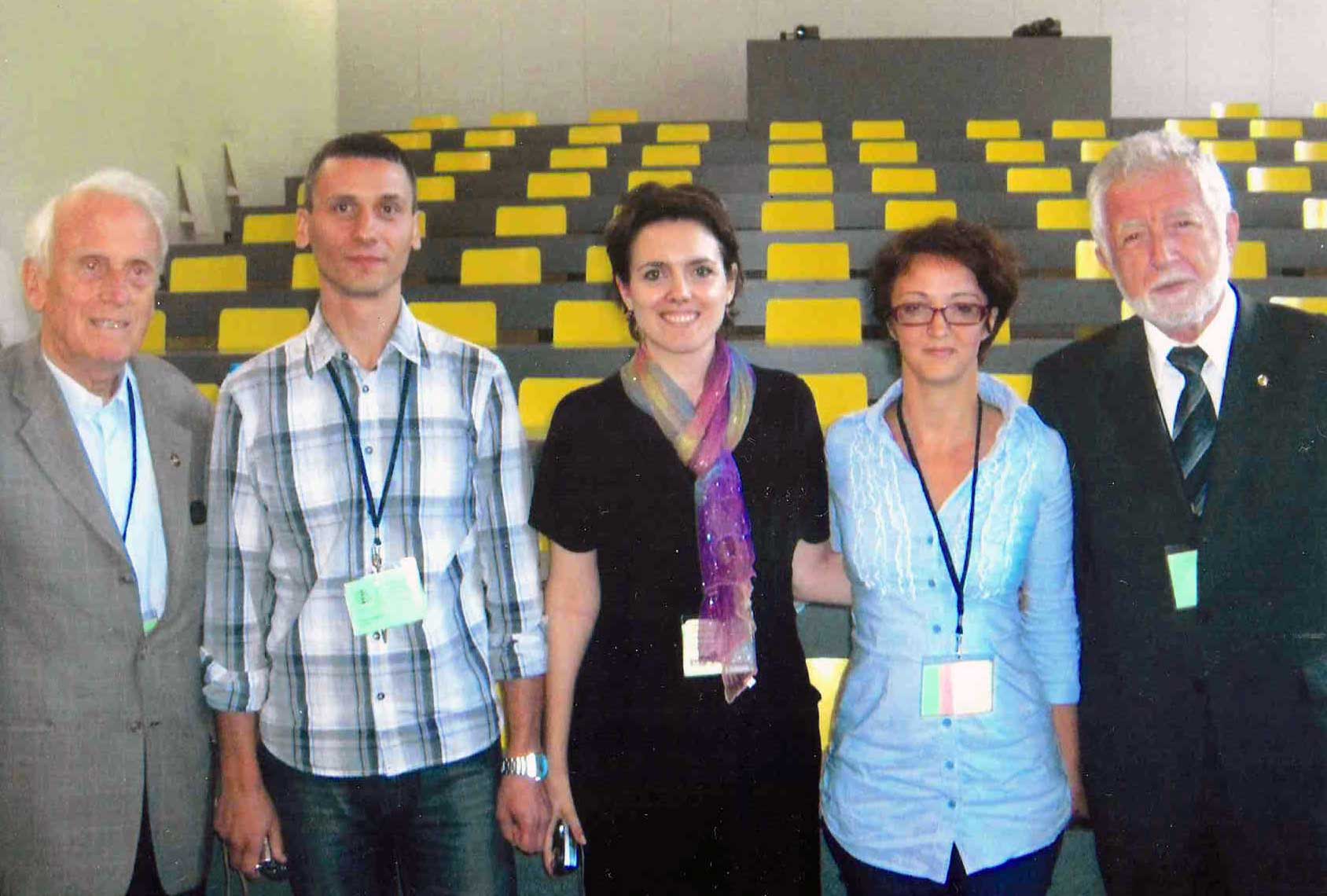
Left to right: Prof. Ulrich Gottstein, Germany, Dr. Dragan Veljkovic, Serbia, Dr. Emilija Jovanovska-Trajkovska, Macedonia, Dr. Ilirjana Bajraktari, Kosovo and Prof. Mazlu Belegu, Kosovo.
One of the smaller highlights of the IPPNW World Congress in Basel, Switzerland was the participation of “founders in progress” of new affiliates from former Yugoslavia. They were very impressed and felt enormously stimulated to start and to continue peace work in their countries which had been enemies for such a long time.
—
Note from the editor: the affiliates-in-formation from Macedonia and Kosovo are going through the affiliation process which will be voted on at the next Board of Directors meeting and then ratified by the IC at the 2010 Congress. It has been wonderful to witness the warm welcome and ongoing support, guidance and encouragement from the leaders of other established affiliates such as IPPNW Germany.

 Bimal Khadka
 Bjorn Hilt
 Charles K. Johnson
 Dr. Ghassan Shahrour
 Gunnar Westberg
 IPPNW
IPPNW John Loretz
 Lawrence Wittner
 Maria Valenti
 mollymcgint
 Sue Wareham
 Tilman Ruff
 Tim Wright
 Xanthe Hall