The medical conscience of the nuclear age: the legacy of Hiroshima and Nagasaki’s physicians
Introduction: Hiroshima Day 2026
Hiroshima Day, observed each year on 6 August, marks the moment the world first witnessed the catastrophic human consequences of nuclear weapons. The 81st anniversary in 2026 invites renewed commitment to prevention, justice, and global human security. As communities and campaigners prepare for this year’s observance, it is essential to recall the legacy of those who first confronted the medical reality of nuclear war. The physicians, nurses, and caregivers of Hiroshima and Nagasaki shaped the moral foundation of today’s humanitarian movement for nuclear abolition.
This article is offered as an early contribution to Hiroshima Day 2026. It is a resource for educators, volunteers, journalists, and advocates who seek to highlight the enduring role of medical conscience in the struggle for a world free of nuclear weapons.
On the morning of 6 August 1945, physicians and nurses in Hiroshima began their day as they always had. Hospital rounds were being prepared, clinics opened, and medical students attended to routine duties. Within seconds, the first atomic bomb transformed the city into a landscape of fire, silence, and unimaginable suffering. Many medical workers were killed instantly. Those who survived became the first doctors in history to confront the medical consequences of nuclear warfare. They entered a world no medical textbook had prepared them for.
Their survival often depended on chance. Some had been delayed on their way to work. Others were shielded by walls or happened to be outside the center of destruction. Yet these survivors did not retreat. They moved toward the wounded, toward the flames, toward the unknown. In those first hours, their instinct to heal became an act of profound moral courage. Their experiences would shape the world’s understanding of radiation injury and the humanitarian consequences of nuclear weapons.
Dr. Shuntaro Hida, an army physician, was outside the city when the bomb exploded and returned to find thousands suffering from burns and injuries. Dr. Fumio Shigeto survived inside the Hiroshima Red Cross Hospital and helped treat the overwhelming number of casualties. Three days later, in Nagasaki, radiologist Dr. Takashi Nagai joined relief efforts despite losing his wife and suffering injuries himself. Their stories, like those of countless unnamed caregivers, reveal the human face of medical duty under impossible conditions.
Hospitals that remained standing became overcrowded sanctuaries. Supplies were scarce, operations were performed under desperate conditions, and doctors and nurses worked continuously despite exhaustion and personal loss. They soon encountered symptoms that conventional medicine could not explain. Patients who initially appeared stable developed bleeding, fever, hair loss, and severe weakness. Radiation sickness was revealing itself for the first time on a large scale, and these physicians were forced to learn its course by watching their patients suffer.
Women played an essential but often overlooked role in this response. Many of the first survivors to reach the wounded were nurses and midwives who continued working despite burns, injuries, and radiation exposure. They carried water to the dying, improvised bandages from their own clothing, and comforted patients when no treatment was possible. Several women kept diaries and notes that later became vital historical records, helping physicians understand the progression of radiation illness. Their courage and endurance form an indispensable part of the humanitarian legacy of Hiroshima and Nagasaki. The voices of the women who cared for the wounded, nurses, midwives, and survivors who refused to abandon the vulnerable, embodied a form of medical conscience grounded in compassion, endurance, and moral clarity.
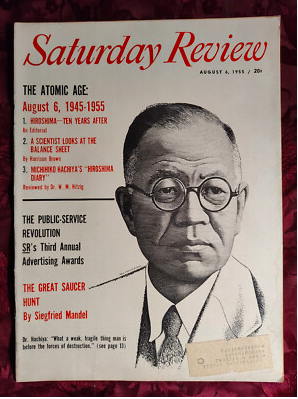
Physicians such as Hida Shigeto, Dr. Terufumi Sasaki, and Dr. Michihiko Hachiya carefully recorded their observations. Their work created the first clinical descriptions of radiation injury in human history.
Hachiya’s diary and later accounts by survivors preserved invaluable testimony about the medical consequences of the bombings. These records were not only scientific documents. They were acts of remembrance written so that the world could not claim ignorance.
Despite censorship during the Allied occupation, physicians and survivors preserved records and continued to speak about what they had witnessed. Their efforts ensured that the reality of nuclear warfare would not be forgotten. International attention increased when Marcel Junod of the International Committee of the Red Cross visited Hiroshima and reported on the catastrophe to the world. His testimony echoed the voices of the Japanese doctors and helped carry their message beyond national borders.
Over time, the testimony of these doctors and survivors shaped the humanitarian arguments that now stand at the center of nuclear abolition efforts. Through scientific observation and moral witness, these physicians transformed personal tragedy into a universal warning. They demonstrated that the consequences of nuclear weapons extend far beyond immediate blast injuries, affecting future generations, public health systems, social structures, and the environment. Their experiences helped shift the nuclear debate from questions of military strategy to questions of human survival and humanitarian responsibility.

Their experiences influenced generations of physicians who later formed organizations such as International Physicians for the Prevention of Nuclear War and Physicians for Social Responsibility as well as medical scholars and groups in different parts of the world. Their evidence helped build the case that nuclear weapons are not abstract tools of strategy but instruments of mass suffering. This medical truth became a cornerstone of the humanitarian movement that eventually led to the Treaty on the Prohibition of Nuclear Weapons, that was adopted in 2017 by the United Nations.
The doctors of Hiroshima and Nagasaki were not political leaders or military strategists. They were healers who transformed tragedy into knowledge and service. Their work continues to influence medicine, public health, and international efforts aimed at preventing nuclear catastrophe. In doing so, they affirmed one of the oldest principles of medicine. Prevention is superior to treatment, and no health system can adequately respond to the devastation caused by nuclear war.
The lesson these physicians ultimately taught is one repeatedly emphasized by modern medical organizations. No adequate humanitarian or medical response exists for nuclear war. Prevention remains the only cure.
More than eight decades later, their legacy endures as a reminder that the true measure of security lies not in destructive power but in the protection of human life and human dignity. For ICAN, IPPNW, and all other organizations who work for a world free of nuclear weapons, these physicians remain the medical conscience of the nuclear age. Their testimony is not only a record of the past. It is a responsibility carried forward by every campaigner who speaks, organizes, educates, and refuses silence.
Drawing on decades of medical and humanitarian work, I recognize in their legacy a trajectory that continues into our own time. Their courage reminds us that medical witness is not passive observation but an active duty to humanity. Their example affirms that the work of prevention, protection, and human solidarity belongs to every generation.
Their message was simple: human suffering must be the measure of all policy. Their work endures in those who stand today for abolition. Their courage lives in every treaty, every survivor’s voice, every act of conscience. And now, it lives in all of us.
Dr. Ghassan Shahrour, coordinator of the Arab Human Security Network, is a medical doctor and human rights advocate specializing in health, disability, disarmament, and human security. This article was originally published in CounterCurrents, and is republished with permission under their fair use policy.

 Bimal Khadka
 Bjorn Hilt
 Charles K. Johnson
 Dr. Ghassan Shahrour
 Gunnar Westberg
 IPPNW
IPPNW John Loretz
 Lawrence Wittner
 Maria Valenti
 mollymcgint
 Sue Wareham
 Tilman Ruff
 Tim Wright
 Xanthe Hall