Bridging Climate Crisis, Nuclear Weapons, Health, and Peace
The following remarks were delivered by Dr. Angelika Claussen at the SB64 side event, Peace and Climate Justice: Emissions, Finance and Equity, in Bonn, Germany on June 8, 2026.
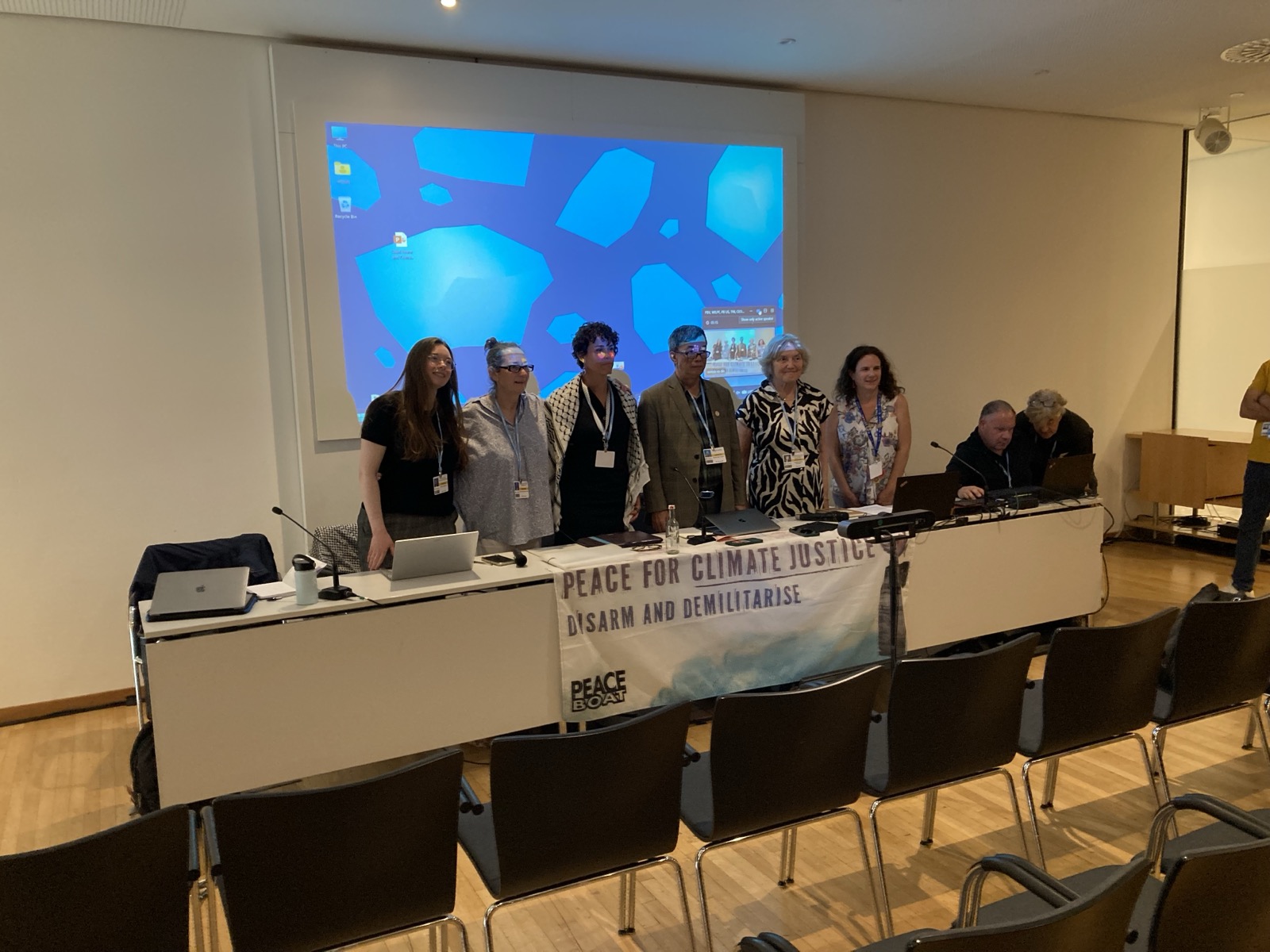
Hello, my name is Angelika Claussen, I am a physician by training and the vice-president of the German section of the international Physicians for the Prevention of Nuclear War. A big thank you to Karen, for putting this important panel together, to my esteemed fellow panellists and to you in the audience for joining us here today.
In this panel, I would like to speak from the perspective of a health professional about the deep interconnections between the climate crisis, nuclear weapons, militarisation, and public health.
As health professionals, our responsibility is not only to treat illness, but to prevent the conditions that cause mass suffering. Today, humanity faces two paramount human-made existential threats: climate change and nuclear weapons. These threats are often discussed separately, but they are deeply interconnected and must be addressed together.
Climate change is already harming health. Through heat-related illness, food insecurity, displacement, infectious disease, and mental health impacts. Nuclear war represents a different but equally catastrophic threat. Even a limited nuclear war could disrupt the global climate system, collapse food production, and threaten the survival of billions.
Many people do not realise that nuclear war is also a climate issue. The stable climate on which human and planetary health depend must be protected not only from global heating, but also from the abrupt global cooling that nuclear war would cause.
The Australian epidemiologist Dr. Tilman Ruff has summarised the evidence clearly:
“Nuclear weapons pose the most acute existential threat to humankind and the biosphere. Both qualitatively and quantitatively, they are uniquely destructive.”
Scientific studies show that smoke and soot from burning cities would rise into the stratosphere, block sunlight, and rapidly lower global temperatures. Crop production would fall dramatically, leading to widespread famine and social instability.
This is why health professionals say: in the event of nuclear war, there is no meaningful medical response. No health system could cope with the scale of destruction. Prevention is the only cure.
There is another dimension that is too often overlooked: nuclear injustice.
Since 1945, more than 2,000 nuclear test explosions have been conducted around the world, often on Indigenous lands and in colonised territories. Communities in the Marshall Islands, French Polynesia, Kazakhstan, Australia, and elsewhere have experienced cancers, birth defects, chronic illness, environmental contamination, displacement, and intergenerational trauma.
As health professionals, we recognise these impacts not only as medical consequences but as violations of human rights and environmental justice.
The Marshall Islands illustrate this connection clearly. Marshallese communities endured some of the largest nuclear explosions ever conducted by the United States. Today, those same communities are on the frontline of the climate crisis, facing sea-level rise and the possible loss of their homelands.
This is not accidental. It reflects a broader pattern in which lands and peoples considered peripheral to global power have been treated as sacrifice zones. Small Island States have contributed least to climate change and possess no nuclear arsenals, yet they bear some of the gravest consequences of both. Climate justice and nuclear justice are inseparable.
We must also recognise that nuclear weapons depend on the broader nuclear fuel cycle. Historically, civilian nuclear programmes have often provided pathways, expertise, materials, and political justification for military nuclear capabilities.
From a public health perspective, nuclear energy is not the climate solution we need. It is slow to deploy, expensive, generates hazardous radioactive waste, and perpetuates systems that can contribute to nuclear proliferation. Resources are better directed toward faster, safer, and more equitable renewable energy solutions.
Despite these challenges, there are reasons for hope.
The International Campaign to Abolish Nuclear Weapons (ICAN), co-founded by IPPNW and partners, from around the world, helped achieve the Treaty on the Prohibition of Nuclear Weapons. This treaty entered into force in 2021 and is the first nuclear treaty to include obligations for victim assistance and environmental remediation.
We are also seeing momentum in the climate arena. In May 2026, the UN General Assembly adopted a landmark resolution backing last years’ historic World Court ruling on states legal obligations to protect the environment from greenhouse gas emissions. This reflects growing recognition that climate protection is a matter of international law and intergenerational justice.
Similarly, the Fossil Fuel Non-Proliferation Treaty Initiative is building global support for a coordinated phase-out of fossil fuels, applying lessons from nuclear disarmament to the climate crisis.
As health professionals, we have a unique voice. We understand that prevention is more effective than treatment and that human health depends on peace, justice, and a livable planet.
The time has come to move beyond siloed thinking—security in one box, climate in another, health in a third. Protecting health in the 21st century means preventing both climate catastrophe and nuclear catastrophe. The health community has a vital role to play in achieving both.

 Bimal Khadka
 Bjorn Hilt
 Charles K. Johnson
 Dr. Ghassan Shahrour
 Gunnar Westberg
 IPPNW
IPPNW John Loretz
 Lawrence Wittner
 Maria Valenti
 mollymcgint
 Sue Wareham
 Tilman Ruff
 Tim Wright
 Xanthe Hall