Day two at the ATT: Dialogue with the US

IPPNW's Dr. Cathey Falvo (right) and PSR's Elina van Schaik meet Ambassador Mahley and other members of the US delegation.
March 1, 2011 — On day two of the second session of the Preparatory Committee for the Arms Trade Treaty, IPPNW members met with members of the US delegation, including Ambassador Donald Mahley, to discuss health issues related to the ATT and public health approaches to preventing violence.
We listened to their views on a range of complex subjects including import, export, and human rights considerations. We offered to be a resource on health issues and in educating on and documenting the human costs of arms violence, which the Ambassador endorsed as very important to helping countries make informed spending decisions.
The IPPNW delegation was joined today by Dr. Omolade Oladejo from Nigeria who arrived to add her voice to our activities. IPPNW members participated in a range of other meetings with NGOs and state delegates to the ATT PrepCom. Tomorrow Dr. Ogebe Onazi from Nigeria will provide a physician’s perspective on armed violence and development as part of a panel sponsored by IANSA, Amnesty International, and the Permanent Mission of Norway .
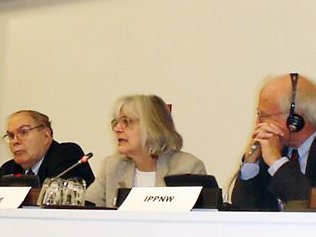
Vic Sidel, Cathey Falvo, and Don Mellman at ATT panel
IPPNW presented a side panel at the second session of the Preparatory Committee for the Arms Trade Treaty on February 28, entitled Control the Arms Trade: Improve Human and Environmental Health. The panel was co-sponsored by Zambia, and included physicians from that country, the United States, and Austria who spoke about the human health and environmental dimensions of the full cycle of the arms trade. The panelists addressed how a robust Arms Trade Treaty can help promote health and reduce environmental contamination.
The week-long ATT PrepCom convened on February 28 at the United Nations Headquarters in New York City. The PrepCom is expected to recommend essential elements of a legally binding international agreement to regulate transfers of conventional arms, to be negotiated in July 2012. Read more…
Australian senator questions uranium policies; cites IPPNW resolution
Senator Scott Ludlam, a member of the Australian Parliament from the Green party, has been asking the government some pointed questions about the health and environmental effects of uranium mining.

Greens MP Sen. Scott Ludlam says the Australian government ignores the warnings of IPPNW about the health, human rights, and environmental impacts of uranium mining and processing at its peril.
Last November, after IPPNW’s Australian affiliate, MAPW, provided him with a copy of a resolution on uranium mining and processing adopted by the federation’s International Council at the IPPNW World Congress in September, Sen. Ludlam went to work. Citing assertions made by IPPNW that “‘uranium ore mining and the production of uranium oxide (yellowcake) are irresponsible and represent a grave threat to health and to the environment” and that “both processes involve an elementary violation of human rights and their use lead to an incalculable risk for world peace and an obstacle to nuclear disarmament,” he asked Nicola Roxon, the Minister for Health and Ageing whether the Australian Radiation Protection and Nuclear Safety Agency (ARPANSA) had looked into these hazards with regard to Australian uranium mining. Read more…
European health groups launch Medical Peace Work courses
 European health groups have launched seven freely available, interactive online courses in violence prevention and peacebuilding. The aim of the courses is to educate health professionals about the impact of war and other forms of violence on the health of individuals and populations, and to show how they can make a positive and particular contribution to peace building, violence prevention and conflict transformation. The courses provide the participants with new insights about the special role and responsibility of healthcare professionals in peace work.
Bernard Lown, inventor of the defibrillator and founding Co-President of IPPNW said “The doctor cannot ignore the issues of peace and war. There is no greater pathogen than war. So why do you worry about tuberculosis, malaria, shistosomiasis, coronary artery disease, hypertension, diabetes, but when it comes to war you don’t want to talk about it.”
The courses, which will be promoted worldwide, were developed by 19 organizations from Denmark, Finland, Germany, the Netherlands, Norway, Slovenia, Turkey, and the UK. They are not only designed for health professionals and students who wish to do humanitarian or development work or who want to work with human rights or medical peace organizations; these courses are valuable for all health workers, no matter where they work and live. The course issues range from suicide and interpersonal violence prevention to the abolition of nuclear weapons.
According to Dr. Klaus Melf of the Health Department of the County Governor in Troms, Norway, “It is vital that doctors and other health professionals understand how people are affected – both physically and psychologically – by power abuse and war. Many health professionals want to do more than simply patch up the wounded. They want to get to grips with the underlying issues and do everything they can to prevent violence and achieve peace.”
To access the courses, which were developed with support from the European Commission, go to www.medicalpeacework.org.
IPPNW responds to ratification of New START
IPPNW’s co-presidents have sent the following letter to the presidents of the US and Russia, to mark the successful ratification of the New Strategic Arms Reduction Treaty (START), under which each country will limit the number of deployed strategic nuclear weapons to 1,550, with additional reductions in deployed and non-deployed launchers to 800 in each country. The treaty was ratified by the Russian State Duma on January 25, 2011 , by the Federation Council of Russia on January 26, and by the US Senate on December 22, 2010. The New START will enter into force in February, when Russian Foreign Minister Sergei Lavrov and US Secretary of State Hillary Clinton exchange ratification papers.
January 31, 2011
President Barack Obama
President Dmitri Medvedev
Dear Presidents Obama and Medvedev:
The ratification of the New START by the Russian Parliament this week and by the US Senate last month fulfills a pledge each of you made almost two years ago to lay the groundwork for a world without nuclear weapons. When you met in Moscow in March 2009, you spoke of this new round of US-Russia nuclear arms reductions as a “down payment” toward a nuclear-weapons-free world. While this down payment is modest in numerical terms, the New START, as its name suggests, is a promise of more to come. Read more…
It’s Still the Same Old Story—from Guns to Nukes
The discussion of the Tucson tragedy should be familiar, as we witness similar massacres in U.S. schools, shopping centers, and other public places played out periodically. Each time, the NRA and other gun apologists tell us that the easy accessibility of firearms, including assault weapons, had nothing to do with it. Indeed, they argue that the key to our safety is to obtain more guns.
But does the fact that nearly 100,000 Americans are shot with guns and nearly 10,000 Americans are killed with them each year really have no connection to the remarkable availability of guns in the United States? Read more…
On Worms and Firewalls
In a previous post, I made fun of the latest news about alleged alien intervention, cyberwar and men who stare at goats. But behind the mockery, there is an emerging problem that we need to address: The technological “fix”.
The tendency to search for technological solutions to what are often ethical or even moral questions seems to be inherent in today’s society. The popular answer to the loss of extended family and dwindling social community seems to be Facebook and Twitter. The nuclear industry’s solution to climate change is a nuclear “renaissance”. What do we do about nuclear weapons? Build a firewall. How do we defeat our maybe-about-to-go-nuclear enemies? Put a worm in their system.
If one was to make a medical analogy out of this, then mine would be “the sticking plaster”. It might stop the bleeding, but if the wound isn’t cleaned out or the cause of the damage not dealt with, then it is only superficial. None of these solutions are sustainable. And in all of these cases, the solution on offer is part of the problem itself.
Let’s take a look at the firewall. On face value, the idea of missile defence is attractive. Ronald Reagan was completely in love with it because its simplicity was so beguiling. If one could stop the missiles coming in, then neither side would need nuclear weapons anymore and we could go to zero. Even though successive US Presidents have whittled the missile defence programme down to a mere shadow of SDI, the problem essentially remains the same: it doesn’t work. We are not talking even about only 95% effectiveness, the success rates are way lower than that. And in order for the military to feel safe enough to give up weapons, the system would need to be near to foolproof. This is the point the French were making in the debate on NATO missile defence last October. You need the firewall AND the weapons behind it, in case the firewall doesn’t work. This might bring the numbers down, but you would never get to zero.
This is what the German government was betting on. They thought – along with parts of the US administration and some of the academic community – that missile defence would offer us an alternative to “deterrence by punishment” (nuclear weapons) and give us “deterrence by denial” (missile defence). In other words, Germany hoped that by agreeing to missile defence in Europe they could get rid of the remaining 180 US nuclear gravity bombs based here.
But would missile defence even bring the numbers down? The Russians say nyet. In fact, they are saying that missile defence, if expanded beyond a point that is yet to be defined, will endanger new START because they will need to rebuild nuclear weapons to overcome the firewall and maintain strategic stability and effective deterrence. Moreover, if their concerns about missile defence and the US conventional superiority are not addressed, then the Russian tactical nuclear arsenal cannot be considered for negotiation.
Which brings me to the next problem. What to do about Iran? After all, missile defence was supposed to be the answer to the threat of Iranian nuclear-tipped missiles targetted on Europe. Let us lay aside the question of the correctness of this threat perception for now (although I would fundamentally challenge Western perception of the threat by Iran and its key players, especially after the latest Wikileaks revelations). Given the fact that it is common knowledge that a European missile defence system would only, at best, stop some incoming missiles and not all of them, building it would simply encourage Iran to build more missiles. And it focusses solely on one type of delivery system – missiles – when Iran has purportedly many other avenues to deliver its weapons of choice.
This is where Stuxnet the worm raises its little, ugly head. According to latest reports, Israel tried and tested this new cyberweapon in Dimona on a dummy of the Natanz installation, specially constructed for the purpose. The departing head of Mossad claimed that the Iranian nuclear programme has now been set back years, implying that Stuxnet was the reason for this.
Again, like the firewall idea, cyberwar also has its attractions. Noone got killed, I hear people say. There were no bombs, no military strike. Well, the question remains: who killed the nuclear scientists? Iran says it was Mossad. And other questions arise, like: how will Iran retaliate? More repression of its people? It is even conceivable that Iran killed its own scientists because of Stuxnet, who knows? Perhaps people think that it is a small price to pay – a couple of lives – to stop a fledgling nuclear programme whose purpose we don’t trust.
But the point is that the Iranian nuclear programme will not be stopped by a worm. Such an attack will only add to the fierce determination to continue the programme at all costs. It bolsters up the government position that the world is against Iran and they must stand united against outside interference. It adds to the rationale behind repression and prevents reform. Worst of all, if the nuclear programme was in fact entirely for power production and not to feed an illicit nuclear weapons programme – as Iran has consistently contended – this may have changed as a result of being attacked. Back when Estonia was subject to a cyberattack by an unknown source inside Russia, their government responded by asking a nuclear alliance – NATO – for protection. Who can Iran turn to? If they want protection, they have to build it themselves.
It works both ways. If the West is looking to replace its weapons with virtual ones it will run up against the same problem as with the firewall. If the effectiveness is not 100%, then they will need to retain real weapons as well. At the end of the day, NATO will need a software arsenal of cyber weapons, a cyber firewall, missile defence as the hardware firewall, conventional weapons and as the final insurance: a nuclear deterrent in order to prevent war. And endless updates.
This will cost billions upon billions at a time when we really need the money to deal with other, more pressing, crises – climate change, energy security, economic instability – that are killing people or making them suffer every day. This is the real cost of the technological “fix”, and it is industry-driven. We have become addicted to technology in a way that is apparent to me every time I hear a bunch of schoolkids talking about gadgets. It is the new tobacco, purporting to be more “user-friendly” than the last global addiction we are still trying to eliminate. From Nintendo to Lockheed Martin, we want the latest in the technological arms race.
I am not against technology per se, but we need to differentiate between sustainable, useful technology and scams or sales gimmicks. I am all for pragmatism in politics, but there comes a time when we need a sea-change and this is that time. Instead of seeking “quick fix” solutions to these problems, we need to deepen our understanding of the interconnectedness of this world. Facebook cannot replace actual human contact. Wars cannot be fought virtually or using drones remotely-controlled from other parts of the planet, they will always turn into a battle with deaths on all sides – through insurgency, terrorism or cyberattack on the systems that are vital for our society. There was never before such need for sustainable solutions and common security built through trust, as there is now. And the funny thing is, we obviously have the intellectual capacity to achieve it. But are we evolved enough?
Peace and Health Blog welcomes Larry Wittner
Lawrence S. Wittner, Professor of History (emeritus) at the State University of New York in Albany, has joined IPPNW’s Peace and Health blog as a regular contributor. Prof. Wittner is the author of the definitive three-volume The Struggle Against the Bomb, and the recently published companion 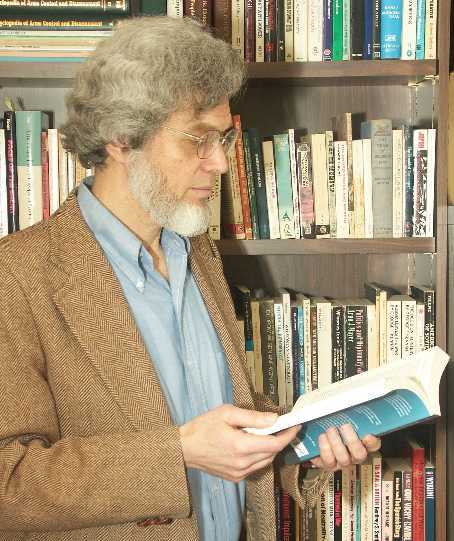 piece, Confronting the Bomb: A Short History of the World Nuclear Disarmament Movement.
A former president of the Council on Peace Research in History, Larry also chaired the Peace History Commission of the International Peace Research Association. He has spoken on peace and disarmament topics around the world, most recently at IPPNW’s World Congress in Basel in August 2010. In addition to lifelong involvement in the peace, civil rights, and labor movements, Larry is a musician, and I fully intend to track him down during one of my occasional visits to Albany for a jam on guitar and banjo.
For now, I recommend that you take a look at the articles already posted here, and watch for new pieces as they arrive. You might want to start with “The ‘Golden Rule’ Will Sail Again,” a really uplifting story about a small group of antinuclear protesters in the 1950s who drove the US government bonkers years before the Rainbow Warrior set sail.
After New START: Where Does Nuclear Disarmament Go From Here?
[Dr. Wittner, Professor of History at the State University of New York/Albany, spoke about the impact of civil society on nuclear policy at IPPNW’s World Congress in Basel this past August. His latest book is Confronting the Bomb: A Short History of the World Nuclear Disarmament Movement (Stanford University Press).]
With U.S. Senate ratification of the New START treaty on December 22, supporters of nuclear disarmament won an important victory. Signed by President Barack Obama and Russian President Dmitry Medvedev last April, the treaty commits the two nations to cut the number of their deployed strategic (i.e. long-range) nuclear warheads to 1,550 each—a reduction of 30 percent in the number of these weapons of mass destruction. By providing for both a cutback in nuclear weapons and an elaborate inspection system to enforce it, New START is the most important nuclear disarmament treaty for a generation.
Nevertheless, the difficult battle to secure Senate ratification indicates that making further progress on nuclear disarmament will not be easy. Treaty ratification requires a positive vote by two-thirds of the Senate and, to secure the necessary Republican support, Obama promised nearly $185 billion over the next decade for “modernizing” the U.S. nuclear weapons production complex and nuclear weapons delivery vehicles. Even with this enormous concession to nuclear enthusiasts—a hefty “bribe,” in the view of unhappy arms control and disarmament organizations—Senator Jon Kyl, the Republican point man on the issue, continued to oppose New START and ultimately voted against it. So did most other Republican senators, including Mitch McConnell (Senate Republican leader) and John McCain (the latest Republican presidential candidate). Leading candidates for the GOP presidential nomination in 2012, including Mitt Romney and Sarah Palin, also opposed the treaty. As a result, New START squeaked through the Senate by a narrow margin. With six additional Republicans entering the Senate in January, treaty ratification will become much harder. Read more…
US Senate does “right thing”; ratifies New START
[IPPNW has released the following statement, following the announcement that the US Senate, by a vote of 71-26, has ratified the New START agreement between the US and Russia.]
International Physicians for the Prevention of Nuclear War praised the US Senate for “doing the right thing” today in ratifying the New START agreement between the US and Russia, and called on the Russian Duma to quickly follow suit and bring the treaty into force.
IPPNW chair Bjorn Hilt of Norway said the treaty is a modest but welcome step toward a world without nuclear weapons, and urged the leaders of the two largest nuclear-weapon states to waste no time in negotiating much deeper cuts in their arsenals in the new year.
“Even with the New START,” Dr. Hilt said, “the US and Russia continue to deploy thousands of nuclear weapons that contribute nothing to the security of their people, endanger the rest of the world, and give other countries an excuse to retain or acquire nuclear weapons of their own.
“Presidents Obama and Medvedev deserve credit for pushing this treaty through to a successful conclusion. We hope they will now take bold new steps to make good on their promise that the small reductions guaranteed by this Senate vote are merely a ‘down payment’ on the nuclear-weapons-free world to which they have pledged their leadership. The sooner all the nuclear powers can get to work on a global nuclear disarmament agreement, the better.”
IPPNW warned that modernization of the large arsenals still possessed by the US and Russia would undermine the progress made by the New START, and criticized US plans to spend more than $85 billion over the next 10 years to rebuild its nuclear weapons research and production complex.
“The focus after today must be on ways to accelerate the liberation of the world from these weapons of mass annihilation,” said Dr. Hilt, “not on programs to ensure that they will continue to endanger us for decades to come.”

 Bimal Khadka
 Bjorn Hilt
 Charles K. Johnson
 Dr. Ghassan Shahrour
 Gunnar Westberg
 IPPNW
IPPNW John Loretz
 Lawrence Wittner
 Maria Valenti
 mollymcgint
 Sue Wareham
 Tilman Ruff
 Tim Wright
 Xanthe Hall