Nuclear bombs at Lakenheath
Accidents and deployment at an Air Force base in East Anglia, UK
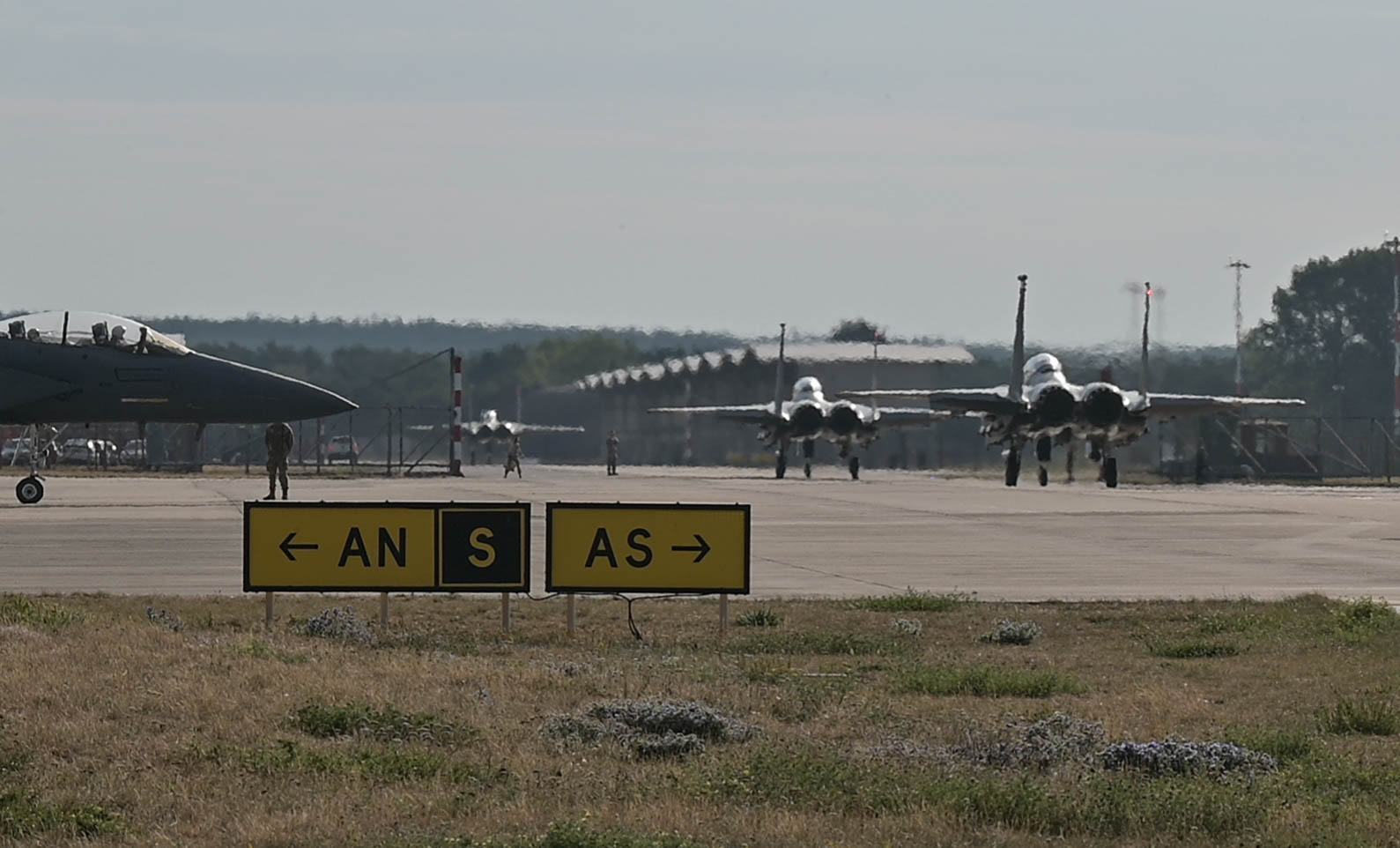
RAF Lakenheath is a Royal Air Force (RAF) base, but to all intents and purposes it is a US Air Force (USAF) base, hosting only US units. It is located in Suffolk, United Kingdom, about 140 km north-west of London. During the Cold War, US nuclear weapons were stored at Lakenheath, as part of NATO nuclear sharing. These were withdrawn in 2008. There are indications that US nuclear weapons have recently been redeployed at the base. However, these have not been officially confirmed.
Nuclear accidents
There have been two accidents involving nuclear weapons at Lakenheath: in July 1956 and in January 1961, both of which were very serious.
Covered up until 1979, reports of a near disaster on 27 July 1956 at the Lakenheath Air Base quoted a retired USAF major general who said that an accident had occurred that could have resulted in a nuclear explosion. The nuclear accident was classed as a “Broken Arrow”, a worst-case accident just short of disaster. The British government was forced to make a statement in November 1979, explaining what had taken place.
A B-47 US-American bomber lost control during landing and crashed into a storage igloo. The store contained several Mark 6 nuclear bombs. The aircraft then exploded and showered burning fuel over the nuclear bombs. The crew died in the accident. In a telex message from General Walsh, commander of the 7th air division, to General Curtis Le May, STRATCOM commander, revealed the severity of the accident:
“Preliminary exam by bomb disposal officer says a miracle that one Mark Six with exposed detonators didn’t go off”.
The base was quickly evacuated and the fire service called. The firemen reported seeing a large convoy of US vehicles leaving the base with their families. Other people living in the area also caught wind of the panic, encountering fleeing servicemen, without themselves being told of impending danger.
The fire chief moved as close to the building containing the bombs and poured foam on the fire from four trucks. No attempt was made to save the crewmen as it was presumed they were dead.
However, others claim that the threat was not as great as many thought. The nuclear cores were stored separately from the bombs meaning that if there had been a detonation, the ensuing explosion would not have been a nuclear one. Still, the bomb contained uranium which would have been dispersed by the explosion. However, if the aircraft had struck the neighbouring storage igloo where the cores were kept, then plutonium would have been dispersed, a far more dangerous substance for health and the environment.
Just four and a half years later, a second accident occurred at Lakenheath. The fuel tanks on a US F-100D fighter jet were accidentally jettisoned while the plane was still on the ground, causing them to rupture and catch fire underneath the plane which was carrying a hydrogen bomb, a Mark 28 with a yield of 70 Kilotons. This type of bomb was, according to Eric Schlosser, susceptible to detonation when exposed to prolonged heat. Fortunately, the fire was put out, averting a disaster. The bomb was left scorched and blistered.
Withdrawn and redeployed?
Although the last 100 US nuclear weapons were withdrawn from Lakenheath in 2008, after more than 50 years of nuclear deployment in the United Kingdom. Although nuclear weapons were first deployed in September 1954, the bombs that were withdrawn in 2008 were part of a European contingent of nuclear bombs that the US provided for Europe under the Clinton Administration in 2000. It has been postulated that the withdrawal was a consequence of a 2008 Blue Ribbon Review that found security problems at several European nuclear bases.The withdrawal of the nuclear bombs was not made public but has been confirmed by various sources.
After the Russian invasion of Ukraine in March 2022, there has been much debate about increasing nuclear deterrence in Europe. In 2024, reports appeared in the media of documents showing construction work at Lakenheath, indicating that nuclear storage could be imminent. Combined with the deployment of the new B61-12 in Europe, analysts said that construction of a new “surety dormitory” could plausibly be intended for an influx of guards needed to maintain the storage of nuclear weapons. At regular intervals since then there have been reports of further evidence of a planned nuclear deployment but the British government has neither confirmed nor denied this.
In July 2025, the Campaign for Nuclear Disarmament called on the British government to officially respond to the rumours that B61-12 nuclear bombs had indeed been deployed at Lakenheath. This was presumed, as a transport plane from Kirtland Air Force base in New Mexico—the main US nuclear storage site—had landed at Lakenheath to make a drop-off. Combined with the UK government decision to buy 12 F-35A fighter jets—the preferred dual-capable aircraft for the B61-12—as well as the inclusion of Lakenheath on a list of NATO nuclear weapons storage locations, all added to the suspicion that the UK was again participating in NATO nuclear sharing.
Since 2024, protests have regularly taken place at the gates of Lakenheath air base. CND argues that the new nuclear bombs might more easily be used because of its variable yield and high precision. In contrast to the old B61 bombs, the new tactical weapons have a guided system allowing a greater accuracy, so they might conceivably be used with a very low yield against a military target as a kind of warning ‘shot across the bows’. The new B61-12 is to be based at five known locations in Europe: Büchel (Germany), Klein Brogel (Belgium), Voelkel (Netherlands) and Aviano (Italy). There has also been some speculation that other European bases where nuclear weapons were previously deployed may also be reactivated.
The British government maintains its position of ‘neither confirm or deny’ about nuclear deployment in the United Kingdom.
22 July 2026
Sources
Campaign for Nuclear Disarmament: RAF Lakenheath: have US nuclear weapons returned to Britain? No date given, accessed on 22 Jul 2026.
Casciani D: UK hid ‘nuclear accident threat’, BBC News, 24 Jul 2003
Evans R: MoD catalogues its nuclear blunders, The Guardian, 13 Oct 2003
Kristensen H: U.S. Nuclear Weapons Withdrawn From The United Kingdom, Federation of American Scientists, 26 Jun 2008
Precey M: Are US nuclear weapons set to return to RAF Lakenheath? BBC news, 18 Feb 2024
Schlosser E: Why we must end our reliance on nuclear weapons, Times, 2 Aug 2020
Walsh JH: Top secret telex message to General Curtis Le May, 27 Jul 1956
Wilson J: ‘Broken Arrow’ in Cold War: East Anglia, Chapter 9, accessed via Google Books

 Bimal Khadka
 Bjorn Hilt
 Charles K. Johnson
 Dr. Ghassan Shahrour
 Gunnar Westberg
 IPPNW
IPPNW John Loretz
 Lawrence Wittner
 Maria Valenti
 mollymcgint
 Sue Wareham
 Tilman Ruff
 Tim Wright
 Xanthe Hall