By Misha Byrne
It’s Day Two of the NPT, and I’m rapidly coming to realise just how important civil society organizations are to the running of official UN events. Far from being passive observers, NGOs are known, respected and often consulted by missions from NPT countries; there’s definitely a scope for making a difference.
A few brief examples from the last few days…
Example 1: WILPF and Reaching Critical Will
The Women’s International League for Peace and Freedom (WILPF) has a long history, dating right back to its founding in 1915 (making it the oldest women’s peace organisation in the world). To be honest, I’d never really heard of it before I arrived in New York, but the NPT Review Conference certainly seems to know and respects WILPF’s work. Why? Read more…
The growing tide of support for a Convention
by Tim Wright

UN Photo/Mark Garten - May 5, 2010, Secretary-General Ban Ki-moon (left) speaks prior to a special screening of "Countdown to Zero", a documentary film on the history of the atomic bomb. Also at the podium are: actor and UN Peace Messenger Michael Douglas (centre) and the President of the 2010 Review Conference, Libran N. Cabactulan.
Yesterday more than a dozen states and groups of states mentioned the need for a Nuclear Weapons Convention in their statements at the NPT Review Conference. This vocal display of government support for a global ban on nuclear weapons is unprecedented in this forum, and it is encouraging for the many civil society groups — and governments — intent on shifting the focus of the debate from the failed policy of arms control to a roadmap for abolition. Read more…
Slaves of fear
Malte Andre, IPPNW-Germany
By Malte Andre
On the 14th of June 1946, when Bernard Baruch presented his famous plan to the United Nations Energy Commission, nuclear abolition was within reach. “If we fail”, the report said, “then we have damned every man to be the slave of fear”. They obviously failed, they even keep failing today. If the plan had contained less egoism, it may have had a chance. The nuclear industry would have been controlled before having spread and surely, history would have run another path.
But as all arguments remain the same today, we can state that the intellectual level never changed. Nuclear warheads are still treated like sandbox toys and elected leaders behave like children. Whole populations keep living under the announced slavery, just struggling to look away. Various techniques of looking away even became quite comfortable in the recent years. Whole industries were raised to conduct and guide “ordinary” people through their “ordinary” worlds.
Everything’s gonna be alright, one day. Somebody will take care of it. In this struggle, the entire concept of “civil society” and how we are living and working, our basic democratic values are put to the proof. To reinvent a sane society, we as doctors have to speak up loudly. We will not be silent. That was not news. It only has to be repeated from time to time, not to lose the moral basis, from which we know it is infinitely true.
As another couple of dozen states made their opening statements to the 2010 NPT Review Conference, IPPNW held an expert panel on the medical and environmental consequences of nuclear war and launched its new publication, “Zero Is the Only Option.” The panel, chaired by former IPPNW co-president Vic Sidel, included Dr. James Yamazaki of PSR-Los Angeles, Prof. Brian Toon of the University of Colorado, long-time PSR and IPPNW leader Ira Helfand, science and policy consultant Steven Starr, and Peter Herby, head of the arms unit of the International Committee of the Red Cross.
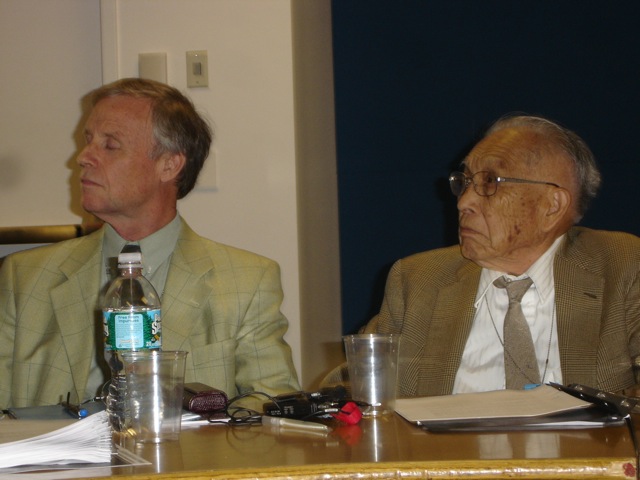
Dr. James Yamazaki (right) with Peter Herby at IPPNW's NPT briefing
Dr. Yamazaki, at 93, is an articulate and enormously resilient man who was assigned to the first team that went into Nagasaki under the auspices of the Atomic Bomb Casualty Commission. He focused this afternoon on the kinds of illnesses that have afflicted not only survivors of the atomic bombings of Hiroshima and Nagasaki, but also the victims of fallout from nuclear testing in the Pacific region. His talk was a vivid reminder that the human suffering caused by nuclear explosions lasts for decades.
Something else that could last for a decade or more is the sudden global cooling that would result from even a relatively small nuclear war involving arsenals of only 100 weapons. Prof. Toon described how massive amounts of smoke and soot from urban firestorms would block sunlight and reduce rainfall over much of the Earth, shortening growing seasons by as much as a month each year for many years to come. Dr. Helfand explained the impact on global food supplies and nutrition, warning that a billion people or more who already live on the edge of starvation would likely die from a nuclear-war-induced famine.
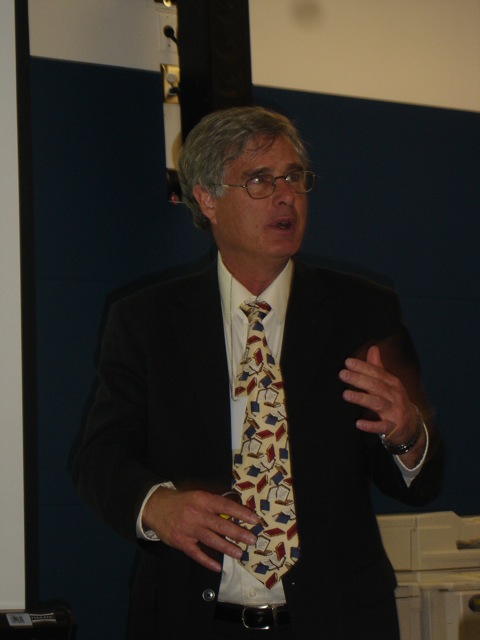
Prof. O. B. Toon, University of Colorado, Boulder at IPPNW panel at the NPT Review
One member of the audience, a grassroots activist from Philadelphia, told Prof. Toon afterwards that she could not clap for such a terrible message, but deeply appreciated the work done by the messenger. She wondered if we could produce a webinar around these talks to get the information out to as many people as possible. Not a bad idea. What we were able to arrange on the spot was for Brian and Ira to film interviews with some young videographers from the Ban All Nukes generation (BANg). I’ll post links as soon as those videos are online.
Steven Starr bridged the gap between science and policy by explaining that the only possible response to these scientific findings is a crash program to eliminate nuclear weapons by commencing work on a Nuclear Weapons Convention as soon as possible. Steven has created a great website based on the work of Prof. Toon and more than half a dozen other scientists who have been studying the climate effects of nuclear war for more than 20 years.
Peter Herby distributed a major statement about nuclear weapons from ICRC president Jakob Kellenberger — the first and most important the organization has made since the end of the Cold War — and said that after reviewing its past positions and the current threat, the ICRC had felt compelled to issue an unequivocal condemnation of nuclear weapons on humanitarian grounds, and to call for their elimination as the only way to ensure that they are never used again. He noted that IPPNW and the ICRC are talking essentially the same language, and suggested that we explore ways to work together — an idea that was received warmly by the IPPNW members in the room.
Ira Helfand: On the climate effects of nuclear war
Ira Helfand: Risk and impact of nuclear detonations
O. B. Toon: Global consequences of regional nuclear war
 by Tim Wright
We have heard over the last two days the foreign ministers from numerous countries repeat the call for a “successful” Review Conference outcome. But what defines success? The Norwegian deputy foreign minister, Ms. Gry Larsen, said yesterday: “Our ambitions should be far higher than merely agreeing on a final document. We need an outcome document that makes a real difference.”
The Non-Aligned Movement has made it clear that movement towards a Nuclear Weapons Convention is “integral” to any agreed plan of action at the conference. Some European countries have also expressed support for an abolition-focused outcome. This Friday, Norway will co-sponsor an event with the International Campaign to Abolish Nuclear Weapons titled “Nuclear Weapons Convention: Now We Can”, which will explore the political and legal requirements of achieving zero.
China remains the only NPT nuclear-weapon state to have expressed its support for such an approach, although the United Kingdom has accepted that a convention will likely be necessary at some point in the future. The Chinese head of delegation, Mr. Li Baodong, argued yesterday that “[t]he international community should develop, at an appropriate time, a viable, long-term plan composed of phased actions, including a convention on the complete prohibition of nuclear weapons”.
The final government speaker on the second day of the conference was Mr. Nasser Bin Abdulaziz Al-Nasser of Qatar, who stressed that the Review Conference should adopt an action plan to eliminate nuclear weapons, and concluded on this optimistic note: “We hope that we will not wait long before we celebrate a universal treaty for disarmament and prohibition of nuclear weapons, for this has legal and political importance.”
Campaigners and diplomats met at lunchtime to examine ways to advance the idea of a Nuclear Weapons Convention at this Review Conference. The model convention developed by civil society was presented as a useful tool with which to stimulate debate. Ban Ki-moon described it in 2008 as a “good point of departure” for actual negotiations.
Ten key arguments for advancing a Nuclear Weapons Convention now are: Read more…
The 2010 NPT Review Conference: May 5th
By Tova Fuller
For those students who have never attended the NPT review conference, I would like to first give a snapshot of what the experience–or at least the first couple of days–is like. First, you queue…for hours. We waited outside in a line with visitors and other NGO representatives. Unfortunately there were only two people working at the registration on day 1, and this inside line inside was even worse – perhaps spending five minutes on each person, and well, with, say, 75 people in front of you…and you can do the math. The NGO representatives flit between the North Lawn building where a room was reserved specifically for them, and the general assembly. By contrast, the general assembly takes place in the main building, with balcony seating from which one can view the delegates and speakers below. Each morning at 8, and I’ve heard this is a tradition at the NPT review conferences, an abolition caucus meets and reviews and discusses the past day’s events, suggesting forming committees to address specific issues.
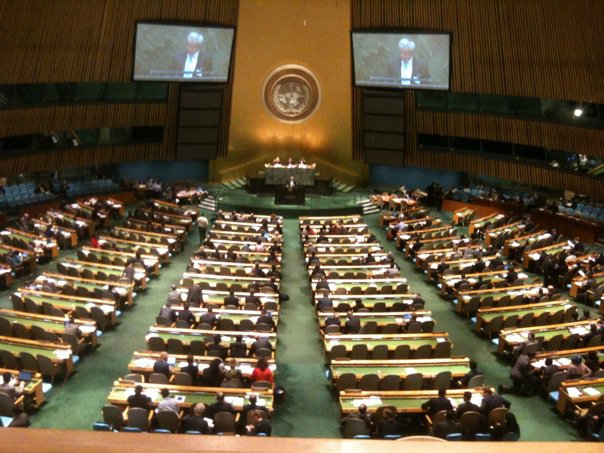
The UN General Assembly
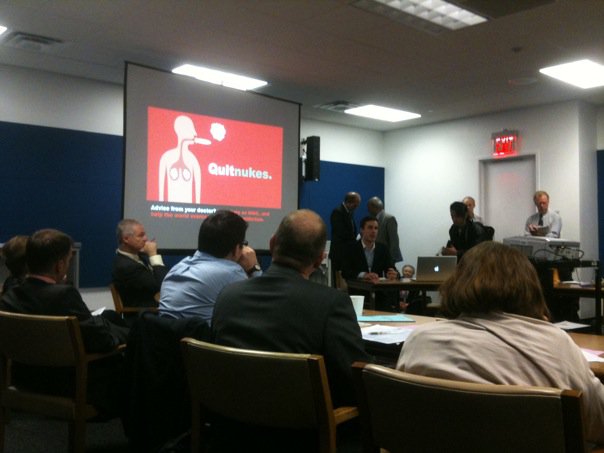
Tim Wright of ICAN in Room A of the North Lawn building
In the past two days of the NPT review conference, there have been three major recurrent themes addressed by the NGOs and those in the general assembly (from my experience). The first, not surprisingly perhaps, is the idea of a nuclear weapons convention (NWC). Tim Wright of ICAN presented a model NWC in a workshop in the North Lawn building yesterday, and it was emphasized that such a model serves as a template or suggestion only, to prove that one can be written. Some arguments against such a NWC are that it may compete with the NPT, whereas it may be obvious to us in the disarmament community that the two are complementary. Some have claimed that the nuclear weapons industry is really the one competing with the NWC, however. Egypt, Liechtenstein, Costa Rica, Malaysia, Mongolia, Tunisia, Kenya and Colombia have all come out in support of a NWC.
As an aside, in this session one responded to the idea that the nuclear weapons complex must be preserved to dismantle the weapons, an idea which has been promoted in the US. She responded that we don’t need a huge infrastructure to dismantle the weapons, and in fact, all that was needed was a large vat of molasses to gunk up the inner workings of each weapon.
The other theme I have come across is the promotion of nuclear energy. Ahmadinejad, Clinton, and others have come out in support of nuclear energy in recent days. In addition, so have representatives from South Africa, Kuwait, Slovenia, Tunisia and Mongolia, to name a few. Over and over, I have heard the phrase “the peaceful use of nuclear energy.” In fact, the permanent representative of Tunisia claimed that we need, not choose, nuclear energy because of financial constraints. It is apparently seen as an engine of development, leading to prosperity, but as addressed by the representative of Slovenia, it comes hand in hand with increased proliferation risks. However, as the ambassador from Kuwait quoted Einstein, “The release of atom power has changed everything except our way of thinking.” One might wonder what role nuclear energy industry plays in encouraging the pro-nuclear energy sentiments expressed by nearly everyone but the NGOs, who for obvious reasons oppose it.
The third theme, expressed strongly by different countries’ representatives is the inherent hypocrisy of Israel’s possession of nuclear weapons.
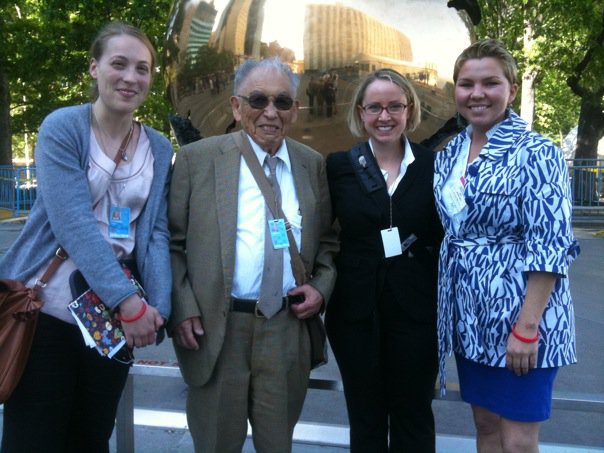
Dr. Yamazaki after his talk
On another note, IPPNW held a specifically relevant session entitled “Expert briefing on the medical and environmental consequences of nuclear war.” Amongst other presentations, Dr. James Yamazaki, the lead physician of the US Atomic Bomb Medical Team, spoke to the medical consequences of the atomic blasts from his studies and experience. The effects of nuclear war were covered: reduction of temperatures to the lowest levels in 1000 years, shortening of growing seasons at midlatitudes, a reduction of rainfall in topic zones, and the destruction of the ozone levels. Dr. Ira Helfand spoke about the famine that would result from even a limited nuclear war, and the effects of a 20 megaton bomb in NYC. He relayed that this model is unlikely today. More likely, 15 or 20 half ton bombs would be used in an attack, but the destruction would be spread out much more efficiently, causing an even greater catastrophe with less total tonnage. Professor O. B. Toom also addressed the reduction of global temperatures to ice age conditions and the reduction of global precipitation by 50%. Steven Starr followed up by, amongst other topics, addressing a NWC. During the ensuing discussing, Dr. Ira Helfand used the example of the recent oil spill as an example of failure of a “failsafe” system. He also talked about the potential on someone hacking into the system and creating an unauthorized launch. Finally, the topic of the economics of the weapons industry was raised.
Day two of the NPT Review conference lacked the drama of the opening session, as the general debate settled into a pattern of statements from Member States and state groupings calling for steps to strengthen all three pillars of the NPT. In fact, the pattern was so evident that, with very few exceptions, we seemed to get the same basic statement more than 30 times over the course of several hours.
The template went something like this: we endorse the goal of a world without nuclear weapons (but have varying perspectives on how hard and how quickly to push for that); we welcome the New START by the US and Russia; we see the new US Nuclear Posture Review as a step in the right direction, although it could have gone further; we insist upon entry into force of the Comprehensive Test Ban Treaty and completion of a treaty to ban fissile materials (in one form or another); we like nuclear-weapon-free zones and want to see more of them, especially in the Middle East; we think safeguards against proliferation have to be strengthened; we want stricter enforcement of non-proliferation rules (if we’re upset about Iran) but we don’t want that done in a discriminatory way (if we think the US and its allies are picking unfairly on Iran); and every last one of us wants to make sure that nuclear energy is available to everyone who wants it, even if it’s the most ill advised, most costly, and most dangerous energy option on the table (okay…they didn’t say that last part, but the NGOs will later this week). Read more…
Day one of the NPT Review: Much ado about Iran

President Mahmoud Ahamadinejad of Iran addresses 2010 NPT Review Conference
The first day of the 2010 Review Conference of the Treaty on the Non-Proliferation of Nuclear Weapons (NPT) was largely a theater piece about Iran, thanks in part to an hour-long speech by Iranian President Mahmoud Ahmadinejad, which was equal parts denunciation of nuclear weapons and denunciation of the United States and its allies, with a dose of theology thrown in for good measure.
Even before Ahmadinejad took the floor, he heard his government’s nuclear activities and lack of cooperation with the IAEA criticized by both Secretary-General Ban Ki-Moon and by IAEA Director General Yukiya Amano. He wasted no time in telling the Secretary-General that he had it wrong and that “the ball is in your court.” As the day went on, it became clear that no one else agreed. Read more…
The NPT Review Conference: Monday, May 3rd
By Malte Andre, IPPNW-Germany
Being honest to ourselves, President Mahmud Ahmadinejad gave a very modest speech at the NPT Review Conference today. He followed Ayatollah Ali Khamenei, the religious leader of Iran, who recently issued a fatwa against nuclear weapons, by calling nuclear weapons “disgusting and shameful”. Furthermore, the Iranian President criticized the leadership role of the US in both, the United Nations Security Council and the NPT reviewing process.
By introducing some steps to improve the disarmament actions making them legally-binding without discrimination or precondition, Ahmadinejad seeked more credibility in the international community.
Later in the evening US Secretary of State Hillary Clinton would answer that the “US will do its part.” These statements may have provided some hope unless Mrs Clinton threatened all states “breaking the rules”, they had to pay a high price if they did.
Did we all forget Condoleeza Rice’s statements concerning Saddam Hussein whom she suspected to develop nuclear devices in hidden places in 2003? Back then, the US did not wait until the final proof, which they said, would have been a mushroom cloud coming out of Saddam’s smoking gun.
Finally, every audience has to decide on his own whom to believe, Clinton or Ahmadinejad.
Friday, April 30th, 2010: Reality and Hope
By Misha Byrne
Day One in New York. We’re here for the Non-Proliferation Treaty (NPT) Review Conference. Who’s ‘we’? Close to a hundred students, and at least 1,000 other peace activists.
While the NPT RevCon doesn’t begin until Monday (and none of us will get in the UN door without first successfully navigating registration that will likely take several hours waiting to complete), many have come early for a two-day peace conference (Friday and Saturday) in the Riverside Church, a building rich with activist history, including speeches from Martin Luther King, Jr amongst others. Read more…

 Bimal Khadka
 Bjorn Hilt
 Charles K. Johnson
 Dr. Ghassan Shahrour
 Gunnar Westberg
 IPPNW
IPPNW John Loretz
 Lawrence Wittner
 Maria Valenti
 mollymcgint
 Sue Wareham
 Tilman Ruff
 Tim Wright
 Xanthe Hall