As another couple of dozen states made their opening statements to the 2010 NPT Review Conference, IPPNW held an expert panel on the medical and environmental consequences of nuclear war and launched its new publication, “Zero Is the Only Option.” The panel, chaired by former IPPNW co-president Vic Sidel, included Dr. James Yamazaki of PSR-Los Angeles, Prof. Brian Toon of the University of Colorado, long-time PSR and IPPNW leader Ira Helfand, science and policy consultant Steven Starr, and Peter Herby, head of the arms unit of the International Committee of the Red Cross.
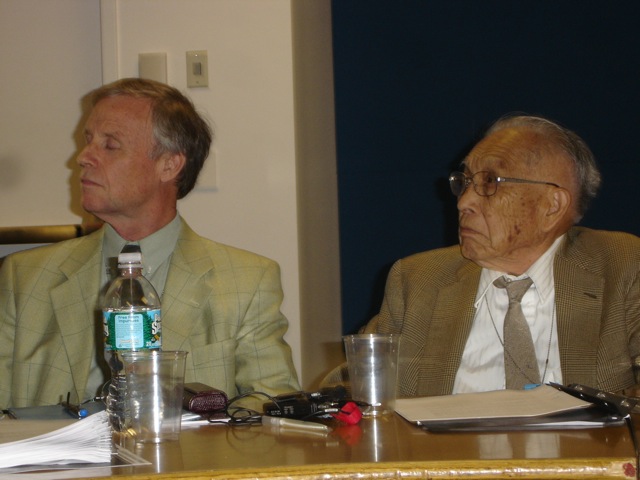
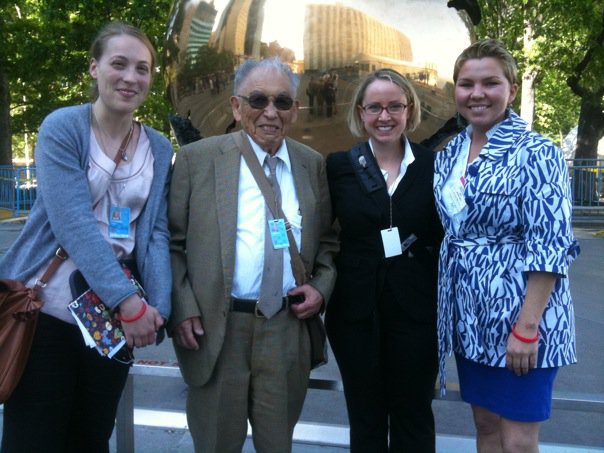
Dr. James Yamazaki (right) with Peter Herby at IPPNW's NPT briefing
Dr. Yamazaki, at 93, is an articulate and enormously resilient man who was assigned to the first team that went into Nagasaki under the auspices of the Atomic Bomb Casualty Commission. He focused this afternoon on the kinds of illnesses that have afflicted not only survivors of the atomic bombings of Hiroshima and Nagasaki, but also the victims of fallout from nuclear testing in the Pacific region. His talk was a vivid reminder that the human suffering caused by nuclear explosions lasts for decades.
Something else that could last for a decade or more is the sudden global cooling that would result from even a relatively small nuclear war involving arsenals of only 100 weapons. Prof. Toon described how massive amounts of smoke and soot from urban firestorms would block sunlight and reduce rainfall over much of the Earth, shortening growing seasons by as much as a month each year for many years to come. Dr. Helfand explained the impact on global food supplies and nutrition, warning that a billion people or more who already live on the edge of starvation would likely die from a nuclear-war-induced famine.
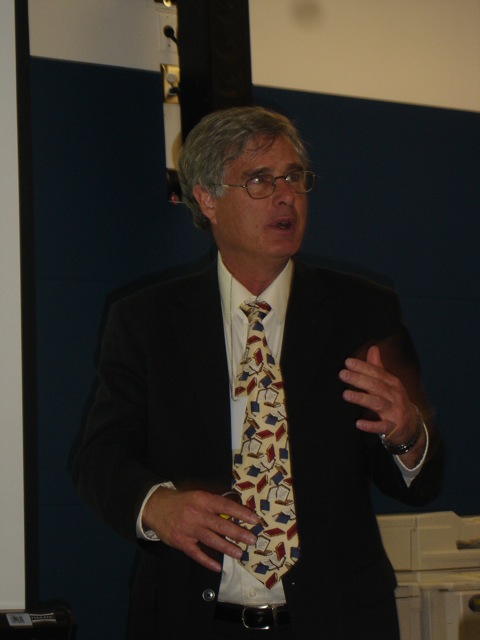
Prof. O. B. Toon, University of Colorado, Boulder at IPPNW panel at the NPT Review
One member of the audience, a grassroots activist from Philadelphia, told Prof. Toon afterwards that she could not clap for such a terrible message, but deeply appreciated the work done by the messenger. She wondered if we could produce a webinar around these talks to get the information out to as many people as possible. Not a bad idea. What we were able to arrange on the spot was for Brian and Ira to film interviews with some young videographers from the Ban All Nukes generation (BANg). I’ll post links as soon as those videos are online.
Steven Starr bridged the gap between science and policy by explaining that the only possible response to these scientific findings is a crash program to eliminate nuclear weapons by commencing work on a Nuclear Weapons Convention as soon as possible. Steven has created a great website based on the work of Prof. Toon and more than half a dozen other scientists who have been studying the climate effects of nuclear war for more than 20 years.
Peter Herby distributed a major statement about nuclear weapons from ICRC president Jakob Kellenberger — the first and most important the organization has made since the end of the Cold War — and said that after reviewing its past positions and the current threat, the ICRC had felt compelled to issue an unequivocal condemnation of nuclear weapons on humanitarian grounds, and to call for their elimination as the only way to ensure that they are never used again. He noted that IPPNW and the ICRC are talking essentially the same language, and suggested that we explore ways to work together — an idea that was received warmly by the IPPNW members in the room.
Ira Helfand: On the climate effects of nuclear war
Ira Helfand: Risk and impact of nuclear detonations
O. B. Toon: Global consequences of regional nuclear war
 by Tim Wright
We have heard over the last two days the foreign ministers from numerous countries repeat the call for a “successful” Review Conference outcome. But what defines success? The Norwegian deputy foreign minister, Ms. Gry Larsen, said yesterday: “Our ambitions should be far higher than merely agreeing on a final document. We need an outcome document that makes a real difference.”
The Non-Aligned Movement has made it clear that movement towards a Nuclear Weapons Convention is “integral” to any agreed plan of action at the conference. Some European countries have also expressed support for an abolition-focused outcome. This Friday, Norway will co-sponsor an event with the International Campaign to Abolish Nuclear Weapons titled “Nuclear Weapons Convention: Now We Can”, which will explore the political and legal requirements of achieving zero.
China remains the only NPT nuclear-weapon state to have expressed its support for such an approach, although the United Kingdom has accepted that a convention will likely be necessary at some point in the future. The Chinese head of delegation, Mr. Li Baodong, argued yesterday that “[t]he international community should develop, at an appropriate time, a viable, long-term plan composed of phased actions, including a convention on the complete prohibition of nuclear weapons”.
The final government speaker on the second day of the conference was Mr. Nasser Bin Abdulaziz Al-Nasser of Qatar, who stressed that the Review Conference should adopt an action plan to eliminate nuclear weapons, and concluded on this optimistic note: “We hope that we will not wait long before we celebrate a universal treaty for disarmament and prohibition of nuclear weapons, for this has legal and political importance.”
Campaigners and diplomats met at lunchtime to examine ways to advance the idea of a Nuclear Weapons Convention at this Review Conference. The model convention developed by civil society was presented as a useful tool with which to stimulate debate. Ban Ki-moon described it in 2008 as a “good point of departure” for actual negotiations.
Ten key arguments for advancing a Nuclear Weapons Convention now are: Read more…
The 2010 NPT Review Conference: May 5th
By Tova Fuller
For those students who have never attended the NPT review conference, I would like to first give a snapshot of what the experience–or at least the first couple of days–is like. First, you queue…for hours. We waited outside in a line with visitors and other NGO representatives. Unfortunately there were only two people working at the registration on day 1, and this inside line inside was even worse – perhaps spending five minutes on each person, and well, with, say, 75 people in front of you…and you can do the math. The NGO representatives flit between the North Lawn building where a room was reserved specifically for them, and the general assembly. By contrast, the general assembly takes place in the main building, with balcony seating from which one can view the delegates and speakers below. Each morning at 8, and I’ve heard this is a tradition at the NPT review conferences, an abolition caucus meets and reviews and discusses the past day’s events, suggesting forming committees to address specific issues.
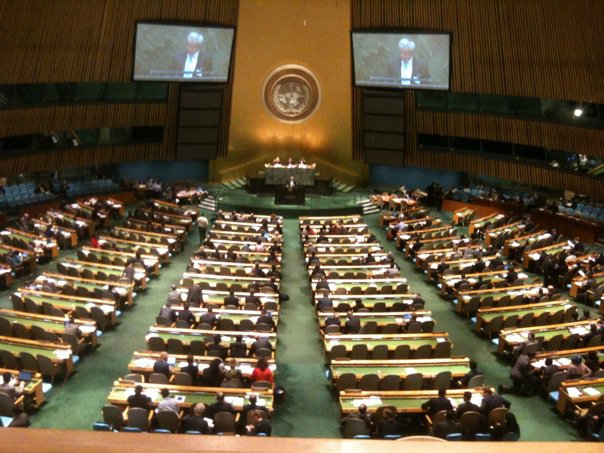
The UN General Assembly
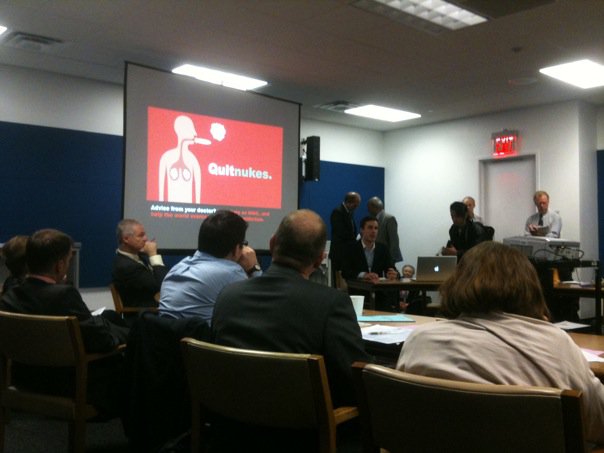
Tim Wright of ICAN in Room A of the North Lawn building
In the past two days of the NPT review conference, there have been three major recurrent themes addressed by the NGOs and those in the general assembly (from my experience). The first, not surprisingly perhaps, is the idea of a nuclear weapons convention (NWC). Tim Wright of ICAN presented a model NWC in a workshop in the North Lawn building yesterday, and it was emphasized that such a model serves as a template or suggestion only, to prove that one can be written. Some arguments against such a NWC are that it may compete with the NPT, whereas it may be obvious to us in the disarmament community that the two are complementary. Some have claimed that the nuclear weapons industry is really the one competing with the NWC, however. Egypt, Liechtenstein, Costa Rica, Malaysia, Mongolia, Tunisia, Kenya and Colombia have all come out in support of a NWC.
As an aside, in this session one responded to the idea that the nuclear weapons complex must be preserved to dismantle the weapons, an idea which has been promoted in the US. She responded that we don’t need a huge infrastructure to dismantle the weapons, and in fact, all that was needed was a large vat of molasses to gunk up the inner workings of each weapon.
The other theme I have come across is the promotion of nuclear energy. Ahmadinejad, Clinton, and others have come out in support of nuclear energy in recent days. In addition, so have representatives from South Africa, Kuwait, Slovenia, Tunisia and Mongolia, to name a few. Over and over, I have heard the phrase “the peaceful use of nuclear energy.” In fact, the permanent representative of Tunisia claimed that we need, not choose, nuclear energy because of financial constraints. It is apparently seen as an engine of development, leading to prosperity, but as addressed by the representative of Slovenia, it comes hand in hand with increased proliferation risks. However, as the ambassador from Kuwait quoted Einstein, “The release of atom power has changed everything except our way of thinking.” One might wonder what role nuclear energy industry plays in encouraging the pro-nuclear energy sentiments expressed by nearly everyone but the NGOs, who for obvious reasons oppose it.
The third theme, expressed strongly by different countries’ representatives is the inherent hypocrisy of Israel’s possession of nuclear weapons.
Dr. Yamazaki after his talk
On another note, IPPNW held a specifically relevant session entitled “Expert briefing on the medical and environmental consequences of nuclear war.” Amongst other presentations, Dr. James Yamazaki, the lead physician of the US Atomic Bomb Medical Team, spoke to the medical consequences of the atomic blasts from his studies and experience. The effects of nuclear war were covered: reduction of temperatures to the lowest levels in 1000 years, shortening of growing seasons at midlatitudes, a reduction of rainfall in topic zones, and the destruction of the ozone levels. Dr. Ira Helfand spoke about the famine that would result from even a limited nuclear war, and the effects of a 20 megaton bomb in NYC. He relayed that this model is unlikely today. More likely, 15 or 20 half ton bombs would be used in an attack, but the destruction would be spread out much more efficiently, causing an even greater catastrophe with less total tonnage. Professor O. B. Toom also addressed the reduction of global temperatures to ice age conditions and the reduction of global precipitation by 50%. Steven Starr followed up by, amongst other topics, addressing a NWC. During the ensuing discussing, Dr. Ira Helfand used the example of the recent oil spill as an example of failure of a “failsafe” system. He also talked about the potential on someone hacking into the system and creating an unauthorized launch. Finally, the topic of the economics of the weapons industry was raised.
Day two of the NPT Review conference lacked the drama of the opening session, as the general debate settled into a pattern of statements from Member States and state groupings calling for steps to strengthen all three pillars of the NPT. In fact, the pattern was so evident that, with very few exceptions, we seemed to get the same basic statement more than 30 times over the course of several hours.
The template went something like this: we endorse the goal of a world without nuclear weapons (but have varying perspectives on how hard and how quickly to push for that); we welcome the New START by the US and Russia; we see the new US Nuclear Posture Review as a step in the right direction, although it could have gone further; we insist upon entry into force of the Comprehensive Test Ban Treaty and completion of a treaty to ban fissile materials (in one form or another); we like nuclear-weapon-free zones and want to see more of them, especially in the Middle East; we think safeguards against proliferation have to be strengthened; we want stricter enforcement of non-proliferation rules (if we’re upset about Iran) but we don’t want that done in a discriminatory way (if we think the US and its allies are picking unfairly on Iran); and every last one of us wants to make sure that nuclear energy is available to everyone who wants it, even if it’s the most ill advised, most costly, and most dangerous energy option on the table (okay…they didn’t say that last part, but the NGOs will later this week). Read more…
Day one of the NPT Review: Much ado about Iran

President Mahmoud Ahamadinejad of Iran addresses 2010 NPT Review Conference
The first day of the 2010 Review Conference of the Treaty on the Non-Proliferation of Nuclear Weapons (NPT) was largely a theater piece about Iran, thanks in part to an hour-long speech by Iranian President Mahmoud Ahmadinejad, which was equal parts denunciation of nuclear weapons and denunciation of the United States and its allies, with a dose of theology thrown in for good measure.
Even before Ahmadinejad took the floor, he heard his government’s nuclear activities and lack of cooperation with the IAEA criticized by both Secretary-General Ban Ki-Moon and by IAEA Director General Yukiya Amano. He wasted no time in telling the Secretary-General that he had it wrong and that “the ball is in your court.” As the day went on, it became clear that no one else agreed. Read more…
The NPT Review Conference: Monday, May 3rd
By Malte Andre, IPPNW-Germany
Being honest to ourselves, President Mahmud Ahmadinejad gave a very modest speech at the NPT Review Conference today. He followed Ayatollah Ali Khamenei, the religious leader of Iran, who recently issued a fatwa against nuclear weapons, by calling nuclear weapons “disgusting and shameful”. Furthermore, the Iranian President criticized the leadership role of the US in both, the United Nations Security Council and the NPT reviewing process.
By introducing some steps to improve the disarmament actions making them legally-binding without discrimination or precondition, Ahmadinejad seeked more credibility in the international community.
Later in the evening US Secretary of State Hillary Clinton would answer that the “US will do its part.” These statements may have provided some hope unless Mrs Clinton threatened all states “breaking the rules”, they had to pay a high price if they did.
Did we all forget Condoleeza Rice’s statements concerning Saddam Hussein whom she suspected to develop nuclear devices in hidden places in 2003? Back then, the US did not wait until the final proof, which they said, would have been a mushroom cloud coming out of Saddam’s smoking gun.
Finally, every audience has to decide on his own whom to believe, Clinton or Ahmadinejad.
Friday, April 30th, 2010: Reality and Hope
By Misha Byrne
Day One in New York. We’re here for the Non-Proliferation Treaty (NPT) Review Conference. Who’s ‘we’? Close to a hundred students, and at least 1,000 other peace activists.
While the NPT RevCon doesn’t begin until Monday (and none of us will get in the UN door without first successfully navigating registration that will likely take several hours waiting to complete), many have come early for a two-day peace conference (Friday and Saturday) in the Riverside Church, a building rich with activist history, including speeches from Martin Luther King, Jr amongst others. Read more…
Cutting the Gordian Knot
“Turn him to any cause of policy,
The Gordian Knot of it he will unloose,
Familiar as his garter” (Shakespeare, Henry V, Act 1 Scene 1. 45–47)
Before you all physically or mentally traipse off to New York – volcanic ash allowing – I’d like to say something. Nuclear weapons do have a purpose. What I want to share with you may seem a tad too philosophical for your liking, but as the daughter of a philosopher and a nurse I feel that we may have been missing the point. Of course, we need to get rid of them. Like cancer, they are spreading disease that cause pain and suffering and no-one wants to talk about because of the feelings of helplessness they engender. But we are now, at last, really talking about nuclear weapons. That is a good start in the process of healing ourselves. Getting out of denial.
There are two sides to everything: a positive and a negative one. The negative side to nuclear weapons has preoccupied our thoughts almost exclusively up until now. We have left others to surmise what the positive side might be and have always simply negated it. No, they do not prevent war; no, they do not protect us from ruthless and unpredictable dictators; and so forth. But the true purpose of nuclear weapons lies in their absolute ability to destroy everything. The ultimate weapon of suicide for humanity as a whole. And this ability to destroy everything, discovered through the deaths of millions in two world wars, brought us to a brink. For the past 65 years civilisation has stood teetering on that brink and has not yet truly stepped back. The purpose of nuclear weapons is to constantly remind us of where we stand and of the task that humanity has before it: to make peace.
I am not arguing that we need to keep nuclear weapons to do this, quite the contrary. In order to make peace we have to talk about why we have nuclear weapons and how to get rid of them. In my opinion, this discussion has at last begun. All over the world protagonists for abolition are facing open doors (well maybe so much in North Korea, France or Israel) to the corridors of power where questions are being asked. How can it be done? What are the preconditions for nuclear abolition? What are the first steps? How high is the mountain and can we see the top?
Take Germany, for instance. Who would have thought that getting rid of 20 nuclear gravity bombs would end up being so difficult? Debating the role of nuclear weapons has brought all of the worms out of the woodwork of NATO. Suddenly we realise that – although the world has changed immeasurably – our attitudes towards security remain encrusted in Cold War thinking. We’re back to talking about missile defence and common security, the positions that Reagan and Gorbachev brought to the Icelandic negotiating table in 1986. Old Europe finds its anti-nuclear ambitions tied contractually to the fears and distrust of New Europe and is unable to do anything but reassure them that we will not do anything. Why is the US foreign minister proposing that we should hold on to these old relics unless the Russians are prepared to negotiate away theirs? Surely she knows that this means that nothing will happen? The Russians are equally unable to break free of the confines of the balance of terror. They see plans for Prompt Global Strike and cling desperately to their aging nuclear arsenal as the only possible answer.
To free ourselves from this scourge, we need to cut the Gordian Knot. It needs a bold stroke of unilateralism to engender trust and finally make peace with Russia. Both new START and the Nuclear Posture Review demonstrated how stuck we actually are, unable to do more than rearrange the numbers and engage in fine semantics without actually engaging in real disarmament. The withdrawal of the two hundred bombs in Europe could be one such bold stroke. A demonstration of goodwill and willingness to begin true negotiation. How can we make friends if we are afraid of giving a sign of weakness which in fact is a sign of real strength?
When I read the US Nuclear Posture Review I could see why it took so long to complete. It is the work of an administration in internal conflict. There are grand visions and statements alongside pettiness. You can almost smell the arrogant fear that is clutching its position of strength and pouring billions of dollars down the nuclear drain, while a small voice shines through, saying: “but in the future…” Yes, what about that future? This document doesn’t tell us how to get there. It talks of others giving up their small vestiges of power and of building up more reserves of strength, of remodelling its weapons and reaching into every corner of the earth with its military might.
How would I read this document if I was a proclaimed enemy of the United States of America, or even a potential one? I could not in all conscience say I will lay down my arms and leave my country defenseless. I would have to be another Mahatma Gandhi to do that. In the face of these expressions of absolute hegemony there is only one answer, and it is to wield the nuclear threat. Never mind that it is suicide, should we ever be forced to use it. Never mind that it will drain all our resources and poison our land and people.
If we could at last begin to understand the meaning of common security and how to achieve it, nuclear weapons would have served their purpose. It means putting ourselves in the shoes of our adversaries and understanding what their problems are. The process of negotiating nuclear abolition, like with any disarmament treaty before it, brings with it an exchange of needs and desires and seeks fulfilment of those, in order to bring security. A nuclear weapons convention is not just the phased reduction and elimination of the weapons themselves, it is about learning how to trust while evolving a system of verification (through governance and societal control) to underpin that trust. It means opening up and becoming transparent so that fear is reduced and less is based on assumption and more on reality. It also means talking about history and the reasons for conflict while seeking resolution. It means countries that have experience in resolving conflict stepping up to mediate with those who have not yet done so. It is, in fact, a whole new world.
We could begin the process in New York by committing to preparations for a negotiation of a nuclear weapons convention. Or we could stay here on the brink, distrusting and fearful. Some of us looking down into the maw of disaster and repeatedly crying for change. While others have turned their backs and pretend that nothing is wrong, saying there are other more important problems to be solved.
ICRC Calls for End to Nuclear Weapons Era
International Committee of the Red Cross:
Bringing the era of nuclear weapons to an end
Official Statement by Jakob Kellenberger, President of the ICRC, to the Geneva Diplomatic Corps, Geneva, 20 April 2010
This statement originally appeared on the ICRC website.
The International Committee of the Red Cross firmly believes that the debate about nuclear weapons must be conducted not only on the basis of military doctrines and power politics. The existence of nuclear weapons poses some of the most profound questions about the point at which the rights of States must yield to the interests of humanity, the capacity of our species to master the technology it creates, the reach of international humanitarian law, and the extent of human suffering we are willing to inflict, or to permit, in warfare. The currency of this debate must ultimately be about human beings, about the fundamental rules of international humanitarian law, and about the collective future of humanity. Read more…
Anatomy of an IPPNW Stalwart
The following profile of IPPNW board member and chair of the International Campaign to Abolish Nuclear Weapons (ICAN) Tilman Ruff appeared in The Age and was written by Jo Chandler.
WHAT makes an activist?
What compels someone to spend the bulk of their working life pursuing, pro bono, the most noble, consuming and seemingly – until maybe, just maybe, this week – hopeless of causes? What enables that person to continue to focus on collective safety even after a close call with personal mortality?
These are the questions you take to a meeting with Associate Professor Tilman Ruff, part-time physician, full-time campaigner against nuclear arms, and cancer survivor – a doctor who considers protecting the world from nuclear arms as fundamental to public health as the vaccines he dispenses. An old-school leftie who headbutts the Rudd government over nuclear inertia while consorting with the likes of former Liberal prime minister Malcolm Fraser and former military chiefs to espouse ambitious nuclear disarmament ideology.
Right now, Ruff is a hopeful man. Cautiously hopeful. With many caveats – much like the overhauled American strategic policy limiting the use of nuclear weapons released this week by President Barack Obama. Ruff says the vision of a world without nuclear weapons, while still too distant, feels closer. Maybe closer than at any time since the nuclear age exploded over Hiroshima and Nagasaki. Read more…




 IPPNW peace and health blog