New US Nuclear Posture enhances safety and security…only a world without nuclear weapons can ensure human survival
The long-awaited Nuclear Posture Review released yesterday by President Obama is the most important and thorough re-evaluation of US nuclear policy since the Cold War. While it is not a blueprint for rapid nuclear disarmament, it marks the first time the US has made the elimination of nuclear weapons a guiding principle, focusing more on reducing the dangers of nuclear weapons than on finding roles and rationales for them. This is a very welcome and long overdue course correction.
Like the New START agreement with Russia, the NPR begins to anticipate a world in which nuclear weapons no longer exist. Nevertheless, the pace for disarmament set by this review, which is intended to establish the framework for US nuclear policy for 10 years or more, is still too slow.
For more than 45 years, physicians have documented and described the horrifying medical and humanitarian consequences of nuclear weapons explosions. We have warned that the unique nature of nuclear weapons—their unprecedented destructive power and the radiation they release, causing cancers, birth defects, and genetic disorders across generations—removes any justification for their use and requires their abolition.
While IPPNW welcomes many of the changes embodied in the new US policy framework, more is needed—and more is possible—to make the abolition of nuclear weapons a realizable goal, not just a declaratory vision postponed until some distant future. We are opposed to an enduring role for nuclear weapons and the doctrine of deterrence. We concur wholeheartedly with the assertion in this Nuclear Posture Review that
“It is in the U.S. interest and that of all other nations that the nearly 65-year record of nuclear non-use be extended forever.”
One of the most positive and welcome changes is the unprecedented assurance from the US that it will not use nuclear weapons against non-nuclear-weapon states as long as they are NPT members in good standing. That assurance is phrased carefully to carve out potential exceptions for Iran and North Korea, but it is a much needed and responsible policy shift that enhances US and global security. The US has also promised, for the first time, that it will not use nuclear weapons in response to a threat from chemical or biological weapons.
A more important change — a declaration that the US would not be the first to use nuclear weapons — was rejected, as was a call for limiting the doctrine of deterrence to the sole purpose of preventing the use of nuclear weapons by others. Instead, the NPR defines this as the “fundamental” purpose, leaving other options open. A no-first-use pledge would have been far more constructive.
We are also disappointed that the thousand or more strategic weapons that can now be launched on short notice will remain on alert. Taking these weapons off high alert and increasing the decision time available to the President in the event of a nuclear strike or a suspected missile launch would all but eliminate the possibility of an accidental nuclear exchange killing millions of innocent people.
We enthusiastically welcome the US pledge to keep its moratorium on nuclear testing, the assurances that it will not develop new warhead designs or produce warheads with new capabilities and will propose no new missions for nuclear weapons. But we continue to question the major new investments in nuclear infrastructure requested by the administration. To the extent that up-to-date facilities and well-trained personnel are needed to keep existing nuclear weapons safe and secure until they can be dismantled and destroyed, we have no quarrel with these plans. But infrastructure modernization also serves the purpose of ensuring that nuclear weapons will be around for decades to come, and that the production of new weapons can easily be resumed. We urge the administration to hold a firm line against modernization of nuclear forces.
IPPNW is convinced that nuclear weapons serve no legitimate security purpose, and that basing national security on threats to kill hundreds of millions of people and to cause irreparable environmental damage is fundamentally immoral and irresponsible. Therefore, we are disappointed at the extent to which deterrence — including extended deterrence — remains the basis of US nuclear policy under this review. Seeking a world without nuclear weapons on the one hand, while insisting upon the necessity for a deterrent posture and the nuclear forces to back it up on the other, is a fundamental contradiction that has to be resolved if we are ever to rid the world of these instruments of mass murder. The only nuclear policy that should be promulgated by the United States, Russia, and the other nuclear-weapon states, is one that recognizes the moral and political imperative of eradicating nuclear weapons as soon as possible, and that charts a clear and irreversible course toward that goal.
While the NPR foresees even deeper reductions in US and Russian nuclear forces after the ratification of the New START agreement, it also emphasizes the US commitment to missile defenses, a program that Russia considers a threat to its security. IPPNW has argued that reductions to as few as 500 warheads in each country would leave the other nuclear weapon states with no further excuse from joining negotiations on a Nuclear Weapons Convention. The pursuit of missile defenses as a key objective of the new NPR needlessly undermines the urgent goal of dramatic deep reductions.
IPPNW and other NGOs committed to the abolition of nuclear weapons will continue to challenge some of the elements of nuclear policy embodied in this NPR and we will offer alternatives. But we take great hope and encouragement from the fact that the elimination of nuclear weapons is presented here as the overriding goal of US policy. We urge President Obama, President Medvedev, and the leaders of the other nuclear-weapon states to move even more decisively and more quickly in the most positive directions opened up by this course shift in US policy and to make the abolition of nuclear weapons the focal point of all efforts from this point forward.
The signing of the new START agreement next week in Prague is heavy with symbolism, coming almost a year to the day after President Obama pledged his leadership toward “the peace and security of a world without nuclear weapons.” The choice of Prague for the signing ceremony was meant to remind us of that commitment and to provide a context for the Treaty within that broader vision. From that perspective, START comes as welcome news, and President Obama and President Medvedev deserve credit for seeing a difficult series of negotiations through to a conclusion.
But that’s also the underside of the story, because these negotiations should not have been as difficult as they were, and they could have resulted in a much larger “down payment” toward zero, which the US and Russian leaders said was their intention when they met in early 2009.
START limits each country to 1,550 nuclear warheads and 800 delivery systems – the triad of missiles, bombers, and submarines poised to incinerate millions of people at a moment’s notice on the baddest of bad days. That’s about a 30% cut, but it leaves 3,100 nuclear warheads too many, and doesn’t even count the thousands of strategic weapons in storage, or the huge arsenal of tactical weapons the Russians still own, not to mention hundreds more held by China, France, the UK, Israel, India, and Pakistan (and maybe one or two in the DPRK). Strictly by the numbers, this is only a small improvement over the reductions made in the Moscow Treaty (SORT) negotiated by Presidents Bush and Putin. SORT was so deeply flawed in so many ways, however, that it was pilloried by abolitionists and pragmatic arms controllers alike; START gets much higher grades for credibility because it takes compliance and verification seriously.
The fact that the US and Russia are making so much of so modest an outcome at least means that they want to portray themselves to the world as starting down a new, more promising path. Obama has talked about a next round of talks to make even deeper cuts, and we need to encourage him and Medvedev to identify a more ambitious set of goals before the ink even dries on START. IPPNW, ICAN, and other abolition NGOs have suggested that reductions to 500 warheads each might be the tipping point that could bring the other nuclear-weapon states into negotiations on a Nuclear Weapons Convention. There would be nothing equivocal about our response to an objective like that.
Unfortunately, the issues around which the START negotiations stalled and stumbled for many months will carry over into the ratification process in both countries, and call the whole incremental approach favored by arms controllers into question. Each country apparently had its own reasons for resisting deeper cuts now. The US military looked at the numbers and realized that anything lower might force them to give up one leg of their triad. The Russians were happy to stop at 1,500 or so, because that preserves their status as a nuclear superpower at a time when they are feeling threatened by the massive conventional militaries of the US and a NATO alliance pressing up against the border. As long as nuclear weapons remain central to that kind of security calculus – rather than being seen as unacceptably dangerous on their own terms – the more significant cuts Obama has hinted at will be extremely hard to achieve.
The obstacles to further progress, however, run deeper than squabbles over numbers. The US, even with Obama at the helm, adheres religiously to the doctrine of deterrence, has only been willing to budge a little on missile defenses, and has said in so many words that nuclear weapons will have to be replaced by something else before they can be completely abandoned. The Russians see their nuclear force as the only thing that corrects a highly disadvantageous military imbalance and ensures their status as a global power.
All of the nuclear weapon states are modernizing their forces, sending a contradictory and provocative message to the rest of the world. Russia uses modernization for political leverage; China is reportedly engaged in a significant upgrade of its heavily veiled arsenal; the UK is still stubbornly (I’ve heard the word “stupidly” used) pressing ahead with Trident replacement despite the compelling arguments against doing so; and France, which has always marched to the beat of its own drum, is adding new nuclear capabilities across the board. India and Pakistan, if not exactly in an arms race, are busily adding to their own nuclear capabilities.
The US insists it is not modernizing. Hawkish politicians and advocates for modernization in the Pentagon and in right-wing think tanks complain that it ought to be; the Clinton State Department says that none of the investments in nuclear infrastructure intended to keep the US force “safe, secure, and effective” count as “modernization,” because there are no new warhead designs involved. But if $7 billion to ramp up plutonium pit production and to give the weapons labs a 21st century makeover with up-to-date facilities and technology is not “modernization,” what is it?
Part of the reason the Obama administration is embracing the modernization agenda – Vice President Biden and others, for example, have called the weapons labs a neglected national treasure – is that ratification of START and the CTBT will be impossible without the votes of US Senators from both parties who are demanding a nuclear quid pro quo. Earlier this month, Montana Senators Baucus and Tester demanded that all 450 land-based ICBMs be retained, because they are part of a “robust national defense” and, come to think of it, they provide jobs. Both are Democrats.
Of course, that’s only part of the reason. Almost from day one there has been a fight for the soul of the Obama administration between those who fully embrace the goal of a nuclear-weapons-free world and those who see the primary task as stopping proliferation and preventing nuclear terrorism while keeping a permanent US arsenal, trimmed back to what they consider a more reasonable and manageable size. The latter group, which tends to populate the US negotiating team, appears to have more clout, both with the administration and with Congress.
During the next two months, nuclear weapons are going to be in the headlines more than they have been in the past 10 years. START, the long-awaited and long-deferred US Nuclear Posture Review, the Obama conference on nuclear security (how about one on the impossibility of nuclear security?), and the five-year review of the NPT are all bringing the nuclear issue – and particularly the prospects for global nuclear disarmament – into sharper focus. On the other hand, anxiety about Iran’s nuclear intentions and Israel’s possible response, uncertainties about Pakistan’s ability to prevent the spread of nuclear materials to other countries or to terror groups, the unresolved status of North Korea’s nuclear weapons program, and the proliferation dangers inherent in the global expansion of nuclear energy are fogging up the landscape. Not to mention the fact that not one nuclear weapon state has yet stepped up to acknowledge that its own weapons are part of the problem and have to go.
So where do we stand one year after President Obama inspired the world with his call for abolition? In terms of measurable progress, I would have to say a tiny bit further along, but far short of where we could be. The progress that can’t be measured yet is actually a lot more interesting. The rest of the world has let Obama know in countless ways that we were, in fact, inspired by his Prague speech. The notion that a nuclear-weapons-free world is achievable – and that a Nuclear Weapons Convention is the way to achieve it – is catching on in high places. Secretary-General Ban Ki-moon has urged the United Nations to take the Convention seriously as part of his five-point disarmament action plan. The President of Austria recommended the NWC to the special session of the Security Council chaired by President Obama; state supporters of the NWC, at the urging of civil society groups, are even now considering ways to bring it up for discussion at the month-long NPT Review Conference when it convenes in New York on May 3. With the exception of India (which has nothing to lose by voicing support for the Convention in principle, as long as someone else takes the lead) only the nuclear-weapon states are wholly allergic to nuclear disarmament as a practical matter.
That won’t change until the decision makers get it that deterrence is an obscene tautology, not a security policy.
When the five-year review of the Treaty on the Non-Proliferation of Nuclear Weapons (NPT) convenes in New York on May 3, 70 IPPNW doctors, medical students, and activists from 20 countries will join hundreds of other civil society representatives to demand fulfillment of the Treaty’s disarmament obligation some 40 years since its entry into force. In the months leading up to the Review Conference, IPPNW affiliates and ICAN activists have been bringing a clear message to their governments – that NPT member states should call for work on a Nuclear Weapons Convention to begin as soon as the conference ends.
IPPNW activities at the NPT Review will include:
• A seminar and panel discussion on the environmental and health effects of nuclear war, featuring climate scientist O. B. Toon of the University of Colorado in Boulder. Other speakers will include nuclear famine expert Dr. Ira Helfand; Dr. James Yamazaki of PSR-Los Angeles, who was a member of one of the earliest teams that studied the effects of the atomic bombing of Nagasaki; and Steven Starr, a science and policy advisor to PSR. The panel will be chaired by Dr. Victor W. Sidel, a former IPPNW co-president and the federation’s UN representative.
• Side events on grassroots campaigning for a Nuclear Weapons Convention, sponsored by the International Campaign to Abolish Nuclear Weapons (ICAN).
• A formal, three-hour session of presentations and recommendations to the NPT member states. IPPNW has co-authored a paper making the case for a Nuclear Weapons Convention as the essential, most appropriate, and most practical way to fulfill Article VI of the NPT.
• Public events in New York City including a march to the United Nations on Sunday, May 2 and a series of actions organized throughout the month by the Ban All Nukes generation (BANg).
For complete details about the NPT Review Conference, including the official agenda and a calendar of NGO events, visit Reaching Critical Will.
Getting to 311 (on the way to zero)
A group of active US Air Force strategists has made a stunning recommendation: that the US unilaterally reduce its nuclear arsenal to 311 weapons. That’s approximately a 95% cut, which, according to these military policy advisers, can be made regardless of what any other nuclear weapon state does. You read that correctly. Air Force experts have said that even if Russia and the other nuclear-armed states were to keep every warhead they have, the US can go down to a little more than 300 without (from their point of view) being any less secure.
The analysis appears in the spring issue of the Air Force journal Strategic Studies Quarterly and is written by James Wood Forsyth Jr., a professor at the USAF School of Advanced Air and Space Studies; Colonel B. Chance Saltzman, head of the Strategic Plans and Policy Division; and Gary Schaub, Jr., a professor at the Air War College. Their proposal – coming as it does from the strategic center of the nuclear establishment – is bound to have an impact on the debate that has been raging within the Obama administration around the long-delayed US Nuclear Posture Review and whether it will mark a clear, dramatic departure from existing policy. The impact of the Air Force Three won’t necessarily be all for the good, but that doesn’t make their bottom line any less intriguing.
The fact that 311 weapons is their bottom line is part of the reason we shouldn’t wax too enthusiastic. These are not abolitionists, and a large part of their paper is a lengthy, detailed defense of the policy of deterrence, albeit an adjusted “minimum” deterrence as they view it, and the permanent need for nuclear weapons in an unstable world.
“Would the world be better off without nuclear weapons?” they ask. “Although it might be desirable to rid the world of nuclear weapons, it is not wise,” is their immediate answer. Why? They give a number of reasons, but here are three that got my attention:
“In theory, nuclear weapons are better than conventional forces in terms of enhancing general deterrence.”
“Nuclear weapons socialize statesmen to the dangers of adventurism, which in turn conditions them to set up formal and informal sets of rules that constrain their behavior.”
“Nuclear weapons allow international life to go on in spite of their inherent dangers because leaders of nuclear states realize that that they are constrained despite their goals, desires, or rhetoric.”
In other words, because they are so awful, nuclear weapons keep everyone – owners and non-owners alike – on their best (or at least non-worst) behavior. Stability trumps risk, and even brings some benefits. The problem with that argument, of course, is that it presumes – and actually requires – that deterrence will never fail, that nuclear weapons will never be used because everyone is just too sensible (or scared) to use them, and that we should learn to live with them because they are thought to provide some kind of security buffer against aggression in other forms.
As I’ve written on this blog before [No room for deterrence in the logic of zero; Nuclear Deterrence in the 21st Century: Getting It Wrong], betting the world on the success of deterrence each and every time a nuclear threat appears, even as the threats (and those doing the threatening) multiply, is either arrogant or foolish or both. What kind of security comes from the ever present awareness – or the fear – that one misstep means the incineration of a city, or a country, or the world? Abolitionists understand what the Air Force Three themselves make perfectly clear: that a continued belief in the deterrent value of nuclear weapons is the biggest obstacle to their elimination.
And yet…
This 311 number is fascinating. Not because it is so curiously precise, but because it is even lower than the number many of us have been saying would provide a real incentive for the other nuclear weapon states to sit at the negotiating table for a Nuclear Weapons Convention. Many of us have placed that number at around 500 each for the US and Russian arsenals – roughly comparable the Chinese, French, and British forces. That number was also recommended by the International Commission on Nuclear Non-Proliferation and Disarmament, which disappointingly set a timid deadline of 2025 for reductions to that level.
The Air Force strategists believe some nuclear weapons make us safer and want to stop at 311 (for the US). Abolitionists see nothing but catastrophe and suffering – and potentially the end of humanity – in nuclear weapons and have set zero (for everybody) as the only acceptable goal. In order for talk about a world without nuclear weapons to be more than aspirational, we’re going to have to debunk the policy of deterrence once and for all. In the meantime, a 95% cut is a serious step in the right direction.
Another look at the Jos crisis, this time at the heroes
By Agyeno Ehase, IPPNW-Nigeria
Reprinted from the Sahara Reporters, 19 February 2010.
Permit me sir to use this medium to write a rejoinder to the various articles that have been published in almost every national daily condemning the recent incident in Jos. I, like most Nigerian citizens, think that this recent crisis was one too many in a city that has lost its allure and is already trailing by many decades among states of a country that has little that is positive by way of international image. I was born and bred in Jos, and there is yet no city in this country that gives me the feeling of ‘home’ like Jos does. The scenery is breathtaking, the weather second to none and the people are probably the friendliest to be found in any part of this country (and I say this without any bias to any group in particular). Let me reiterate as a man of conscience that the killings and wanton destruction of property are shameful and godless acts that are condemnable by every standard; let he who thinks that killing in the name of religion either preemptively or by retaliation is justified correct me!
As a student of the University of Jos, I remember how stranded and heartbroken I was during the 2001 crisis seeing a city I loved so much burnt to the ground and people who have lived in harmony for decades suddenly take up arms and sides against each other. When it happened again in 2008 it proved, in my opinion, the dogged nature with which man can hate. This recent one proves nothing more than what we all feared: that with the phlegm of government to institute programmes that foster citizen interaction and understanding and failure to bring culprits to book, coupled with the increasing erection of walls along indigene-settler, religious and ethnic lines spurred in a lot of cases by some not so tactful columnists riding on a wave of inept leadership, the situation in Jos was akin to an unscrewed cork sitting atop a shaken bottle of champagne. This crisis has come and exerted its physical, economic and emotional tolls, could we now bow our heads and reflect on when we loved each other, lived and dined and married each other?
So much has been said in the media by different people representing different interests but I have yet to see anyone who dared mention the heroes of Jos crisis; and I mean every single one of them right from 2001. By heroes I mean those people on both sides who surmounted hatred and took the path of honour and neigbourliness to ensure the safety of their friends, colleagues and neighbours in the heat of the crisis. Examples are replete to buttress this fact, most of which I am afraid are not in black and white.
In Bukuru, around Gyero Road is the story of a middle-aged Muslim who while trying to pacify the hordes of Muslim youths going to attack Christians was slashed with a machete. My friend who recounted the incident did not wait long enough to see if the man survived or not, but if he did he no doubt would have an indelible souvenir from that incident. Then there is a story of a Muslim family that had been in Bukuru for over three decades whose home was completely razed down but found refuge with Christian neighbours until transport was arranged for them to Abuja, to safety. And back in 2001, I won’t forget a friend of mine from Gombe who was given shelter by a Muslim family in Angwan Rogo – ground zero as it was then – till they were able to bring her to the safety of the student hostels in the University of Jos. And while the cynics amongst us can rightfully question the authenticity of my sources, refer to the story of Kuru karama on allAfrica.com in which an Imam recounted how Christian youths beat a local pastor – to death or not, we do not know – when he tried to impress on them the virtue of tolerance.
What am I driving at here? Over the past few days there have been accusations and counter accusations which in my mind only serve to demonize our neighbours of the other faith inadvertently serving as crisis propaganda of sorts. We have forgotten that there are everyday heroes amongst us whose actions (and inaction in some cases) have exemplified the very virtues that we all are supposedly using the media to extol. Shouldn’t we cast these deeds in gold and have them serve as templates for action to those seeking to go beyond the hate? Should we not instead of demonizing ourselves highlight the great deeds that humans like us have exhibited in this present adversity? Should we not try to bring out the Jos crisis from the realm of strict group dynamics and interaction to that of personal interaction and propensities over which each of us has the capacity to control for the sake of peace in our respective domains? The situation in Jos is already becoming something of a leviathan to the country, what with states like Bauchi proposing to send away Plateau State citizens from their state; and I do not see it ending there.
Let us open our eyes and see that the devil is neither a Christian nor a Muslim nor yet the God they worship, but the hate in our hearts which reflects in our eyes and now increasingly in our deeds.
To those peace loving-people of Jos, everyday people amongst us who have through the hate shown virtue and neighbourliness, I urge to keep on in the path they have chosen and know that despite the seeming obscurity, we acknowledge their existence and praise their heroism. We must find common ground; we must live together, in peace. Old things have passed away, including partisanship and ethnicity and racism and nepotism and all the ills that could be perpetrated by or on a group of people.
Blessed are the peace makers for they shall see God!
Ehase Agyeno
Dalhatu Araf Specialist Hospital
Lafia
IPPNW Doctors Examine Roots of Nigerian Massacres
IPPNW colleagues at the Society of Nigerian Doctors for the Welfare of Mankind once again are dealing with the aftermath of horrific killings of their country men. The latest armed violence in the Central Plateau area near the city of Jos, Nigeria saw a reported hundreds of men, women, and children massacred and thousands fleeing from a machete-wielding rampage of Muslims against Christian villages. The Journal of Public Health Policy, which published a special section on armed violence in 2007 authored by a number of IPPNW leaders, has re-posted an IPPNW paper that examines the roots of Nigeria’s violence, Gun Violence in Nigeria: A Focus on Ethno-Religious Conflict in Kano by IPPNW Drs. Ime A John, Aminu Z Mohammed, Andrew D Pinto and Celestine A Nkanta. The JPHP paper investigated gun violence in Nigeria and identified that there was a link between small arms injuries and communal riots between Christians and Muslims. For recent news on the Nigeria killings go to the BBC .
NPT to get five-year review in May
The Treaty on the Non-Proliferation of Nuclear Weapons (NPT) comes up for a crucial five-year review in May — arguably the most important review in the treaty’s troubled history. IPPNW members, activists from the International Campaign to Abolish Nuclear Weapons (ICAN), and hundreds of non-governmental organization (NGO) representatives from around the world will gather in New York for the month-long Review Conference with a single purpose: to drum up member state support for a comprehensive action plan for the global elimination of nuclear weapons in the shortest possible time.
While the 2010 Review Conference does not open until May 3, the work to shape its outcome has already started. NGOs committed to ridding the world of nuclear weapons are producing a coordinated set of presentations and recommendations that they will deliver in formal session during the first week of the conference. Others are organizing activities throughout the city to raise public awareness about the nuclear threat and the urgency of commencing negotiations on a Nuclear Weapons Convention.
ICAN, in consultation with Rebecca Johnson of the Acronym Institute, has developed a two-part international strategy designed to promote the Convention as an inseparable part of the NPT agenda. For the next two months, ICAN activists, including IPPNW affiliates, will be pressing their governments to name the Convention in their conference statements and working papers and to support our call for the prompt commencement of negotiations or, at the very least, for preparatory work that can pave the way to negotiations in the shortest possible time.
The second part of the strategy has abolitionists organizing a global series of local actions upon the conclusion of the NPT Review, regardless of the outcome. If the member states come together around a strong set of concrete recommendations for achieving a nuclear-weapons-free world and the political will to implement them, the message sent out by ICAN activists will be one of support and encouragement. If the outcome of the Review falls short of either a comprehensive vision for disarmament or a sense of urgency or both, these worldwide actions, planned for World Environment Day on June 5, will give voice to the public demand for nothing less than the eradication of nuclear weapons and the intolerable threat they pose to our lives.
ICAN has hired Tim Wright to coordinate these activities from now through the conclusion of the NPT Review. Tim will be based in New York at the offices of Reaching Critical Will, which does all of the heavy lifting to facilitate NGO participation at the NPT, the Conference on Disarmament, the First Committee, and other UN disarmament bodies. Among other things, he will be helping ICAN and its partner groups communicate with UN-based diplomats, producing materials about the Nuclear Weapons Convention and the NPT, networking with other NGOs, and developing a website that can be used by local groups to plan and share information about their post-NPT actions.
To learn more about Nuclear Weapons Convention advocacy at the NPT, contact Tim.
To learn everything there is to know about the NPT, its history, the controversies and outcomes at previous review conferences, and NGO participation for the past 10 or 15 years, visit Reaching Critical Will.
“People who have visions should go to see their doctor”
The Horsemen ride again
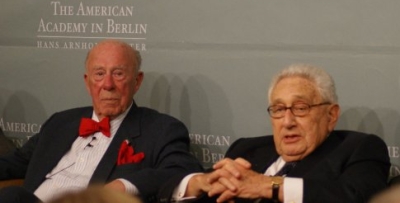
George Shultz and Henry Kissinger at the American Academy in Berlin
An article published on Znet by Darwin Bondgraham, Will Parrish and Nicholas Ian Robinson entitled “Full Court Press” prompted me to write this blog post. It appeared in the same week that I attended a “once-in-a-lifetime” meeting at the American Academy in Berlin between seven of the eight US and German “horsemen”, as we are wont to call them. That is, the elder statesmen Kissinger, Shultz, Perry and Nunn plus Schmidt, Genscher and Weizsäcker. Unfortunately the main thinker of the German group, Egon Bahr, was laid up in bed with fever and couldn’t attend.
In the Znet article, all those who have welcomed this mainstream vision of a nuclear weapon-free world are labelled “naiv” and as having committed “a major political and moral blunder” in believing that this was “a signal that the US national security state was poised to pursue an enlightened course of de-escalation toward eventual disarmament”. Now, I for one did not think that the Kissinger et al article in the Wall St. Journal, coming as it did more than two years before Obama won the US election, was an indication of US government policy to come. And I think that one might be forgiven for accusing many of us of believing too readily that Obama’s speech in Prague was just such an indication. But it seems that reform in the United States is as mammoth a task as it was for Michail Gorbachev to reform the Soviet Union, which – I remind you – collapsed in the process. And a jolly good thing it was too.
This very strong criticism on the part of Bondgraham and co. comes hot on the heels of the latest essay in the Wall St. Journal “How to Protect our Nuclear Deterrent”, which calls for the “maintenance of confidence in our nuclear arsenal” and argues for greater investment in the nuclear laboratories to do so. This article received a very bad response from the abolitionists around the world and quite rightly so, since it would appear on the surface that the US horsemen are contradicting their earlier vision. Indeed, it was unfortunate that they should – having spent so much effort on becoming anti-nuclear visionaries – resort to such pragmatic and tactical politicking. However, as I read the article, my first reaction was that it was not addressed to me, but to the 40 Republican and 1 independent Senators who were trying to hijack the not-yet-signed new START treaty by demanding a complete modernisation of the US nuclear arsenal be a condition of ratification. In stating their support of the findings of the JASON study, the Gang of Four were saying no to modernisation and yes to maintenance. As the Znet Gang of Three so aptly wrote: “The reality of nuclear weapons policy formation is much more complex and political” than it often appears.
Having said that, it is quite right not to herald the statements of the US elder statesmen as “anti-nuclear” or “abolitionist”. These are men who belong to the high church of nuclear deterrence and are true believers. The only reason that they can envision a world without nuclear weapons now is that they realise that nuclear deterrence will not work against the undeterrable. They are not prepared to concede for one moment that it was a mistake to rest our security for the last 65 years on such a dangerous policy that was repeatedly on the brink of collapsing into nuclear war. They do not agree that it is somehow immoral that their country should possess the means to destroy the planet many times over and other countries should not. They are deeply Conservative.
But on the other hand, in order to effect the major mindset change that is necessary to abolish nuclear weapons (and thereby open the way to common security), must we not effect this change across the board of political persuasion? Irregardless of whether these elder statesmen are willing to admit to mistakes made in the past, is it not better to nurture this first little sapling of change and help it to grow into something that advances our common goal – a nuclear weapon-free world? Look how far it has got us already: through their “vision”, the way was cleared for Obama to state that he also had this “vision” and then Medvedev agreed. Really good news is the new Russian military doctrine, just out, that states that “Russia reserves the right to use nuclear weapons in response to a use of nuclear or other weapons of mass destruction against her and (or) her allies, and in a case of an aggression against her with conventional weapons that would put in danger the very existence of the state.” No mention of “preventive” nuclear strikes after all. And now we are close to getting a new treaty for major nuclear arms reductions. This could easily be scuppered by the nuclear protagonists which is why the Gang of Four are lining up in front of it.
At the meeting in Berlin, the US horsemen explained – somewhat superficially – that they had a vision that they did not know how to achieve. So they are now in the process of working out what steps are needed. Here, the analogy of the mountain with its peak in the clouds was repeated, an analogy that has been very well countered by the description of the strategy used for conquering Everest of making a plan first and then executing the climb. But in both of these analogies the base camps are the nuclear disarmament and non-proliferation steps needed to go forward and upward. The questions that remain are these: which steps; can steps be taken in parallel; and how much of the full plan should be decided (and committed to) in advance?
We were reminded at the meeting in Berlin that Helmut Schmidt has often been quoted as saying that “people with visions should go and see their doctor”. Of course, he was being derogatory at the time, but we could turn this statement on its head by saying this: “They might have the vision, but we have the prescription”. And interestingly enough, it was General Klaus Naumann, one of the very High Priests of nuclear deterrence, who mentioned the prescription that evening in Berlin. Naumann is a member of the illustrious International Commission on Non-Proliferation and Nuclear Disarmament that produced its report “Eliminating Nuclear Threats” late in 2009 and presented it to the Conference on Disarmament recently. The report gives quite a lot of thought to the Nuclear Weapons Convention – our prescription for survival – while still not committing itself to being a proponent of it. Obviously Naumann thinks that the Convention is not a good idea and was looking for a condemnation of it from the Horsemen. He asked “does not the public desire for a Nuclear Weapons Convention pose a risk to a realistic approach to nuclear disarmament?” And Sam Nunn replied that we may well reach a point when a Convention would become plausible, but we are not there now. Nunn’s argument against the Convention is this: we shouldn’t focus on negotiating a new treaty right now but on getting the US and Russia to lead the way with disarmament.
This can be interpreted in two opposite ways and I’m sure it will be. Many abolitionists will say that Sam Nunn and the Nuclear Threat Initiative are blocking the way to a Convention. Or we could look at it differently and say that Sam Nunn and the ICNND are saying they think there needs to be more groundwork done before actual negotiation begins. But they are not saying there should not be a Convention at all, and that is a big difference from the past.
For those of us in Europe who are really interested in halting the modernisation of the US nuclear arsenal, the way forward lies in debunking the argument of the nuclear protagonists that the allies are the ones that want these weapons. That is why we have to take every available opportunity to get rid of the US bombs in Europe and close the nuclear umbrella worldwide. The proposed modernisation of the B61 bomb is still on the table and the money for the first study has been approved by Congress.
The really interesting thing about the US-German meeting of horsemen was not to be found at the event that I witnessed, but in private discussions to which I was not privy. But I am assured by those that are that the German four are pushing hard for movement on the US tactical nuclear weapons in Europe and on discussion of Medvedev’s proposal for a common security architecture. We have been here before, as I am reminded by reading Richard Rhodes’ excellent book “Arsenals of Folly”. Gorbachev picked up on the Bahr-Brandt idea of common security and made it a cornerstone of his international policy. It is often agreed that common security is needed in order to abolish nuclear weapons. But I would contend that it is the other way round: retaining nuclear deterrence as a basis for our security prevents us from achieving the common security that we desperately need in this world. And Gorbachev was also correct in perceiving that it was the military-industrial complex that is running that show. Just imagine what would happen to the arms industry if we were to go down the road of common security. Now that really would be an interesting vision. Perhaps we should go and see the doctor.
Indian Doctors for Peace and Development

The 8th National Conference of the Indian Doctors for Peace and Development (IDPD), the Indian affiliate of IPPNW, which began on 29 January 2010 with a peace rally outside Taj Mahal, called for the complete abolition of nuclear weapons, checks on the proliferation of small arms, resolution of issues through mutual dialogue, easing of travel to neighbouring countries by relaxation of VISA rules, and diversion of funds from arms race to health, education and development. The conference set an agenda for action in pursuit of the International Campaign to Abolish Nuclear Weapons (ICAN), effective steps to prevent climate change, and a people-oriented health policy.
The conference was inaugurated by Dr.Vappu Taipale, Co-President of International Physicians for the Prevention of Nuclear War (IPPNW) who lauded the efforts of the IDPD for sustainable peace in South Asia. Admiral Vishnu Bhagwat, former chief of Indian Navy in his address expressed skepticism that nuclear weapons will be abolished in near future as there is control of financial oligarchy on the institutions interested in the arms race. The struggle therefore has to be against them. Maj. Gen. (Retd.) Vinod Saighal said that the climate change is killing the world much faster than anything else. Therefore we must unite to combat this. Shri.Aziz Pasha-MP Rajya Sabha pointed out that India has a rich tradition of non violence and the great son of the soil Mahatma Gandhi whose martyrdom day falls on 30th January preached and practiced non violence which was a new concept of the contemporary world. Others who addressed the conference include Mrs.Amarjeet Kaur-National Secretary All India Trade Union Congress (AITUC) on ‘Women’s Initiatives for Peace’, Shri.Praful Bidwai – eminent journalist on ‘Climate Change Challenges Ahead’ and Shri Arjun Dev – a prominent historian on ‘Growing Intolerance an Impediment to Peace’.
The medical students who participated in large number from various parts of the country gave their presentations on several issues related to the theme of the conference ‘Building Future through Peace and Non Violence’. An ‘Ariel Conversations’ Video Conference was organized with Dr. Bernard Lown– Founding Co-President of IPPNW. Medical students put several queries to him, which Dr.Lown answered.
Dr.Tejbir Singh and Dr.Shakeel Ur Rehman gave presentations on National Health Policy and Health Right Bill 2009. The consensus of the conference was that there has to be increased public spending to ensure health care to each and every citizen. The conference also felt that whereas the health right bill is a step in the positive direction it requires amendments to ensure protection to the health providers. A committee will soon prepare a document which will be submitted to the health minister.
Dr Arun Mitra
Politics is the art of the possible.
According to a recent article in the Wall Street Journal (WSJ) by Vice President Joe Biden, President Obama intends to increase the funding for the Nuclear Weapons Laboratories by approximately 5 billion dollars over the next five years. The laboratories shall work on means to prolong the active life span of the nuclear charges.
This project is technically and militarily meaningless. In the article in WSJ there are quotes from the JASON report to the government, written by prominent physicists and weapon experts. The report confirms that nuclear weapons have shown no sign of deteriorating reliability. They will function as intended. And they are and remain secure: They will not explode unintentionally.
Of course, it is of little importance if the reliability decreases from 99% to 90% or less. That would not decrease their effects as deterrent. Do we know the reliability of the Russian strategic nuclear weapons? Certainly not, but that does not decrease their capacity to threaten. The reliability of the missiles and of the systems for intelligence, control and command is much more important.
William Perry who was Secretary for Defense to President Clinton took part in a commission which recently advocated a great increase in the support for the Nuclear Weapons Laboratories. The same opinion was expressed in a paper in WSJ by “The four apostles” Shultz, Kissinger, Nunn and Perry a couple of weeks ago. They argued that as long as the USA has nuclear weapons these must be reliable. It seems these four statesmen now place the vision for a world without weapons into a distant hazy future.
In an interview with Mr. Kissinger in the French newspaper Le Figaro last November he says that, of course, a nuclear weapons free world is generations away. Yes, it is, if we want it so. Then maybe the nukes will abolish us, while we discuss how fast we shall abolish them.
I do not know what means the supporters of the weapons laboratories have used to further their continued prosperity. One argument is recurring: The labs are needed to attract new researchers to their work, thus maintaining the competence. This is difficult nowadays when the lure of an atomic test explosion as the final examination test for the weapons designer has been denied. We do not know when we need to develop new nuclear weapons…
The President’s dedication to the work for a nuclear weapons free world seems to be waning. Politics is the art of the possible, say some, and he might have found it necessary to throw this piece of pork to the senators who love the bomb and the bomb makers. Obama wants to get the ratification of the Comprehensive Nuclear Test Ban Treaty, an important part of the work to prevent proliferation of nuclear weapons, through the Senate where it has been blocked since the time of Clinton. Obama knows too that there will be demands for new nuclear weapons, which he pledged during his election campaign not to accept. Mr. Gates, no one less, spoke for a new type of nuclear warheads recently, but was quickly censored. The President also wants the successor to the START agreement on a decrease of the strategic nuclear weapons to be agreed with Russia.
The resistance against President Obama is strong on all these three points. A few billion dollars to the weapons laboratories, out of the trillion used for the military, may help certain senators to look with less disfavor at the President’s proposals. He needs every vote.
Gunnar Westberg
Past Co-President of IPPNW




 IPPNW peace and health blog