Stop the killing in Libya
The following statement has been issued by the IPPNW Executive Committee on behalf of the 1985 Nobel Peace Laureate organization.
International Physicians for the Prevention of Nuclear War (IPPNW) calls on all parties for an immediate cease fire in Libya. Having established a no fly zone, we call on the governments responsible for the international forces for an immediate halt in all military actions, and on the Libyan government and the Libyan rebels to end the fighting and to seek a peaceful conflict solution, if necessary facilitated by UN negotiators.
With continued hostilities and foreign military intervention, a humanitarian crisis is emerging in Libya. IPPNW demands that health care and medical facilities at all times must be accessible for all parties and that health care workers must be allowed to perform their duties according to humanitarian and ethical principles.
IPPNW, the recipient of the 1985 Nobel Peace Prize, is a non-partisan federation of national medical organizations in 63 countries, representing tens of thousands of doctors, medical students, other health workers, and concerned citizens who share the common goal of creating a more peaceful and secure world freed from the threat of nuclear annihilation.
The Nuclear Chain – Splitting Atoms, Hairs and Personalities
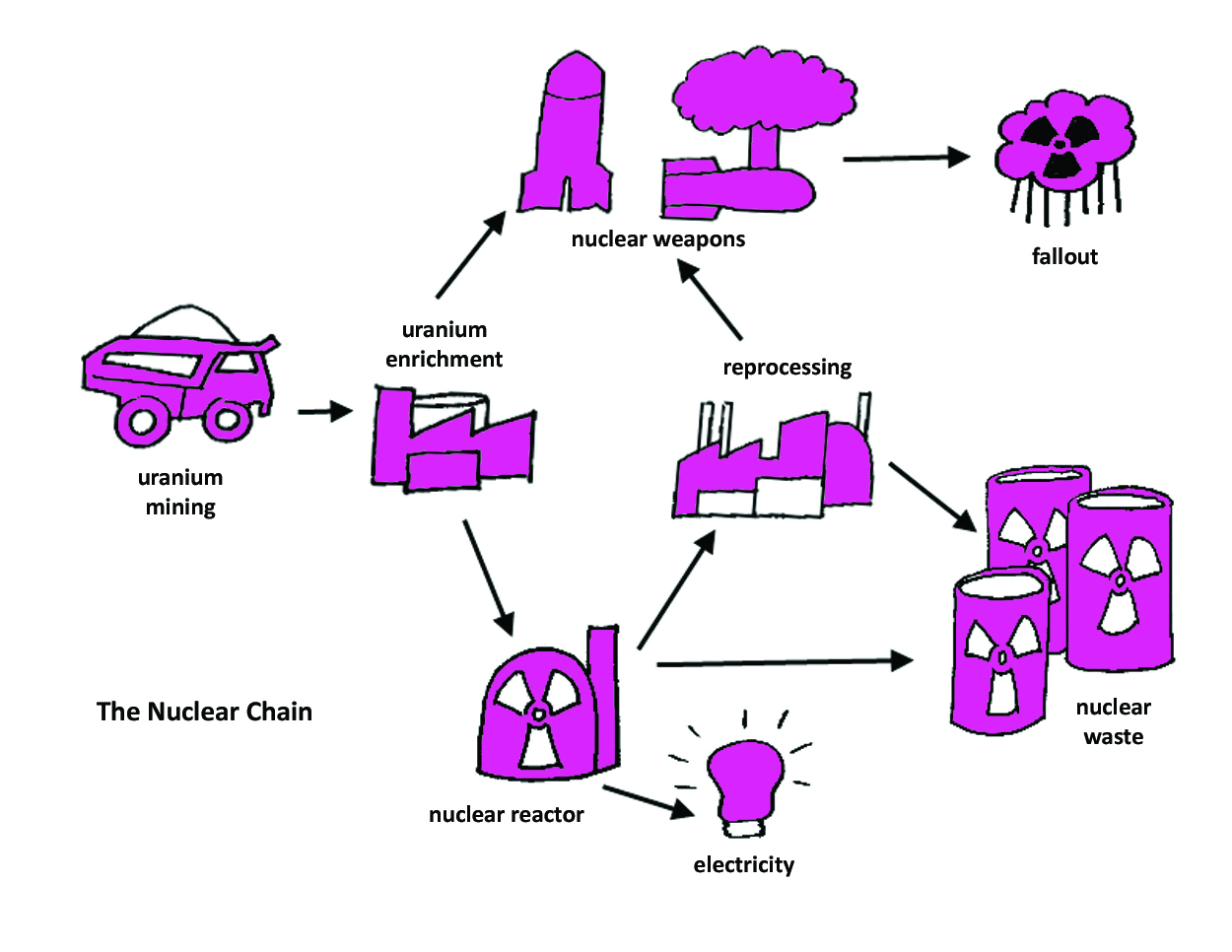 It is no coincidence that one speaks of the civilian and military use of nuclear energy. There is nuclear energy on the one hand and on the other there is the way it is used. It can create a nuclear explosion or it can be harnessed to make electricity, but intrinsically, it is the same thing.
After the earthquake and tsunami hit Fukushima, many people around the world asked the question: after what the Japanese had suffered from the military use of nuclear energy on Hiroshima and Nagasaki, why did they invest so greatly in the civilian use? Indeed, it is surprising that the original distaste for all things nuclear was lost in the sixties, when Japan began building nuclear power plants to beat the band. More than just about any other country, except perhaps France, the Japanese seemed to think nuclear energy was the best thing since sliced bread. And while just about everyone else (except the Russians) was shifting away from the plutonium economy, saying that it was too dangerous and too expensive, Japan began using MOX and expanding its reprocessing facilities. Read more…
Sent: Sat 3/19/2011 1:47 AM
[IPPNWFORUM] one week has passed…..still in a difficult situation
Dear all,
I am sorry but I do not have time to update the things now.
Many things are happening here. I myself have to deal with the things what I can do here, in addition to my own routine work and activities.
You may see some of the updates on the following site, at least the “official” information.
http://www.ustream.tv/channel/nhk-world-tv
We are still in a critical situation at the nuclear power plant site. Many people, many young skilled workers, fire fighters , engineers and SD staff, at the site have been making great effort to try to stop the situation getting worse. They themselves are already exposed to radiation……it is really sad, but we know that we cannot get rid of this crisis without their hard work…..
We, anti-nuclear-power-plants activists are starting to discuss concretely the evacuation of children and pregnant women, from the 20-30 km zone. We are afraid of the possibility of the worse situation. (We really hope [evacuation] would happen.) It might be too late if we decide after having such a situation. We never want to make people in panic. However, we have to prepare even for the worst scenario. We know that we should carry on such a measurement with an official initiative. The crisis situation makes the government too busy to work on this. They have to focus on the crisis of the plants to avoid the further disaster. It is reality.
Another important thing for us is to request government and companies to release real time and precise information and data of environmental radiation, including the data of isotopes, and the situation of the plants.
We heard that already some or many of them, who have a chance to do so, have already left the areas. However, it is not easy to do so without gas and before preparing proper place to accept them outside of the zone.
I also know that some people even in Tokyo has already left the city and been in a kind of “panic” situation. I really understand their feeling and we cannot blame none of them.
However, we have to focus on the people right now who have been facing to the most “possible” or “realistic” danger to radiation exposure and also the shortage of food, water, medicine, fuel and everything.
The local governments are already starting to accept more than a thousand people from a town which is within 2km, (they evacuated already from their hometown to 20-30 km zone some days ago). Many people, including local authorities, are now trying to do their best.
I am not sure whether or not you who are living away from Japan could understand my complex feeling, sadness and realistic thinking.
Another additional thing is that NHK in Japan has stopped the continuous live news on the affected areas and the nuclear plants today. They might decide to do so as a week has already passed since the earthquake. (Of course, we can get a live image at the site from time to time, when something new happens.) It makes me strange feeing watching sports game, cultural program and other things which do not have any relation to the present disaster. I myself may be in an “usual” mental a situation…..
I will stop now.
I wish you all have a nice week end. We have no idea about our weekend, though.
Please also continue to work hard to stop nuclear power plants in your own country…….
Peace,
Katsumi
P.S. I saw a video of WHO staff who is commenting on the evacuation. I personally thing it very sorry. They are not in a stance of “preventing” possible health impacts on the people who are staying within 20-30km or just out side of the 30km zone. We are not discussing the immediate danger of the people who are living in Tokyo! I hope he will come to Japan and stay with the people in the 20-30 km zone…….. I will not say anything further now. We may discuss after we finish this crisis. Sorry in a hurry…..
Fukushima updates from Dr. Furitsu (March 18)
Date: March 17, 2011 9:45:11 PM EDT
Subject: [IPPNWFORUM] 30 fire engine has joined the DF
#The 30 fire engine have just arrived at the place (probably 20km from the plant) and joined the DF.
The cars are:
– rudder truck with folding radder of 22m
– large special (chemical?) fire engine which can spray water 5 ton/ min, even while driving
– fire engine which can pump water from 2km distance water source
– fire engine for special disaster which have equipments to clean up radioactive contamination
I do not know what actually they are, though.
I would say that they are really to do their best to avoid the worst case.
Of course, they will be measuring the radiation dose rate at the site and within the “exposure limit”….
I only hope that they could work with minimum exposure, as smaller as possible….
Katsumi
_____
Date: March 17, 2011 8:09:35 PM EDT
[IPPNWFORUM] some information/ they are ready to go also today…..
# The defense force (DF) personnel who worked for injecting water into reactor No. 3 yesterday:
Dropping water from helicopters:
17 personel were involved in the operation worked around 90 m above the reactor
The exposure dose was officially reported: all of them are under 1mSv
They used a plate of tungsten (not lead, reporter revised the information) for shielding.
Injecting water from cars:
13 personel
The chief of the DF reported: exposure dose of personnel was up to 60 mSv (maximum)
[FOLLOWUP NOTE: I wrote the message above with my quick memo, though.
According to their report today, “all of the exposure dose of the DF personnel was several mSv.”
I am not sure whether or not my memo was only a mistake. I am sorry.]
#The company made comments on the effectiveness of the operation yesterday, on March 17:
There was not so much change of radiation dose rate by the operation of helicopters: changed from 3782 to 3752 micros Sv/h (somewhere inside the plant site).
However, they think a spout of steam from the building which can be seen just after dropping water might be an evidence that the operation could reduce the temperature at the fuel pond to some extent. (I also want to believe so……..)
As for the injection of water from cars on ground 50m from the reactor building:
The radiation level at the gate of the plant site:
3:30 pm (before the operation): 309 micro Sv/h
11:00 pm(after the operation): 289 micro Sv/h
#The data radiation level measured by the Ministry of Education, Culture, Sports, Science and Technology on March 17:
Max: 170 mico Sv/h (14:00, 30 km northwest from the plant)
They measured at 28 places in 20-60 km zone, 9:20-15:00 : 18.3-1.1 micro Sv/h
The data depends on the direction of the wind.
#Today (March 18), the DF is ready to work for the same operation both from sky and ground.
In addition to the DF, a fire brigade with special type of cars (usually used for a fire of airplane) from Tokyo has already headed to Fukushima at the midnight. They will also join the operation.
Four helicopter will work.
More cars of DF will work.
#More sad stories are reported:
More than 20 patients (old people) passed away who were left in a hospital in the 20 km zone or on the way of evacuation from the 20 zone.
I cannot write all of these stories now, but they must be recorded.
…………………………….
We should not / cannot estimate the number of people who might be exposed to more radiation in the case of larger amount of radioactive materials from the nuclear fuel, though. I would say, at least “hundreds of thousands” people…..
…….
We, who know the danger of radiation, are thinking about those personnel, fire fighter and workers of the company & associate companies and their families. I believe the government and the company also know that the task is really dangerous because of the high level of radiation. However, we also know: without their work, at least several hundreds of thousands people including children, pregnant women…… might be exposed to more radiation……
It is really sad and complicated situation………..
Katsumi
How Japan learned about “nuclear safety”
Although people can be educated in a variety of ways, experience is a particularly effective teacher. Consider the Japanese, who today are certainly learning how dangerous nuclear power can be.
Of course, the Japanese people also have had a disastrous experience with nuclear weapons—not only in 1945, when the U.S. government destroyed Hiroshima and Nagasaki with atomic bombs, but in 1954, when a U.S. government H-bomb test showered a Japanese fishing boat, the Lucky Dragon, with deadly radioactive fallout, and a vast nuclear disarmament movement began. Read more…
IPPNW has been a constant voice against nuclear energy
For the past six days, IPPNW doctors in a number of countries have been overwhelmed with requests from journalists hungry for information about the health effects of radiation and the potential health consequences of the crisis at Japan’s nuclear reactors.
The leaders of IPPNW-Germany, many of them experts on radiation and on Chernobyl-related illnesses, happened to be meeting in Frankfurt on the weekend the disaster unfolded, and have worked around the clock ever since analyzing what information is available and putting it into a medical and public health context (see Xanthe Hall’s excellent piece, “Nuclear power — basta!”). In the US, PSR has mobilized its own physician leadership to help reporters (who are openly frustrated with the quality of “official” briefings) understand what is going on. A PSR press briefing conducted by telephone from Washington, DC yesterday drew questions from the country’s leading newspapers not only about the basic science of radiation, but also about how to interpret and evaluate the information coming from official sources. Read more…
What could be worse?
Each day the news out of Japan is that much worse than the day before. Desperate attempts to scoop loads of water out of the ocean and dump them from helicopters onto overheating spent fuel pools at the Fukushima Nuclear Power Plant failed today. So did a plan to spray the reactor buildings with water cannons normally used for crowd control. Neither the helicopters nor the cannons could get close enough to their targets because radiation levels were too high. The secondary containment around one reactor is now reportedly destroyed.
Thousands of people have been evacuated from around the plant, adding to the hundreds of thousands already made homeless by the earthquake and tsunami — events that would be dominating the news under any other circumstances but now seem almost like afterthoughts (or pre-shocks?). We keep hearing that Tokyo is not in any danger from radiation right now, but our Japanese friends have told us that people in Tokyo are under enormous stress, unsure of how to balance individual and family anxiety with their deeply ingrained sense of collective responsibility. Read more…
30 tons of water was injected into the reactor No.3
Sent: Thu 3/17/2011 10:27 AM EDT
Subject: [IPPNWFORUM] 30 tons of water was injected into the reactor No.3
#In addition to dropping water from the helicopters this morning, the defense force has injected 30 tons of water in total to the No.3 reactor.
Five special cars were involved in the operation today. They spend around five min for each (7:35, 7:45, 7:53, 8:00, 8:07 p.m.). A pair of personnel worked staying in a car.
We hope the operation was successfully……we do not know whether or not radiation level has decreased after the operation.
#Prior to the operation by the defense force, the riot police tried to inject water into the No. 3 reactor, but they failed to reach the target.
#It was reported the radiation dose of personnel involved in the operation by helicopter this morning was within the emergency dose limit 100 mSv (max data was 60mSv).
— Katsumi Furitsu

 Bimal Khadka
 Bjorn Hilt
 Charles K. Johnson
 Dr. Ghassan Shahrour
 Gunnar Westberg
 IPPNW
IPPNW John Loretz
 Lawrence Wittner
 Maria Valenti
 mollymcgint
 Sue Wareham
 Tilman Ruff
 Tim Wright
 Xanthe Hall