European health groups launch Medical Peace Work courses
 European health groups have launched seven freely available, interactive online courses in violence prevention and peacebuilding. The aim of the courses is to educate health professionals about the impact of war and other forms of violence on the health of individuals and populations, and to show how they can make a positive and particular contribution to peace building, violence prevention and conflict transformation. The courses provide the participants with new insights about the special role and responsibility of healthcare professionals in peace work.
Bernard Lown, inventor of the defibrillator and founding Co-President of IPPNW said “The doctor cannot ignore the issues of peace and war. There is no greater pathogen than war. So why do you worry about tuberculosis, malaria, shistosomiasis, coronary artery disease, hypertension, diabetes, but when it comes to war you don’t want to talk about it.”
The courses, which will be promoted worldwide, were developed by 19 organizations from Denmark, Finland, Germany, the Netherlands, Norway, Slovenia, Turkey, and the UK. They are not only designed for health professionals and students who wish to do humanitarian or development work or who want to work with human rights or medical peace organizations; these courses are valuable for all health workers, no matter where they work and live. The course issues range from suicide and interpersonal violence prevention to the abolition of nuclear weapons.
According to Dr. Klaus Melf of the Health Department of the County Governor in Troms, Norway, “It is vital that doctors and other health professionals understand how people are affected – both physically and psychologically – by power abuse and war. Many health professionals want to do more than simply patch up the wounded. They want to get to grips with the underlying issues and do everything they can to prevent violence and achieve peace.”
To access the courses, which were developed with support from the European Commission, go to www.medicalpeacework.org.
IPPNW responds to ratification of New START
IPPNW’s co-presidents have sent the following letter to the presidents of the US and Russia, to mark the successful ratification of the New Strategic Arms Reduction Treaty (START), under which each country will limit the number of deployed strategic nuclear weapons to 1,550, with additional reductions in deployed and non-deployed launchers to 800 in each country. The treaty was ratified by the Russian State Duma on January 25, 2011 , by the Federation Council of Russia on January 26, and by the US Senate on December 22, 2010. The New START will enter into force in February, when Russian Foreign Minister Sergei Lavrov and US Secretary of State Hillary Clinton exchange ratification papers.
January 31, 2011
President Barack Obama
President Dmitri Medvedev
Dear Presidents Obama and Medvedev:
The ratification of the New START by the Russian Parliament this week and by the US Senate last month fulfills a pledge each of you made almost two years ago to lay the groundwork for a world without nuclear weapons. When you met in Moscow in March 2009, you spoke of this new round of US-Russia nuclear arms reductions as a “down payment” toward a nuclear-weapons-free world. While this down payment is modest in numerical terms, the New START, as its name suggests, is a promise of more to come. Read more…
It’s Still the Same Old Story—from Guns to Nukes
The discussion of the Tucson tragedy should be familiar, as we witness similar massacres in U.S. schools, shopping centers, and other public places played out periodically. Each time, the NRA and other gun apologists tell us that the easy accessibility of firearms, including assault weapons, had nothing to do with it. Indeed, they argue that the key to our safety is to obtain more guns.
But does the fact that nearly 100,000 Americans are shot with guns and nearly 10,000 Americans are killed with them each year really have no connection to the remarkable availability of guns in the United States? Read more…
On Worms and Firewalls
In a previous post, I made fun of the latest news about alleged alien intervention, cyberwar and men who stare at goats. But behind the mockery, there is an emerging problem that we need to address: The technological “fix”.
The tendency to search for technological solutions to what are often ethical or even moral questions seems to be inherent in today’s society. The popular answer to the loss of extended family and dwindling social community seems to be Facebook and Twitter. The nuclear industry’s solution to climate change is a nuclear “renaissance”. What do we do about nuclear weapons? Build a firewall. How do we defeat our maybe-about-to-go-nuclear enemies? Put a worm in their system.
If one was to make a medical analogy out of this, then mine would be “the sticking plaster”. It might stop the bleeding, but if the wound isn’t cleaned out or the cause of the damage not dealt with, then it is only superficial. None of these solutions are sustainable. And in all of these cases, the solution on offer is part of the problem itself.
Let’s take a look at the firewall. On face value, the idea of missile defence is attractive. Ronald Reagan was completely in love with it because its simplicity was so beguiling. If one could stop the missiles coming in, then neither side would need nuclear weapons anymore and we could go to zero. Even though successive US Presidents have whittled the missile defence programme down to a mere shadow of SDI, the problem essentially remains the same: it doesn’t work. We are not talking even about only 95% effectiveness, the success rates are way lower than that. And in order for the military to feel safe enough to give up weapons, the system would need to be near to foolproof. This is the point the French were making in the debate on NATO missile defence last October. You need the firewall AND the weapons behind it, in case the firewall doesn’t work. This might bring the numbers down, but you would never get to zero.
This is what the German government was betting on. They thought – along with parts of the US administration and some of the academic community – that missile defence would offer us an alternative to “deterrence by punishment” (nuclear weapons) and give us “deterrence by denial” (missile defence). In other words, Germany hoped that by agreeing to missile defence in Europe they could get rid of the remaining 180 US nuclear gravity bombs based here.
But would missile defence even bring the numbers down? The Russians say nyet. In fact, they are saying that missile defence, if expanded beyond a point that is yet to be defined, will endanger new START because they will need to rebuild nuclear weapons to overcome the firewall and maintain strategic stability and effective deterrence. Moreover, if their concerns about missile defence and the US conventional superiority are not addressed, then the Russian tactical nuclear arsenal cannot be considered for negotiation.
Which brings me to the next problem. What to do about Iran? After all, missile defence was supposed to be the answer to the threat of Iranian nuclear-tipped missiles targetted on Europe. Let us lay aside the question of the correctness of this threat perception for now (although I would fundamentally challenge Western perception of the threat by Iran and its key players, especially after the latest Wikileaks revelations). Given the fact that it is common knowledge that a European missile defence system would only, at best, stop some incoming missiles and not all of them, building it would simply encourage Iran to build more missiles. And it focusses solely on one type of delivery system – missiles – when Iran has purportedly many other avenues to deliver its weapons of choice.
This is where Stuxnet the worm raises its little, ugly head. According to latest reports, Israel tried and tested this new cyberweapon in Dimona on a dummy of the Natanz installation, specially constructed for the purpose. The departing head of Mossad claimed that the Iranian nuclear programme has now been set back years, implying that Stuxnet was the reason for this.
Again, like the firewall idea, cyberwar also has its attractions. Noone got killed, I hear people say. There were no bombs, no military strike. Well, the question remains: who killed the nuclear scientists? Iran says it was Mossad. And other questions arise, like: how will Iran retaliate? More repression of its people? It is even conceivable that Iran killed its own scientists because of Stuxnet, who knows? Perhaps people think that it is a small price to pay – a couple of lives – to stop a fledgling nuclear programme whose purpose we don’t trust.
But the point is that the Iranian nuclear programme will not be stopped by a worm. Such an attack will only add to the fierce determination to continue the programme at all costs. It bolsters up the government position that the world is against Iran and they must stand united against outside interference. It adds to the rationale behind repression and prevents reform. Worst of all, if the nuclear programme was in fact entirely for power production and not to feed an illicit nuclear weapons programme – as Iran has consistently contended – this may have changed as a result of being attacked. Back when Estonia was subject to a cyberattack by an unknown source inside Russia, their government responded by asking a nuclear alliance – NATO – for protection. Who can Iran turn to? If they want protection, they have to build it themselves.
It works both ways. If the West is looking to replace its weapons with virtual ones it will run up against the same problem as with the firewall. If the effectiveness is not 100%, then they will need to retain real weapons as well. At the end of the day, NATO will need a software arsenal of cyber weapons, a cyber firewall, missile defence as the hardware firewall, conventional weapons and as the final insurance: a nuclear deterrent in order to prevent war. And endless updates.
This will cost billions upon billions at a time when we really need the money to deal with other, more pressing, crises – climate change, energy security, economic instability – that are killing people or making them suffer every day. This is the real cost of the technological “fix”, and it is industry-driven. We have become addicted to technology in a way that is apparent to me every time I hear a bunch of schoolkids talking about gadgets. It is the new tobacco, purporting to be more “user-friendly” than the last global addiction we are still trying to eliminate. From Nintendo to Lockheed Martin, we want the latest in the technological arms race.
I am not against technology per se, but we need to differentiate between sustainable, useful technology and scams or sales gimmicks. I am all for pragmatism in politics, but there comes a time when we need a sea-change and this is that time. Instead of seeking “quick fix” solutions to these problems, we need to deepen our understanding of the interconnectedness of this world. Facebook cannot replace actual human contact. Wars cannot be fought virtually or using drones remotely-controlled from other parts of the planet, they will always turn into a battle with deaths on all sides – through insurgency, terrorism or cyberattack on the systems that are vital for our society. There was never before such need for sustainable solutions and common security built through trust, as there is now. And the funny thing is, we obviously have the intellectual capacity to achieve it. But are we evolved enough?
Peace and Health Blog welcomes Larry Wittner
Lawrence S. Wittner, Professor of History (emeritus) at the State University of New York in Albany, has joined IPPNW’s Peace and Health blog as a regular contributor. Prof. Wittner is the author of the definitive three-volume The Struggle Against the Bomb, and the recently published companion 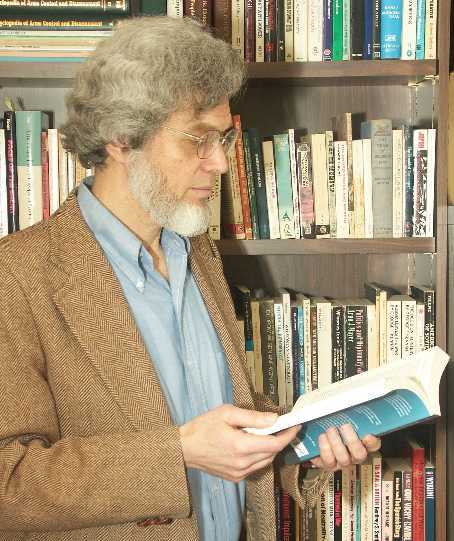 piece, Confronting the Bomb: A Short History of the World Nuclear Disarmament Movement.
A former president of the Council on Peace Research in History, Larry also chaired the Peace History Commission of the International Peace Research Association. He has spoken on peace and disarmament topics around the world, most recently at IPPNW’s World Congress in Basel in August 2010. In addition to lifelong involvement in the peace, civil rights, and labor movements, Larry is a musician, and I fully intend to track him down during one of my occasional visits to Albany for a jam on guitar and banjo.
For now, I recommend that you take a look at the articles already posted here, and watch for new pieces as they arrive. You might want to start with “The ‘Golden Rule’ Will Sail Again,” a really uplifting story about a small group of antinuclear protesters in the 1950s who drove the US government bonkers years before the Rainbow Warrior set sail.
After New START: Where Does Nuclear Disarmament Go From Here?
[Dr. Wittner, Professor of History at the State University of New York/Albany, spoke about the impact of civil society on nuclear policy at IPPNW’s World Congress in Basel this past August. His latest book is Confronting the Bomb: A Short History of the World Nuclear Disarmament Movement (Stanford University Press).]
With U.S. Senate ratification of the New START treaty on December 22, supporters of nuclear disarmament won an important victory. Signed by President Barack Obama and Russian President Dmitry Medvedev last April, the treaty commits the two nations to cut the number of their deployed strategic (i.e. long-range) nuclear warheads to 1,550 each—a reduction of 30 percent in the number of these weapons of mass destruction. By providing for both a cutback in nuclear weapons and an elaborate inspection system to enforce it, New START is the most important nuclear disarmament treaty for a generation.
Nevertheless, the difficult battle to secure Senate ratification indicates that making further progress on nuclear disarmament will not be easy. Treaty ratification requires a positive vote by two-thirds of the Senate and, to secure the necessary Republican support, Obama promised nearly $185 billion over the next decade for “modernizing” the U.S. nuclear weapons production complex and nuclear weapons delivery vehicles. Even with this enormous concession to nuclear enthusiasts—a hefty “bribe,” in the view of unhappy arms control and disarmament organizations—Senator Jon Kyl, the Republican point man on the issue, continued to oppose New START and ultimately voted against it. So did most other Republican senators, including Mitch McConnell (Senate Republican leader) and John McCain (the latest Republican presidential candidate). Leading candidates for the GOP presidential nomination in 2012, including Mitt Romney and Sarah Palin, also opposed the treaty. As a result, New START squeaked through the Senate by a narrow margin. With six additional Republicans entering the Senate in January, treaty ratification will become much harder. Read more…
US Senate does “right thing”; ratifies New START
[IPPNW has released the following statement, following the announcement that the US Senate, by a vote of 71-26, has ratified the New START agreement between the US and Russia.]
International Physicians for the Prevention of Nuclear War praised the US Senate for “doing the right thing” today in ratifying the New START agreement between the US and Russia, and called on the Russian Duma to quickly follow suit and bring the treaty into force.
IPPNW chair Bjorn Hilt of Norway said the treaty is a modest but welcome step toward a world without nuclear weapons, and urged the leaders of the two largest nuclear-weapon states to waste no time in negotiating much deeper cuts in their arsenals in the new year.
“Even with the New START,” Dr. Hilt said, “the US and Russia continue to deploy thousands of nuclear weapons that contribute nothing to the security of their people, endanger the rest of the world, and give other countries an excuse to retain or acquire nuclear weapons of their own.
“Presidents Obama and Medvedev deserve credit for pushing this treaty through to a successful conclusion. We hope they will now take bold new steps to make good on their promise that the small reductions guaranteed by this Senate vote are merely a ‘down payment’ on the nuclear-weapons-free world to which they have pledged their leadership. The sooner all the nuclear powers can get to work on a global nuclear disarmament agreement, the better.”
IPPNW warned that modernization of the large arsenals still possessed by the US and Russia would undermine the progress made by the New START, and criticized US plans to spend more than $85 billion over the next 10 years to rebuild its nuclear weapons research and production complex.
“The focus after today must be on ways to accelerate the liberation of the world from these weapons of mass annihilation,” said Dr. Hilt, “not on programs to ensure that they will continue to endanger us for decades to come.”
The “Golden Rule” Will Sail Again
[Dr. Wittner, Professor of History at the State University of New York/Albany, spoke about the impact of civil society on nuclear policy at IPPNW’s World Congress in Basel this past August. His latest book is Confronting the Bomb: A Short History of the World Nuclear Disarmament Movement (Stanford University Press).]
The “Golden Rule,” the legendary 30-foot ketch that once terrified U.S. government officials, will return to the seas again this coming summer.
The glory days of the “Golden Rule” occurred in 1958, when the atmospheric testing of nuclear weapons sent huge clouds of radioactive nuclear fallout aloft and, later, raining down on people around the world. As popular revolt grew against this toxic practice, as well as against the preparations of the Cold War antagonists for nuclear war, a small group of pacifists, led by Albert Bigelow, a retired U.S. Navy captain, decided that the time had come for action. In January of that year, they wrote to President Dwight Eisenhower, telling him that they intended to sail the “Golden Rule” into the U.S. government’s unilaterally-declared nuclear testing zone in the Pacific. Read more…
Nuclear weapons are so typically twentieth century
It is twenty-five years since IPPNW received the Nobel Peace Prize, and 30 years since the founding of our federation. We can certainly feel good about what we have accomplished in those three decades, while realizing that we have not yet eliminated nuclear weapons from the world. If we look back, it is only to link what we’ve done with what we still have to do.
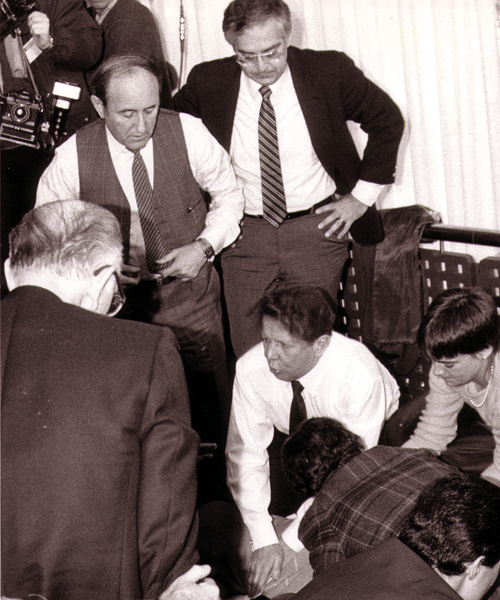
Dr. Chazov (kneeling) and others tend to a journalist who had a cardiac arrest during the press conference.
At the press conference after the Nobel award ceremony, a Soviet journalist lost consciousness and fell off his chair. “Damn malingerer,” hissed a Western journalist. Such was the atmosphere in those days, suspicion and hostility everywhere. The two cardiologists, Eugeny Chazov and Bernard Lown, who had received the Nobel Peace Prize on behalf of IPPNW, rushed to the unconscious man, found that he had had a cardiac arrest, and started resuscitation. After defibrillation the man was brought to an Oslo hospital, and survived.
Many years later, in his memoir Prescription for Survival, Dr. Lown recalled his words at the Oslo press conference immediately after this incident:
We have just witnessed what doctoring is about. When faced with a dire emergency of sudden cardiac arrest, doctors do not inquire whether the patient was a good person or a criminal. We do not delay treatment to learn the politics or character of the victim. We respond not as ideologues, nor as Russians nor Americans, but as doctors. The only thing that matters is saving a human life. We work with colleagues, whatever their political persuasion, whether capitalist or Communist. This very culture permeates IPPNW. The world is threatened with sudden nuclear death.
We work with doctors whatever their political convictions to save our
endangered home. You have just witnessed IPPNW in action.”
The important characteristic of the work of IPPNW, compared with that of other peace groups, is the medical approach. We thought, and still think, that a nuclear war is the greatest threat to the survival of our patients, and of humankind. Thus, prevention of nuclear war is a medical duty. We also believe that if humans can take to their heart—can really understand—the consequences of a nuclear war, they will demand that all nuclear weapons are abolished.
We have been true to our obligation of medical neutrality when we demand protection from nuclear war for every human being, regardless of nationality. Today the threat comes not just from the nuclear weapons of the US and Russia—though it still does—but from nine countries that possess the means to inflict “sudden nuclear death,” and from others who may acquire those means in the coming years. A changing threat means that IPPNW has had to change as well. Russian doctors still engage with American doctors, but nowadays Swedish doctors talk with Iranian doctors, Finns talk with North Koreans, Indians talk with Pakistanis. This is our own version of track two diplomacy—from physician to physician, from medical student to medical student—and we know that it makes a difference.
We have often ventured rather far into the political field. We have prescribed a Nuclear Test Ban Treaty and a Nuclear Weapons Convention, and we have proposed many steps on the way that we think will lead to a world free from the risk of nuclear genocide. Have we been able to stay within our medical competence when we propose how nuclear abolition can be achieved—when we offer a “prescription for survival?” This is a difficult question.
 We do not merely say to a patient who has a respiratory illness “just stop smoking.” We also try to suggest practical and effective ways for her to combat the tobacco addiction. We have a similar responsibility to propose means by which a nuclear-weapons-free world can be achieved. We must show the roadmap and the tools. When we are told that nuclear abolition is wishful thinking, we should say that the idea that we can maintain nuclear weapons for generations without them being used is the real delusion, defying credibility.
What we must not do is get caught up in the technicalities and jargon of nuclear doctrines and arms control—the language diplomats use to explain how this approach and that approach have been tried and found not acceptable by one country or the other. We need to avoid this trap and have confidence in our medical message: Nuclear weapons are the greatest threat to the survival of mankind and thus must be abolished.
IPPNW has broadened its agenda since 1985, but our mission has never changed. We are working against all wars, and we are waging a very important campaign against armed violence—especially the small arms and light weapons that are killing millions every year. Here we have no problem staying within our medical domain, since the medical arguments and human stories make the most compelling case against the tragedy of war.
In our campaign against the nuclear holocaust, we shall continue to use every available tool—ethical, humanistic, and medical— to bring about a change in the policies that place us in such peril. I can here, as so often, not do better than to quote Arundhati Roy:
The nuclear bomb is the most anti-democratic, anti-national, anti-human, outright evil thing that man has ever made.
“ If you are religious, then remember that this bomb is Man’s challenge to God. It’s worded quite simply: We have the power to destroy everything that You have created.
“If you’re not religious, then look at it this way. This world of ours is four thousand, six hundred million years old. It could end in an afternoon.”
Wars are becoming outdated. Twenty-five years ago there were more than twenty interstate wars raging. In the ten years just past, there have been only three, according to the peace research institute SIPRI. Unfortunately, civil wars are not decreasing, but wars between nations are becoming unfashionable. Is this because so many countries have become democratic? If this is the reason, nuclear weapons should also become unfashionable. A majority of people in most countries demand that all nuclear weapons should be abolished.
It is twenty-five years since we received the Nobel Peace Prize. Let us hope that it will not take another twenty-five years until the Nobel Prize is awarded for the final abolition of this threat to our existence.
Or, maybe, that step will be barely noticeable. Nuclear weapons will just disappear, as the worst nightmare wanes from our mind when morning breaks.
Nuclear weapons were so typically twentieth century…

IPPNW Germany joins the protest at one of several demonstrations throughout Berlin, and activists symbolically sweep nuclear weapons into the trash.
The continuing Korean war and IPPNW
To understand what is going on in Korea it is helpful to try to see the conflict from the other side, from that of North Korea.
There is no peace agreement after the Korean War, which ended in 1953 with an armistice agreement. There is still a state of war between the Democratic Peoples Republic of Korea, DPRK, and the USA. The Armistice Demarcation Line is the 38th parallel. However, no agreement has been reached regarding where that line continues in the sea. The sovereignty of the waters where the recent shelling occurred is disputed.
As I write this article, on Nov. 30, 2010, marine forces from South Korea together with US units are running a military maneuver in these disputed waters. Such operations have in the past often been opposed by the North. When shots were fired from the South as a part of that exercise, the North demanded that the fire should stop and when the shooting continued the North started to shell the South Korean island of Yeonpyeong.
A reaction from DPRK was to be expected but it was not expected that North Korea should shell an island with civilian inhabitants. It is entirely possible that internal rivalry in DPRK played a role. The newly designated heir to the dictator may have wanted to show that he is now in command. Speculations by Pyongyangologists abound.
The question which is not asked from our side is: What was the purpose to hold a provocative military exercise in this disputed area? No explanation has been offered from ROK, (Republic of Korea, South Korea) or the USA.
We understand little of the political situation in DPRK. Our ignorance should increase our caution. It should be kept in mind that military leaders in that country are even more ignorant of the world around them. Diplomats from DPRK are worried that the generals believe that they can win a war with the South and even successfully attack US bases in Japan.
A war with the South or a civil war inside DPRK would be a disaster for both North Korea and its neighbors. A rebellion by the starving and oppressed population would result in millions of refugees and serious problems for ROK and China
The recent report from Amnesty International tells a story of rapidly deteriorating health in DPRK. Food supply is irregular. Corruption is increasing. The health care is deteriorating, medicines are not available. Apartments and houses are cold in wintertime, because of the lack of oil and coal. The old and the children in the many institutions for child care are in danger of succumbing from deprivation and cold.
We in IPPNW should in the present situation demand from DPRK that the policy of “Military first” is changed to “Human security first”. From ROK and USA we ask:
Provocations against the DPRK should be avoided;
Humanitarian and especially medical help and food should be offered, disregarding the actions of the DPRK leadership;
Peace negotiations should begin, now almost sixty years after the war.
Regarding this last point I would like to quote from the article in the Washington Post published on Nov. 23rd by the former president Jimmy Carter, who has made several visits to DPRK:
Pyongyang has sent a consistent message that during direct talks with the United States, it is ready to conclude an agreement to end its nuclear programs, put them all under IAEA inspection and conclude a permanent peace treaty to replace the “temporary” cease-fire of 1953. We should consider responding to this offer. The unfortunate alternative is for North Koreans to take whatever actions they consider necessary to defend themselves from what they claim to fear most: a military attack supported by the United States, along with efforts to change the political regime.”
Should not peace talks between the USA and DPRK be tried, instead of provocative military maneuvers?
P.S. The day after I wrote this I learnt that South Korea had intended to refrain from military activities in the disputed waters for the time being. We should be grateful.

 Bimal Khadka
 Bjorn Hilt
 Charles K. Johnson
 Gunnar Westberg
 IPPNW
IPPNW John Loretz
 Lawrence Wittner
 Maria Valenti
 mollymcgint
 Sue Wareham
 Tilman Ruff
 Tim Wright
 Xanthe Hall


 IPPNW peace and health blog