Jadugoda Black Magic on YouTube
Three years ago, Indian Doctors for Peace and Development conducted a series of community health surveys among workers and their families at the Jadugoda uranium mines in northeast India. They presented their findings — evidence of increased rates of leukemias, miscarriages, birth defects, and other illnesses — at an IPPNW conference in London in October 2007.
Since then, IDPD, the Indian affiliate of IPPNW, has continued to work with the communities affected by the mining and milling operations of UCIL — the Uranium Corporation of India Limited — and has lobbied the government on their behalf, demanding better health monitoring, health care, and protections for mine workers and their families.
The story of Jadugoda and the terrible legacy of uranium mining in India was told by film maker Sri Prakash in an award-winning full-length documentary, Buddha Weeps in Jadugoda (1999). IDPD has now updated the story of the Indian miners with a 10-minute YouTube video, chronicling the health concerns that emerged during the surveys.
The IDPD report, written by project leaders Shakeel ur Rahman and Satayajit Kumar Singh, is available here.
Will Senate Republicans produce another international disaster?
[Dr. Wittner is Professor of History emeritus at the State University of New York in Albany. His latest book is Confronting the Bomb: A Short History of the World Nuclear Disarmament Movement (Stanford University Press). He spoke at IPPNW’s World Congress in Basel in August.]
As the U.S. Senate prepares to vote this December on ratification of the New START Treaty, Republican legislators appear on the verge of producing an international disaster.
From the standpoint of logic, there are excellent reasons to ratify the treaty. This agreement between the U.S. and Russian governments provides that each of the two nations would reduce the number of its deployed strategic nuclear warheads from 2,200 to 1,550. This reduction—although a modest one, given their current nuclear arsenals totaling over 20,000 nuclear weapons—would honor the commitment of the two governments, under the nuclear Nonproliferation Treaty of 1968, to nuclear disarmament. At least as important, it would resume the nuclear arms control and disarmament process, which has been stalled for years. At a time when Washington is pressing the North Korean government to dismantle its nuclear arsenal and to convince the Iranian government not to develop one, New START also would lend moral authority to such non-proliferation efforts. Read more…
Australia makes a killing with weapons exports
Things have been a bit dodgy in my neighbourhood lately. Some strange characters are hanging around, and more than the usual smattering of domestic arguments are disturbing the peace. Were it not for our gun ownership laws, it would be a golden opportunity. Set up a local arms and graft fair, similar to those wonderful weekend art and craft fairs, make a neat profit and help the nation’s economy, all at once.
The international scene is not constrained by such laws however, and there’s a killing to be made in, well, killing, aka “defence and security”. Ask Austrade. The government organisation that promotes Australian exports is conducting a seminar today [19 November] in Canberra to tell people how to sell their weapons and related wares to our neighbours. “Defence and Security Opportunities in India and South East Asia” it’s called, with the sub-heading “Trade. Invest. Prosper”. Austrade entices participants to “tap into two of the world’s fastest growing defence and security markets”. Read more…
“Until we get to zero we cannot rest”
By Vappu Taipale
[An address by IPPNW’s Co-President to the 11th World Summit of Nobel Peace Laureates, in Hiroshima, Japan.]
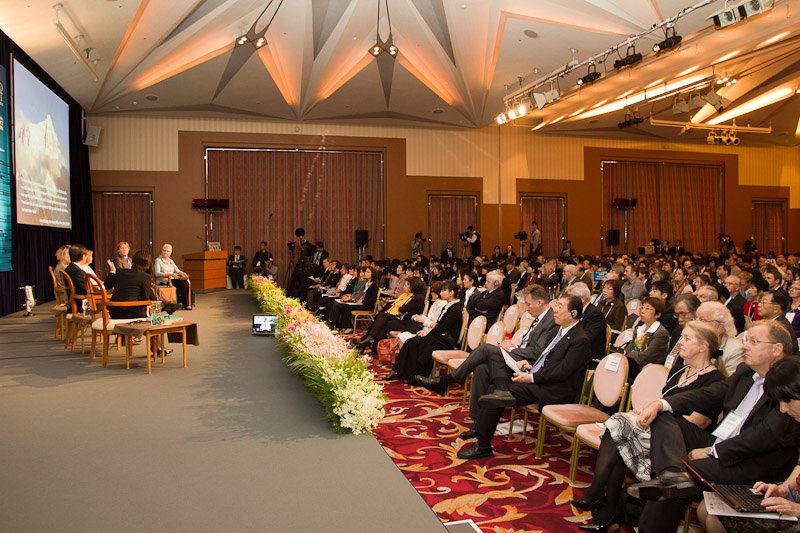
Photo:World Summit of Nobel Peace Laureates
I speak to you today not only as a representative of a Nobel Peace Laureate organisation, IPPNW, and not only as a former Minister of Health from Finland, but I am addressing you as a doctor. We physicians understand the full extent of the costs of relying on nuclear weapons for our security. We know that after the possible use of nuclear weapons there will be no cure and no care.
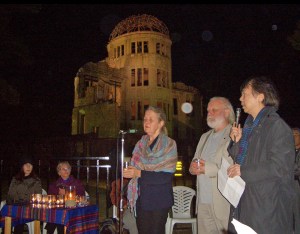
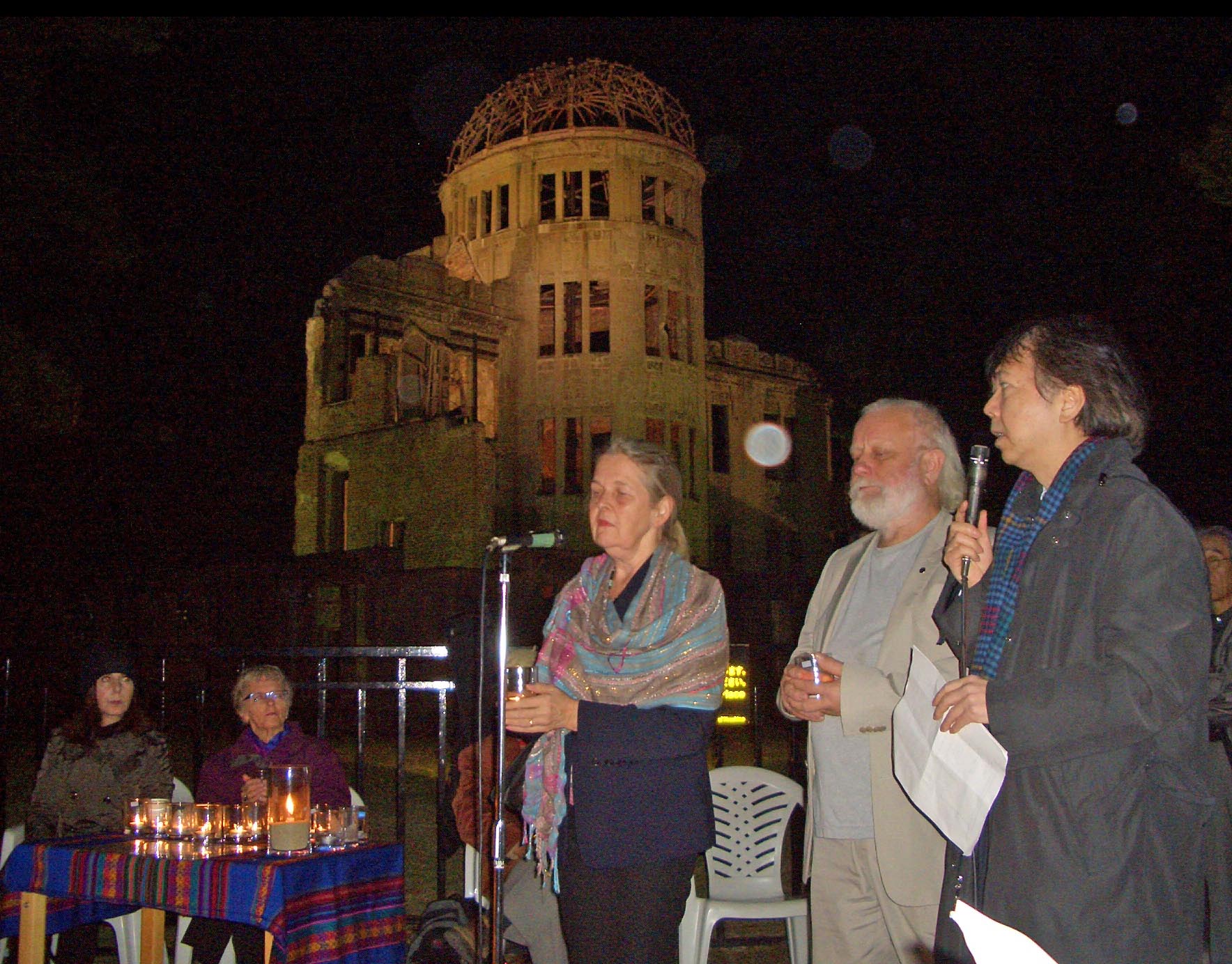
- Drs. Vappu and Ilkka Taipale of Finland during a moment of reflection at a candlelight memorial ceremony in Hiroshima. Photo: Katsuko Kataoka / IPPNW
There will not only be unimaginably great human, economic and ecological direct costs but also long lasting indirect costs to our whole globe. Our message is that our only opportunity as physicians and as human beings is the total prevention of nuclear war or even a regional conflict.
Our knowledge about these consequences starts with the tragedies of Hiroshima and Nagasaki. Since we are gathered in the first city ever destroyed by an atomic bomb, let me take a moment to remind us what happened here more than 50 years ago. Read more…
Nobel Peace Laureates Summit: Final Declaration
[IPPNW was among the signatories to the Final Declarati0n of the 11th World Summit of Nobel Peace Laureates, reprinted below.]
The undersigned Nobel Peace Laureates and representatives of Nobel Peace Prize organisations, gathered in Hiroshima on November 12-14, 2010, after listening to the testimonies of the Hibakusha, have no doubt that the use of nuclear weapons against any people must be regarded as a crime against humanity and should henceforth be prohibited.
We pay tribute to the courage and suffering of the Hibakusha who survived the atomic bombings of Hiroshima and Nagasaki in August 1945 and honour those that have dedicated their lives to teaching the rest of the world about the horrors of nuclear war. Like them, we pledge ourselves to work for a future committed to peace, justice and security without nuclear weapons and war. Read more…
A safer and healthier world without nuclear weapons
By Bjorn Hilt
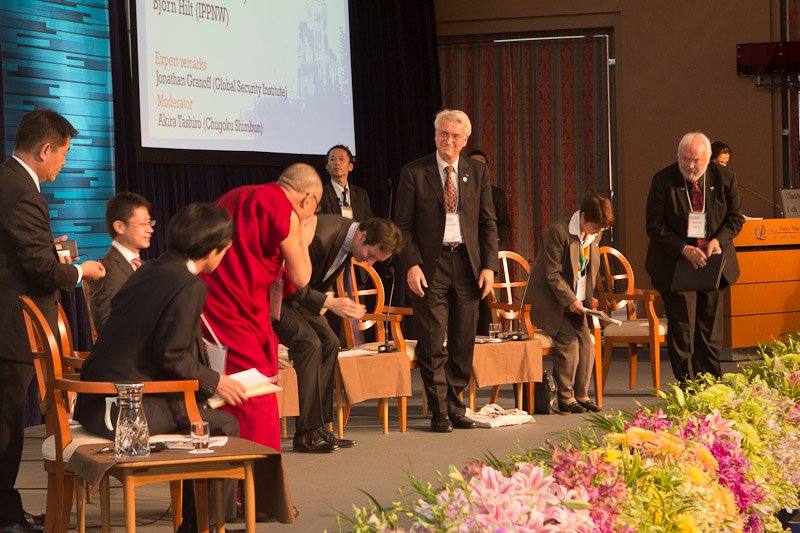
Dr. Bjorn Hilt (center standing) greeting panelists. Six Nobel Peace laureates, including the 14th Dalai Lama, the supreme leader of Tibetan Buddhism, and F.W. de Klerk, the former president of South Africa who dismantled the country's notorious apartheid, attended the meeting. Representatives of 13 institutional winners, including the International Atomic Energy Agency and the International Physicians for the Prevention of Nuclear War, also attended. Photo: Nobel Peace Laureates' Summit
[An address by the Chair of IPPNW’s Board to the 2010 Nobel Laureates Summit in Hiroshima, Japan.]
Dear Nobel peace price laureates, representatives of organizations that have been awarded the Nobel Peace Price and distinguished friends. Thank you for letting me use a few moments of your time this morning to tell you why we medical doctors feel so helpless and are so scared when we are facing the horrible effects of nuclear weapons and the threat that they pose. We have been afraid ever since doctor Sasaki of Hiroshima and doctor Junod from the Red Cross were among the first doctors to witness and describe the horrible scenes right after a nuclear attack and also were the first doctors who felt the professional impotence when they faced the overwhelming human suffering of the victims without being able to help. Medical doctors from more than sixty countries have later joined together in International Physicians for the Prevention of Nuclear War in order to contribute to the prevention of such a disaster ever again.

- Finnish, Japanese and Norwegian affiliate members representing IPPNW at the Nobel Peace Laureate Summit in Hiroshima, Japan. Photo: Katsuko Kataoka / IPPNW

But first let me also devote attention to the fact that we are now gathered here in the city of Hiroshima where humankind for ever will be reminded of the disaster that happened here and in Nagasaki sixty-five years ago. Sincere thanks and deep respect go to the Hibakusha, who will never let us forget, to the children of Hiroshima with their suffering and drawings of the disaster that make such impression when shown all over the world, and to Mayor Akiba and all the other mayors who have joined him in Mayors for Peace in the call for nuclear abolition before 2020. Read more…
Valduc “nuclear simulation” complex undermines efforts for a nuclear-weapons-free world
[IPPNW’s British and French affiliates, Medact and AMFPGN, have released the following statement condemning the establishment of a joint UK-France facility to engage in computer-based simulated testing of nuclear weapons components to ensure their safety and long term reliability. The statement represents IPPNW policy on this issue.]
On 2nd November 2010, France and Britain signed a Treaty that will see the two countries test the safety of their nuclear arsenals in a joint facility in France.
A nuclear simulation centre will be built at Valduc in eastern France, about 45 kilometres northwest of the city of Dijon, and start operating from 2014. The Valduc laboratory will work with a French-British research centre based in Aldermaston in southern England, and will enable French and British scientists to model the performances of nuclear materials to ensure the “viability, safety and security in the long term of our nuclear arsenals.” The data so obtained could be used to design new warhead types.
Article I of the Non-Proliferation Treaty (NPT) forbids the transfer of nuclear explosive devices to any recipient. The new Anglo-French Treaty is largely driven by the current economic downturn and adds to similar agreements already negotiated between the USA and France and the USA and the UK. It allows an indirect transfer of nuclear weapon knowledge between France and the UK and indicates very clearly that neither Government recognises the legitimate objections of the Non-Nuclear Weapons States which have signed the NPT to the maintenance by the British and the French of weapons which can be deployed without notice; and also why the Non-Nuclear Weapons States view with great scepticism the “good faith” of the Western Nuclear Powers to reduce substantially their nuclear arsenals and their readiness to use them, to which they are committed by the NPT. Furthermore, as the new Anglo-French facilities allow research into the development of nuclear weapons – even though not needing an actual nuclear explosion – they also breach the principles behind the Comprehensive Test Ban Treaty.
The global dangers to the health, welfare and very survival of societies and peoples otherwise not involved which are posed by nuclear arsenals deployed intentionally or by accident or false alarms, continue to be ignored by the Powers in possession of these arsenals. Not only do the chances of a nuclear exchange remain unacceptably high, the NPT itself is undermined and made increasingly vulnerable to the withdrawal from it of Non-Nuclear Weapons States who feel the need to develop and possess nuclear weapons for their own security, thus encouraging nuclear weapons proliferation.
Medact and AMFPGN, the British and the French affiliates of International Physicians for the Prevention of Nuclear War (IPPNW), therefore oppose this new Anglo-French contribution to nuclear proliferation and urge that all Powers work for the rapid implementation of a Nuclear Weapons Convention to abolish all nuclear weapons throughout the world.
Note from the Laureates Summit

By Bjorn Hilt
Today I visited the ruins of the Hiroshima dome, the Hypocenter of the A-bomb detonation, the Children’s peace monument, and the Hiroshima Peace Memorial Museum. Truly an educational journey even for someone who thought himself educated about nuclear weapons. Testimonies, photos, and drawings are so strong that it is hard to digest. Go and see for yourself. Together with IPPNW co-president Vappu Taipale, I am here in Hiroshima to attend the yearly summit of the Nobel Peace Laureates who, together with Mayor Akiba of Hiroshima and many others, this time will discuss how we can proceed to finally free the world from nuclear weapons, in our lifetime. There will be presentations by many of the laureates and also by both Vappu and me. A Peace Summit Award will be given to somebody who is really worth it, and there will be a strong final declaration for everyone to read. Vappu and I will keep you updated.
The Haas peace award: IPPNW’s humanitarian message continues to resonate
I had the privilege of accepting the 2010 John and Chara Haas International Peace and Justice Award, which was given to IPPNW, the International Association of Lawyers Against Nuclear Arms, and the International Peace Bureau on November 8 in Philadelphia. The award, given by the Project for Nuclear Awareness, recognized the joint effort of our organizations to obtain an advisory opinion on the illegality of nuclear weapons from the International Court of Justice. The World Court Project, as it was known, not only succeeded in persuading the ICJ to generally condemn the use of nuclear weapons as a violation of International Humanitarian Law, but also laid the groundwork for the Nuclear Weapons Convention.
Cora Weiss of IPB and Peter Weiss of IALANA spoke eloquently about the grassroots organizing and legal analysis that were key to the Project’s success. If I can track down their talks, I’ll link to them here later. I had a chance to talk about IPPNW’s contribution to the World Court Project and its relevance to our work today, particularly ICAN.
____
I’d like to thank the Project for Nuclear Awareness for honoring IPPNW, IALANA, and IPB with this award, which is graced by the names of two people — John and Chara Haas — who have been major lifelong supporters of the civil society movement for a peaceful, nuclear-weapons-free world. IPPNW’s gratitude to the Haas’s for their support of our work, in particular, is enormous and heartfelt.
I also want to acknowledge the IPPNW doctors who led a truly global effort to persuade the World Health Organization to petition the International Court of Justice. The late Erich Geiringer of New Zealand was the chief strategist, who helped guide our affiliates through the often challenging process of lobbying their health and foreign ministries. Anne Marie Janson of Sweden and George Salmond of New Zealand understood the workings of the World Health Assembly as well as anyone, and lobbied successfully for the adoption of WHA resolution 46.40 in 1993. Many IPPNW activists invested a great of their time and energy in the project — no one more so than our executive director Michael Christ, who spent just about every waking hour (and, knowing Michael, probably a few that he should have been sleeping) on the project.
But Michael told me last week about Manasseh Phiri of IPPNW-Zambia, who unquestionably paid the highest price. As an official government advisor to the WHA, Dr. Phirie convinced the Zambian delegation to become the first resolution co-sponsor, gathered support from other delegates, agreed to formally introduce the resolution, and personally hand-delivered the draft to secretariat. When he returned home, Dr. Phiri was fired from his medical position after the US government sent a “demarche” to Lusaka and lodged a formal protest about the Zambian WHA delegation. Read more…
Attainment of health for all requires promotion of peace
[Dr. Wareham, the Immediate Past President of Medical Association for Prevention of War, IPPNW’s Australian affiliate, addressed the 63th annual UN Department of Public Information NGO Conference in Melbourne on August 30, 2010. The theme of this year’s conference was achieving the Millennium Development Goals in our changing world.]
I would like to pay my respects to the original inhabitants of this land.
I’ll start with a reflection from my work as a general practitioner, family physician, in Canberra. When I speak with my patients at work about what they want out of life, basically most people want peace. They want to live at peace in their relationships with those around them. They also want access to good health care. They want access to adequate food and clean water, which, fortunately, most people – but not all – in this country have. And they want some access to leisure time also, so that they can enjoy life. And if you ask Australians what gives them most security in life, often the answer will be their Medicare Card. The Medicare Card here gives us access to moderately equitable care – not totally equitable but moderately so – and that is very important to Australians.
I am going to remind us of a resolution from the World Health Organisation from 1981, which talks about the role of health workers and the promotion of peace, and I think this resolution is still as important today as it was nearly 30 years ago. The resolution stated that the role of health workers in the preservation and promotion of peace is the most significant factor in the attainment of health for all. We need to remind ourselves of that frequently. Read more…

 Bimal Khadka
 Bjorn Hilt
 Charles K. Johnson
 Gunnar Westberg
 IPPNW
IPPNW John Loretz
 Lawrence Wittner
 Maria Valenti
 mollymcgint
 Sue Wareham
 Tilman Ruff
 Tim Wright
 Xanthe Hall


 IPPNW peace and health blog