[Ilkka and Vappu Taipale visited Lambaréné Hospital in Gabon in July 2013, by invitation of the chair of the Lambaréné Hospital Executive Board, Lachlan Forrow. Dr. Forrow, a former executive director of IPPNW, is now Associate Professor of Medicine at Harvard Medical School. The Taipales were deeply moved to see the museum hospital once run by one of the medical heroes of their youth, Albert Schweitzer, and refreshed their knowledge of Schweitzer’s relationship to the nuclear issue.]
By Vappu Taipale and Ilkka Taipale
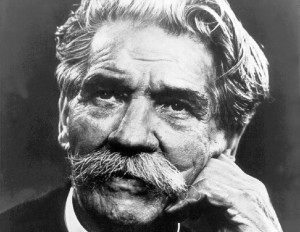 Do young people know Albert Schweitzer?
He was the hero of the youth in the 50´s and 60´s, one of the great humanists of the world, a Nobel Peace Prize laureate, an opponent of nuclear bombs. His hospital, Lambaréné, celebrated its centennial July 6-7, 2013 with a high-level applied research symposium on the triple epidemic HIV, tuberculosis, and malaria. Read more…
Nearly a quarter century after the disappearance of the Soviet Union and the end of the Cold War, the US government is still getting ready for nuclear war.
This fact was underscored on June 19, 2013, when the Pentagon, on behalf of President Barack Obama, released a report to Congress outlining what it called the US government’s “Nuclear Employment Strategy.” Although the report indicated some minor alterations in US policy, it exhibited far more continuity than change. Read more…
[On June 18, 2013, IPPNW Co-President Ira Helfand participated in an unprecedented debate about nuclear weapons in Israel’s parliament, the Knesset. At an event organized by ICAN-Israel and the Israeli Disarmament Movement, Dr. Helfand presented the scientific findings about the global climate effects of a limited nuclear war, and made a compelling case for the abolition of nuclear weapons. The next day, he traveled to Ankara, where he gave a similar talk about nuclear famine and the medical consequences of nuclear war to the Turkish parliament. The following is Dr. Helfand’s report.]
by Ira Helfand

Must-see video!: Dr. Ira Helfand debates nuclear abolition with a member of Israel’s Likud Party in the Knesset.
Sharon Dolev, the ICAN campaigner in Israel, and the Director of the Israeli Disarmament Movement (RPM), ICAN’s partner organization in Israel, organized an enormously successful series of events to publicbize the nuclear famine report, build support for the upcoming Mexico conference on the humanitarian impact of nuclear weapons, and promote a WMD-Free Zone in the Middle East.
The centerpiece of the event was a discussion of these issues, including open discussion of Israel’s nuclear arsenal, in the Israeli Parliament, the Knesset. Read more…
What matters are the consequences
 “Ich bin ein abolitionist.”
That’s what President Barack Obama could have said in Berlin, were he not still looking over his shoulder at an obstructionist Congress, rather than ahead to a not-too-distant future when a world that had banned and eliminated nuclear weapons would credit him with having led the way. Read more…
ICAN on Obama Berlin speech: nuclear weapon reductions will reduce risks, but prohibition treaty urgent
[ICAN has released the following statement in response to US President Barack Obama’s speech today in Berlin, calling for new reductions in nuclear arsenals, including a new round of negotiated cuts between the US and Russia.]
 The International Campaign to Abolish Nuclear Weapons (ICAN) welcomes President Obama’s announcement in Berlin today calling for a world without nuclear weapons and the readiness to pursue further reductions in the US and Russian nuclear arsenals. However, the humanitarian consequences of any nuclear weapon use, increasingly the focus of global engagement on these weapons, demands their prohibition and elimination. Read more…
History made in the Knesset
By Ra’anan Friedmann, IPPNW Israel
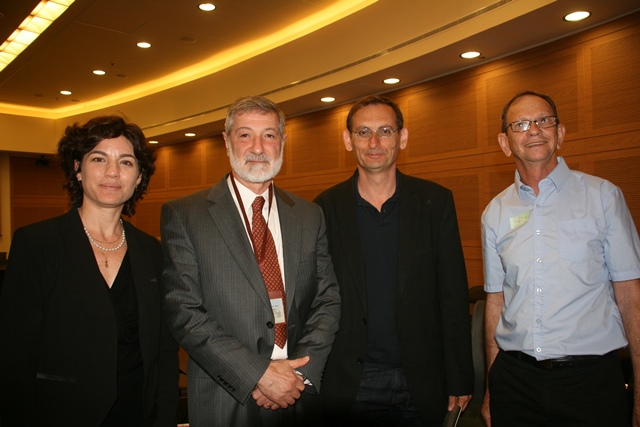
IPPNW co-president Ira Helfand described the humanitarian consequences of nuclear weapons to members of the Israeli parliament in Jerusalem. (L-R: MP Tamar Zandberg, Dr. Helfand, MP Dov Hanin, Ra’anan Friedmann of IPPNW-Israel
A historical event took place today in Jerusalem—an official meeting of IPPNW and ICAN members with Israeli members of the Knesset (the Israeli parliament) at the Knesset in Jerusalem. The unprecedented meeting was organized by Sharon Dolev, ICAN’s campaigner in Israel and director of the Israeli Disarmament Movement.
Dr. Ira Helfand gave a thorough presentation on the effects and outcome of a limited nuclear war on the world climate and human population, followed by a discussion of the nuclear situation in Israel with the parliamentarians.
This is a breakthrough. For more than 50 years the subject of nuclear weapons and nuclear activity in Israel was a non-discursive issue, forbidden to talk about but in secret chambers. For the first time, this important subject was raised from the shadows and discussed openly in the Israeli parliament.
We are looking forward to more and larger open discussions that might eventually change the nuclear situation in the Middle East.
B61 – a pork barrel* bomb
[Ed. note: Dr. Westberg of SLMK, IPPNW’s Swedish affiliate, joined a delegation that met with NATO officials in Brussels on June 3.]
 There are at present about 180 B-61 nuclear bombs in Europe, in Germany, Italy, Turkey, the Netherlands, and Belgium. There used to be about three times as many but under pressure from both governments and peace movement most have been returned to the owner, the USA.
We have always been told that these “NATO-bombs” were of no military value. This has been the message at our meetings with NATO officials as well as during meetings preparing for the Chicago NATO Summit in 2012. As “gravity bombs,” they could not be well targeted. They stayed in Europe as pawns, indicating that the USA was willing to defend Europe, with nukes if need be. This was of course quite irrational, but nuclear weapons are irrational. France seems to have resisted the removal of the bombs with great passion, although France is not a member of the strategic council of NATO. France is very special…
Now the B-61 role is being changed. Read more…
Fukushima nuclear disaster is far from over
[The IPPNW Board of Directors has issued the following statement about the ongoing public health crisis resulting from the March 2011 nuclear reactor disaster in Fukushima. The statement makes reference to a report from Anand Grover, UN Special Rapporteur on the right to health, an advance, unedited copy of which has been made available by the Office of the High Commissioner for Human Rights.]
Statement by IPPNW Board of Directors on the ongoing nuclear disaster in Japan and the report of the UN Special Rapporteur on the right to health to the UN Human Rights Council
30 May 2013, Villingen-Schwenningen, Germany
We warmly welcome Mr. Anand Grover’s report, which provides important recommendations on the continuing and long-term health implications of the Fukushima nuclear disaster. If implemented by the Japanese government, the measures recommended would significantly reduce the adverse impacts of the disaster now and for future generations, and improve the lives and health of the many affected people.
We are deeply disturbed by the clear evidence that the government of Japan has not made public health and safety its top priority in its response to the disaster. It has failed in the paramount duty of governments to protect their citizens. There is an urgent need to redress this failure. Read more…
Historic Day at UN as Arms Trade Treaty Signed

Members of Control Arms coalition join ATT Chairman Amb. Peter Woolcott and others to celebrate as Australia signs the ATT
Cathey Falvo
3 June, 2013 United Nations Headquarters, New York
Historic Day!
67 countries sign the Arms Trade Treaty (ATT) at the United Nations! Many more say they will sign soon.
Several countries made comments praising the process and results as showing that the UN can work, and complimenting the NGOs (non-governmental organizations) on our crucial role in achieving the treaty.
Team IPPNW present at the signing ceremony consisted of Drs. Shannon Gearhart, Donald Mellman, Robert Mtonga and Cathey Falvo and Kay Tyler-all veterans of this multiyear process.
Now a new set of work starts. Tomorrow the Control Arms coalition is having a next steps meeting and then we all have to start the process of getting remaining governments to sign the treaty then ratify/accept.
We will continue.
Wir stellen ein
We’re hiring!
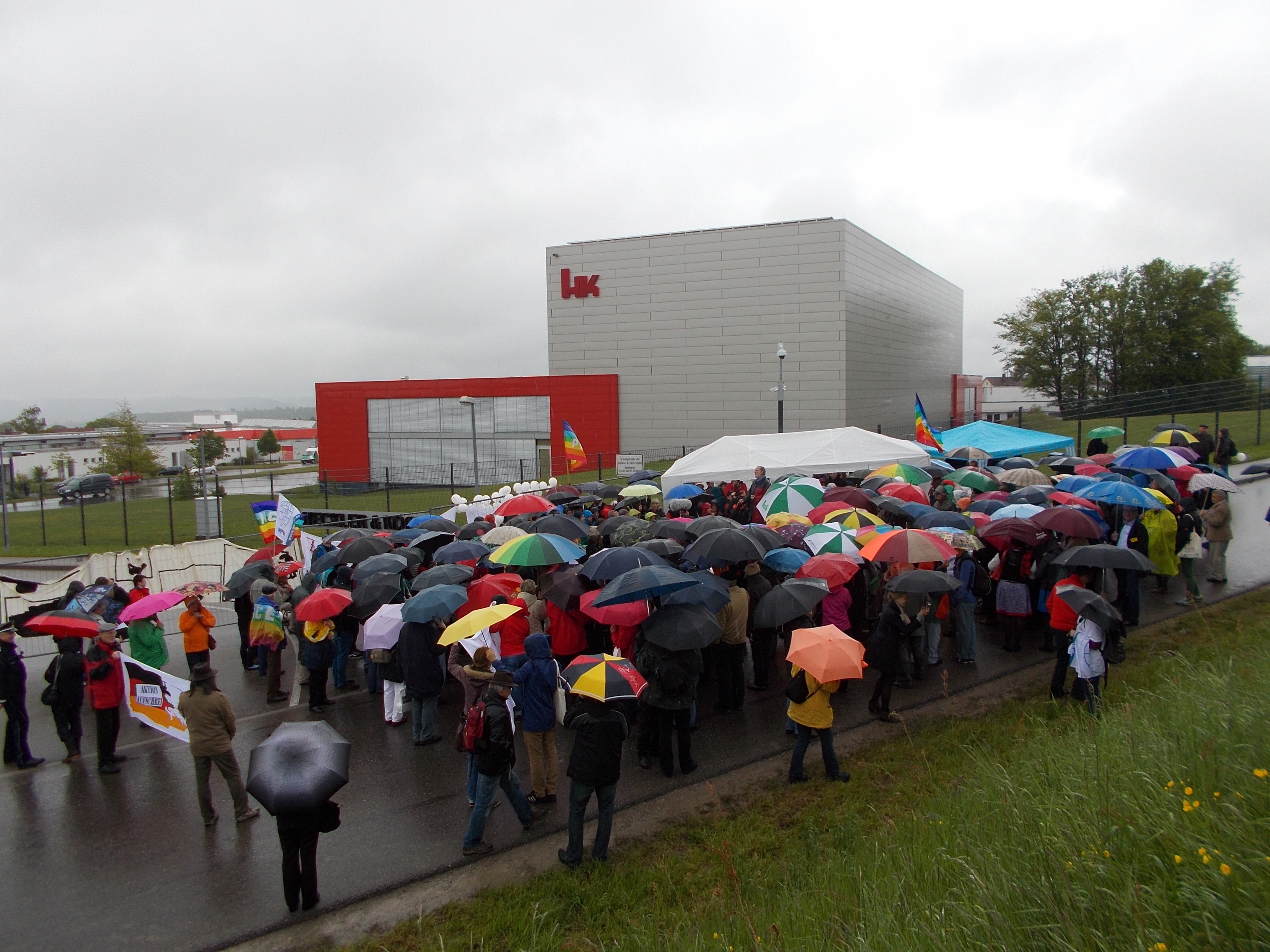
IPPNW demonstrates in the rain. H&K promotes weapons that produce “steel rain.”
That sign greeted a couple of hundred participants in IPPNW’s “Human Target” congress as our buses approached the Heckler & Koch headquarters in Oberndorf this morning in a steady rain.
H&K, the largest manufacturer of rifles and handguns in Europe, is increasing its workforce in order to keep up with the demand for weapons that have killed two million people since its foundation in 1949, according to Jürgen Grässlin, the foremost expert on German weapon exports. That’s 114 people killed every day, on average, by a firearm made either here, in Oberndorf, or in one of the H&K facilities with a “legal” export license outside of Germany. Read more…

 Bimal Khadka
 Bjorn Hilt
 Charles K. Johnson
 Dr. Ghassan Shahrour
 Gunnar Westberg
 IPPNW
IPPNW John Loretz
 Lawrence Wittner
 Maria Valenti
 mollymcgint
 Sue Wareham
 Tilman Ruff
 Tim Wright
 Xanthe Hall