Syria today. What to do?
by Ernesto Kahan
Catherine Thomasson, MD, the Executive Director of Physicians for Social Responsibility (PSR) of the USA, in a letter dated September 5, 2013 wrote “The use of chemical weapons, like any weapon of mass destruction, needs a strong response. However, the use of military force in Syria is not the answer” and added that “International action against a war criminal should be united and targeted; and justice for President Assad and his military should be delivered in the International Criminal Court.” This policy was based on the paper OP-ED: Defining Appropriate Action in Syria.
The Syrian present civil war is terrible, producing until now at least more than 110,000 killed, two million refugees, and seven millions of people in need of urgent humanitarian help. Read more…
The Syrian problem — and an international solution
Let us consider the worst: that, in violation of the 1925 Geneva Protocol and the subsequent Chemical Weapons Convention, the Syrian government has used chemical weapons to massacre large numbers of people. If true, that is a real problem, for it is not only a dastardly act, but a clear violation of international law that, if left unopposed, will encourage further use of these abhorrent weapons.
But will the US government’s lobbing cruise missiles into Syria provide a solution to the problem? Read more…
Volcanoes and nuclear war

Rutgers climate scientist Alan Robock at the ICAN Civil Society Forum in Oslo.
Alan Robock, Distinguished Professor of Climatology at Rutgers University and a consultant with IPPNW on the climate effects of nuclear weapons, has posted an informative blog for the American Geophysical Union on the lessons of volcanoes for both global warming and the catastrophic global cooling that would result from nuclear war.
“While the world has banned cluster munitions, land mines, biological weapons, and chemical weapons,” Prof. Robock concludes, “the worst weapons of mass destruction, nuclear weapons, are still not banned. They cannot be used, they do not serve as a deterrent, and their use would be suicide. We can rid the world of nuclear weapons so we have the luxury of working to address global warming without the fear of global catastrophe. For more information, please visit my website and join the International Campaign to Abolish Nuclear Weapons.”
[The IPPNW Board has issued the following statement on the tragic conflict in Syria.]
IPPNW firmly believes that chemical weapons, and any weapon of mass destruction, should never be used, and existing stockpiles should be eliminated in line with the Chemical Weapons Convention.
Chemical weapons are banned because of their capacity to cause indiscriminate deaths in large numbers, extreme suffering and long-term disability. It is essential that whatever stockpiles of chemical weapons exist in Syria are maintained in a safe condition prior to their final elimination, which should be achieved as rapidly as possible. A cessation of hostilities would provide a much more favourable context for this to happen.
We call on all parties involved in the present conflict in Syria to ensure that any existing stockpiles of chemical weapons are placed under safeguards and that there is no intentional use, or threat of use, whatever the circumstances. UN weapons inspectors must be allowed full, safe and timely access to investigate suspected chemical weapons use. If the facts determine that chemical weapons have been used, then those who used them should be brought before the International Criminal Court and held accountable for crimes against humanity.
We call on all sides to cooperate with the UN and Arab League Special Envoy to Syria in his quest to resolve the present conflict through dialogue. The present suffering of civilians in areas controlled by the government and by the opposition forces is unacceptable and a ceasefire needs to be negotiated as soon as possible.
IPPNW demands free and safe access of the population to medical care. To make medical facilities and personnel a target of violence is unacceptable and a gross violation of international humanitarian law.
We urge all parties to the civil war in Syria to engage in negotiations to resolve the conflict. We demand from all countries and parties outside Syria that they stop delivering weapons into Syria.
Clinging to mass violence
Is the human race determined to snuff itself out through mass violence? There are many signs that it is.
The most glaring indication lies in the continued popularity of war. Despite well over a hundred million deaths in World Wars I and II, plus the brutal military conflicts in Korea, Indochina, Hungary, Algeria, Lebanon, Angola, Mozambique, the Philippines, the Congo, Afghanistan, Iraq, and elsewhere, wars continue to rage across the globe, consuming vast numbers of lives and resources. In 2012, worldwide military spending reached $1.75 trillion. Moreover, the most lavish spenders for weaponry, war, and destruction were the supposedly “civilized” nations of NATO, with $1 trillion in military expenditures. By far the biggest military spender in 2012 was the United States, which accounted for 39 percent of the world total. Read more…

Dr. Omolade Oladejo, IPPNW Nigeria, addresses delegates to the UN ATT 4th Prepcom, while Chairman Moritan (L) looks on.
Yesterday, on August 12th, Nigeria became the 82nd UN Member State to sign the Arms Trade Treaty, and the 3rd to ratify the landmark agreement. Foreign Minister Dr. Olugbenga Ashiru signed and deposited Nigeria’s instrument of ratification at the UN in New York. Read more…
“100 nuclear blasts = worldwide starvation”
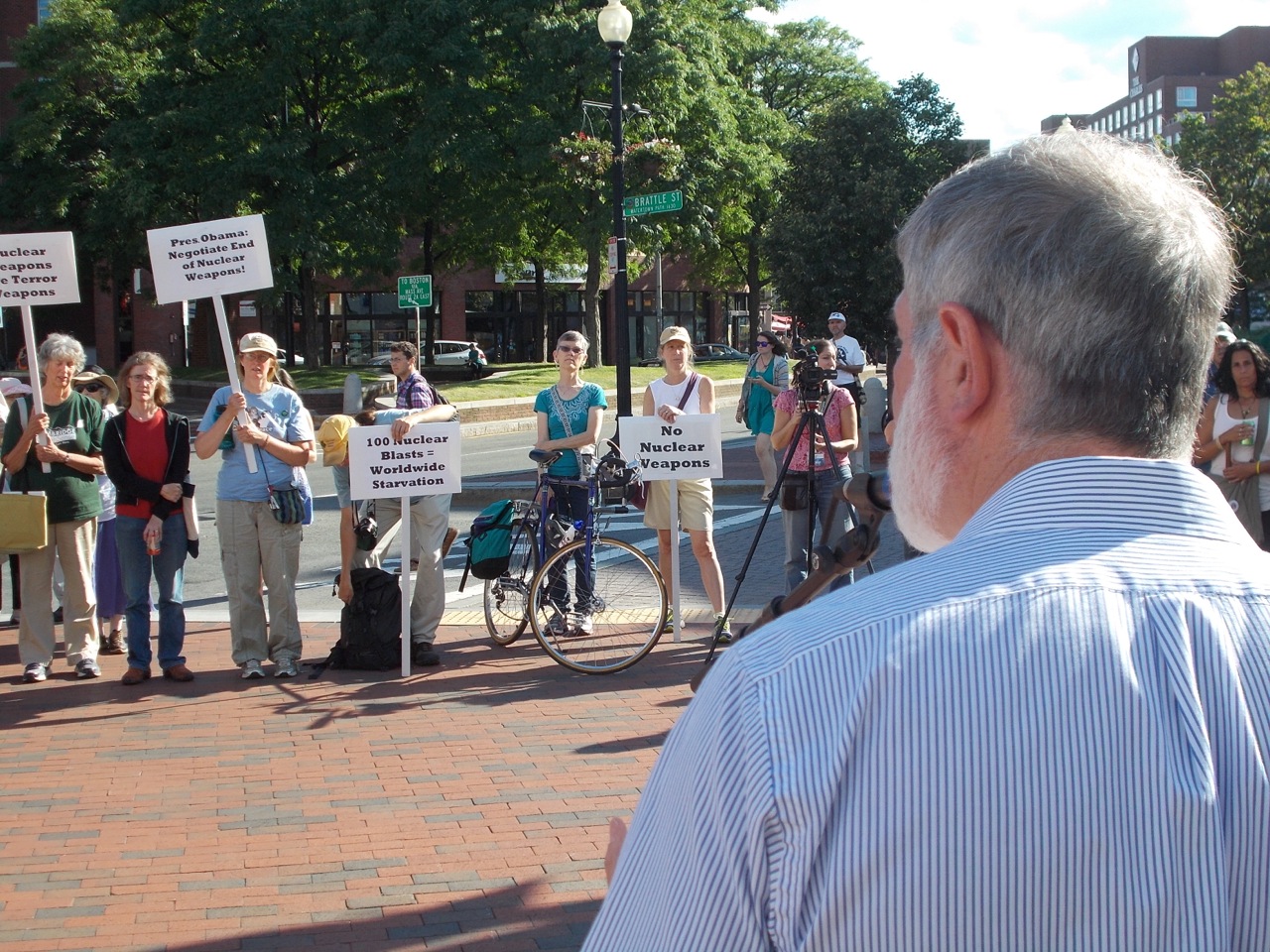
IPPNW’s nuclear famine message was carried on signs during a march from Cambridge City Hall to Harvard Square, where they provided a backdrop to Ira Helfand’s impassioned plea for the abolition of nuclear weapons. Photo: John Loretz
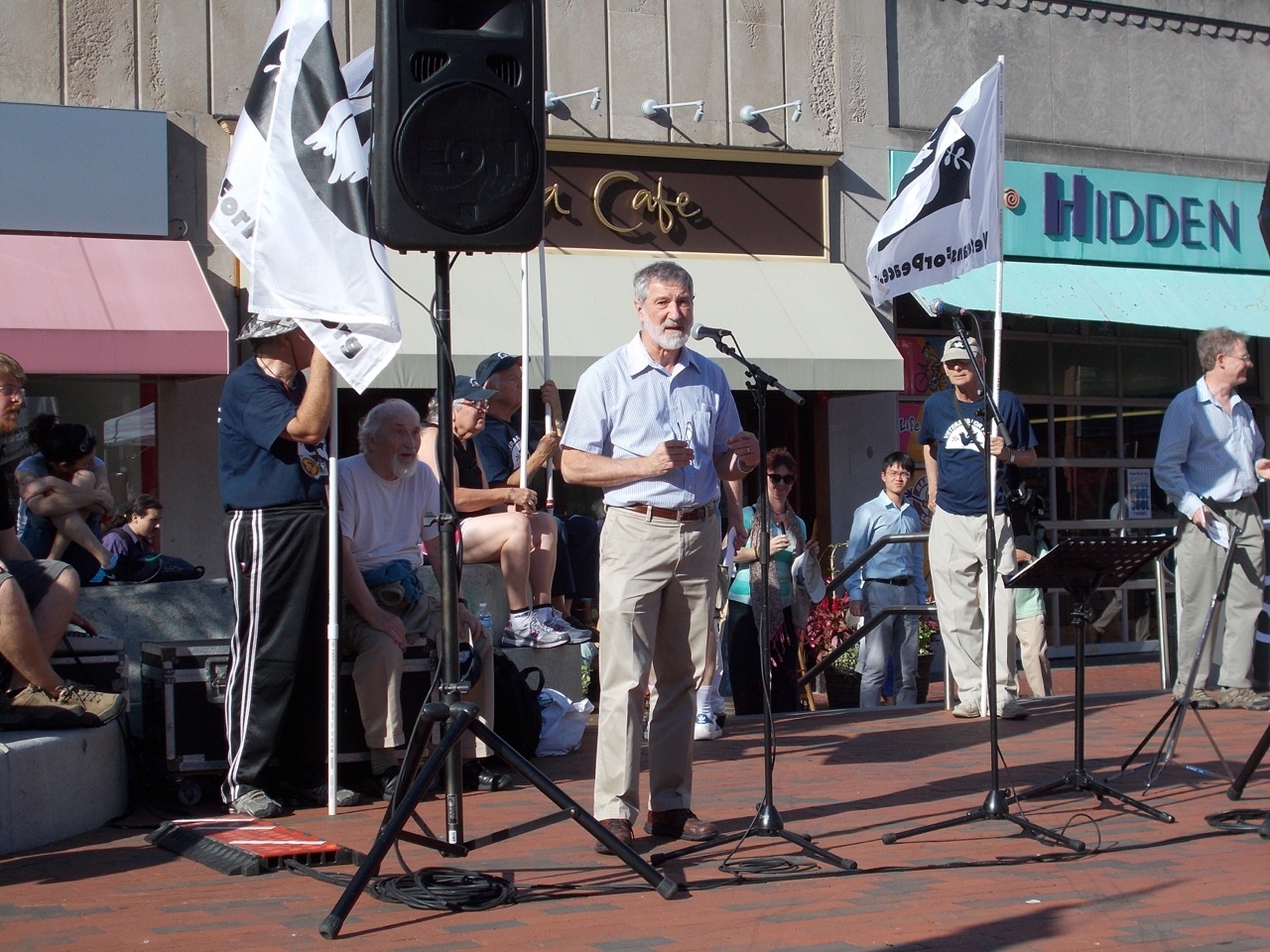
IPPNW Co-president Ira Helfand explains the medical and humanitarian consequences of nuclear weapons at a Hiroshima Day memorial gathering in Cambridge, Massachusetts on August 6. Dr. Helfand asked the participants to sign a petition urging President Obama to make good on his pledge to pursue a world without nuclear weapons. Photo: John Loretz
Hiroshima Peace Declaration
[The Mayor of Hiroshima, Kazumi Matsui, issued the following declaration today, August 6, 2013, the 68th anniversary of the US atomic bombing of Hiroshima.]
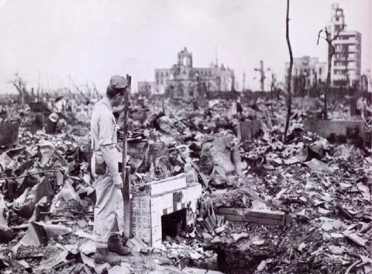
The city of Hiroshima lay in ruins after the US atomic bombing on August 6, 1945—68 years ago today.
We greet the morning of the 68th return of “that day.” At 8:15 a.m., August 6, 1945, a single atomic bomb erased an entire family. “The baby boy was safely born. Just as the family was celebrating, the atomic bomb exploded. Showing no mercy, it took all that joy and hope along with the new life.”
A little boy managed somehow to survive but the atomic bomb took his entire family. This A-bomb orphan lived through hardship, isolation, and illness, but was never able to have a family of his own. Today, he is a lonely old hibakusha. “I have never once been glad I survived,” he says, looking back. After all these years of terrible suffering, the deep hurt remains. Read more…
IDPD assists flood victims
by Arun Mitra, IDPD General Secretary

Sending medical supplies by ropeway over the flooded Ganges
The Uttrakhand state in the Himalayas, in North India, had flash floods in June. The disaster was so high that the government estimates deaths of about 4,000 people, while unofficial figures claim more than 25,000 people have died.
IPPNW’s Indian affiliate—Indian Doctors for Peace and Development (IDPD)—took a medical relief team to the disaster-affected area on 7 July and stayed there for a week. The situation was so bad that we had to climb up the hills 7-8 kilometers or cross the Ganges river on ropeways carrying medicines with us to reach the affected people. There were constant landslides and at one place we were stranded for nine hours. Somehow we were successful and have returned safe.
In context of this experience, our commitment for a nuclear-weapon-free world is further strengthened, as we will not be able to provide any relief should nuclear weapons ever be used.

Arun Mitra (right) led an IDPD team to flood-ravaged Uttrakhand

Assisting flood victims in Uttrakhand was challenging; medical and humanitarian relief for the victims of nuclear war would be impossible.
Stumbling in the dark, reaching for the light
 IPPNW Co-President Tilman Ruff has written an important, very thoughtful essay on the links between nuclear weapons abolition and human rights for Right Now, an Australian not-for-profit media outlet.
Referring to the three existential threats to life on Earth—collision with another celestial body; environmental degradation, particularly global warming; and the use of nuclear weapons—Dr. Ruff writes that two of the three have human origins and require human solutions:
In addressing such momentous challenges, we need wisdom from all cultures, faiths and ethical traditions; lessons, insights, tools and perspectives from every field of human endeavor; and the recognition that whatever our core business, eradicating nuclear weapons is part of everyone’s business. Like respect for universal human rights, like addressing global warming on the scale and urgency demanded. Nuclear weapons are a critical human rights issue; the most urgent development issue; the paramount sustainability issue; potentially the most egregious violation of international humanitarian law; the most urgent environmental issue; the most profound ethical issue; the greatest blasphemy.”
“Were the Universal Declaration of Human Rights being drafted today,” he concludes,
one would hope that additional rights would be front and centre: the right to live free from the threat of indiscriminate, inhumane weapons, most of all nuclear weapons; the rights of future generations; the rights of people everywhere to access benign, renewable energy sources; and to be protected from preventable, indiscriminate, transgenerational radioactive contamination. These human rights urgently need to become prominent in the global human rights agenda.”

 Bimal Khadka
 Bjorn Hilt
 Charles K. Johnson
 Dr. Ghassan Shahrour
 Gunnar Westberg
 IPPNW
IPPNW John Loretz
 Lawrence Wittner
 Maria Valenti
 mollymcgint
 Sue Wareham
 Tilman Ruff
 Tim Wright
 Xanthe Hall