Medical students expand their horizons in Tunisia
by Niloufar Rahim (Netherlands), Carlotta Conrad (Germany), Michelle Gin (USA)
We were invited by the International Federation of Medical Students’ Association (IFMSA) to join their Pre General Assembly (preGA) meeting, from 27 February to 3 March in Hammamet, Tunisia, leading up to their annual March meeting. Excited, we accepted the invitation, looking forward to meeting medical students from all over the world, and engaged to reinstall communication, exchange and collaboration IFMSA.
“No greater insanity” is more like it
The other day I read a news article about churches in Kentucky that are offering incentives to “unchurched” men in order to bring them into the congregation. Do I even have to make you guess?
From the Courier-Journal of March 1: “In an effort its spokesman has described as ‘outreach to rednecks,’ the Kentucky Baptist Convention is leading ‘Second Amendment Celebrations,’ where churches around the state give away guns as door prizes to lure in nonbelievers in hopes of converting them to Christ.” Read more…
Fukushima three years later: A photo essay
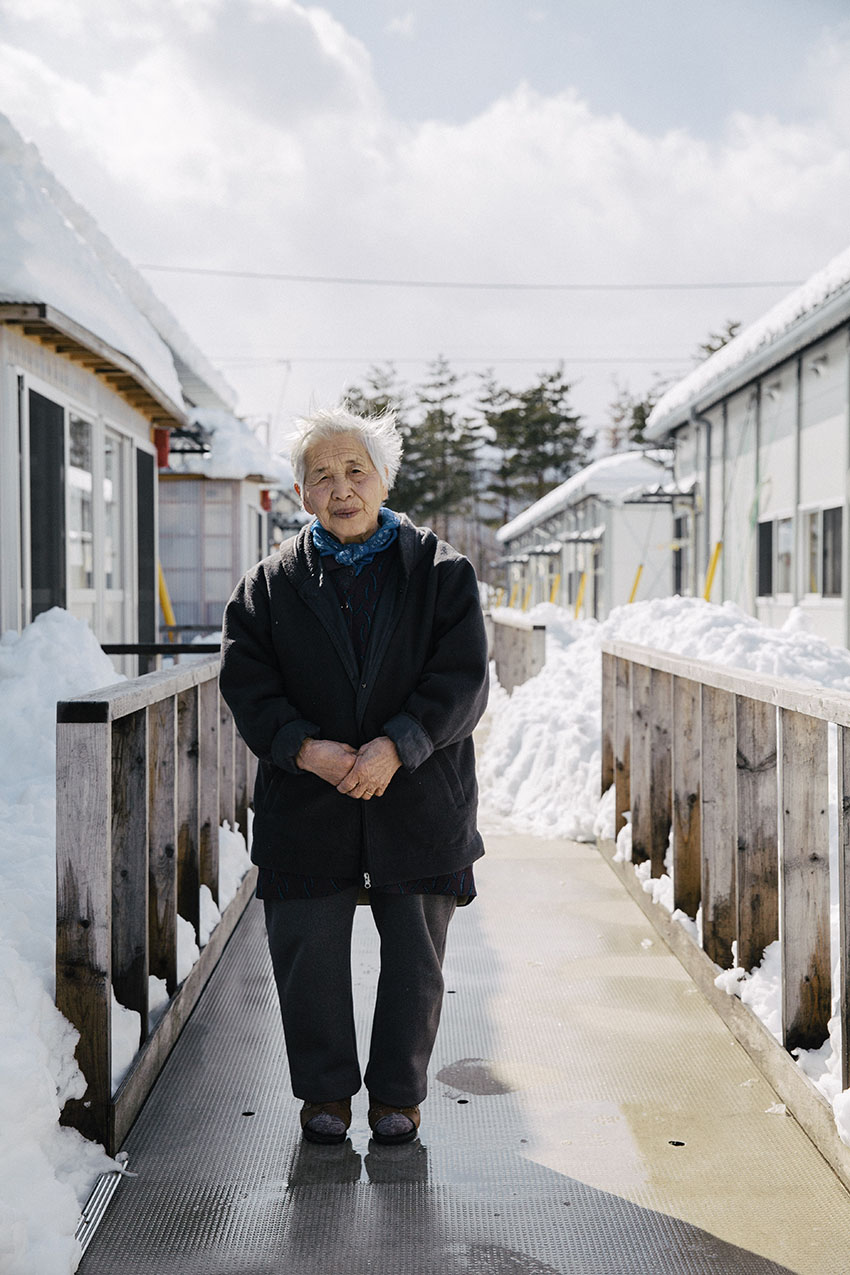 [Ed. note: Photo-journalist Kristian Laemmle-Ruff was recently in Fukushima, where he took hundreds of photos documenting the continuing health and environmental costs of the nuclear power plant disaster that devastated a city and its people and shook the world three years ago today. A selection of Kristian’s photos and his commentary are below. His father—IPPNW co-president Tilman Ruff—has written here about the ongoing public health issues that challenge Japan and the international community today as a result of the Fukushima disaster.] Read more…
The Fukushima nuclear disaster three years on
by Tilman Ruff
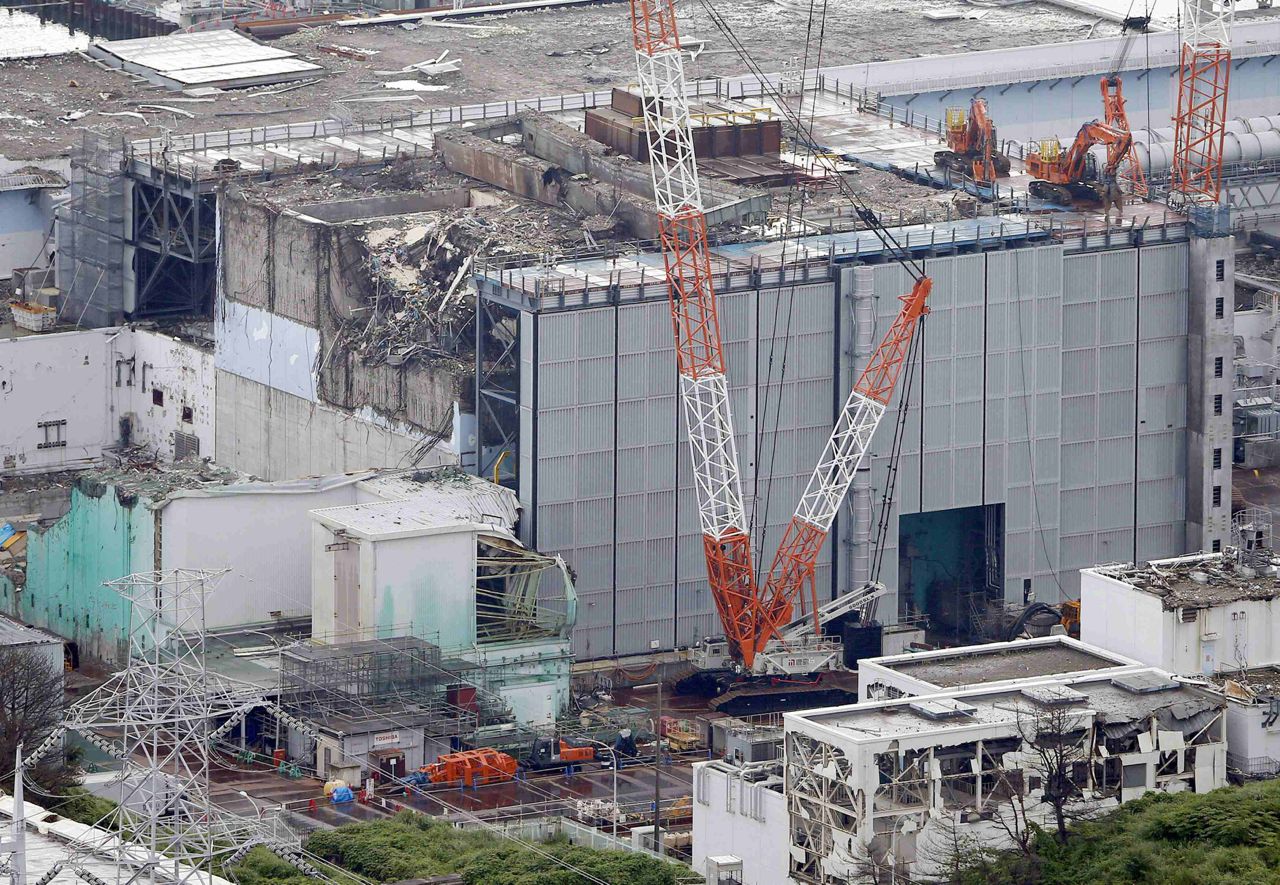
Fukushima-Daiichi Unit 3 reactor in July 2013
The world’s most complex nuclear power plant disaster continues three years on, and will continue for many years hence. Uncontrolled flows of around 1,000 tons of groundwater per day into the site continue; 400 tons of water daily flows into the damaged reactor and turbine buildings where it becomes radioactively contaminated. Some is collected—more than 430,000 tons of radioactively contaminated water is now stored in about 1,000 makeshift tanks, many of which are bolted rather than welded, lack even gauges to show how full they are, and have leaked repeatedly. Read more…
Praise be to Bill Clinton, Boris Yeltsin and Leonid Kravchuk: There are no nuclear weapons in Ukraine!
When the Soviet Union fell apart, Ukraine, Belarus and Kazakhstan became de facto nuclear states. Ukraine had the third largest nuclear arsenal in the world with about 5,000 nuclear charges, more than the UK, France, and China put together. The situation was dangerous. Russia, the USA, and Europe all had a strong interest in stopping the proliferation.
It was not a given that the plan to remove nuclear weapons from these three member states of the former Soviet Union would work. Read more…
IPPNW views with deep concern the recent developments in Ukraine. IPPNW underscores the absolute imperative to avoid the possibility of use of nuclear weapons. This danger exists with any armed conflict involving nuclear armed states or alliances, which could escalate in uncontrollable, unintended and unforeseeable ways.
“Ukraine is commendable in being one of the few states to have given up its nuclear weapons peacefully, and the people of Ukraine should not have to fear nuclear weapons ravaging their country.” said IPPNW co-president Dr. Ira Helfand from Boston, USA. Any war involves a terrible and lasting human toll, risks spreading and harming people’s health in the region and beyond.
IPPNW calls on all parties involved to work for a negotiated solution that respects the rights of all people in Ukraine to be safe from armed conflict and their right to participate in decisions affecting their future.
From Oslo and Nayarit to Vienna
Starting in Oslo, Norway, in March 2013, with a follow up in Nayarit, Mexico, in February 2014, a majority of states have jointly entered into a process that focuses on the humanitarian impacts of nuclear weapons. We don’t know yet exactly where this process will lead, but there is no doubt that the international community, with a vast majority of states, clearly declares that nuclear weapons are too dangerous and too harmful both for humans and the environment to be kept around in a state ready for use. We also know that the process—with a humanitarian focus—will continue to move forward when States and NGOs gather in Vienna in Austria later this year.
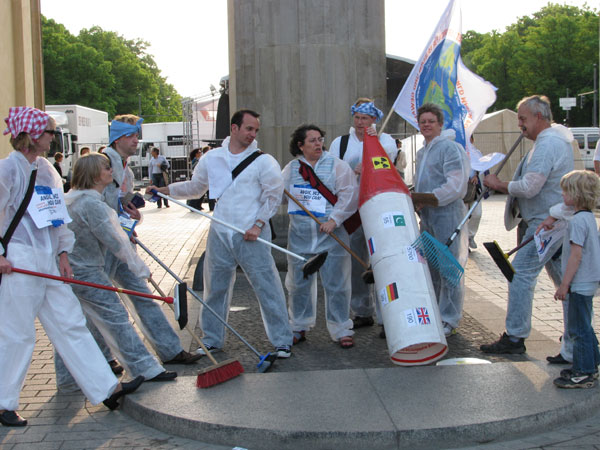
IPPNW Germany activists symbolically sweep nuclear weapons into the trash during a recent protest.
There is, perhaps, no wonder that the small minority of States armed with nuclear weapons—and apparently addicted to them— have so far stayed away from the process. Nevertheless, they will have to come on board sooner or later, unless they have a desire to be left out altogether. They simply have no choice. Like smokers who have no real reason to continue smoking, the nuclear-armed states have no real reason whatsoever to cling to their completely useless, immoral, inhuman, and tremendously expensive nuclear weapons.
Last weekend, I told my oldest grandson, who is 12, about the recent conference in Nayarit and the exciting results that came out of it. During our talk he asked me why somebody does not simply ask the few nuclear armed states why they claim to need their nuclear weapons and for what purpose. When we discussed this further, we could not think of any significant reason that they could come up with, only bad excuses, like deterrence, peacekeeping, and such meaningless and outdated rubbish. We agreed that his question is absolutely in place, and that the only real answer to it is total nuclear weapons abolition in our lifetime.
“Ridding the world of nuclear weapons will take courage”
ICAN closing statement to the Second Conference on the Humanitarian Impact of Nuclear Weapons
February 14, 2014
[Ray Acheson of WILPF’s Reaching Critical Will project and a member of ICAN’s International Steering Group, read the following statement during the closing session of the Second Conference on the Humanitarian Impact of Nuclear Weapons in Nayarit, Mexico.]
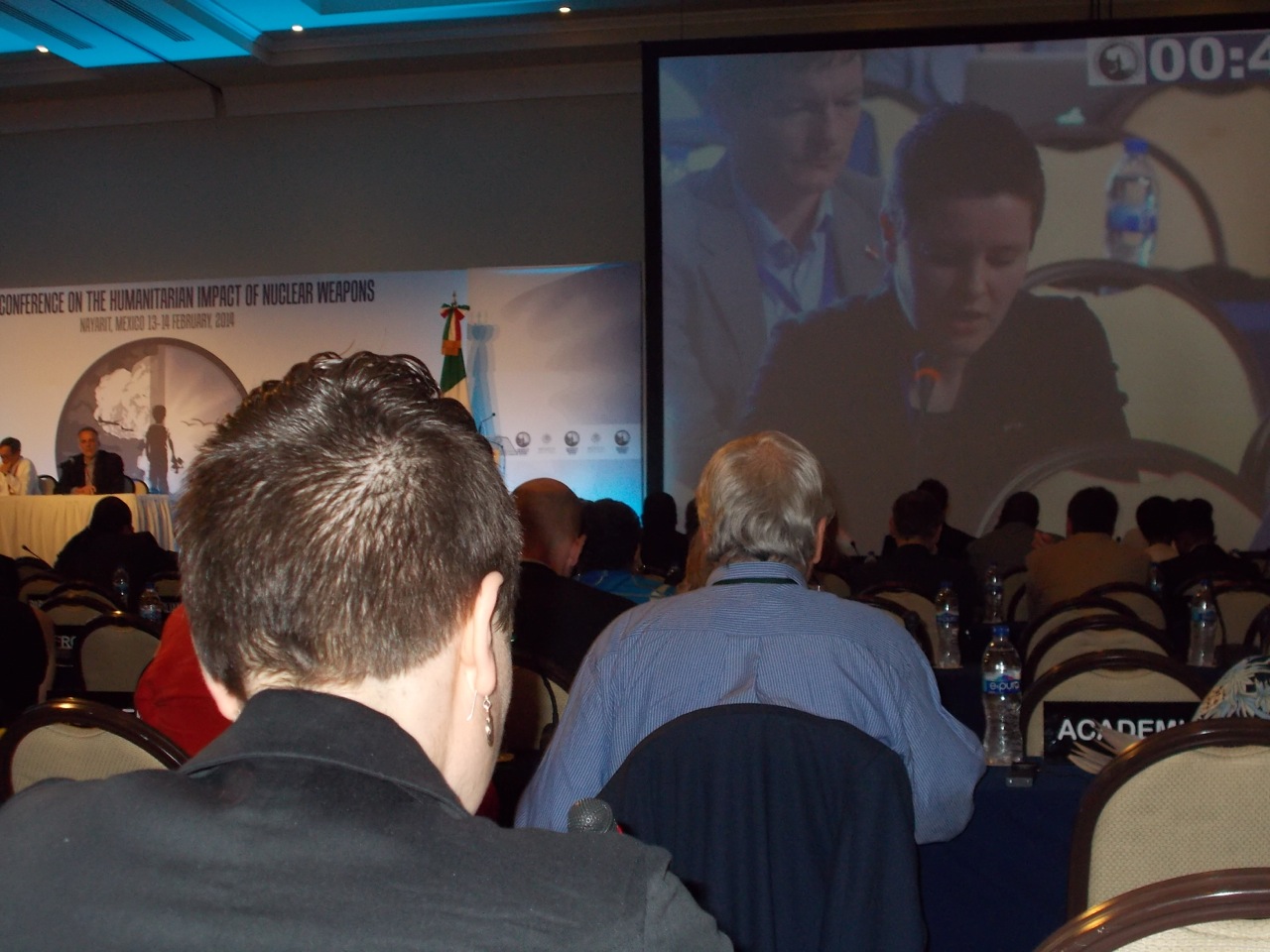
Ray Acheson speaks on behalf of ICAN
I am speaking on behalf of the International Campaign to Abolish Nuclear Weapons, a coalition of over 350 organisations in 90 countries.
We have been given over the past two days a chilling reminder of what nuclear weapons are, and what they do.
They do not bring security. They bring death and destruction on a scale that cannot be justified for any reason. Read more…
By Antti Junkkari, Dr. Kati Juva, Finland, and Dr. Ehase Agyeno, Nigeria
An exciting new South/North project of Physicians for Social Responsibility (PSR), Finland in cooperation with the Society of Nigerian Doctors for the Welfare of Mankind (SNDWM), Zambian Healthworkers for Social Responsibility (ZHSR), and IPPNW just got a financial boost from the “Mazda Make Things Better Award.” The Mazda award was launched at the summit of Nobel Peace Laureates in October, 2013 in Warsaw, and the joint IPPNW project “Raising awareness on small arms through interactive radio programmes” has now won the first of these awards!  Read more…
“Point of no return”
“Somewhere Over the Rainbow” is playing in the conference hall in Nayarit following the chair’s declaration that this conference has been “the point of no return” in the humanitarian initiative to achieve a world without nuclear weapons.
Without getting overly specific, he called for an appropriate process in an appropriate forum that would have the goal of a legally binding instrument that would outlaw nuclear weapons by the 70th anniversary of the bombings of Hiroshima and Nagasaki.
The ICAN campaigners erupted into applause at the conclusion of his statement. This is exactly what we wanted coming into Mexico, and we can now leave knowing that the road to Austria has been clearly marked.
More details in a more sober mood later. Now off the the ICAN party!!

 Bimal Khadka
 Bjorn Hilt
 Charles K. Johnson
 Dr. Ghassan Shahrour
 Gunnar Westberg
 IPPNW
IPPNW John Loretz
 Lawrence Wittner
 Maria Valenti
 mollymcgint
 Sue Wareham
 Tilman Ruff
 Tim Wright
 Xanthe Hall