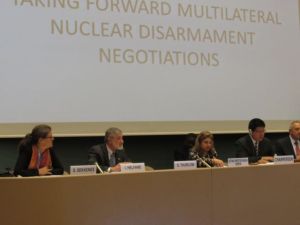
IPPNW co-president Ira Helfand (second from left) addresses the Open-Ended Working Group in Geneva
[IPPNW co-president Ira Helfand was an expert panelist on the humanitarian impact of nuclear weapons at the UN Open-Ended Working Group (OEWG) taking forward multilateral nuclear disarmament negotiations. Following are his opening remarks during the OEWG session on May 4, 2016, which began with remarks by Hiroshima survivor Setsuko Thurlow.]
Thank you Setsuko for your moving testament to the vast human suffering that the detonation of a nuclear weapon will produce.
And thank you, Mr. Chairman, for the opportunity to review with you today the medical consequences that will result from nuclear war. It is the belief of the International Physicians for the Prevention of Nuclear War, the World Medical Association, the World Federation of Public Health Associations and the International Council of Nurses that a full understanding of the humanitarian impact of nuclear weapons, an understanding of what nuclear weapons will actually do when they are used, must lie at the core of policy discussion about what to do with these most dangerous of all weapons of mass and indiscriminate destruction. Read more…
Global health federations issue collective appeal for prohibition and elimination of nuclear weapons
The leading international federations representing the world’s physicians, public health professionals, and nurses have told a special UN working group that the medical and scientific evidence about the consequences of nuclear weapons requires urgent action to prohibit and eliminate them as “the only course of action commensurate with the existential danger they pose.”
International Physicians for the Prevention of Nuclear War (IPPNW), the World Medical Association (WMA), the World Federation of Public Health Associations (WFPHA), and the International Council of Nurses (ICN) have submitted a joint working paper—“The health and humanitarian case for banning and eliminating nuclear weapons”—to the UN Open-Ended Working Group (OEWG), which meets in Geneva this week and next to decide what new legal measures are needed to achieve nuclear disarmament. The OEWG will report back to the UN General Assembly later this year. Read more…
Zambians to Zambia leaders – Ratify the ATT!
BY Dr. Robert Mtonga, Zambian Healthworkers for Social Responsibility
The inertia-laden Zambian bureaucracy got a push recently from IPPNW-Zambia, Control Arms coalition partners and members of Zambian civil society to ratify the Arms Trade Treaty (ATT). Read more…
By Bimal Khadka, Nepal, IPPNW International Student Representative
Young doctors and medical students from throughout Asia overcame vast geographical boundaries, cultural barriers and financial difficulties to bring their ideas and energy to the first Asian IPPNW Youth Congress in Patna, India in March. 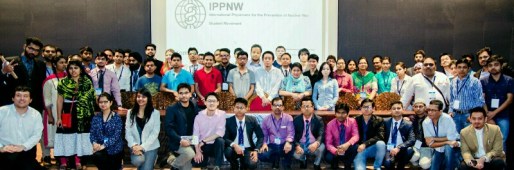
We came from Nepal, Bangladesh, Indonesia, Kazakhstan, Philippines, Mongolia, and Japan to join our Indian colleagues to discuss how we can use our medical expertise to advance heath through peace throughout the region. We were supported by observers from IPPNW Germany and many members of Indian doctors for Peace and Development (IDPD) who were involved in smooth and fruitful discussions on many IPPNW topics. Read more…
The trillion dollar question
Isn’t it rather odd that America’s largest single public expenditure scheduled for the coming decades has received no attention in the 2015-2016 presidential debates?
The expenditure is for a thirty-year program to “modernize” the US nuclear arsenal and production facilities. Although President Obama began his administration with a dramatic public commitment to build a nuclear weapons-free world, that commitment has long ago dwindled and died. It has been replaced by an administration plan to build a new generation of US nuclear weapons and nuclear production facilities to last the nation well into the second half of the twenty-first century. This plan, which has received almost no attention by the mass media, includes redesigned nuclear warheads, as well as new nuclear bombers, submarines, land-based missiles, weapons labs, and production plants. The estimated cost? $1,000,000,000,000.00—or, for those readers unfamiliar with such lofty figures, $1 trillion. Read more…
IPPNW’s Dr. Bob Mtonga participated in a February 29th “Extraordinary Meeting” of states parties and observers to the Arms Trade Treaty (ATT) that turned out to be quite ordinary.
The meeting was convened to discuss organizational issues including proposals for the administrative arrangements of the Secretariat, its structure, location, funding and confirmation of staffing positions, as well as cost estimates and location of the 2nd Conference of States Parties to the ATT (CSP2), to be held at the World Trade Centre in Geneva, Switzerland from 22–26 August 2016.
The Extra-ordinary Meeting however missed an opportunity to consider substantive items – such as possible violations of the Treaty by States Parties, including continued arms exports to Saudi Arabia. Read more…
Passion for peace drives IPPNW research in Liberia

Photo: Lucie Collinson
Results of hospital-based research in Liberia on armed violence spearheaded by members of IPPNW was published recently by the Small Arms Survey in Switzerland. A main finding of The Value of Hospital Data – Understanding and Preventing Intentional Injury in Liberia was that the Liberian Armed Violence Observatory (LAVO) is not receiving all the data it needs to most effectively inform intervention strategies on armed violence prevention. Read more…
Dutch medical appeal for nuclear disarmament
In September 2015, on the UN International Day for Total Elimination of Nuclear Weapons, a medical appeal for nuclear disarmament was presented in Amsterdam. This declaration, signed with remarkable enthusiasm by 100 leading Dutch healthcare executives, clinicians, and scientists, is meant to put the urgent need for nuclear disarmament back on the societal and political agenda—not from an ideological or political viewpoint, but from a medical humanitarian one. It is now circulating within the Dutch medical community, and will be officially presented to Parliament in the coming months.
That day the NVMP, the Dutch affiliate of the International Physicians for Prevention of Nuclear War, organised a symposium about nuclear weapons for physicians and other medical professionals. It covered the medical humanitarian consequences of nuclear weapon use, and the position and role of Dutch healthcare and its allies.
North Korea and the missile threat
North Korea has again launched a missile. Several of the previous launches have malfunctioned and whether any of the successful ones have achieved the intended distance and accuracy is unknown. But with enough missiles, reliable or not, and several sufficiently lightweight and sturdy nuclear charges, a bomb might, in the future, reach Okinawa or Alaska, or even further. Read more…
Honors to a former staffer
 Congratulations to former staff member Garrett FitzGerald, who has been named the John and Judy Scully Fellow in Peace Studies at the University of Notre Dame’s Kroc Institute for International Peace Studies. Garrett served as IPPNW’s development officer from 2010 to 2015, blending a commitment to peace work with experience in nonviolence education and community organizing. He returned to academic life last year to study the relationships among religion, ethics, and politics, and has clearly made his mark. Garrett’s many friends at IPPNW wish him continued success.

 Bimal Khadka
 Bjorn Hilt
 Charles K. Johnson
 Dr. Ghassan Shahrour
 Gunnar Westberg
 IPPNW
IPPNW John Loretz
 Lawrence Wittner
 Maria Valenti
 mollymcgint
 Sue Wareham
 Tilman Ruff
 Tim Wright
 Xanthe Hall