Reykjavik Summit, 40 years on.
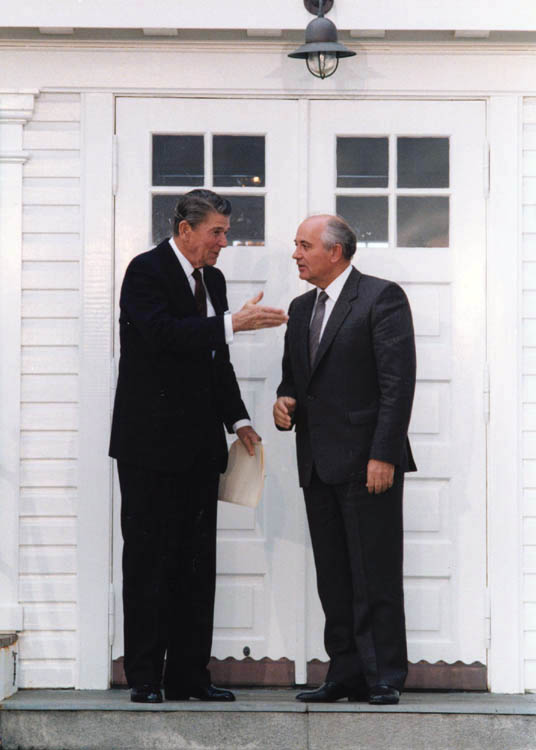
Michail Gorbachev and Ronald Reagan famously shook hands in front of the wooden Hofdi House in Reykjavik, Iceland on 12 October 1986. Twenty years later, it was revealed that they came within inches of achieving an agreement on total nuclear disarmament, only for Reagan’s “Star Wars” to block their vision. Forty years later, Russia and the USA aren’t even talking, arms control is in tatters and first-strike weapons are back.
The Soviet-US summit took place from 10-12 October 1986 in the Icelandic capital Reykjavik, on what was seen as relatively neutral ground. The main subject of the meeting was to discuss the issue of intermediate range nuclear weapons. On the one side, the Soviet Union had deployed SS-20 ballistic missiles that threatened Western Europe. On the other, the USA had deployed Pershing II missiles in West Germany and Cruise missiles in the United Kingdom as part of the dual-track decision of NATO to try to force the Soviet Union to withdraw the SS-20.
Because of the proximity of the intermediate range nuclear weapons to their targets flight times were very low, giving almost no warning of attack. They were therefore perceived as first strike weapons. This escalation increased the danger of accidental nuclear war considerably, and the idea of conducting a first strike to decapitate the adversary was seen to undermine the concept of mutually assured destruction (MAD).
A missed chance
At the meeting, the Soviet leader Michail Gorbachev surprised US President Ronald Reagan by proposing that they should both agree to eliminating nuclear weapons within ten years.
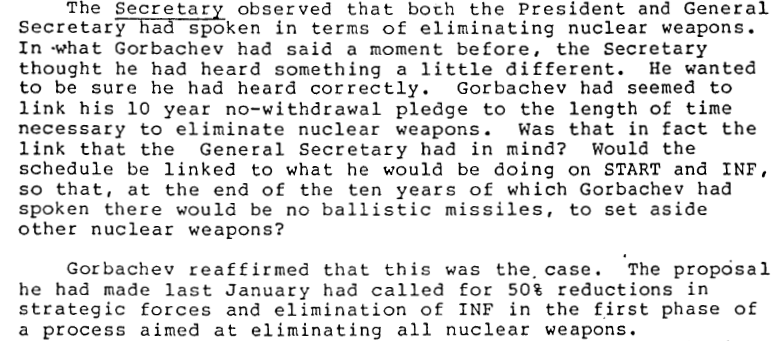
Although the initial reaction of Reagan to the proposal was positive, he continued to insist on retaining his plan of developing the Strategic Defense Initiative — missile defence in space, often nicknamed “Star Wars”. Reagan believed he could make the USA invulnerable to nuclear attack by doing so. The withdrawal mentioned in the above quote refers to the need to withdraw from the Anti-Ballistic Missile (ABM) Treaty in order to install SDI.
However, Gorbachev argued that SDI would increase the likelihood of nuclear war if only one side was invulnerable to a retaliatory strike and the Soviet Union did not want to develop missile defence in space. With a first strike capability and SDI, the USA could conceivably feel they had such an advantage that they could risk a nuclear attack. The USSR would, in turn, have to prepare for such an eventuality by planning to preempt such a strike, until they had the same technology in space. The risk of nuclear war by miscalculation would be greatly increased. Instead, Gorbachev was proposing that both sides destroy all of their nuclear weapons and the SDI programme be cancelled.
Ronald Reagan would not, however, let go of the SDI programme and Gorbachev was not prepared to discuss nuclear disarmament without an assurance that SDI would no longer be an issue. Some believe that this impasse blocked a major chance for total nuclear disarmament in the 1980s. Both leaders publicly gave the blame to the other for the failure of the talks.
The Transcripts
It is worth reading the transcripts to see how this meeting started, progressed and ended. The shared vision of nuclear abolition is tangible. The US and Soviet transcripts are mostly congruent about what was said, on both sides. Reagans belief in SDI as an ultimate insurance policy, as well as Gorbachev’s suspicion that the arms race would be moved into space and the US could potentially launch a nuclear first-strike on the USSR, are clear. However, the question arises as to why Reagan could not have at least put the development of SDI on hold for ten years (in the end SDI was downsized to National Missile Defense under Bush and never went into space). Similarly, one wonders why Gorbachev didn’t just accept Reagan’s offer to share SDI technology to seal the deal.
At the end of the meeting the US and Soviet transcriptions diverge. In the Soviet version, Reagan says “I think you didn’t want to achieve an agreement anyway” and “I don’t know when we’ll ever have another chance like this and whether we will meet soon.” Despite this, apparently Gorbachev’s take-away from the meeting was to say he was “even more of an optimist after Reykjavik,” and that the summit signified a new stage in the process of disarmament: from limitations to total abolition.
Era of real detente
Most are agreed that the meeting established good relations and a measure of trust between the two men, paving the way for further talks on intermediate-range nuclear weapons, and the following year to the successful completion of the INF Treaty. Because of this, the meeting at Reykjavik is often hailed as a major turning point in the Cold War and the beginning of an era of real detente. For the first time the leaders of the two superpowers showed their willingness to talk about complete nuclear disarmament. After this, it became easier to negotiate the destruction of a whole class of nuclear weapons with the INF treaty, and also to negotiate the reduction of strategic nuclear weapons with the START talks.
The INF treaty was responsible for the destruction of nearly 2,700 nuclear weapons systems by May 2001, leaving Europe entirely free of land-based short or medium-range nuclear weapons. The treaty did not, however, get rid of medium-range nuclear weapons at sea. It was regarded as one of the most important bilateral treaties of our time, along with the START 1 treaty (1991), that reduced the number of strategic nuclear weapons to 1,600 on each side, and — most importantly — ensured their verified destruction. All the follow-on treaties, such as SORT or New START did not go as far as eliminating the weapons, simply withdrawing them from operational service.
Medium Range Ballistic Missiles are back
Today, all of this important work has been more or less unravelled. The follow-on treaties to START 1 have expired without replacement and bilateral talks have stalled completely. The US withdrew from the INF treaty in 2019 under the first Trump administration and Russia quickly followed suit. The USA left the ABM treaty in 2002 to develop National Missile Defence.
Worst of all, the threat of land-based intermediate-range ballistic missiles (IRBM) is once again with us. The Russians have already developed and used the Oreshnik missile to strike Ukraine, albeit with conventional warheads. The missile’s speed can exceed Mach 10 and it is MIRVed — i.e. It can carry multiple independently targetted reentry vehicles carrying warheads. Russian announced that the first Oreschnik unit was deployed in Belarus in December 2025.
Because of plans to deploy US IRBMs in Europe, a German civil society campaign has been launched entitled “Capable of Peace, not First Strike” (my translation). Serial production of cruise missiles planned by a US start-up in Leipzig was criticised by the campaign as threatening to escalate the arms race. They demand a return to diplomacy and de-escalation.
Reykjavik is perhaps not immediately comparable to today’s situation. We are no longer in a Cold War but a protracted and destructive war that has been raging since 2022, causing tens of thousands of casualties. The motivation for talks, however, is the same: IRBMs are first-strike weapons that change the nature of war, and increase the danger of nuclear war immeasurably. A return to a stand-off between Russia and NATO with weapons that can barely be intercepted and can carry nuclear warheads calls for drastic intervention on the part of all countries that stand to suffer the consequences of a conflagration in Europe.
Further Reading
Aktionsbündnis “atomwaffenfrei.jetzt”: Keine Produktion von Angriffswaffen! Press release (in German), Website of the Campaign “Friedensfähig statt erstschlagfähig”, 14 Sep 2026
Issel S: US defence firm plans medium-range missile production near Leipzig, Euronews, 30 Aug 2026
Podvig P: Oreshnik in Belarus? Russian strategic nuclear forces, 27 Dec 2025
Savranskaya S, Blanton T: The Reykjavik File, National Security Archive, George Washington University, 13 Oct 2006
Savranskaya S, Blanton T: Gorbachev’s Nuclear Initiative of January 1986 and the Road to Reykjavik, National Security Archive, George Washington University, 12 Oct 2016
Sokov N: Reykjavik Summit: The Legacy and a Lesson for the Future, Nuclear Threat Initiative, 30 Nov 2007