The ICJ Advisory Opinion—What did it give us?
On this day, 30 years ago, the International Court of Justice published its historic document on the Legality of Use and Threat of Use of Nuclear Weapons. It was the result of a worldwide campaign by a network of over 500 organisations, led by IPPNW, IALANA and IPB. But did the nuclear disarmament community get the result it wanted? Opinion on the Opinion was divided. The third and final part of this anniversary series on the ICJ Opinion looks at what we achieved, and what is to be done next.
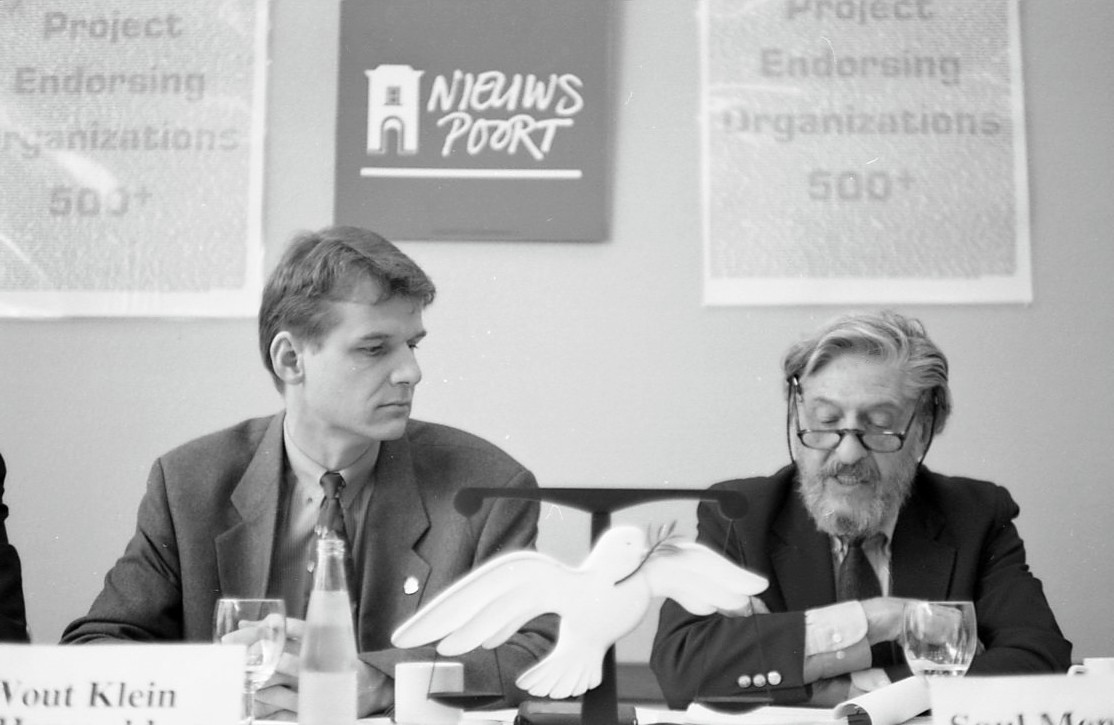
Unanimity
While legal experts argued over the one point in the Advisory Opinion where the judges themselves were at variance, the points on which they were unanimous remained largely overlooked. The legal status wasn’t seriously looked at again until the Humanitarian Initiative, which culminated in a series of State conferences hosted by Norway, Mexico and Austria on the Humanitarian Impact of Nuclear Weapons (HINW) in 2013 and 2014, initiated the process—on a state level— of considering what the use of nuclear weapons actually would mean. The ‘legal gap’ was then identified—not so much as under which circumstances nuclear weapons might legitimately be used—but the unfinished business which the Court identified in its unanimous statement:
“There exists an obligation to pursue in good faith and to bring to a conclusion negotiations leading to nuclear disarmament in all its aspects under strict and effective international control” [ICJ (3) 1996].
The Court had already found that no specific prohibition of the threat or use of nuclear weapons existed at that time, although a body of international law made it clear that the use of nuclear weapons would be “scarcely reconcilable” with legal requirements. In fact, the judges were unable to conceive of a specific circumstance under which nuclear weapons could be used, despite all the scenarios the Nuclear Weapons States presented. They wrote in the longer version of the Opinion:
“ In the long run, international law, and with it the stability of the international order which it is intended to govern, are bound to suffer from the continuing difference of views with regard to the legal status of weapons as deadly as nuclear weapons. It is consequently important to put an end to this state of affairs: the long-promised complete nuclear disarmament appears to be the most appropriate means of achieving that result.” [ICJ (4) 1996]
Path to Prohibition
In October 2015, a UN resolution was passed to establish an Open-Ended Working Group (OEWG) to address concrete effective legal measures, provisions, and norms that needed to be concluded to attain and maintain a world without nuclear weapons [UNGA 2015]. The OEWG was to discuss, in other words, the legal gap.
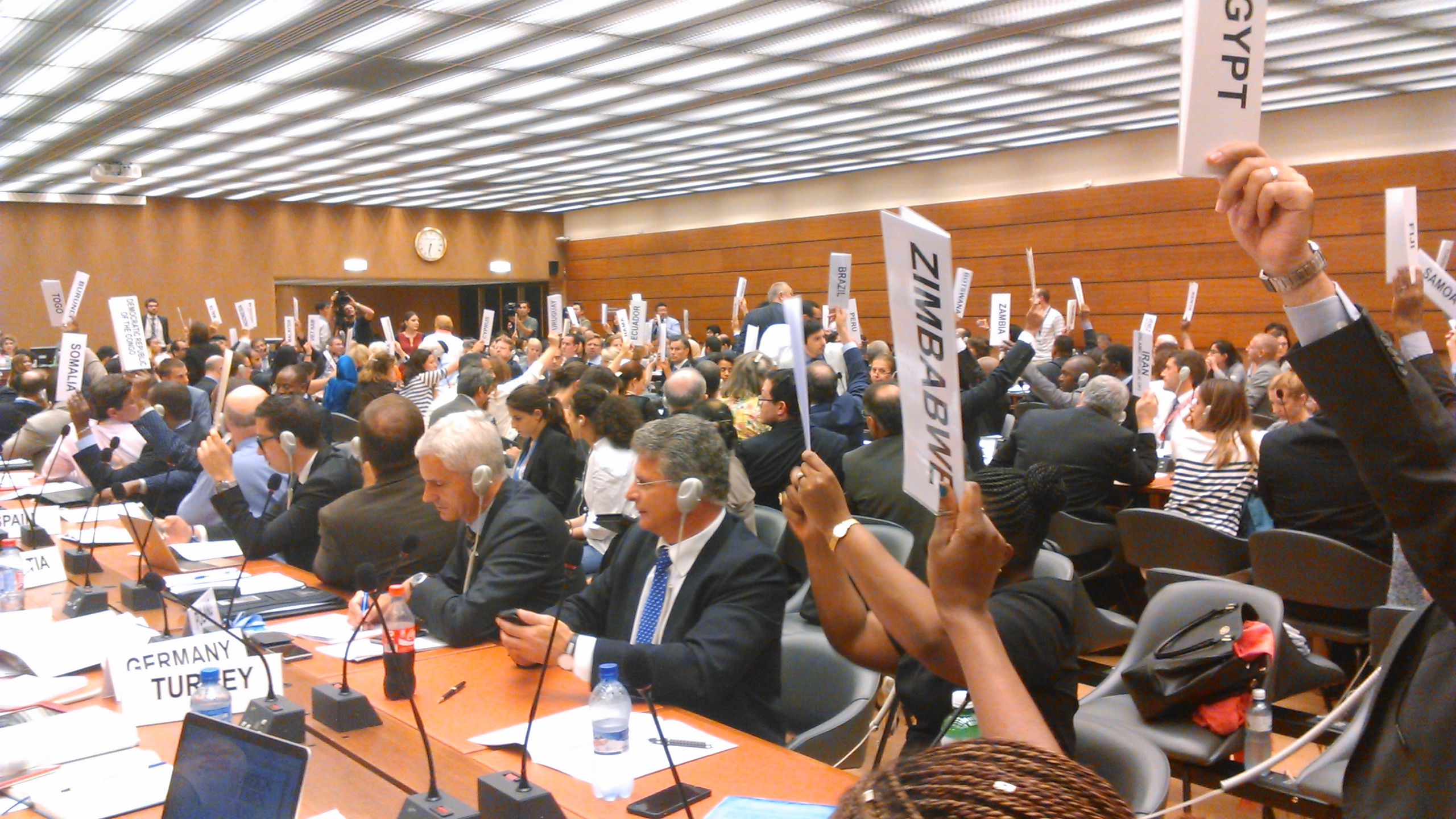
On 19 August 2016, in an uproar of dissent, unable to reach consensus, and with a stopped clock, the OEWG voted on recommending to the UN that a legally-binding treaty should be negotiated to prohibit nuclear weapons [OEWG 2016]. I witnessed the scenes in the overcrowded room in Geneva where hot, sweaty and tired diplomats raised their country name-plates to vote for this historic recommendation. Watch this space for a more detailed breakdown of that conference later this year.
1996 was the moment that the ICJ set the ball rolling with its clear answer on what was needed to be done. Twenty years after the ICJ Opinion, 2016 was the year the UN took action and began the process towards prohibition, having found a critical mass that would take it forward, despite pressure from the 40 nuclear-dependent states. The unfinished business of a prohibition and elimination (complete nuclear disarmament) needed much strategic discussion before arriving at the point we now find ourselves: with a Treaty on the Prohibition of Nuclear Weapons (TPNW) in the bag. [Breaking news: Tonga has become the 100th country to join the treaty].
Part of the consideration along the way to getting a ban was whether to continue banging on the doors of the Nuclear Weapon States, waving a Nuclear Weapons Convention at them while they smiled on complacently and added the word ‘ultimately’ to every document.
Unfortunately, right now elimination seems farther away than ever.
So I conclude: 30 years after the Advisory Opinion, in 2026, we are in need of a new strategic discussion as to how to get from prohibition to elimination. While the Nuclear Weapon States continue blindly on down the road to ultimate destruction, the rest of the world needs a new road-map to abolition. Fresh ideas are welcome; brainstorming and thinking outside of the box are necessary. Let’s use this time of stagnation and roll-back to find a new process.
Maybe the Egyptian representative was right to remind us in 1995 that some Opinions needed 40 years to reach fulfilment. The next ten years are crucial.
Sources and further reading
ICJ (3): Legality of the Threat or Use of Nuclear Weapons, summary of Advisory Opinion, 8 Jul 1996 https://www.icj-cij.org/sites/default/files/case-related/95/7497.pdf
ICJ (4): Legality of the Threat or Use of Nuclear Weapons, Advisory Opinion in full (english), p 41 (98), 8 Jul 1996 https://www.icj-cij.org/sites/default/files/case-related/95/095-19960708-ADV-01-00-EN.pdf
OEWG: Report of the Open-ended Working Group taking forward multilateral nuclear disarmament, 19 Aug 2016 https://www.reachingcriticalwill.org/images/documents/Disarmament-fora/OEWG/2016/Documents/OEWG-report-final.pdf
UNGA: Taking forward multilateral nuclear disarmament negotiations, UN General Assembly Resolution A/RES/70/33, 7 Dec 2015 https://docs.un.org/en/A/RES/70/33

 Bimal Khadka
 Bjorn Hilt
 Charles K. Johnson
 Dr. Ghassan Shahrour
 Gunnar Westberg
 IPPNW
IPPNW John Loretz
 Lawrence Wittner
 Maria Valenti
 mollymcgint
 Sue Wareham
 Tilman Ruff
 Tim Wright
 Xanthe Hall