Thirty years on: The Canberra Commission
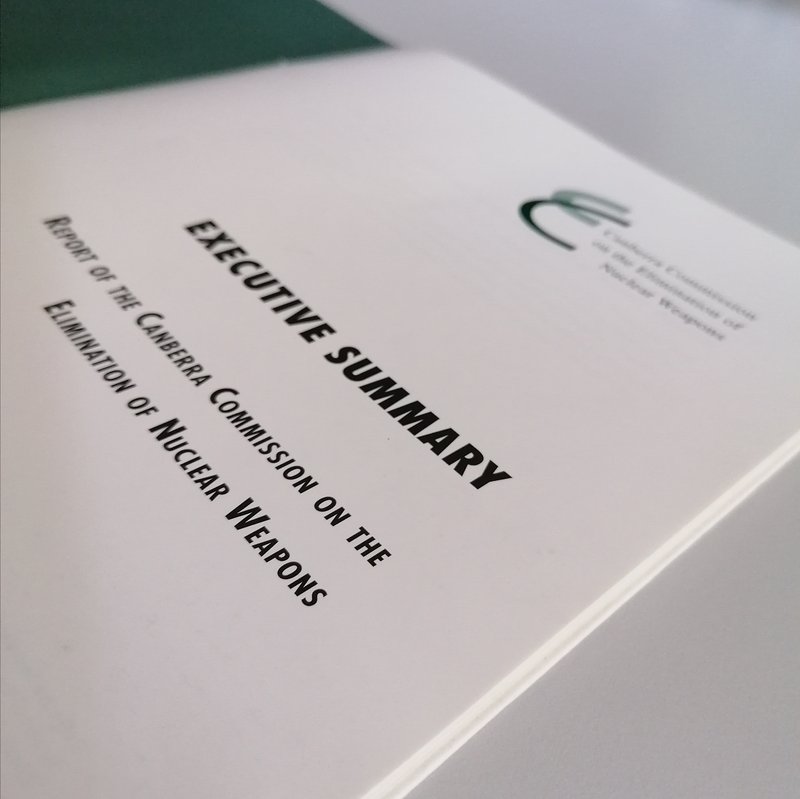
In its report, presented on August 14, 1996, the Canberra Commission on the Elimination of Nuclear Weapons examined nuclear deterrence. It also proposed a series of concrete steps to immediately begin the process of nuclear disarmament. The report received significant international attention. Thirty years after its publication, opinions on its conclusions remain divided. None of the recommendations have been implemented.
On November 26, 1995, Paul Keating, then Prime Minister of Australia, announced the establishment of the 17-member “Canberra Commission on the Elimination of Nuclear Weapons.” The task of this high-level independent commission of experts was to:
“identify practical pathways toward a world free of nuclear weapons, taking into account the associated challenges of maintaining stability and security during the transition phase and after this goal is achieved.”
The group was convened by Australian Ambassador Richard Butler. Among the commission members were Nobel Peace Prize laureate Professor Joseph Rotblat, former U.S. Secretary of Defense Robert McNamara, former Commander of the U.S. Nuclear Forces General Lee Butler, former Prime Minister of France, Michel Rocard, President of the International Peace Bureau, Maj Britt Theorin, IPPNW Co-President Ron McCoy, and oceanographer Jacques-Yves Cousteau.
In its report, published on August 14, 1996, the Canberra Commission comprehensively examined nuclear deterrence as well as the arguments raised against a world free of nuclear weapons. It concluded in a statement introducing the report that:
- Nuclear weapons are immensely destructive and any use of them would be catastrophic.
- Nuclear weapons pose an intolerable threat to mankind.
- Assertions of the utility of nuclear weapons continue despite the end of the Cold War.
- If people were more aware of their dangers, they would reject them. Possession on their behalf would not be permitted.
- The discriminatory situation of few states possessing nuclear weapons is unstable and cannot be sustained. So long as any state has nuclear weapons, others will want them.
- The proposition that nuclear weapons can be retained in perpetuity and never used – accidentally or by decision – defies credibility.
- Nuclear weapons diminish the security of all states, and makes possessor states into targets.
- An opportunity exists to choose to get rid of nuclear weapons.
The Commission then proposes a series of concrete recommendations with which the process of nuclear disarmament can be initiated immediately. The following immediate measures are proposed as feasible in the short term:
- Lifting the highest alert status (LOW) for nuclear weapons.
- Separating warheads from their delivery systems.
- Ending the deployment of sub-strategic (tactical) nuclear weapons.
- Halting nuclear weapons testing.
- Commencement of negotiations to further reduce the nuclear arsenals of the United States and Russia.
- Agreement among nuclear-weapon states on a mutual renunciation of first use and on refraining from the use of nuclear weapons against non-nuclear-weapon states (negative security assurances).
The report proper, entitled “The Nuclear Weapon Debate” makes the case for a nuclear weapon-free world and details the steps to be taken immediately, reinforcing measures, and the future environment. There is an annex which deals with verification, disposal and other technical and legal matters.
The Canberra Commission succeeded in bringing together representatives from governments and nongovernmental organizations in a collaboration unprecedented in the field of disarmament at that time. It was the first time that a state had addressed the assumption that the existence of nuclear weapons means that it continues to be necessary for them to exist in order to deter their use. The Commission’s report played a significant role in summarising the state of scientific discourse on a nuclear-weapon-free world and translating it into concrete proposals that were incorporated into the subsequent international political debate.
The report was presented by Alexander Downer, Minister of Foreign Affairs, to the United Nations on 30 September 1996, and to the Conference of Disarmament in Geneva on 30 January 1997.
Political Context
The Commission was established at the time that the French government was conducting the final round of nuclear testing on Moruroa, which was highly unpopular internationally and particularly in the Pacific. At the same time, Australia was looking at increasing its uranium exports and the government was possibly hoping the report would placate the anti-nuclear lobby.
Internationally, it came at a time following the collapse of the Soviet Union, the Fall of the Berlin Wall, and the renewed interest in nuclear disarmament as a dividend from the end of the Cold War. The period of advances in the field of multilateral arms control and nuclear disarmament was, however, slowing down and did, in fact, more or less halt in 1996 after the Non-Proliferation Treaty was indefinitely extended in 1995, and the Comprehensive Test Ban Treaty was signed in 1996, but till today never entered into force.
Reception
The Keating government was defeated and a new coalition government formed—led by John Howard— before the report was finalised. After this, Australia no longer championed the goals of the report, downgrading its importance to procedural support. It was still presented to the United Nations, but the new government did not advocate or implement any of its policies, unwilling to put strain on its alliance with the United States.
The report received much international attention and was welcomed by the non-aligned nations and the NGO disarmament community, particularly for addressing the dangers of nuclear deterrence. The reaction of the official nuclear weapon states ranged from dismissive to sceptical. They continued to defend continued reliance of nuclear deterrence. Critics of the report believed that it contained presuppositions and assumptions and concluded that the arguments were not persuasive.
No UN member state moved to legally adopt the report’s set of recommendations though many of them have been individually put forward during negotiations.
Later Australian administrations have revisited the report and seen value in it. The government administration under Kevin Rudd (2007-2010) established the International Commission on Nuclear Non-Proliferation and Disarmament (ICNND) to continue the work of the Canberra Commission in the hope of making a positive contribution to the 2010 NPT Review Conference. ICNND was launched in July 2008 by the governments of Australia and Japan and co-chaired by Gareth Evans and Yoriko Kawaguchi, publishing its final report in December 2009.
However, many proponents of the Canberra Commission report viewed ICNND’s report as a watered-down version of the original which was much further-reaching, both in its conclusions and recommendations.
The Weapons of Mass Destruction Commission, led by Hans Blix, reference the Canberra Commission Report more than a decade later, when it was clear that arms control and disarmament had stagnated. Several of the members of the Blix Commission had served on the Canberra Commission, such as Gareth Evans, Patricia Lewis and Jayantha Dhanapala. Many of the conclusions of both reports overlap, such as the catastrophic effects of any use, that “so long as any state has such weapons—especially nuclear arms—others will want them”, and emphasising the high risk of use. The main difference in the two reports is that the Blix Commission covers all weapons of mass destruction and not just nuclear weapons.
The Report today
Thirty years after the publishing of the Canberra Commission Report, opinions on the onclusions remain as divided as ever. None of the recommendations have been implemented. Yet, advocates of the conclusions see it as a foundational text in disarmament diplomacy, because it argues that nuclear deterrence is dangerous and no longer necessary.
The Report of the Canberra Commission is also seen by arms control experts as part of a long-term norm building process that has strengthened the international taboo against nuclear weapons. It has become a core reference paper for the ongoing debate on nuclear deterrence and the need for the abolition of nuclear weapons, including during negotiations for the Treaty on the Prohibition of Nuclear Weapons (TPNW), which was adopted by the UN in 2017.
Amid new geopolitical tensions, nuclear weapons modernisation, and renewed dependence on nuclear deterrence, the Report’s conclusions still serve as concise arguments, put forward by international independent and renowned experts, to counter the proponents of nuclear deterrence. The core warning that failure to eliminate nuclear weapons will inevitably lead to further proliferation and nuclear use remains as valid as ever today.
Verbatim: The Report of the Canberra Commission on the Elimination of Nuclear Weapons, https://www.dfat.gov.au/sites/default/files/the-canberra-commission-on-the-elimination-of-nuclear-weapons.pdf
Further reading
Evans G: The Canberra Commission on the Elimination of Nuclear Weapons and Subsequent International Developments, paper presented to NIRA Roundtable, Tokyo, 6-7 Oct 2000 https://www.gevans.org/speeches/speech319.html
Forge J, Myrha S: The Canberra Commission: A “Realistic” Analysis? Australian Journal of Politics and History, vo. 44, no. 4, 1998 https://www.academia.edu/94738310/The_Canberra_Commission_A_Realistic_Analysis
Hanson M, Ungerer CJ: Promoting an Agenda for Nuclear Weapons Elimination: The Canberra Commission and Dilemmas of Disarmament, Australian Journal of Politics & History, 18 Dec 2002 https://doi.org/10.1111/1467-8497.00035

 Bimal Khadka
 Bjorn Hilt
 Charles K. Johnson
 Dr. Ghassan Shahrour
 Gunnar Westberg
 IPPNW
IPPNW John Loretz
 Lawrence Wittner
 Maria Valenti
 mollymcgint
 Sue Wareham
 Tilman Ruff
 Tim Wright
 Xanthe Hall