Nuclear spending and global health: A physician’s reflection on human security
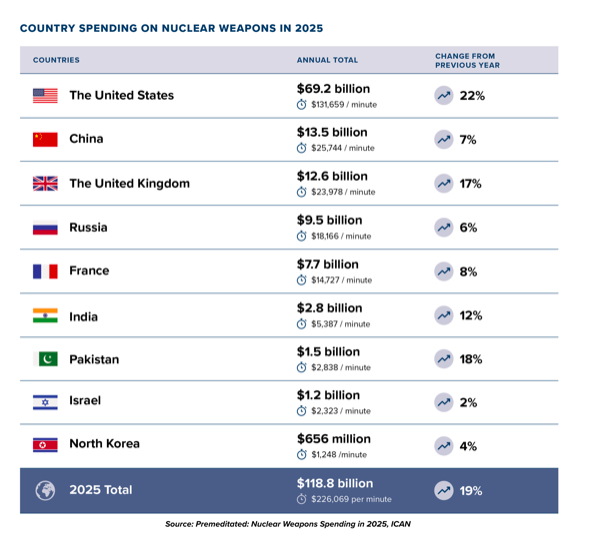
The 2025 ICAN report on nuclear weapons spending, released on 9 June 2026, presents a stark picture of global priorities. In 2025, nine nuclear armed states spent 119 billion dollars on their nuclear arsenals, a nineteen percent increase from the previous year, equal to 3,768 dollars every second (ICAN 2026, Executive Summary). These expenditures are not temporary. Many nuclear systems are planned to remain in service until the late twenty first century, and some even into the twenty second century. The report documents systems expected to operate until 2085, 2090, and in some cases 2120 (ICAN 2026, Long Term Projections). These figures reflect deliberate, long term investment in weapons designed to destroy cities.
For me, as a physician who has written for decades on the links between health, disarmament, and human security, these numbers are not abstract. They represent a profound distortion of global priorities. Nuclear weapons do not heal. They do not strengthen health systems. They do not protect families or communities. They consume resources that could save lives.
The contrast with global health financing is striking.According to WHO and the World Bank, achieving basic universal health coverage in low and middle income countries requires an additional 371 billion dollars per year (WHO and World Bank, Global Monitoring Report). Nuclear armed states spent nearly one third of that amount in a single year. The world faces a projected shortage of ten million health workers by 2030 (WHO Health Workforce Report). Training and deploying one million nurses costs about 26 to 30 billion dollars. The 2025 nuclear budget could have trained four million nurses, enough to stabilise health systems in many regions.
Two billion people lack access to essential medicines. Ensuring universal access to a basic package of essential medicines would cost between 80 and 100 billion dollars per year (WHO Essential Medicines Report). This is less than what was spent on nuclear weapons in 2025. The FAO estimates that ending global hunger requires 33 to 50 billion dollars annually. ICAN notes that the last three years of nuclear spending could have ended world hunger (ICAN 2026, Executive Summary). The 2025 spending alone could have funded thirty two years of the regular United Nations budget (ICAN 2026, Executive Summary).
Climate change adds another layer of urgency. Climate related disasters already cause hundreds of thousands of deaths each year and threaten to push an additional 100 million people into poverty by 2030 (World Bank Climate and Poverty Report). Health systems require major investment to build climate resilient hospitals, early warning systems, clean energy transitions, and heat preparedness plans. WHO estimates that climate related health harms will cost between 2 and 4 billion dollars per year by 2030 (WHO Climate and Health Fact Sheet). Yet governments continue to prioritise nuclear arsenals over climate adaptation. Every dollar spent on nuclear weapons is a dollar not spent on protecting communities from heat waves, floods, food insecurity, and vector borne diseases. Nuclear budgets are not only a threat to peace. They are a direct obstacle to climate resilience and the health of future generations.
These comparisons are not rhetorical devices. They are moral indictments. Nuclear weapons do not prevent pandemics. They do not reduce maternal mortality. They do not provide clean water or nutrition. They do not protect against climate driven health crises. They are instruments of mass death that divert resources from the infrastructures of life.
The ICAN report also exposes the political economy behind this distortion. At least twenty five companies earned thirty eight billion dollars from nuclear weapons work in 2025 and held more than four hundred billion dollars in outstanding contracts. These companies spent more than one hundred thirty eight million dollars on lobbying in the United States and France and held two hundred twenty six meetings with senior officials in the United Kingdom (ICAN 2026, Executive Summary). This is not simply defence spending. It is a system that shapes national priorities at the expense of global health.
As someone who has long argued that peace is a determinant of health, I believe the global health community must reclaim its historic role in disarmament. Physicians and health professionals helped expose the medical consequences of nuclear war in the past. Today, the stakes are no less urgent. Nuclear weapons threaten not only human survival but the financing of global health itself. As we all know, health is not merely the absence of disease but a state of physical, mental, and social well-being. Nuclear weapons threaten all three dimensions.
A world that can spend 119 billion dollars a year on nuclear weapons can afford universal health coverage, essential medicines, pandemic preparedness, climate resilient health systems, and nutrition for all. The barrier is not scarcity. It is political will. Redirecting resources from instruments of destruction to the infrastructures of life is the foundation of genuine human security, which is measured not by the capacity to destroy cities, but by the capacity to protect human life, dignity, and the conditions necessary for future generations to flourish.
Dr. Ghassan Shahrour, coordinator of the Arab Human Security Network, is a medical doctor and human rights advocate specializing in health, disability, disarmament, and human security. This article was originally published in CounterCurrents, and is republished with permission under their fair use policy.

 Bimal Khadka
 Bjorn Hilt
 Charles K. Johnson
 Dr. Ghassan Shahrour
 Gunnar Westberg
 IPPNW
IPPNW John Loretz
 Lawrence Wittner
 Maria Valenti
 mollymcgint
 Sue Wareham
 Tilman Ruff
 Tim Wright
 Xanthe Hall