“People who have visions should go to see their doctor”
The Horsemen ride again
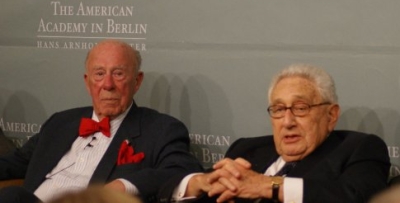
George Shultz and Henry Kissinger at the American Academy in Berlin
An article published on Znet by Darwin Bondgraham, Will Parrish and Nicholas Ian Robinson entitled “Full Court Press” prompted me to write this blog post. It appeared in the same week that I attended a “once-in-a-lifetime” meeting at the American Academy in Berlin between seven of the eight US and German “horsemen”, as we are wont to call them. That is, the elder statesmen Kissinger, Shultz, Perry and Nunn plus Schmidt, Genscher and Weizsäcker. Unfortunately the main thinker of the German group, Egon Bahr, was laid up in bed with fever and couldn’t attend.
In the Znet article, all those who have welcomed this mainstream vision of a nuclear weapon-free world are labelled “naiv” and as having committed “a major political and moral blunder” in believing that this was “a signal that the US national security state was poised to pursue an enlightened course of de-escalation toward eventual disarmament”. Now, I for one did not think that the Kissinger et al article in the Wall St. Journal, coming as it did more than two years before Obama won the US election, was an indication of US government policy to come. And I think that one might be forgiven for accusing many of us of believing too readily that Obama’s speech in Prague was just such an indication. But it seems that reform in the United States is as mammoth a task as it was for Michail Gorbachev to reform the Soviet Union, which – I remind you – collapsed in the process. And a jolly good thing it was too.
This very strong criticism on the part of Bondgraham and co. comes hot on the heels of the latest essay in the Wall St. Journal “How to Protect our Nuclear Deterrent”, which calls for the “maintenance of confidence in our nuclear arsenal” and argues for greater investment in the nuclear laboratories to do so. This article received a very bad response from the abolitionists around the world and quite rightly so, since it would appear on the surface that the US horsemen are contradicting their earlier vision. Indeed, it was unfortunate that they should – having spent so much effort on becoming anti-nuclear visionaries – resort to such pragmatic and tactical politicking. However, as I read the article, my first reaction was that it was not addressed to me, but to the 40 Republican and 1 independent Senators who were trying to hijack the not-yet-signed new START treaty by demanding a complete modernisation of the US nuclear arsenal be a condition of ratification. In stating their support of the findings of the JASON study, the Gang of Four were saying no to modernisation and yes to maintenance. As the Znet Gang of Three so aptly wrote: “The reality of nuclear weapons policy formation is much more complex and political” than it often appears.
Having said that, it is quite right not to herald the statements of the US elder statesmen as “anti-nuclear” or “abolitionist”. These are men who belong to the high church of nuclear deterrence and are true believers. The only reason that they can envision a world without nuclear weapons now is that they realise that nuclear deterrence will not work against the undeterrable. They are not prepared to concede for one moment that it was a mistake to rest our security for the last 65 years on such a dangerous policy that was repeatedly on the brink of collapsing into nuclear war. They do not agree that it is somehow immoral that their country should possess the means to destroy the planet many times over and other countries should not. They are deeply Conservative.
But on the other hand, in order to effect the major mindset change that is necessary to abolish nuclear weapons (and thereby open the way to common security), must we not effect this change across the board of political persuasion? Irregardless of whether these elder statesmen are willing to admit to mistakes made in the past, is it not better to nurture this first little sapling of change and help it to grow into something that advances our common goal – a nuclear weapon-free world? Look how far it has got us already: through their “vision”, the way was cleared for Obama to state that he also had this “vision” and then Medvedev agreed. Really good news is the new Russian military doctrine, just out, that states that “Russia reserves the right to use nuclear weapons in response to a use of nuclear or other weapons of mass destruction against her and (or) her allies, and in a case of an aggression against her with conventional weapons that would put in danger the very existence of the state.” No mention of “preventive” nuclear strikes after all. And now we are close to getting a new treaty for major nuclear arms reductions. This could easily be scuppered by the nuclear protagonists which is why the Gang of Four are lining up in front of it.
At the meeting in Berlin, the US horsemen explained – somewhat superficially – that they had a vision that they did not know how to achieve. So they are now in the process of working out what steps are needed. Here, the analogy of the mountain with its peak in the clouds was repeated, an analogy that has been very well countered by the description of the strategy used for conquering Everest of making a plan first and then executing the climb. But in both of these analogies the base camps are the nuclear disarmament and non-proliferation steps needed to go forward and upward. The questions that remain are these: which steps; can steps be taken in parallel; and how much of the full plan should be decided (and committed to) in advance?
We were reminded at the meeting in Berlin that Helmut Schmidt has often been quoted as saying that “people with visions should go and see their doctor”. Of course, he was being derogatory at the time, but we could turn this statement on its head by saying this: “They might have the vision, but we have the prescription”. And interestingly enough, it was General Klaus Naumann, one of the very High Priests of nuclear deterrence, who mentioned the prescription that evening in Berlin. Naumann is a member of the illustrious International Commission on Non-Proliferation and Nuclear Disarmament that produced its report “Eliminating Nuclear Threats” late in 2009 and presented it to the Conference on Disarmament recently. The report gives quite a lot of thought to the Nuclear Weapons Convention – our prescription for survival – while still not committing itself to being a proponent of it. Obviously Naumann thinks that the Convention is not a good idea and was looking for a condemnation of it from the Horsemen. He asked “does not the public desire for a Nuclear Weapons Convention pose a risk to a realistic approach to nuclear disarmament?” And Sam Nunn replied that we may well reach a point when a Convention would become plausible, but we are not there now. Nunn’s argument against the Convention is this: we shouldn’t focus on negotiating a new treaty right now but on getting the US and Russia to lead the way with disarmament.
This can be interpreted in two opposite ways and I’m sure it will be. Many abolitionists will say that Sam Nunn and the Nuclear Threat Initiative are blocking the way to a Convention. Or we could look at it differently and say that Sam Nunn and the ICNND are saying they think there needs to be more groundwork done before actual negotiation begins. But they are not saying there should not be a Convention at all, and that is a big difference from the past.
For those of us in Europe who are really interested in halting the modernisation of the US nuclear arsenal, the way forward lies in debunking the argument of the nuclear protagonists that the allies are the ones that want these weapons. That is why we have to take every available opportunity to get rid of the US bombs in Europe and close the nuclear umbrella worldwide. The proposed modernisation of the B61 bomb is still on the table and the money for the first study has been approved by Congress.
The really interesting thing about the US-German meeting of horsemen was not to be found at the event that I witnessed, but in private discussions to which I was not privy. But I am assured by those that are that the German four are pushing hard for movement on the US tactical nuclear weapons in Europe and on discussion of Medvedev’s proposal for a common security architecture. We have been here before, as I am reminded by reading Richard Rhodes’ excellent book “Arsenals of Folly”. Gorbachev picked up on the Bahr-Brandt idea of common security and made it a cornerstone of his international policy. It is often agreed that common security is needed in order to abolish nuclear weapons. But I would contend that it is the other way round: retaining nuclear deterrence as a basis for our security prevents us from achieving the common security that we desperately need in this world. And Gorbachev was also correct in perceiving that it was the military-industrial complex that is running that show. Just imagine what would happen to the arms industry if we were to go down the road of common security. Now that really would be an interesting vision. Perhaps we should go and see the doctor.
Indian Doctors for Peace and Development

The 8th National Conference of the Indian Doctors for Peace and Development (IDPD), the Indian affiliate of IPPNW, which began on 29 January 2010 with a peace rally outside Taj Mahal, called for the complete abolition of nuclear weapons, checks on the proliferation of small arms, resolution of issues through mutual dialogue, easing of travel to neighbouring countries by relaxation of VISA rules, and diversion of funds from arms race to health, education and development. The conference set an agenda for action in pursuit of the International Campaign to Abolish Nuclear Weapons (ICAN), effective steps to prevent climate change, and a people-oriented health policy.
The conference was inaugurated by Dr.Vappu Taipale, Co-President of International Physicians for the Prevention of Nuclear War (IPPNW) who lauded the efforts of the IDPD for sustainable peace in South Asia. Admiral Vishnu Bhagwat, former chief of Indian Navy in his address expressed skepticism that nuclear weapons will be abolished in near future as there is control of financial oligarchy on the institutions interested in the arms race. The struggle therefore has to be against them. Maj. Gen. (Retd.) Vinod Saighal said that the climate change is killing the world much faster than anything else. Therefore we must unite to combat this. Shri.Aziz Pasha-MP Rajya Sabha pointed out that India has a rich tradition of non violence and the great son of the soil Mahatma Gandhi whose martyrdom day falls on 30th January preached and practiced non violence which was a new concept of the contemporary world. Others who addressed the conference include Mrs.Amarjeet Kaur-National Secretary All India Trade Union Congress (AITUC) on ‘Women’s Initiatives for Peace’, Shri.Praful Bidwai – eminent journalist on ‘Climate Change Challenges Ahead’ and Shri Arjun Dev – a prominent historian on ‘Growing Intolerance an Impediment to Peace’.
The medical students who participated in large number from various parts of the country gave their presentations on several issues related to the theme of the conference ‘Building Future through Peace and Non Violence’. An ‘Ariel Conversations’ Video Conference was organized with Dr. Bernard Lown– Founding Co-President of IPPNW. Medical students put several queries to him, which Dr.Lown answered.
Dr.Tejbir Singh and Dr.Shakeel Ur Rehman gave presentations on National Health Policy and Health Right Bill 2009. The consensus of the conference was that there has to be increased public spending to ensure health care to each and every citizen. The conference also felt that whereas the health right bill is a step in the positive direction it requires amendments to ensure protection to the health providers. A committee will soon prepare a document which will be submitted to the health minister.
Dr Arun Mitra
Politics is the art of the possible.
According to a recent article in the Wall Street Journal (WSJ) by Vice President Joe Biden, President Obama intends to increase the funding for the Nuclear Weapons Laboratories by approximately 5 billion dollars over the next five years. The laboratories shall work on means to prolong the active life span of the nuclear charges.
This project is technically and militarily meaningless. In the article in WSJ there are quotes from the JASON report to the government, written by prominent physicists and weapon experts. The report confirms that nuclear weapons have shown no sign of deteriorating reliability. They will function as intended. And they are and remain secure: They will not explode unintentionally.
Of course, it is of little importance if the reliability decreases from 99% to 90% or less. That would not decrease their effects as deterrent. Do we know the reliability of the Russian strategic nuclear weapons? Certainly not, but that does not decrease their capacity to threaten. The reliability of the missiles and of the systems for intelligence, control and command is much more important.
William Perry who was Secretary for Defense to President Clinton took part in a commission which recently advocated a great increase in the support for the Nuclear Weapons Laboratories. The same opinion was expressed in a paper in WSJ by “The four apostles” Shultz, Kissinger, Nunn and Perry a couple of weeks ago. They argued that as long as the USA has nuclear weapons these must be reliable. It seems these four statesmen now place the vision for a world without weapons into a distant hazy future.
In an interview with Mr. Kissinger in the French newspaper Le Figaro last November he says that, of course, a nuclear weapons free world is generations away. Yes, it is, if we want it so. Then maybe the nukes will abolish us, while we discuss how fast we shall abolish them.
I do not know what means the supporters of the weapons laboratories have used to further their continued prosperity. One argument is recurring: The labs are needed to attract new researchers to their work, thus maintaining the competence. This is difficult nowadays when the lure of an atomic test explosion as the final examination test for the weapons designer has been denied. We do not know when we need to develop new nuclear weapons…
The President’s dedication to the work for a nuclear weapons free world seems to be waning. Politics is the art of the possible, say some, and he might have found it necessary to throw this piece of pork to the senators who love the bomb and the bomb makers. Obama wants to get the ratification of the Comprehensive Nuclear Test Ban Treaty, an important part of the work to prevent proliferation of nuclear weapons, through the Senate where it has been blocked since the time of Clinton. Obama knows too that there will be demands for new nuclear weapons, which he pledged during his election campaign not to accept. Mr. Gates, no one less, spoke for a new type of nuclear warheads recently, but was quickly censored. The President also wants the successor to the START agreement on a decrease of the strategic nuclear weapons to be agreed with Russia.
The resistance against President Obama is strong on all these three points. A few billion dollars to the weapons laboratories, out of the trillion used for the military, may help certain senators to look with less disfavor at the President’s proposals. He needs every vote.
Gunnar Westberg
Past Co-President of IPPNW
Who were those masked men?
The US gang of four has ridden off into the sunset.
Three years ago George Shultz, Henry Kissinger, Sam Nunn, and William Perry galloped into town on white horses, their badges gleaming, ready to round up and eliminate every nuclear weapon in sight. In a widely read article published by The Wall Street Journal in January 2007, they declared themselves advocates of “the vision of a world free of nuclear weapons,” which they called “a bold initiative consistent with America’s moral heritage.”
Those of us who had been working for the abolition of nuclear weapons for decades scratched our heads and asked ourselves privately whether there was less to this late-in-life conversion than met the eye. Publicly, we embraced the cross-over abolitionists, who were joined in succeeding months by other gangs of four (or five, or six) in the UK, Germany, Norway, Australia, the Netherlands, Poland, and even France. After all, why question the motives of some erstwhile cold warriors when their words had energized a struggling movement?
The US horsemen mounted up again one year later, but apparently had some trouble finding the road. “Without the vision of moving toward zero,” they reiterated in January 2008, “we will not find the essential cooperation required to stop our downward spiral.” Yet a nuclear-weapons-free world, they fretted, was at “the top of a very tall mountain,” not visible from our present vantage point. They insisted that we keep pushing forward to higher ground, but seemed stuck in a quagmire of inadequate near-term arms control proposals. Civil society abolitionists offered a detailed trailmap to the top of the mountain — the model Nuclear Weapons Convention — but the gang seemed more comfortable tethering their horses at base camp.
This week Shultz, Kissinger, Nunn, and Perry broke camp and headed back to the nuclear reservation. The headline of their third Wall Street Journal piece drops like a whole warehouse of shoes: “How to protect our nuclear deterrent.” Their call for urgent steps toward a world without nuclear weapons is almost wholly replaced by an argument for “[urgently needed] investments in a repaired and modernized nuclear weapons infrastructure.” Judging by the smell, the horses have been standing in one place for too long.
Somehow we are supposed to connect the dots between rearmament and disarmament. The logic — to stretch definitions very thin — seems to go something like this: The same facilities and technologies the US needs to maintain a “reliable” nuclear force “for as long as the nation’s security requires it” will — presto change-o — serve “the long-term goal of achieving and maintaining a world free of nuclear weapons” equally well when the time comes. Which is when, exactly? When we no longer “require” the things that most endanger us?
The gang can’t have it both ways. They can choose to cast their lot (and ours) with deterrence and continue to believe that “reliable” nuclear weapons reduce nuclear danger by dissuading others from using their own nuclear weapons, in which case we might as well stop worrying about proliferation; or they can finally recognize that deterrence is a bankrupt policy incompatible in every respect with progress toward a nuclear-weapons-free world, and that getting to zero requires planned and irreversible obsolescence of the weapons, the infrastructure to make them, and the justifications for clinging to them.
ICNND report: right goals, wrong pace for getting to zero
The International Commission on Nuclear Non-proliferation and Disarmament (ICNND) released its long-awaited final report on December 15 after more than a year of consultations and deliberations. The report contains some welcome, though familiar recommendations — especially on near-term disarmament measures such as substantial US-Russian reductions, delegitimizing nuclear weapons as part of security policy, and removing weapons from launch-on-warning status — but falls short on eliminating the nuclear threat.
The Commission advocates reducing current arsenals by around 90% by 2025. This would still leave 2,000 nuclear weapons in the world — far more than enough to cause a sudden global cooling from nuclear explosions over large cities, killing tens of millions of people and triggering catastrophic famine.
The International Campaign to Abolish Nuclear Weapons (ICAN) stated that “the recommendations do not go far or fast enough towards getting the world to zero nuclear weapons.”
ICAN Australia Chair and IPPNW Board member Tilman Ruff said, “What is needed is a clear roadmap to eliminating and outlawing nuclear weapons. ICAN along with many other civil society organisations around the world advocates a Nuclear Weapons Convention (NWC), a comprehensive global treaty to get the world to zero nuclear weapons.
“While the Commission recognises the need for a NWC, it does not envisage one being negotiated until around 2025. This undermines the urgency of getting to zero.”
The report also heavily promotes nuclear power without sufficiently addressing dangerous proliferation risks. “Achieving and sustaining a world free of nuclear weapons,” Dr. Ruff added, “would be much easier and quicker in a world in which nuclear power was being phased out.”
The full ICNND report, a synopsis, and other materials can be found on the Commission website.
Non-governmental organizations, including IPPNW, have prepared an analysis of the report, in which they state:
Governments should take the report’s recommendations seriously, but aim to implement them ahead of the timetable outlined in the report.
“The biggest reason for our disappointment is that the report failed to draw a practical path to nuclear abolition as an urgent and achievable goal. The report aims for a “minimization point” by 2025, when there should be fewer than 2,000 nuclear weapons in the world. Beyond that, no process or timetable for moving to zero is presented. There is a risk that such an agenda might have the effect not of advancing the goal shared by the Commission of a world free of nuclear weapons, but of being used to perpetuate a world where fewer nuclear weapons are maintained indefinitely.”
By envisioning a world of peace, we will help create it
By Andrew S. Kanter
I, like many people, spent the early part of this morning in bed watching President Obama receive the Nobel Peace Prize. I was struck by the contrasts and conflicting aspects of his speech. I was only a medical student working for IPPNW when I attended the Nobel ceremonies in 1985. I had been a long time member of PSR since my undergraduate days at UCLA, but had only recently taken a year before entering medical school to become the IPPNW Medical Student Liaison. This was the first time that a medical student was working full-time with the organization, and I was honored to be included in the 1985 Peace Prize ceremonies in Oslo.
Read the entire entry on the PSR nuclear weapons blog.
By Ira Helfand
President Obama’s Nobel address was not the speech that many of us had hoped for. He did state again his commitment to nuclear disarmament, but it was a point made almost in passing, and he certainly did not use the address to build the case for eliminating nuclear weapons nor to lay out a plan for achieving this aim.
Having said that, the speech was an extraordinarily thoughtful meditation on issues of war and peace. The address is referred to formally as the Nobel Lecture and the President seems to have taken the title very literally. He began by addressing the irony of a leader at war receiving the Peace Prize, much as he began his address at the Notre Dame graduation this May by acknowledging the opposition to his invitation there by abortion foes. And, as was the case at Notre Dame, he did not offer a facile response to the situation.
Many may disagree with his willingness, under certain circumstances, to use force in the pursuit of peace, but his arguments were substantive and eloquent, and it is hard to doubt the decency of his intentions.
In retrospect this may be just the speech that he needed to give at this point and from this place. It was a clear but nuanced statement of the approach he intends to take towards issues of war and peace and a useful insight into the policies he is pursuing, and it was warmly greeted by the audience here in Oslo that gave him a prolonged standing ovation.
But if this was the speech the President had to give today, there is another speech he has to give soon. His commitment to nuclear disarmament needs to be made more concrete, and the case for nuclear disarmament, which he will argue from the perspective of US national security interests, needs to be spelled out more clearly. The slow pace of the START negotiations, which failed to produce a follow on agreement before the old treaty expired last week, is not a cause for despair and it does not indicate a lack of commitment by the US or Russian governments. But it does underline the need for high level attention to, and direction of, the administration’s efforts to eliminate nuclear weapons if these efforts are to move forward with the urgency and speed which ending the threat of nuclear war requires.
Oslo is getting ready for tomorrow’s Nobel Award
By Ira Helfand

Ira Helfand speaks about a nuclear-weapons-free world on the eve of the Nobel Peace Prize ceremony
This evening a number of organizations sponsored a forum “How to Build Momentum towards a Nuclear Weapons Free World.” Alyn Ware, the coordinator of Parliamentarians for Nuclear Non-proliferation and Disarmament, and I were the speakers.
I discussed the unique situation we are in with a US President who seems to share our understanding of the urgent need for nuclear disarmament, and identified an ongoing failure to appreciate the scope and immediacy of the nuclear danger as the key road blocks to a real transformation of nuclear policy.
Alyn spoke about the experience of New Zealand where a strong national understanding of these dangers was created leading to New Zealand playing a major leadership role in movement for nuclear disarmament. He also discussed the need for US allies to make clear that they do not want a US nuclear umbrella in order to counter the growing argument that the US needs to maintain its huge nuclear arsenal to meet our obligations to our allies and to dissuade them from developing their own nuclear arsenals.
Norway is emerging as a potentially pivotal player in the upcoming Non Proliferation Review Conference. The Foreign Minister has said that if the NPT conference does not go well, Norway will seek negotiations for a Nuclear Weapons Convention outside the NPT framework. The attendees at the meeting also spoke about the vocal role Norway can play in the NATO review of nuclear policy currently underway.
The forum was sponsored by the Norwegian Atlantic Committee, The Norwegian Peace Council, No to Nuclear Weapons, The Norwegian Pugwash Committee and IPPNW Norway.
Tomorrow, the peace community is planning a torch light procession to the Grand Hotel where President Obama will be staying and where the Nobel Dinner will take place. There will also be a second march which will protest US and NATO presence in Afghanistan.
There is a lot of speculation about what Obama will say in his address which takes place at 1 pm Oslo time.
I’ll update you after the speech.
Update from Oslo
CNN has published a piece by IPPNW board member Ira Helfand, urging President Obama to use his Nobel Address to reaffirm his commitment to a world free of nuclear weapons.
“The abolition of nuclear weapons is not an unrealistic fantasy,” Dr. Helfand writes. “It is a practical necessity if the American people are to have a secure future. President Obama should use his Nobel speech this week to reaffirm his commitment to this essential and obtainable goal.”
You can read the entire article here.
Dr. Helfand makes reference to a study entitled “Projected US casualties and destruction of US medical services from attacks by Russian nuclear forces.” The paper can be found here, on the IPPNW website.
Dr. Helfand is in Oslo this week, representing IPPNW and US affiliate Physicians for Social Responsibility at the Nobel ceremony.
President Obama’s Nobel Address on Thursday may be much more than an inspiring speech
by Ira Helfand
[Dr. Ira Helfand, a member of the boards of both IPPNW and its US affiliate, Physicians for Social Responsibility, will be attending the Nobel Peace Prize ceremony in Oslo on December 10, when President Obama joins IPPNW as a Nobel Laureate. Dr. Helfand will blog from the event, and sent this first entry en route to Oslo.]

Ira Helfand will represent IPPNW and PSR at the 2009 Nobel Peace Prize ceremony in Oslo
The Nobel Committee has invited me to attend the award ceremony and dinner in Oslo this week to represent the International Physicians for the Prevention of Nuclear War and our US affiliate Physicians for Social Responsibility. This year marks the 24th anniversary of our receiving the Nobel Peace Prize for the work we did alerting the world to the medical consequences of nuclear war. Their invitation this year highlights our ongoing work to secure the abolition of nuclear weapons and to achieve a number of interim step towards that goal such as final ratification of the Comprehensive Test Ban Treaty.
We’re hoping that the President’s speech will include concrete commitments that show the United States is committed not just to the vision of a world free of nuclear weapons but to the steps needed to get there. In Prague this past spring the President called for a world free of nuclear weapons, but said that it might not be achieved in his lifetime. That wording left many supporters of nuclear abolition wondering how committed the President was to an international treaty—or convention—that would ban all nuclear weapons.
The President’s appearance at the UN in September, and the unexpected insertion of a call for nuclear disarmament in his speech on Afghanistan last week, suggest that he is actually committed to abolition as a practical real time goal.
His address at the Nobel Prize ceremony this week may help to answer the question more clearly. It provides a high profile opportunity for him to reaffirm his commitment to the elimination of nuclear weapons, and to signal whether he is going to work for a treaty to accomplish this. It also gives him the chance to spell out why nuclear abolition is necessary for the security of the American people and all humanity. If he seizes the opportunity this year’s Nobel Address may be truly historic.
I will be blogging from Oslo as the week’s events unfold and hope to be able to report to you further evidence that President Obama is indeed committed to securing the elimination of nuclear weapons. I encourage you to share your thoughts about this historic moment for nuclear disarmament. What would you like to hear the President say?

 Bimal Khadka
 Bjorn Hilt
 Charles K. Johnson
 Dr. Ghassan Shahrour
 Gunnar Westberg
 IPPNW
IPPNW John Loretz
 Lawrence Wittner
 Maria Valenti
 mollymcgint
 Sue Wareham
 Tilman Ruff
 Tim Wright
 Xanthe Hall