In his famous speech in Prague in April 2009, President Barak Obama presented us with his vision of a world free of nuclear weapons. He emphasized that the USA would lead the world towards this goal. He foresaw, however, that this goal would maybe not be reached in his lifetime. Considering that the 48 years old President statistically has a 50% chance of living for 30 more year, adding a few years if he does not relapse into smoking, this was not an optimistic prediction. Can the world survive another three decades with nuclear weapons?
Even more ominous was his statement that ”as long as these weapons exist, we will maintain a safe, secure and effective arsenal to deter any adversary, and guarantee that defense to our allies”. Does that mean that the US will be the last to abolish nuclear weapons?
During the year since this inspiring speech the vision of US leadership to a world without nuclear weapons has faded. This is somewhat surprising as such a world would be clearly in the interest of the USA. In that world, without the great equalizer of atomic weapons, US military superiority would be unchallenged. This was clearly the goal of the proposals from the four elderly statesmen Shultz, Perry, Kissinger, and Nunn in their article in the Wall Street Journal in January 2008.
I will not here try to analyze the reasons why the USA has given up the leadership on this road. Instead I will show in recent documents that the rhetoric remains but the concrete commitments are missing. Read more…
As an NGO participant at the Fourth Biennial Meeting of States (BMS), which was convened to review implementation of the UN’s action plan to combat the illicit trade in small arms and light weapons, IPPNW had an opportunity to address the conference on Thursday, June 17, during a special civil society session.

Emperatriz Crespin, a physician from El Salvador working with IPPNW's Aiming for Prevention campaign, addresses the Biennial Meeting of States at the UN on June 17, 2010.
Dr. Emperatriz Crespin, a physician and activist from El Salvador, told the states parties to the meeting about the public health impact of armed violence and about the role physicians play not only in treating the victims and assisting with their rehabilitation, but also in documenting the broader social dimensions of the problem.
Dr. Crespin noted that the Programme of Action, while it addresses the human health consequences of armed violence, contains no specific actions focused on improving public health outcomes. Referring to a policy paper released at the BMS by IPPNW as part of its Aiming for Prevention campaign, she recommended that states incorporate public health strategies into national action plans. The Programme of Action, she said, should reflect the need for a comprehensive supply and demand approach to control small arms and light weapons proliferation, to recognize that health and development are intricately linked, and to implement national collections of data on gun-related deaths and related costs.
Some excerpts from the policy paper:
“Armed violence has been recognized as a humanitarian crisis and a threat to development, but the dimensions of the problem are poorly understood. Despite the comprehensive nature of the UN Programme of Action (UNPoA) on small arms, the implementation of efforts around this document have been rather narrowly focused on arms management issues….
“Sustained high injury and death rates for violent injury require a public health commitment to develop and support action-oriented research, with a goal of collecting data on armed violence injuries and then using it to help formulate prevention policies at all levels, and which can help define successful measures for interventions. It is important to understand the context in which homicides and violent injuries occur in different countries. It has been recognized that several modalities of interpersonal violence occur in a complex interplay of individual, relationship, social, cultural and environmental factors. This approach for understanding the multiple levels of interaction has been defined as the ‘ecological model’.
“A public health approach to small arms injury focuses on the risk factors driving armed violence and the health effects of gun violence, and brings into the arena the public health community’s emphasis on scientific methodologies and prevention. Public health groups work with many sectors of society promoting a variety of measures that can reduce the frequency and severity of shooting injuries…..
“We recommend the following as a basic action agenda to help states incorporate public health strategies into their National Action Plans.
- UN PoA outcome documents should refer explicitly to the need for a comprehensive supply and to the control of small arms & light weapons proliferation. demand approach
- Recognize that health and development are intricately linked as highlighted in the Millennium Development Goals and the Geneva Declaration, and encourage states to invest in prevention programs by integrating public health strategies into National Action Plans, including those related to development, health and poverty reduction.
- Ensure health representation on National Commissions on Small Arms, and that at minimum the Ministry of Health is represented and ideally an NGO member of the health community as well, to help assess the most strategic investments based on highest needs.
- Implement national collection of data on gun-related deaths and related costs, needed to guide prevention planning, identify high-risk groups and areas, and to monitor the effects of interventions. Support hospital- and community-based research projects to provide details on gun-related injuries, which are needed to identify risk and resilience factors, and assure proper prevention and management of victims. The cost of this should be included National Commission budgets.
- Increase support for victim assistance programs that include comprehensive follow-up to ensure productive reintegration of individuals into society.
- Educate the medical community, students, the media, the public, and policy makers about the public health burden of gun-related injuries.
- Encourage more involvement of the injury prevention community in gun-related injury prevention. This group can help to apply decades of experience with public health approaches to the prevention of injuries from small arms and light weapons.
The complete policy paper, Prescriptions for Prevention: A Public Health and Human-Centered Approach to Reducing Armed Violence and Promoting Health, Development, is available here.
An in-depth summary of the NGO statements to the BMS, prepared by the UN Department of Public Information, is on the DPI website.
Joint Statement on Gaza
Joint Statement on the Armed Assault on Ships to Gaza
Palestinian Physicians For the Prevention of Nuclear War (PPPNW) and the
Israeli Physicians For Peace and the Preservation Of The Environment (IPPPE)
Affiliates of International Physicians For the Prevention of Nuclear War,
Agree as follows:
Our two organizations condemn the armed assault in international waters on ships carrying humanitarian aid to Gaza and deplore the resulting loss of lives.
As physicians on both sides, we agree that the health of the population of Gaza is of deep concern and that medical aid is urgently needed.
We are calling for an international inquiry into this incident, and an immediate end to the blockade of Gaza.
We call upon the Israeli and the Palestinian leaders to enter into serious negotiations in goodwill to find a nonviolent, peaceful resolution of the Israeli-Palestinian conflict.
Dr. Abdelaziz Alabadi, MD — President, PPPNW, Palestine
Prof. Ernesto Kahan M.D. — President and Councilor, IPPPE, Israel
Dr. Mustafa Ghanim, MD, PhD— External Relations, PPPNW, Palestine
Dr. Ra’anan Friedmann M.D., Ph.D. — Vice President, Vice Councilor and Spokesman, IPPPE, Israel
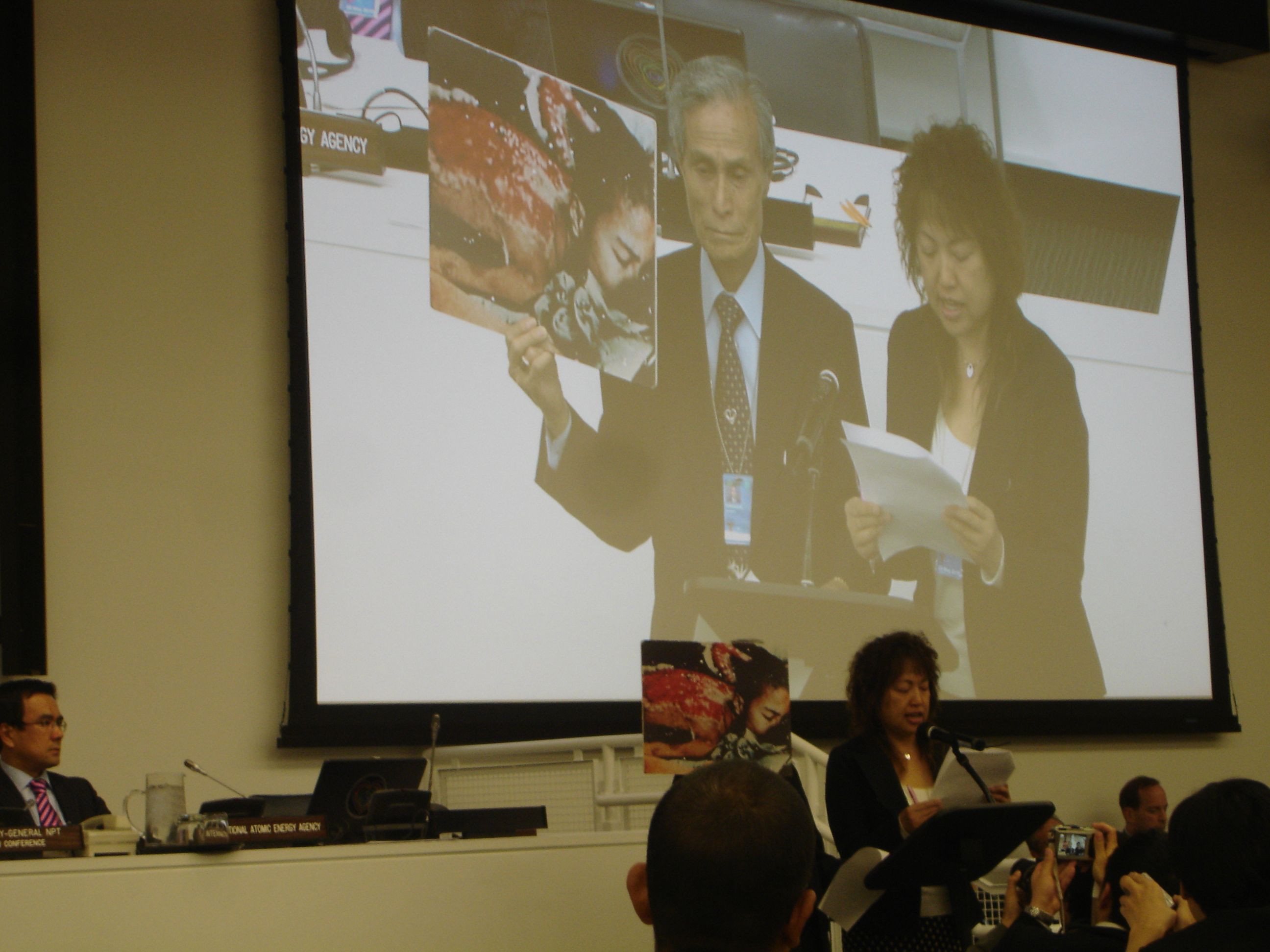
Nagasaki survivor Taniguchi Sumiteru shows the assembled diplomats a graphic photo of the injuries he sustained when he was 16 years old. "Please don't turn your eyes away from me...I cannot die in peace until I witness the last nuclear warhead eliminated from this world."
The only clear point of consensus at the outset of the five-year review of the Treaty on the Non-Proliferation of Nuclear Weapons (NPT), which took place last month in New York, was that it had to succeed. The collapse of the 2005 Review Conference and the lack of progress on nearly every one of the 13 steps adopted as an action plan for disarmament in 2000 haunted the month-long deliberations. “Failure is not an option,” was a refrain among diplomats who feared that one more blocked or insubstantial outcome would cause the Treaty as a whole to unravel.
Definitions of success, however, were elusive, to say the least. For the thousands of NGO and civil society representatives who descended upon the conference with a single purpose, success meant emerging with a call for a serious, comprehensive, and accelerated plan for nuclear disarmament—something that the nuclear-weapon states have resisted throughout the NPT’s troubled 40-year history. NGOs were joined in this demand by a growing number of vocal and insistent non-nuclear-weapon states. According to Tim Wright of the International Campaign to Abolish Nuclear Weapons (ICAN), 28 individual NPT member states[1] and the Non-Aligned Movement group as a whole (116 states) called for work to begin on a Nuclear Weapons Convention in their conference statements and working papers.
The NPT nuclear-weapon states (the P-5) and their allies defined success as recognition of the reductions they have already made in their strategic arsenals since the end of the Cold War, acknowledgment of their good intentions regarding disarmament in the future, and agreement with their view that compliance, enforcement, and safeguards to strengthen the Treaty’s non-proliferation provisions required the most urgent action. The message from the P-5, while presented without the hostility and rancor on display five years ago, was essentially the same as it was in 2005: “proliferation of nuclear weapons (especially in Iran) has to be stopped before we can even consider going to zero ourselves.” This was one of the major fault lines around which the 2010 Review Conference might have fractured.
Another was the whole question of the Middle East, specifically the resolution calling for negotiations on a Middle East nuclear-weapon-free zone, without which the NPT could not have been extended indefinitely in 1995, and which has been in limbo ever since. The resolution is a virtual minefield for a number of reasons. As one of three nuclear-weapon states that have never joined the NPT, Israel does not acknowledge its arsenal and has been unwilling to engage in any negotiations about nuclear weapons or other weapons of mass destruction in the region that are not linked to Middle East peace as a whole. Iran, as it has in the past, pressed for condemnation of Israel and threatened to block the outcome document unless it singled Israel out for criticism. Since the NPT operates by consensus and failure was “not an option,” this challenge had to be taken seriously.
There was no debate at all, among the member states at least, about the “inalienable right” to nuclear technology for peaceful purposes asserted in Article IV of the Treaty. One delegate after another, using almost identical language, cited a growing worldwide demand for nuclear-generated electricity—especially in the emerging economies of the global south—and stressed the importance of promoting expanded access to nuclear fuel without adding to proliferation risks. More than one NGO representative commented that this NPT conference looked like a salesroom for the so-called nuclear renaissance. Most NGOs took an entirely different position, criticizing nuclear energy not only on familiar health, environmental, and security grounds, but also as an outdated, economically unviable means to provide the world’s energy needs while protecting the Earth’s climate. As an alternative, NGOs called for universal participation in the International Renewable Energy Agency (IRENA), and for a crash program of investments in clean, renewable energy sources that could leapfrog over the nuclear “option” and supersede Article IV.
The 2010 Review Conference, in sharp contrast with the debacle in 2005, was characterized from the opening gavel by a sense of optimism that serious ideas about disarmament and non-proliferation could get a serious and respectful airing. A lot of the credit for this more collegial atmosphere was given to the US, which came to the Review pocketing a new START agreement with Russia, a new Nuclear Posture Review asserting that the elimination of nuclear weapons is the ultimate goal of US policy, a pledge to submit the Comprehensive Test Ban Treaty (CTBT) to the Senate for ratification, and a surprise report on the size and structure of the US nuclear arsenal, accompanied by a challenge to the other nuclear-weapon states to do the same for the sake of transparency.
None of the nuclear-weapon states, however, including the US, were willing to look beyond short-term, incremental steps—what NGOs and many non-nuclear-weapon states see as ongoing delaying tactics—and the P-5 (or at least the P-4, since China’s position is a bit more ambiguous) were united in demanding airtight non-proliferation machinery as a pre-condition for their own disarmament. Of even greater concern to NGOs and to non-nuclear-weapon states are the modernization plans of all the nuclear states, with the US, in particular, planning to spend $180 billion over the next several years on its nuclear weapons labs, manufacturing infrastructure, and delivery systems. So while the new US attitude was welcomed, another commonly voiced opinion was that the disarmament steps taken by the P-5 so far were insufficient and that much deeper reductions were needed at a much faster pace.
The most important development at this Review Conference was the outspokenness of a growing number of states about the need to move beyond the NPT itself to a Nuclear Weapons Convention. As recently as the 2009 NPT PrepCom, a treaty that would actually eliminate nuclear weapons was largely dismissed as an unrealistic project of Costa Rica, Malaysia, and abolition-minded NGOs. Even NPT member states frustrated by the lack of progress on disarmament had shied away from the Convention as a premature initiative or as something that could undermine the NPT.
This time, with states such as Austria, Norway, and Switzerland expressing much-needed European support for a Nuclear Weapons Convention, the idea could no longer be swept under the rug. A majority of NPT member states, backed by a strong and sympathetic Conference president—Ambassador Libran Cabactulan of the Philippines—pressed hard for references to the NWC in the conference outcome document. They prevailed, and the Convention was noted in both the summary portion of the document and in the recommendations. The P-4 (China has consistently said it supports the idea of a convention) were unhappy with this result, but they did not block it.
The real drama came on the last day of the conference, when the plenary session to approve the final document was postponed twice until late afternoon. The Iranian delegation, as we learned, had instructions from Tehran to block consensus on the outcome, ostensibly because Iran was dissatisfied with the language about the Middle East resolution and because the disarmament recommendations were not strong enough. Several hours of intense negotiations behind closed doors were required to persuade Iran that another failed NPT Review was in no one’s interest. In the end, Iran joined the consensus and the 28-page final report (available at Reaching Critical Will) was adopted.
At the end of the day, the “success” of the 2010 NPT Review had little to do with finding consensus for an outcome document, or reestablishing a sense of collegiality among the member states, or reaffirming commitments to disarmament made in 1995 and 2000. For IPPNW, ICAN, and the global community of abolition NGOs, success means that a majority of NPT member states have now expressed an interest in looking beyond the NPT itself and some of them appear ready to work actively for a comprehensive treaty to eliminate nuclear weapons. Forging new working relationships with those states and others in an effort to move the abolition agenda further than it can be moved through the NPT process is the task ahead.
[1] Algeria, Austria, Brazil, Chile, China, Colombia, Costa Rica, Cuba, Egypt, Holy See, Indonesia, Iran, Kenya, Lebanon, Libya, Lichtenstein, Malaysia, Mexico, Mongolia, Morocco, Norway, Philippines, Qatar, Senegal, Switzerland, Thailand, Tunisia, Yemen
NPT outcome: We did it!
After days of excruciating negotiations, often long into the night, threats that the outcome document would be blocked, a series of postponements on the final day, and confusion and uncertainty right up until Conference President Cabactulan dropped his gavel, the 2010 NPT Review adopted a final report accompanied by an action plan that makes two explicit references to a Nuclear Weapons Convention as a way to pursue a comprehensive approach to nuclear disarmament and the fulfillment of Article VI of the NPT.
While a significant gap remains between naming the Convention and recommending a specific workplan to achieve a nuclear-weapons-free world with the Convention as its foundation in international law, this is the first time the Convention has been formally included as part of the NPT outcome. Even more important is the path by which it got there. A determined effort by states who would not take no for an answer, a sympathetic (more than that…enthusiastic) Chair, and a cadre of NGOs who started months ago to persuade state delegations that the Convention’s time had come and that they could be in the vanguard, made this happen.
This is only a beginning. The nuclear-weapon states continue to focus on small steps, and some of them resisted inclusion of reference to the Convention all month, which is why the final report only “notes” interest in the NWC rather than endorsing or recommending it. But we now have an important rebuttal to anyone who claims in the future that advocating the Convention is naive or premature. The NPT member states themselves have now brought the NWC out of the shadows.
Detailed analysis of the document will come later, and my train to Boston leaves in 15 minutes. So please forgive the breathless summary. To everyone in IPPNW and ICAN who worked so hard for this result: we did it!
[Physicians for Social Responsibility, IPPNW’s US affiliate, has sent the following letter to President Barack Obama, urging the US to take advantage of “an historic opportunity” to make nuclear abolition “an attainable reality.” Specifically, PSR has urged the US to support a call for a Nuclear Weapons Convention in the outcome statement from the Review Conference.]
President Barack Obama
1600 Pennsylvania Avenue NW
Washington, DC 20500
Dear President Obama,
Since taking office last year you have positively transformed the international debate about nuclear weapons. Your historic call for a world free of nuclear weapons has reverberated around the globe. Faster than many of us thought possible, the call for nuclear abolition has been taken up by leaders around the world, and what once seemed like a distant dream now seems like an attainable reality. Read more…
The NPT identity crisis
What is this NPT Review Conference all about? You might as well ask someone with multiple personality disorder to fill out a short biographical questionnaire.
 The disarmament personality – let’s call her “Abby” – wants the Conference to produce nothing less than a roadmap to a nuclear-weapons-free world. Abby, however, is having a hard time settling on whether the roadmap is a ramped up version of the 13-step action plan adopted in 2000, or Secretary-General Ban Ki-moon’s 5-point disarmament plan, or the Nuclear Weapons Convention, which looks beyond the NPT itself to the actual fulfillment of Article VI.
NGOs have been advocating the comprehensive approach outlined in the Model NWC, which has also found favor with the Secretary-General and with dozens of NPT states who have endorsed it in their Conference statements. In any case, Abby doesn’t much care for the one-step-at-a-time swamp in which the nuclear-weapon states are still mired, even with their newfound commitment to a world without nuclear weapons.
Laying down the law on nuclear disarmament
by Tim Wright
The tired old mantra of arms control and incremental steps is still dominating discussions at the NPT Review Conference, despite the growing push for a Nuclear Weapons Convention. All too many of the non-nuclear-weapon states seem content in seeking only the most modest action on disarmament. Their calls, for the most part, lack any sense of real urgency — even though it is clear that meaningful action for abolition is needed now, and cannot continue to be postponed.
We must delegitimize nuclear weapons
 by Tim Wright
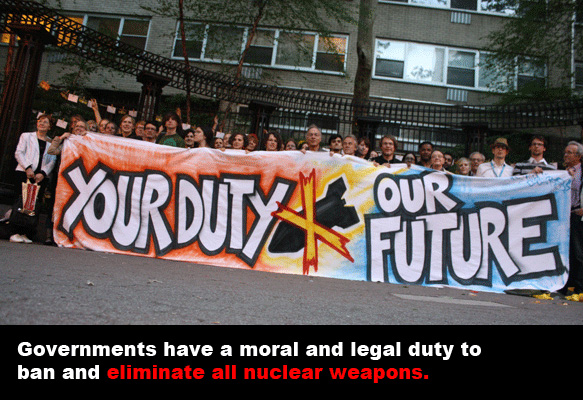
More than four decades have passed since the NPT entered into force. Yet today many governments, particularly those in the Western Group, continue to regard nuclear weapons as legitimate instruments of national security. The few “privileged” states that possess nuclear weapons still attach great prestige to them.
If we are to succeed in the campaign to abolish nuclear weapons through a binding convention, we must effectively break down the perception of these weapons as the ultimate expression of state power. They are, in reality, instruments of terror. The process of negotiating a convention would itself have a delegitimizing effect also.
If students can do it, why not the diplomats?
by Tim Wright
Negotiations began yesterday on a Nuclear Weapons Convention — but not among governments, unfortunately. Thirty university students from Hamburg, Germany, took part in the first day of a simulation exercise organized by the International Network of Engineers and Scientists Against Proliferation. The students have found it to be a valuable learning experience, but it might also teach disillusioned diplomats lessons on how it can be done.
“Not good enough”
As Norway pointed out yesterday, the current rate of progress towards a nuclear-weapon-free world is just not good enough. “After 65 years with nuclear weapons and 40 years with the NPT, we cannot claim that we are where we should be with nuclear disarmament … We must establish a new international nuclear agenda with an action plan for nuclear disarmament with clear benchmarks and deadlines holding us all accountable.”
Norway argued that, if governments are to succeed in implementing Article VI of the NPT and achieve the complete elimination of nuclear forces, they will need to negotiate an additional legal instrument. “This is a topic which is becoming increasingly relevant and important,” it said. “We are likely to see more discussions on this matter in the time to come.”
A legal obligation
Indeed, yesterday in Main Committee I, the need for negotiations on a Nuclear Weapons Convention once again featured prominently, with Egypt, Malaysia and Libya, among others, raising the call. New Zealand — which votes in favour of the annual UN General Assembly resolution on a convention — welcomed the UN Secretary-General’s “strong push in his five-point plan for progress towards a world free of nuclear weapons”.
Last year, 124 governments — roughly two-thirds of all UN member states — backed the General Assembly resolution, which is a follow-up to the International Court of Justice’s landmark advisory opinion on the legality of the threat or use of nuclear weapons. The court held, unanimously, that governments have a legal obligation to achieve nuclear disarmament in all its aspects under strict and effective international control.
In addition to the legal obligation, they also have a moral responsibility to present and future generations to succeed.
Tim Wright is the ICAN – NWC Project Coordinator




 IPPNW peace and health blog