Nuclear preparedness? ICAN responds in Oslo
[At the conclusion of the third session of the international conference Humanitarian Impact of Nuclear Weapons, ICAN Co-Chair Akira Kawasaki read the following statement addressing the question of whether it is possible to respond to the consequences of the use of nuclear weapons and, if not, what is the alternative.]

ICAN co-chair Akira Kawasaki addresses the Oslo conference
Following the discussions of the past one and a half days, it is clear that it is not possible to coordinate and deliver any meaningful humanitarian response to a catastrophe brought by nuclear weapons.
We know from the experience of Hiroshima and Nagasaki that insuperable obstacles prevent such a response, a point reiterated by the International Red Cross and the Red Cross Red Crescent movement, as well as IPPNW, ICAN’s lead medical partner and many States, international organizations and experts present at this conference. Read more…
Prepare to be overwhelmed
Day two in Oslo is about preparedness and response, specifically, could the international community plan a coordinated response to mitigate the damage and suffering caused by the use of nuclear weapons.
Some of the technical presentations about preparedness and relief capacities danced around the unavoidable reality: that the consequences would be of such a magnitude that first responders, doctors, and relief workers would inevitably be overwhelmed and unable to assist in any meaningful way. Read more…
Preparedness on the agenda as day two begins in Oslo
The second day of the international conference on the Humanitarian Impact of Nuclear Weapons in Oslo promises to be controversial. The topic of the third session is preparedness, and the stage was set yesterday when Peter Scott-Bowden of the World Food Program acknowledged that international relief agencies were unequipped to deal with the consequences of the use of nuclear weapons, but suggested that the answer was to ramp up relief infrastructure and logistical preparedness plans. This perspective was challenged from the floor by the New Zealand delegation and others, who reiterated no amount of preparation would be adequate to mitigate the consequences or provide assistance to the victims.
How this controversy will play out during the morning remains to be seen, but as I write this, the director of the Norwegian Radiation Protection Authority has already drawn a sharp distinction between responses to nuclear power plant disasters, which he said are possible but extremely challenging, and responses to nuclear weapons explosions, which are non-existent.
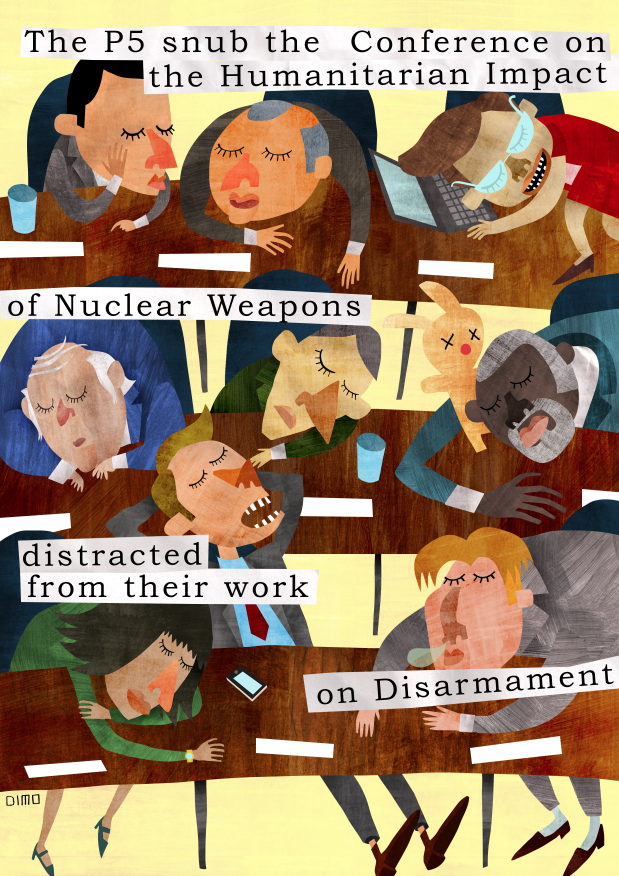
The distracted P5…one picture etc.
Just received this from ICAN’s creative communications staffer, Daniela Varano.
Also watch the ICAN video screened at the Oslo conference earlier this morning.
Nuclear famine comes to Oslo

Ira Helfand addresses the Oslo conference on the Humanitarian Impact of Nuclear Weapons
As the second session of the conference on the Humanitarian Impact of Nuclear Weapons opened, the co-chair, Nozipho Mxakato-Diseko, the Director General of the South African Ministry of International Relations and Cooperation, noted the findings of climate scientists such as Alan Robock, who is here with us, and of IPPNW co-president Ira Helfand, to the effect that even a limited nuclear war would cause global climate disruption and an agricultural crisis that would have catastrophic consequences for her own continent of Africa. Her remarks could have come right out of IPPNW’s report Nuclear Famine. This was exactly the right way to frame a session on the long term consequences of the use of nuclear weapons. Read more…
IPPNW’s message at the heart of Oslo conference
The international conference on the Humanitarian Impact of Nuclear Weapons has opened in Oslo. The first session on the immediate consequences of nuclear weapons detonations is coming to a close as I write this, with speaker after speaker reiterating the message that IPPNW has been delivering for more than 30 years: that the consequences of nuclear weapons use and nuclear war would be unimaginably catastrophic; that not only do we lack the capacity to mount a medical and humanitarian response to the victims of nuclear detonations, but that any attempt to prepare such a response capacity is infeasible; and that the only appropriate and responsible course of action is prevention. Read more…
Telegram from Oslo
by Ira Helfand
Official government conference on Humanitarian Impact of Nuclear Weapons about to begin. 132 nations attending. Delegates being greeted by raucous crowd of young Norwegians holding signs that say “Thank you” in more than 30 languages. Boycott by P5 continues to animate meeting. Delegates feel the boycott underlines the importance of the meeting and the need for non-nuclear weapons states to provide leadership in nuclear disarmament. 25 NATO states—all except for the”P3″ NATO members who have nuclear weapons—are attending.
No boredom in Oslo: ICAN Civil Society Forum day 2
“We’ve been listening to the same story about nuclear weapons since the 1950s…and we’re getting bored.”
So said Jacob Romer of Germany, one of 10 ICAN campaigners from as many countries who talked about bringing the abolition message to their national decision makers and to the public during a fast-paced session on the closing day of ICAN’s civil society forum in Oslo. Read more…
“No small mistakes”: ICAN Civil Society Forum day 1
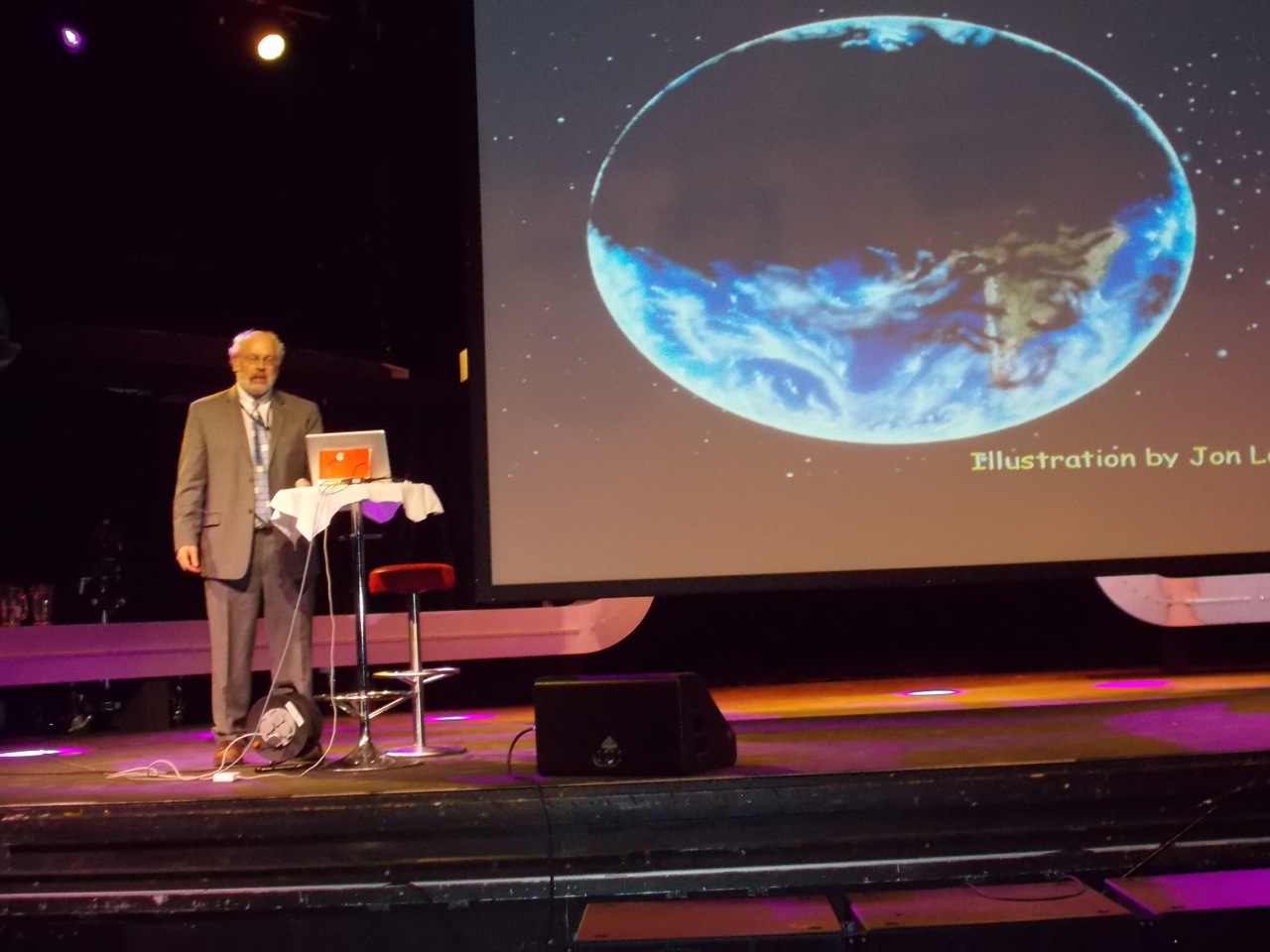
Rutgers professor Alan Robock explains nuclear winter research to the ICAN civil society forum in Oslo
“There are no small mistakes with nuclear weapons.”
That simple statement by Chatham House research director Patricia Lewis set the theme for the first day of ICAN’s Civil Society Forum on the catastrophic humanitarian consequences of nuclear weapons, March 2 in Oslo. Read more…
The P5 boycott of Oslo
by Ira Helfand
Participants began to gather this evening for the ICAN Civil Society Forum on the Humanitarian Consequences of Nuclear Weapons, and most of the talk has been about the decision by the P5, the permanent members of the Security Council and the owners of the world’s largest nuclear arsenals, to boycott the official government conference which begins on Monday.
So far 129 governments have registered to attend that historic event, which will seek to refocus international discussion about nuclear weapons on the catastrophic harm these weapons can actually cause. Among the participants at the parallel civil society conference, the P5 boycott is seen as a serious mistake on their part and a clumsy attempt to deflect the growing call for nuclear disarmament.
Officially the P5 are saying that the conference will be a diversion from their step by step efforts to reduce the danger of nuclear war. But participants here do not understand how a conference that highlights the dangers these weapons pose could possibly undermine efforts to eliminate them. Rather it is believed that the P5 are concerned that non-nuclear weapons states are becoming increasingly impatient with the slow pace of disarmament negotiations, and will organize to pressure the P5 to meet their obligations, under Article VI of the Non-Proliferation Treaty, to negotiate the complete elimination of these weapons.
The failure of the P5 to attend this Conference is seen as powerful evidence of the need for non-nuclear weapons states to do just that.
Dr. Helfand is co-president of IPPNW

 Bimal Khadka
 Bjorn Hilt
 Charles K. Johnson
 Gunnar Westberg
 IPPNW
IPPNW John Loretz
 Lawrence Wittner
 Maria Valenti
 mollymcgint
 Sue Wareham
 Tilman Ruff
 Tim Wright
 Xanthe Hall


 IPPNW peace and health blog