Historic International Arms Trade Treaty passed at UN
An historic and groundbreaking international Arms Trade Treaty (ATT) was approved today at the United Nations General Assembly (UNGA) in New York by a vote of 154 yes, including the US, 3 no, and 23 abstentions! The treaty enshrines in new international law a set of clear rules for all global transfers of weapons and ammunitions.
IPPNW’s delegation has worked tirelessly for years on this issue, and IPPNW representatives Drs. Omolade Oladejo and Emeka Okolo from Nigeria were at the UN today along with many NGO colleagues to witness this landmark event while many of us watched with suspense from afar. Read more…

Dr. Shannon Gearhart, US, medical student Vera Gruner, Austria, and Dr. Emeka Okolo, Nigeria wait to tweet the hoped for good news.
IPPNW representatives were on the edge of our seats last Thursday afternoon as we anxiously awaited the outcome of the long-deliberated Arms Trade Treaty (ATT) negotiations at the UN in New York. So many delegates, NGOs and press attended the final session of the ATT Diplomatic Conference that we spilled over to fill two of the big UN plenary session rooms.
With overwhelming support from the world’s countries, everyone had high hopes for an ATT adoption after the final two weeks of intense discussions took place March 18-28.
But it was not to be. Read more…
UN Secretary-General urges agreement on robust Arms Trade Treaty as landmark conference begins in New York
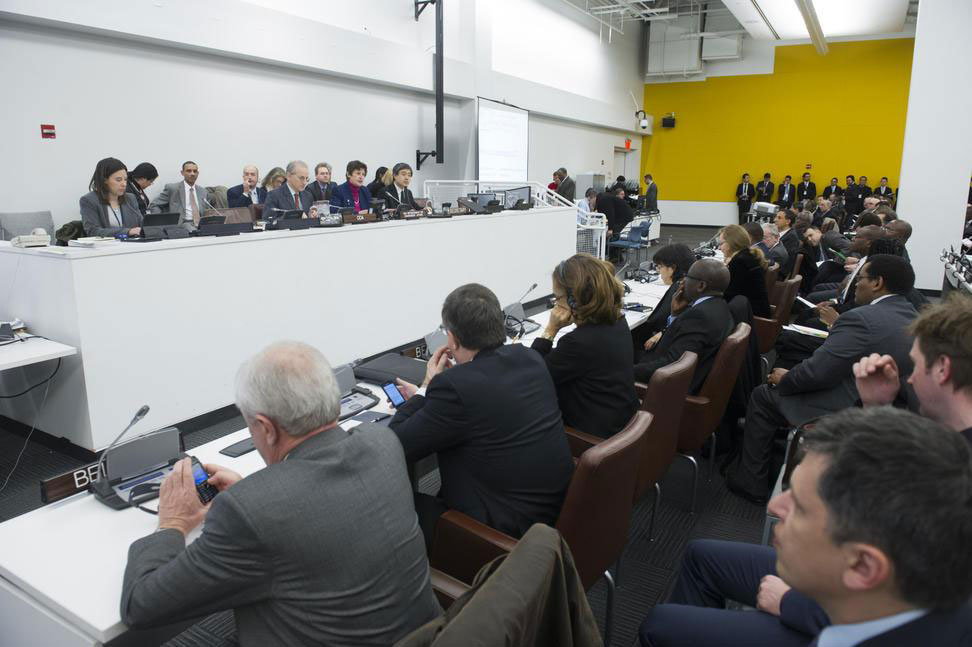
Opening Day ATT DipCon March 18
Arms Trade Treaty (ATT) Diplomatic Conference
Dispatch from Day One
Compiled by Ogebe Onazi, IPPNW Nigeria
UN Secretary-General Ban Ki-moon today urged participants of the United Nations Final Conference on the Arms Trade Treaty (ATT) to conclude work by 28 March on a comprehensive instrument that would establish standards for international trade in conventional weapons.
“You are not here to initiate new negotiations. You are here to strengthen and conclude the work that has been done in earnest since the beginning of the ATT process in 2006,” the Secty. General told representatives from 193 Member States in his opening remarks to the conference in New York. Read more…
Gun control and arms control
In a number of ways, gun control issues are remarkably similar to arms control issues.
Gun controllers argue that the availability of guns facilitates the use of these weapons for murderous purposes. Arms controllers make much the same case, asserting that weapons buildups lead to arms races and wars. Both stress the imperative of weapons controls in an era of growing technological sophistication, pointing out that assault weapons sharply increase dangers domestically, just as nuclear, chemical, and biological weapons increase the dangers of a holocaust globally. Weapons enthusiasts have also adopted a common approach. The National Rifle Association insists that weapons are harmless. According to the NRA, “people” are the problem, which can be solved by “good guys” using guns to intimidate or kill “bad guys.” Adopting much the same position, the military-industrial complex and its fans contend that the people of their nation are “good,” and need superior armaments to “deter” or destroy the “bad” people. Read more…
Looking back at the week in Oslo

Ira Helfand describes nuclear famine at the international conference Humanitarian Impact of Nuclear Weapons, March 4 in Oslo
Last week, ICAN and IPPNW participated in two extraordinarily successful conferences in Oslo on the humanitarian impact of nuclear weapons. That, in fact, was the title of the two-day intergovernmental conference hosted by the Norwegian Ministry of Foreign Affairs, which was attended by 127 States, several UN agencies, the Red Cross Red Crescent movement, and a 50-person civil society delegation coordinated by ICAN. An ICAN-organized Civil Society Forum took place on the two days before the government conference, and drew 500 participants from 70 States, including about 40 of us from IPPNW.
This was the first time that States had come together—inside or outside the UN—to focus entirely on the nature and consequences of nuclear weapons, and to consider them as an existential threat requiring collective action. Read more…
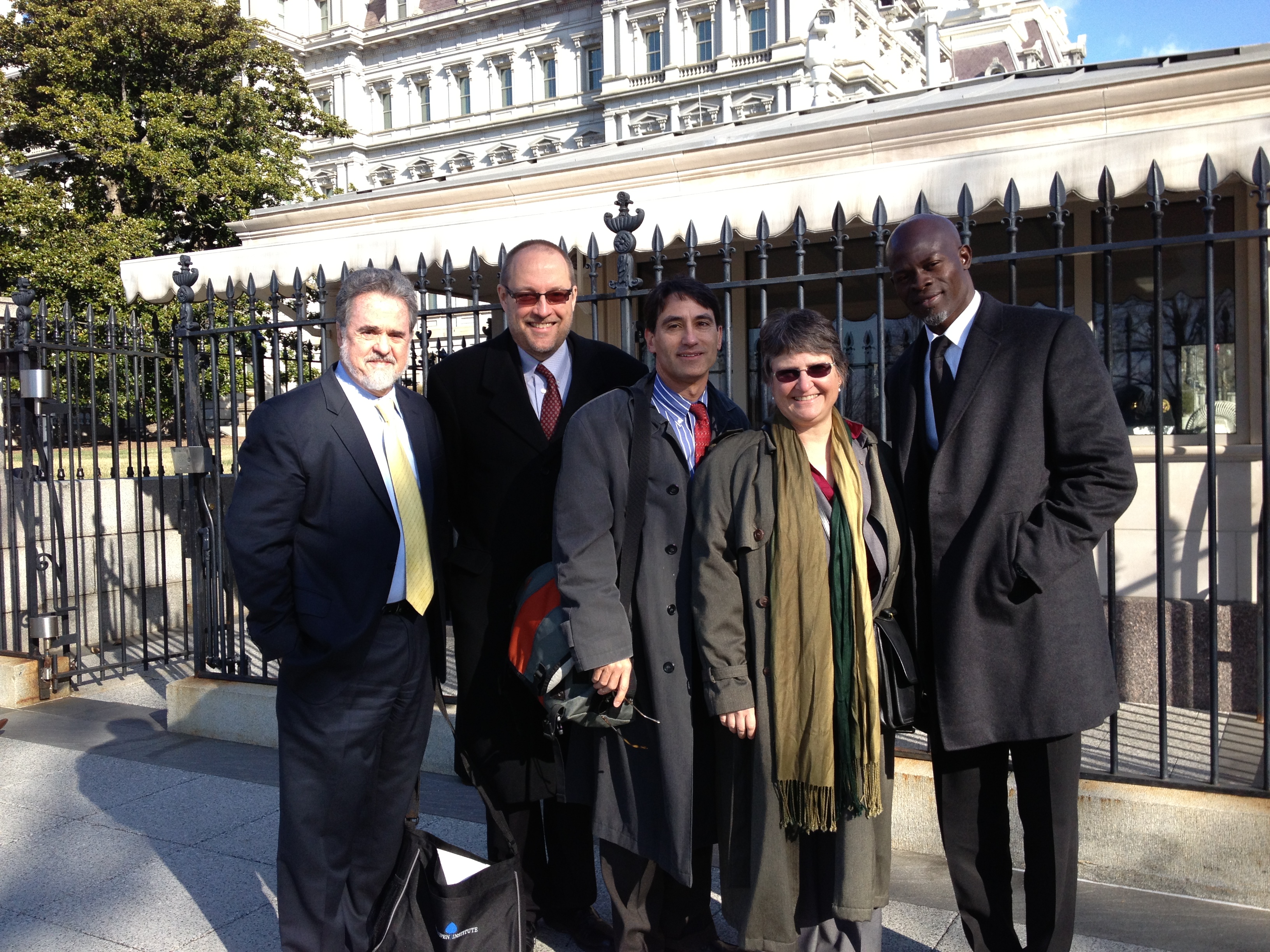
(L-R) Ray Offenheiser, President, Oxfam America; Galen Carey, National Association of Evangelicals; Frank Jannuzi, Deputy Executive Director Amnesty International USA; Dr. Thomasson; and actor Djimon Hounsou
Physicians for Social Responsibility’s Executive Director Dr. Catherine Thomasson today delivered to senior White House National Security staff a letter signed by 18 Nobel Peace Laureates including IPPNW, Amnesty International, former president Jimmy Carter, Archbishop Desmond Tutu, Leymah Gbowee, and Oscar Arias, calling on President Obama to support a strong Arms Trade Treaty at the upcoming UN Diplomatic Conference.
Dr. Thomasson was part of a delegation that included representatives from the faith, legal, military and human rights communities who delivered other letters of a similar nature signed by leading members of those constituencies. President Obama is expected to make a statement on the ATT today or tomorrow. Read more…
These things were sent to test us
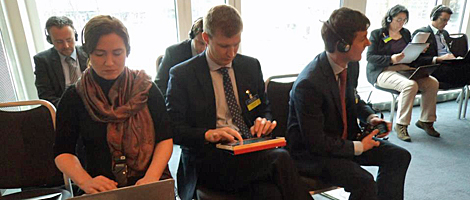
The Great Twitterers (or are we Twits?) of the Oslo Conference
So get this: I’m sitting in an enormously successful conference in Oslo where one after another states are calling for a ban on nuclear weapons. I’m twittering (or tweeting – both words are equally silly) to the world when up jump 140 characters on my screen that really annoy me:
#OMG North Korea threatens to tear up 1953 Korean War cease-fire if it doesn’t get its own way about everything #goodbyeworld #dayspoiler
Actually, that isn’t exactly what the tweet said, I made it up because I can’t be bothered to spend the next hour trawling through twitter for the genuine one – but you get the gist. Read more…
[ICAN Co-Chair Rebecca Johnson read the following statement as the final civil society contribution to the international conference on the Human Impact of Nuclear Weapons in Oslo. ICAN was the civil society partner to the conference and organized a delegation of 50 campaigners and NGO representatives who observed the proceedings and met with State delegations. ICAN was given an opportunity to comment at the conclusion of each of the three substantive sessions and at the conclusion of the conference.]

ICAN co-chair Rebecca Johnson reads ICAN’s final statement to the Oslo conference
Thank you madam Chair – and let me start by thanking the Government of Norway for your vision and commitment in hosting this ground-breaking Conference on the Humanitarian Impact of Nuclear Weapons.
And I want to thank the 132 governments here and eminent speakers from international organisations and civil society for taking our humanitarian concerns about nuclear weapons seriously, and sharing your knowledge, facts, experience and ideas. Read more…
Oslo ends on a high
The Oslo conference has ended in something close to euphoria, with a very clear and strong summary from Norwegian Foreign Minister Eide, and an offer from Mexico to host a followup conference that build upon the new humanitarian perspective that has come to define the nuclear weapons issue for the State and civil society participants here. ICAN’s role was recognized and applauded by the chair and by numerous delegations, and outside the hotel was one of the first demonstrations I’ve seen in a long time thanking Norway and the other States for what they’ve accomplished here, rather than protesting something. I’m holding up a dinner celebration, so will post this now and write something more reflective later.

[ICAN has released the following statement at the conclusion of the international conference on the Humanitarian Impact of Nuclear Weapons.]
Historic global conference on humanitarian impact of nuclear weapons prepares ground for new initiative towards ban treaty
The historic Oslo Conference on the Humanitarian Impact of Nuclear Weapons has concluded with the announcement of a follow-up meeting to be hosted by Mexico. A wide range of states and organisations agreed that an understanding of the global humanitarian consequences of nuclear detonations should be the starting point for urgent action to ban and eliminate nuclear weapons.
At the meeting hosted by Norwegian Foreign Minister Espen Barth Eide, around 130 states, several UN agencies—including OCHA, UNDP and UNHCR—as well as the international Red Cross and Red Crescent movement, and ICAN, presented their findings on the environmental, developmental, and health consequences of nuclear detonations. They concluded that no international response plan could effectively be put in place to respond to such an event. As the facts and evidence sank in, many states expressed their recognition of a shared responsibility to act to prevent any accidental or intentional use of these weapons of mass suffering.
The announcement by Mexico to build on the Norwegian initiative by hosting a further meeting provides a new platform from which to consolidate the humanitarian arguments and to engage all states in a constructive dialogue to outlaw and eliminate nuclear weapons.
Dr Rebecca Johnson, ICAN Co-Chair said: “This Conference has shown that any use of nuclear armaments would cause mass suffering, with calculations of climate disruption and famine in non-nuclear as well as nuclear-armed countries. This global impact makes it the responsibility – and right – of everyone to take action to stop this from happening. The P5 have missed an opportunity for dialogue here, but it has not stopped countries moving forward. On the contrary, Mexico’s welcome decision to host a further meeting on this issue recognises that the nuclear weapon free countries have an important role to play.”
Thomas Nash, ICAN Steering Group member, said: “This conference is a new beginning towards the elimination of nuclear weapons. It is the first time states have come together to consider the humanitarian effects of nuclear weapons. 130 countries have chosen to confront the horror of these weapons and have realised that far from being powerless to do anything about it, they can and must take responsibility for putting in place a long overdue international ban.”
Dr Bob Mtonga, ICAN Steering Group member and physician from Zambia: “This Conference has shown us that the countries that have renounced nuclear weapons and concluded regional Nuclear Weapons Free Zones, such as Africa and Latin America, are providing important moral leadership to carry forward international efforts to free the world of nuclear weapons and prevent the global public health disaster that their use would create.”

 Bimal Khadka
 Bjorn Hilt
 Charles K. Johnson
 Gunnar Westberg
 IPPNW
IPPNW John Loretz
 Lawrence Wittner
 Maria Valenti
 mollymcgint
 Sue Wareham
 Tilman Ruff
 Tim Wright
 Xanthe Hall


 IPPNW peace and health blog