Carl Bildt — Is he serious?
Carl Bildt, the Swedish Minister of Foreign Affairs, feels that the South African-led joint humanitarian appeal for the elimination of nuclear weapons, signed by 80 NPT Member States, is “below my position.”
We in SLMK, the Swedish affiliate of IPPNW, have worked hard over a long time to resurrect the failing dedication to nuclear disarmament in the Swedish Foreign Office. We tried repeatedly to get the MFA to sign on to the South African paper at the NPT PrepCom. We also reminded the MFA that when Sweden now leaves the New Agenda Coalition (NAC) group, which it once founded and which was so important at the 2000 NPT Review, Sweden should search to develop other means to work for nuclear abolition.
We had no success. The MFA prefers to align itself with the nuclear-weapon states. Read more…
 ICAN—the International Campaign to Abolish Nuclear Weapons—has started a global petition drive ridiculing the “stupid” decision by the world’s nuclear-weapon states to endanger our survival and calling for the commencement of negotiations on a treaty banning nuclear weapons. Noting that there are still 19,000 nuclear weapons in the world, with some 2,000 on high alert and ready to be launched, the petition warns that “we are potentially only minutes away from the horror of seeing an entire city flattened in an instant, killing hundreds of thousands of people with no adequate humanitarian relief possible.”
“We all do stupid things,” ICAN stated in launching the petition. “Some stupid things are far more concerning than others.” Including playing with nuclear fire.
You can read and sign the petition on the ICAN website.
Japan admits the obvious

Protest outside Japanese Mission in Geneva. (NHK World screenshot)
When some 50 protesters gathered outside the Japanese Mission to the Conference on Disarmament in Geneva yesterday, questioning that country’s refusal to sign onto a joint statement on the humanitarian consequences of nuclear weapons submitted to the NPT PrepCom by 74 other non-nuclear-weapon states, Ambassador Mari Amano felt obliged to give an answer. Why, after all, would the only country ever to have felt the full effects of atomic bombings find it difficult to condemn their existence on humanitarian grounds and join an appeal for their total elimination? Read more…
74 NPT States issue humanitarian appeal for abolition
The number of countries demanding the elimination of nuclear weapons as a humanitarian imperative grew to 74 today, when South Africa read a joint statement on the humanitarian impact of nuclear weapons on behalf of that many delegations to the 2013 Non-Proliferation Treaty Preparatory Committee in Geneva.
Declaring that “our countries are deeply concerned about the catastrophic humanitarian consequences of nuclear weapons,” the States criticized the NPT for ignoring its very reason for existence “for many years,” even though “the humanitarian impact of nuclear weapons has increasingly been recognised as a fundamental and global concern that must be at the core of all deliberations on nuclear disarmament and nuclear non-proliferation.” Read more…
The legacy of chemical warfare in Iran
Twenty-five years ago, in 1988, Saddam Hussein used chemical weapons against the Kurdish town of Halabja. This atrocity is what we most often talk about when we decry chemical warfare. We do not remember Sadasht and all the other cities in Iran that were also attacked by Iraq. We forget that Iran is a country which has suffered, by far, much more than any other from the terrible effects of mustard gas and nerve gas. This upsets the Iranians today, with good reason. Read more…
That’s where the money goes
 According to a report just released by the highly-respected Stockholm International Peace Research Institute (SIPRI), world military expenditures in 2012 totaled $1.75 trillion.
The report revealed that, as in recent decades, the world’s biggest military spender by far was the US government, whose expenditures for war and preparations for war amounted to $682 billion — 39 percent of the global total. Read more…
Irrational generals in Pyongyang?
Whatever anyone says about North Korea and its leaders and its policy, remember: No one understands the country. Unfortunately, that means no one can predict what the leaders will do in a certain situation. So, that applies to what I write, too.
But even if you do not understand there are certain things you must not do. The less you know about the other side, the less provocative you should be. Read more…
Just sign the damn thing!
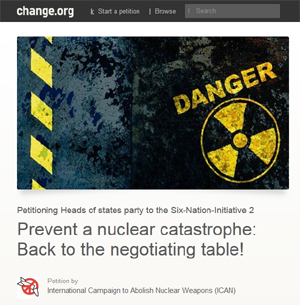 I did something new last week. I started a petition on change.org for ICAN. Now I have signed many online petitions in my time and I have written quite a few too. But I have never used a large online petitioning platform before.
The title of the petition – as you may already know – was “Prevent a nuclear catastrophe – Back to the negotiating table”. At the start things seemed to be going well enough. I obsessively watched the signatures clocking up and overnight the first 500 were there.
But then it started to slow down. Read more…
Cameron: The North Koreans are coming!
Not even the Tories go that far. Actually, the former Tory Defense Secretary, Michael Portillo, ridicules Cameron.
My father, who was a Lutheran parson sometimes used the term from Martin Luther. The excuse of the unrepentant: If you have decided to continue your wicked ways any excuse, however feeble, will do.
http://www.thetimes.co.uk/tto/news/politics/article3731486.ece

IPPNW statement on the Korean nuclear crisis
[The co-presidents of IPPNW have sent the following letter to the leaders of the Democratic People’s Republic of Korea, the Republic of Korea, and the United States, in response to the escalating series of nuclear threats over the past several days.]
The use of nuclear weapons on the Korean peninsula must be prevented. Regardless of the reasons for the current escalation in tensions, the recent displays of nuclear force by the Democratic People’s Republic of Korea and by the US, on behalf of its ally the Republic of Korea, can have only one of two outcomes: either both sides will step back from the precipice or deterrence will fail and millions of people will suffer the fate of Hiroshima and Nagasaki.
The humanitarian consequences of the detonation of nuclear weapons, regardless of who might use them or where, were examined in depth only one month ago in Oslo, at a conference attended by 127 States. The sobering scientific and medical analysis presented in Oslo—millions dead; millions more suffering from injuries, burns, and radiation sickness without hope of medical treatment; social and economic collapse; and the potential for global climate disruption and nuclear-war-induced famine—compelled the participants to call for accelerated action to delegitimize nuclear weapons and to eliminate them from the world’s arsenals. This has been IPPNW’s core message since 1980. The current crisis only underscores the urgency of negotiating a comprehensive, global treaty to ban and eliminate nuclear weapons.
As long as nuclear weapons exist, adversaries who own them will be tempted to engage in nuclear threats and counter-threats calculated to make the other side back down. This is why nuclear deterrence is already a bankrupt policy. Should this be the moment when deterrence fails, as it eventually must, both North and South Korea will be devastated. Even if the use of nuclear weapons were confined to the Korean peninsula, unlikely as that would be, the repercussions for the rest of the world would be catastrophic.
Expressions of willingness—or even intent—to use nuclear weapons, either preemptively or in retaliation, provide security to no one and increase the risk of mutual self-destruction. IPPNW urges the DPRK, the ROK, and the US to refrain from further rhetorical provocations and inflammatory displays of force, and to reopen diplomatic channels where cooler heads can prevail.

 Bimal Khadka
 Bjorn Hilt
 Charles K. Johnson
 Gunnar Westberg
 IPPNW
IPPNW John Loretz
 Lawrence Wittner
 Maria Valenti
 mollymcgint
 Sue Wareham
 Tilman Ruff
 Tim Wright
 Xanthe Hall


 IPPNW peace and health blog