ICAN on Obama Berlin speech: nuclear weapon reductions will reduce risks, but prohibition treaty urgent
[ICAN has released the following statement in response to US President Barack Obama’s speech today in Berlin, calling for new reductions in nuclear arsenals, including a new round of negotiated cuts between the US and Russia.]
 The International Campaign to Abolish Nuclear Weapons (ICAN) welcomes President Obama’s announcement in Berlin today calling for a world without nuclear weapons and the readiness to pursue further reductions in the US and Russian nuclear arsenals. However, the humanitarian consequences of any nuclear weapon use, increasingly the focus of global engagement on these weapons, demands their prohibition and elimination. Read more…
History made in the Knesset
By Ra’anan Friedmann, IPPNW Israel
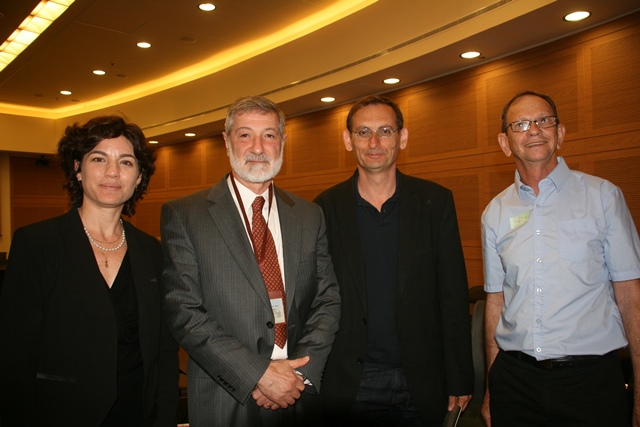
IPPNW co-president Ira Helfand described the humanitarian consequences of nuclear weapons to members of the Israeli parliament in Jerusalem. (L-R: MP Tamar Zandberg, Dr. Helfand, MP Dov Hanin, Ra’anan Friedmann of IPPNW-Israel
A historical event took place today in Jerusalem—an official meeting of IPPNW and ICAN members with Israeli members of the Knesset (the Israeli parliament) at the Knesset in Jerusalem. The unprecedented meeting was organized by Sharon Dolev, ICAN’s campaigner in Israel and director of the Israeli Disarmament Movement.
Dr. Ira Helfand gave a thorough presentation on the effects and outcome of a limited nuclear war on the world climate and human population, followed by a discussion of the nuclear situation in Israel with the parliamentarians.
This is a breakthrough. For more than 50 years the subject of nuclear weapons and nuclear activity in Israel was a non-discursive issue, forbidden to talk about but in secret chambers. For the first time, this important subject was raised from the shadows and discussed openly in the Israeli parliament.
We are looking forward to more and larger open discussions that might eventually change the nuclear situation in the Middle East.
B61 – a pork barrel* bomb
[Ed. note: Dr. Westberg of SLMK, IPPNW’s Swedish affiliate, joined a delegation that met with NATO officials in Brussels on June 3.]
 There are at present about 180 B-61 nuclear bombs in Europe, in Germany, Italy, Turkey, the Netherlands, and Belgium. There used to be about three times as many but under pressure from both governments and peace movement most have been returned to the owner, the USA.
We have always been told that these “NATO-bombs” were of no military value. This has been the message at our meetings with NATO officials as well as during meetings preparing for the Chicago NATO Summit in 2012. As “gravity bombs,” they could not be well targeted. They stayed in Europe as pawns, indicating that the USA was willing to defend Europe, with nukes if need be. This was of course quite irrational, but nuclear weapons are irrational. France seems to have resisted the removal of the bombs with great passion, although France is not a member of the strategic council of NATO. France is very special…
Now the B-61 role is being changed. Read more…
Fukushima nuclear disaster is far from over
[The IPPNW Board of Directors has issued the following statement about the ongoing public health crisis resulting from the March 2011 nuclear reactor disaster in Fukushima. The statement makes reference to a report from Anand Grover, UN Special Rapporteur on the right to health, an advance, unedited copy of which has been made available by the Office of the High Commissioner for Human Rights.]
Statement by IPPNW Board of Directors on the ongoing nuclear disaster in Japan and the report of the UN Special Rapporteur on the right to health to the UN Human Rights Council
30 May 2013, Villingen-Schwenningen, Germany
We warmly welcome Mr. Anand Grover’s report, which provides important recommendations on the continuing and long-term health implications of the Fukushima nuclear disaster. If implemented by the Japanese government, the measures recommended would significantly reduce the adverse impacts of the disaster now and for future generations, and improve the lives and health of the many affected people.
We are deeply disturbed by the clear evidence that the government of Japan has not made public health and safety its top priority in its response to the disaster. It has failed in the paramount duty of governments to protect their citizens. There is an urgent need to redress this failure. Read more…
Historic Day at UN as Arms Trade Treaty Signed

Members of Control Arms coalition join ATT Chairman Amb. Peter Woolcott and others to celebrate as Australia signs the ATT
Cathey Falvo
3 June, 2013 United Nations Headquarters, New York
Historic Day!
67 countries sign the Arms Trade Treaty (ATT) at the United Nations! Many more say they will sign soon.
Several countries made comments praising the process and results as showing that the UN can work, and complimenting the NGOs (non-governmental organizations) on our crucial role in achieving the treaty.
Team IPPNW present at the signing ceremony consisted of Drs. Shannon Gearhart, Donald Mellman, Robert Mtonga and Cathey Falvo and Kay Tyler-all veterans of this multiyear process.
Now a new set of work starts. Tomorrow the Control Arms coalition is having a next steps meeting and then we all have to start the process of getting remaining governments to sign the treaty then ratify/accept.
We will continue.
Wir stellen ein
We’re hiring!
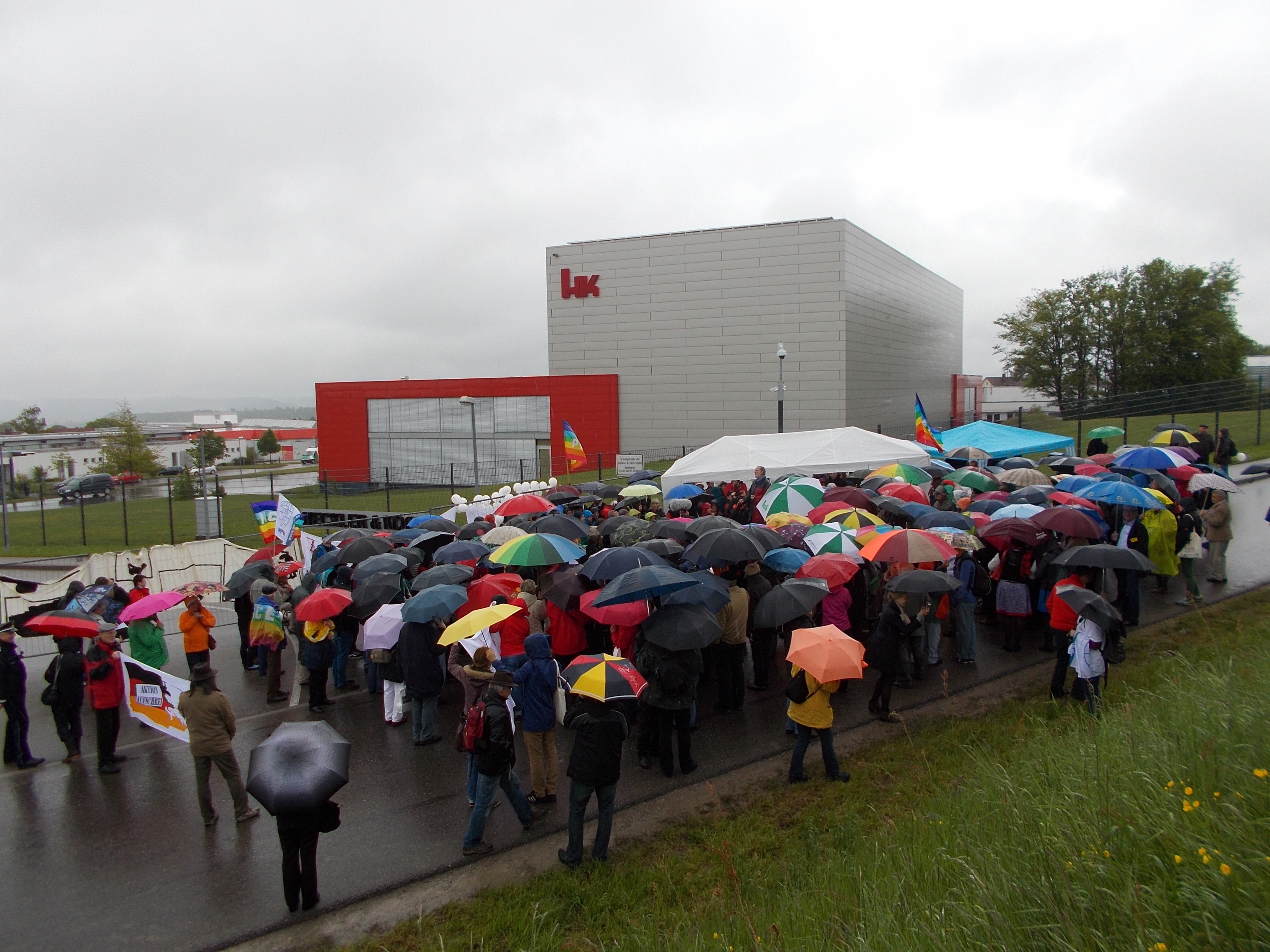
IPPNW demonstrates in the rain. H&K promotes weapons that produce “steel rain.”
That sign greeted a couple of hundred participants in IPPNW’s “Human Target” congress as our buses approached the Heckler & Koch headquarters in Oberndorf this morning in a steady rain.
H&K, the largest manufacturer of rifles and handguns in Europe, is increasing its workforce in order to keep up with the demand for weapons that have killed two million people since its foundation in 1949, according to Jürgen Grässlin, the foremost expert on German weapon exports. That’s 114 people killed every day, on average, by a firearm made either here, in Oberndorf, or in one of the H&K facilities with a “legal” export license outside of Germany. Read more…
Freedom of speech and steel rain

A Heckler & Koch “steel rain” t-shirt
Last night, the Lord Mayor of Villingen-Schwenningen, Dr. Rupert Kubon, welcomed about 300 people to his city in southwest Germany at the opening of IPPNW’s international congress on the social and health effects of the global arms trade. A member of Mayors for Peace and a former Chair of the Pax Christi Commission for Non-violence, Dr. Kubon had taken on the city council, which initially wanted no part of this event, and somehow persuaded them to co-host the congress and to provide the venue.
What was the city council’s problem with a meeting of health professionals and peace activists meant to draw attention to the global carnage caused by firearms? As it happens, the largest German producer of handguns, assault rifles, submachine guns, and grenade launchers—Heckler & Koch—is in the Lord Mayor’s backyard and is a serious economic and political force in this country. Read more…
The Way to Villingen

I wanted to write this blog about a week ago. See, we had the idea in the Berlin IPPNW office that we should write about what it was like to be part of the organisation of a congress like “Human Target“, starting on Thursday in Villingen-Schwenningen, Germany. And now here I am on the train with eight long hours, at last, to spare. Before today there was no time at all to write blogs.
Of all of us in the Berlin office, I had perhaps the least to do for this Congress. Mainly because I had the brainwave early on in the proceedings and told Frank – our Executive Director – that he should take on Elena to help out. Which he did, thank God, and also Isa. Although the local group in V-S, under Helmut’s fantastic leadership, have been working round the clock getting all the logistics set up, we really needed Elena’s and Isa’s help. I was very busy with ICAN and the preparations for the big action at the German nuclear weapons base at Büchel in August, so I knew I couldn’t take on the usual load that I’d take for other congresses we’ve done in the past.
My job was to help structure the planning of the congress organisation using a project structure plan that we have refined over several congresses. In this plan we’re able to quickly check through all the different tasks, assign responsibilities, make a timetable and set deadlines. So Frank and Helmut had the job of running the show as project managers and the rest of the team divided up the rest of the work. In essence there were actually three teams working on the Congress: the local team, the Berlin team and the Boston team.
Angelika and Samantha worked on advertising the Congress through setting up a website, a facebook event and writing to the press. Flyers and posters were designed, printed and distributed. Helmut worked on the programme with Maria in Boston and Frank in Berlin, mostly late in the evening or well into the night because of his work as a busy GP and the time difference. Hours were spent on the telephone to embassies in Africa and other parts of the world, trying to persuade the staff to give people visas – who sometimes had travelled hundreds of kilometres just to find out they had changed the whole application system. Speakers cancelled and new speakers had to be found. Everything had to be translated into English for the website and the programme and then also proofread. Registration had to be set up, name tags printed, confirmations sent out. While I am writing this blog, Jens-Peter and Lale are loading up the van with materials to drive down tomorrow to Southern Germany and begin setting up for the Congress.
That’s just a brief sketch of what has been done and doesn’t do justice to the (probably) thousands of e-mails, telephone calls, faxes, letters, photocopies, skype conferences and meetings over a year, involving hundreds of people. It doesn’t say anything about the planning of the action at Heckler & Koch in Oberndorf or the bike tour from Ulm, visiting and choosing hotels and venues, organising transport and all the rest of it.
And from only doing my little part – mostly translation and correction, sometimes brainstorming with Frank or helping him with international communication – the main thing that strikes me most about all of this is the substance of what we are doing. Bringing people from all over the world to this little corner of Germany where the weapons are made that kill people in the countries those people are coming from. Especially the doctors that treat patients wounded by bullets from those guns, with their stories of those people and their communities. For the community living in the shadow of Heckler & Koch that never talk about the killing that is being exported from the town just down the road, it is an opportunity to witness the effects of those exports. For those visiting Oberndorf, it is an opportunity to make their feelings and the suffering in their countries known. Most of all, it is a chance to make a mark on the landscape of suffering caused by small arms by calling for an end to the export of death and terror.
I, for one, am looking forward to this.
Xanthe Hall is international campaigner for IPPNW Germany
“Bikes not arms” on the road to Villingen
 Taking their protest against small arms trade to the streets, 30 young IPPNW activists from all over the world will cycle from the German arms manufacturer Walther in Ulm to the small Black Forest town of Villingen, where IPPNW is organizing the Small Arms Congress “Human Target.” From 26 May 26-30, the bikers will meet politicians, organize public demonstrations, give interviews and spread information on the impact of the Global Arms trade in the region.
The cyclists have started their own blog, where you can follow them on their journey to Villingen.
Sustainable world depends on nuclear abolition
The risk of nuclear weapons and current progress towards abolition
by Andrew Kanter, Ira Helfand, and John Burroughs
Nuclear weapons continue to pose an existential threat to human civilization. Their elimination must be our highest priority if we hope to bequeath a sustainable world to our children.
During the Cold War it was generally understood that a large scale war between the US and the Soviet Union would be a disaster not just for them, but for the entire planet. With the fall of the Berlin Wall there has been a dramatic decline in our awareness of the danger of nuclear war, but the weapons have not gone away. There remain nearly 20,000 nuclear warheads in the arsenals of the world and there is no indication that the nuclear weapons states intend to eliminate these weapons. Read more…

 Bimal Khadka
 Bjorn Hilt
 Charles K. Johnson
 Gunnar Westberg
 IPPNW
IPPNW John Loretz
 Lawrence Wittner
 Maria Valenti
 mollymcgint
 Sue Wareham
 Tilman Ruff
 Tim Wright
 Xanthe Hall


 IPPNW peace and health blog