Honoring a giant in the movement for peace and social justice

Victor W. Sidel
[Victor W. Sidel, MD, a co-founder of Physicians for Social Responsibility, a former PSR president and IPPNW co-president, a contributor to the original studies on the medical consequences of nuclear war that were published in The New England Journal of Medicine in 1962, Distinguished University Professor Emeritus at the Albert Einstein College of Medicine and Montefiore Medical Center, where he taught public health and social medicine, and a former president of the American Public Health Association, was honored over the weekend at a special session celebrating his career during the APHA annual meeting in Boston. Read more…
Nuclear Exits – out of the dark, into the light
You might have known that South Africa built nuclear weapons and then destroyed them again in the early 90s. But did you know that Sweden tried to get nuclear weapons? Or Switzerland? Countries that have had a nuclear weapons programme and have then chosen to forgo nuclear weapons can be said to have undergone a Nuclear Exit. Nuclear Exits should be examined as examples of best practice when considering how to get countries to forgo nuclear weapons now. Read more…
 124 states condemn unacceptable effects of nuclear weapons
A joint statement on the humanitarian consequences of nuclear weapons was delivered by New Zealand today at the United Nations General Assembly in New York. Expressing deep concern for the catastrophic consequences that any use of nuclear weapons would entail, as well as for their uncontrollable destructive capability and indiscriminate nature, the New Zealand statement was signed by 123 other member states. Read more…
African affiliates call for ATT ratification, nuclear abolition, at Tanzania gathering
[IPPNW’s African affiliates issued the following statement at the conclusion of their regional meeting in Dar Es Salaam, Tanzania, October 5-6.]
We the African affiliates of the International Physicians for the Prevention of Nuclear War (IPPNW, Nobel peace prize 1985) met at Dar es salaam, Tanzania between 5th and 6th October, 2013, to discuss small arms proliferation and resultant violence, as well as abolition of nuclear weapons in the world. Read more…
Nuclear blackmail? (Put down that umbrella!)

Image from accuweather.com
There’s been a lively discussion on the ICAN campaigners list the past couple of days about the kinds of words we use when we’re talking about nuclear weapons policy. The term that started us off was “nuclear umbrella states” — countries such as Japan, South Korea, Australia, the NATO member states — who have what they call an “extended nuclear deterrence” arrangement with a nuclear-armed state.
All those words are loaded. Read more…
US nuclear weapons in good hands?
Over many decades we have heard of substance abuse among soldiers in US forces responsible for nuclear weapons. Some similar information actually leaked from Russia in the nineties. Now we are learning of serious problems in the quality of the leaders too. Two of the top generals in the nuclear forces and the security chief at the Montana base have been asked to leave.
It should be noted that this time, as on previous occasions, the official response is that at all times there was an around-the-clock, functioning nuclear deterrence. Always ready to fire, that means, but we are concerned about the inverse, not to fire.
Does General Kowalski trust the nuclear war plans written by Vice Admiral Tim Giardina?
A well-deserved Nobel Peace Prize for OPCW
IPPNW congratulates the Organisation for the Prohibition of Chemical Weapons for being awarded the 2013 Nobel Peace Prize. Not only has OPCW done remarkable work in overseeing the elimination of Syria’s chemical weapons, it has spent the past 16 years laboring to implement the Chemical Weapons Convention and to demonstrate in very practical ways that international cooperation under the rule of law can deal effectively with the problem of abhorrent, inhumane weapons once they have been delegitimized and made illegal. This is a well-deserved honor.
As the 1985 Nobel Peace Laureate, IPPNW takes additional encouragement from OPCW’s accomplishments as we continue to campaign for a treaty that will ban—and ultimately eliminate—nuclear weapons, the only weapons of mass destruction that have not yet been prohibited by international law.
Who could regret banning nuclear weapons? (As if you didn’t know)
The High-Level Meeting on Nuclear Disarmament, which took place this past Thursday at the UN General Assembly, was a trip to the woodshed for the nuclear-weapon States. One after another, the Presidents, Prime Ministers, and Foreign Ministers of countries large and small, from every inhabited continent, told their deterrence-blinded peers that nuclear weapons are a global humanitarian disaster waiting to happen, and that the only way to prevent such catastrophe is, as Nigerian Minister of Foreign Affairs Viola Onwuliri said, “to outlaw, eliminate and consign nuclear weapons to the dustbin of history.” Read more…
“Each of us is responsible”
Civil society statement to the UN high-level meeting on nuclear disarmament
Delivered by Joseph Gerson of the American Friends Service Committee on behalf of civil society
26 September 2013, New York
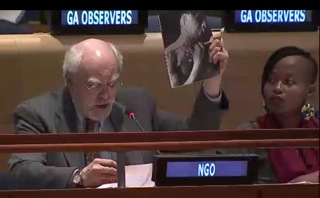
Joseph Gerson follows Nosizwe Baqwa (right) as a civil society speaker at the High Level Meeting
I want to begin by invoking the words of Yamaguchi Senji, one of the most seared and courageous Nagasaki A-bomb survivors, who passed away this summer. Speaking to the Second Special Session on Disarmament thirty-one years ago, he said:
Look at my face and hands. We should never allow people in the world or succeeding generations to suffer deaths and agonies from nuclear war as we, the Hibakusha, have done.
We appeal that now is the time for the UN to draw a comprehensive disarmament program with a specific timetable and with a ban on nuclear weapons as its toppriority, and do its utmost to uproot the crisis of nuclear war.” Read more…

 Bimal Khadka
 Bjorn Hilt
 Charles K. Johnson
 Gunnar Westberg
 IPPNW
IPPNW John Loretz
 Lawrence Wittner
 Maria Valenti
 mollymcgint
 Sue Wareham
 Tilman Ruff
 Tim Wright
 Xanthe Hall


 IPPNW peace and health blog