CSF Vienna—day two: the writing on the wall

ICAN volunteers celebrate (and are celebrated!) at the conclusion of the Civil Society Forum in Vienna.
Nobel Peace Laureate Desmond Tutu set the tone for the second day of the ICAN Civil Society Forum in Vienna during a video message at yesterday’s opening session:
“The writing should be on the wall for the nuclear powers,” said Archbishop Tutu. “A treaty banning nuclear weapons is on the way. The momentum is unstoppable.”
 More than 600 civil society campaigners from around the world filled the Aula der Wissenschaften (Hall of Sciences) for the first day of the ICAN Civil Society Forum in Vienna yesterday. “The courage to ban nuclear weapons,” is both the theme of the two-day campaign gathering, and also the message that campaigners intend to bring to the third Conference on the Humanitarian Impact of Nuclear Weapons hosted by the Austrian Ministry of Foreign Affairs. The conference begins on Monday, and 150 States have already registered, exceeding the numbers that came to the previous HINW conferences in Oslo and Nayarit. Read more…
Nuclear weapons: the road to prohibition
Nuclear weapons are the greatest threat to the health and survival of mankind. This statement from the World Health Organisation in the 1980s is echoed in the recent call to action from the International Red Cross: Nuclear weapons must be abolished.
But climate change? Is that not the greatest danger? OK, let’s not argue. Climate change is already here and experienced by most of us. We know that if strong and decisive action is not taken soon by all states we will face grave problems for mankind, in this century and worse in the next. But as far as we can prophesize, mankind and human civilisation will survive the climate catastrophes, maybe with tremendous losses. Read more…
Vienna – the city of hope
On December 8 and 9, there will be an intergovernmental conference on the Humanitarian Impact of Nuclear Weapons hosted by the Austrian government in the beautiful and historic capital, Vienna, where the first settlements date back to 500 BC. With my own love for Vienna and great expectations for the conference, I have asked some friends what thoughts and feelings they have about the city and what they hope will come out of the conference. Read more…
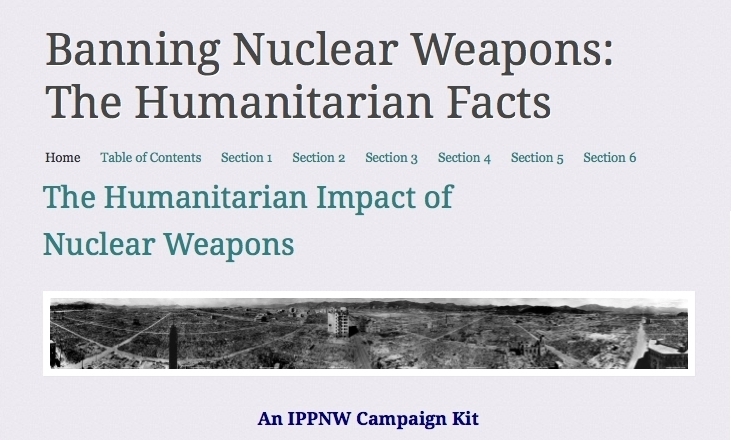 IPPNW has produced a new Campaign Kit on the Humanitarian Impact of Nuclear Weapons, presenting the essential facts about their medical, environmental, and humanitarian effects in clear, simple, and accurate language.
“This important new tool will help ICAN campaigners and other abolition activists make a compelling and irrefutable humanitarian case for banning and eliminating nuclear weapons,” said Program Director John Loretz, who will lead a workshop on the kit and its campaigning uses during the upcoming ICAN Civil Society Forum in Vienna. Read more…
The use of nuclear weapons
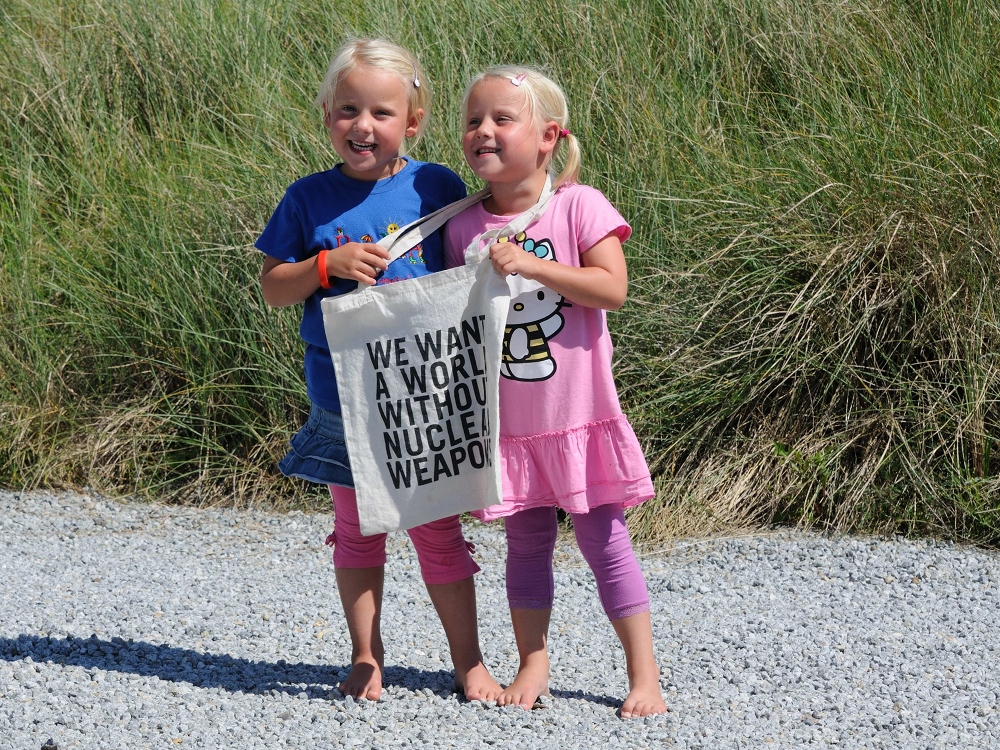 They always tell us that nuclear weapons will never be used.
The fact is that nuclear weapons are used every day by the nuclear-armed states to threaten the rest of the world with total annihilation, while threatening themselves with the same fate.
During the time of the Cold War, we called such an insane situation MAD: Mutual Assured Destruction. The threat was immediate and the situation very dangerous. We don’t like to think about it, but today’s risk that nuclear weapons can be detonated somewhere deliberately or by accident is at least as high. The doomsday clock of the atomic scientists is set at five minutes to midnight. Read more…
No more time to wait for a nuclear weapons ban
 International Campaign to Abolish Nuclear Weapons
Statement to the UN First Committee
28 October 2014, New York
[This statement was prepared and delivered by the International Campaign to Abolish Nuclear Weapons (ICAN), during the 2014 session of the UN General Assembly First Committee on Disarmament and International Security. ICAN represents more than 360 partner organizations in 93 countries. IPPNW founded ICAN in 2007 and is the lead medical partner organization.]
Nuclear disarmament has for too long been about waiting. Waiting for nuclear-armed states to fulfill their obligations. Waiting for the so-called “conditions” to be right for disarmament.
While we wait, we do not get closer to the elimination of nuclear weapons or to a more secure world. While we wait, the risks of the use of nuclear weapons remain or even increase. While we wait, the catastrophic and overwhelming consequences of such use do not diminish.
We do not have time to wait. Read more…
A day to demand that the world wake up and avert nuclear doom
by Richard Tanter and Tilman Ruff
Two odd facts. First, the United Nations General Assembly declared September 26 the International Day for the Total Elimination of Nuclear Weapons.
You might yawn. Why bother? That’s never going to happen, you say. It’s too hard.
The Americans/Chinese/Russians/ … won’t let it happen. Oh, and we might need nuclear weapons one day. Anyway, hasn’t that been done before?
Well, no, this is a first. Never before in more than almost seven decades of nuclear threat has the UN led the world in observing a day dedicated to this goal. Read more…
Everyone to Vienna to save the world!
On the 26th of September in 1983 one man, a Russian officer whose name is Stanislav Petrov showed so much civil courage that he was later called ”the man who saved the world.” When he was on duty as the commander of a Soviet radar station, he disobeyed standing orders and refrained from launching a nuclear counterattack when everyone at the station misinterpreted the radar images and believed they saw a US nuclear missile attack on the Soviet Union.
Without knowing it, on that day we were one hair’s breadth from total extermination. Stanislav Petrov saved us. Read more…
Arms Trade Treaty ratifications enable entry into force this year
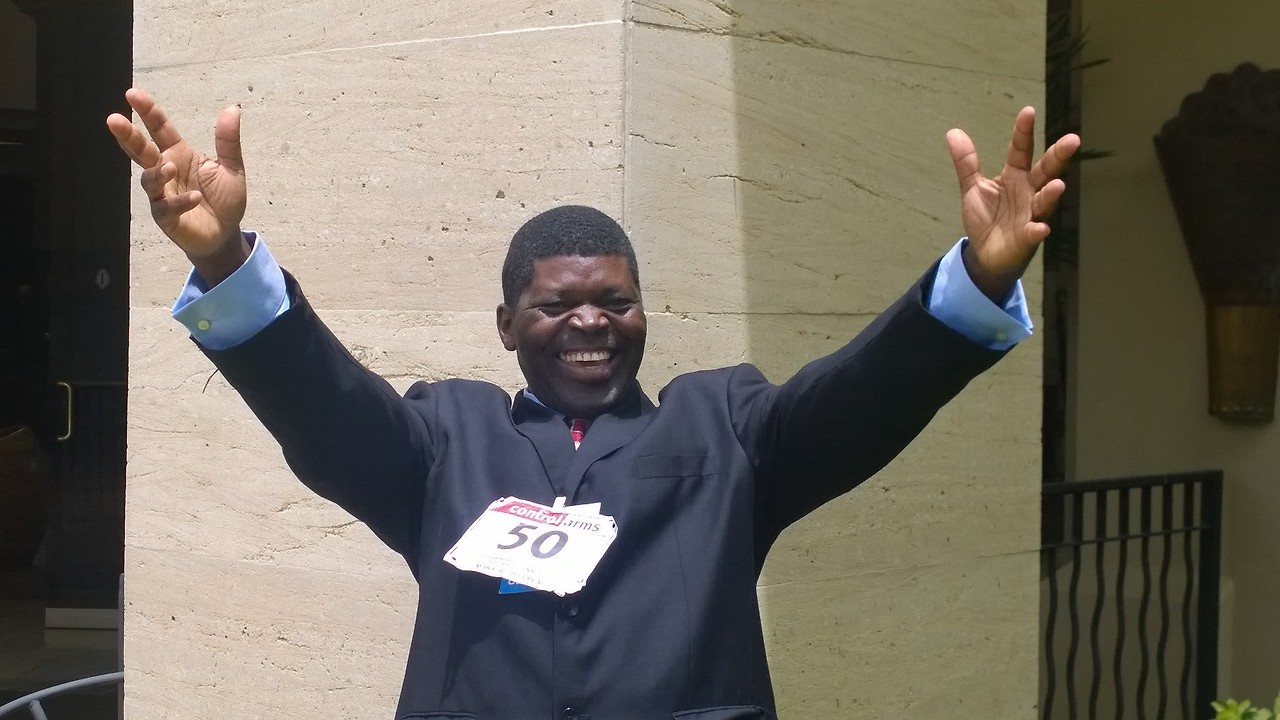
Past IPPNW co-president Dr. Bob Mtonga celebrates ratification of the ATT by more than 50 states
At a special ceremony today at the United Nations in New York, several states, including the Bahamas, St Lucia, Portugal, Senegal, and Uruguay ratified the Arms Trade Treaty (ATT), helping to exceed the magic number of 50 required for the treaty to enter into force. This will now take place in 90 days, or on December 24th. Read more…

 Bimal Khadka
 Bjorn Hilt
 Charles K. Johnson
 Dr. Ghassan Shahrour
 Gunnar Westberg
 IPPNW
IPPNW John Loretz
 Lawrence Wittner
 Maria Valenti
 mollymcgint
 Sue Wareham
 Tilman Ruff
 Tim Wright
 Xanthe Hall