All that’s gold doesn’t glitter
 The 2015 NPT Review Conference limps to a conclusion on Friday. What started as a welcome opportunity to bring the evidence from the three HINW conferences and the renamed Humanitarian Pledge into the NPT as a clear path to the fulfillment of the treaty’s nuclear disarmament goals is ending with a cynical rejection of this game-changing initiative by the nuclear-armed member states. Read more…
IPPNW calls for end to conflict in Ukraine
The IPPNW Executive Committee discussed the conflict in Ukraine during a conference call on May 19, and has issued the following statement:
The ongoing crisis in Ukraine has raised grave concerns about the potential for escalation among the nuclear-armed states engaged in this tragic armed conflict. Nuclear weapons cannot have any role—even rhetorically—in the difficult and dangerous conflict in Ukraine. Rather, what is needed is humanitarian aid for all civilians who are suffering so terribly from this violent conflict. We therefore call on all parties, including Russia, the US, the European Union, and NATO to change course, to ensure that the conflict does not escalate any further and is brought to an end, and to begin what will have to be a long and difficult process of reconciliation. Europe must be the area of peace, culture, and collaboration that its entire population deserves, rather than a field of armed conflicts. IPPNW-Germany has published a statement on the Ukraine conflict that we highly recommend to the entire IPPNW federation and to all others concerned with bringing peace to this region. We also encourage all IPPNW members to participate in the “We refuse to be enemies” project organized by IPPNW-Germany.
All that glitters is not gold
Reductions in nuclear weapons are not the same as nuclear disarmament
On the plane over here, I read an essay in the Financial Times in which the author asks whether there is such a thing as an Obama Doctrine in foreign policy. The criticism of the US President is that he has mistaken declaratory speeches – like the one in Prague in 2009 – for a strategy. Actually, his main goal in the area of foreign policy was to reduce military costs to pay for sorely needed reforms in domestic policies, such as the health care plan. At least with the nuclear weapons budget, he has failed spectacularly. Read more…
Time to look beyond the NPT
When this NPT Review Conference began, I wrote that the outcome would depend on how seriously the humanitarian impacts initiative and the Austrian Pledge were taken up by the member states as a basis for new and effective action on disarmament. Halfway through the month-long conference, the disappointing answer is taking shape. Read more…
An NPT pop quiz
Can you name the “official” NPT nuclear-weapons states?
If you said the US, Russia, the UK, France, and China…you’re wrong. Read more…
Denuclearization of the Korean Peninsula?
Can Korea be reunited after almost 70 years of complete division between North and South? This is the dream of many in the older generation in both parts of the country. The younger people in South Korea do not seem to care so much about the North.
North Korea has a few nuclear weapons and may be producing a few each year. South Korea has a military alliance with the USA, including a “nuclear umbrella,” a pledge from the US to use nuclear weapons, if needed, to defend their ally.
During my two visits to DPRK, as North Korea is called, the officials we met called for a Korean Peninsula without nuclear weapons. Are they serious? Well, only serious negotiations can give us the answer. Read more…
The NPT and the nuclear ban treaty
As this is being written, the conference reviewing the Non-Proliferation Treaty (NPT) is going on at the UN in New York. I often lose the line in the formal presentations by the official delegates, and find myself wondering: Why has the NPT worked? Read more…
Will the NPT sink or swim?
“We were waist deep in the Big Muddy,
The big fool said to push on.”
—Pete Seeger
The NPT member states have to choose between two irreconcilable narratives, and the success of the 2015 Review Conference depends upon their making the right choice.
According to the nuclear-armed states and their closest allies, nuclear disarmament is moving along step by step at a realistic pace, and all that’s needed for the next five years is to keep slogging through the river.
The majority view, expressed during the first week of general debate, is a little different: the NPT has failed to grapple effectively with the humanitarian catastrophe nuclear weapons could bring about in the blink of an eye, and it’s long past time to head for dry land. Read more…
[ICAN delivered the following statement during a special civil society session at the 2015 NPT Review Conference on May 1.]
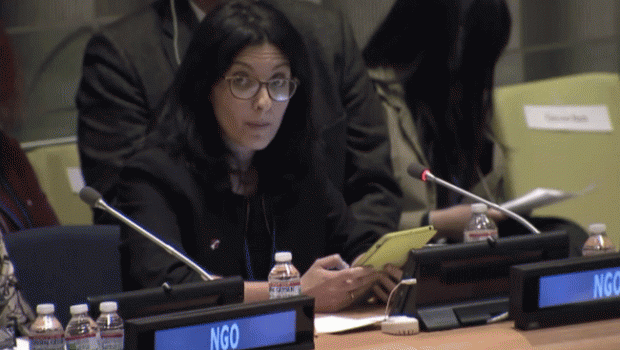
Daniela Varano told NPT Member States “we can and we must move forward with a ban.”
The humanitarian initiative began here five years ago, when the NPT Review Conference expressed its deep concern at the catastrophic humanitarian consequences of nuclear weapons. Since then, a fundamental shift has been under way. Concerns about the impact of nuclear weapons on people and the environment have become central to disarmament discussions.
There is a new sense of empowerment among the peoples and the governments of countries that reject nuclear weapons. Read more…
A nuclear war using only 100 Hiroshima-sized bombs against modern cities would cause prolonged global climate change and create an ozone hole encircling the entire Earth, according to data presented by Rutgers professor Alan Robock at an NPT side event sponsored by IPPNW on April 28. “Nuclear famine and the ban treaty: how prohibiting and eliminating nuclear weapons can prevent a climate disaster” examined the scientific and medical evidence supporting the conclusion that the number of nuclear weapons in the world must be reduced to zero without delay. Read more…

 Bimal Khadka
 Bjorn Hilt
 Charles K. Johnson
 Dr. Ghassan Shahrour
 Gunnar Westberg
 IPPNW
IPPNW John Loretz
 Lawrence Wittner
 Maria Valenti
 mollymcgint
 Sue Wareham
 Tilman Ruff
 Tim Wright
 Xanthe Hall