Things could always be worse…a lot worse
There’s more bad news from the climate scientists. Not about global warming, where the news is never good, but about the impact nuclear weapons would have on the atmosphere, our climate, and food production if even a very small number were used in a limited, regional conflict. Read more…
Doom from the depths

The US has commissioned 12 new Ohio class replacement submarines, each equipped with 16 Trident nuclear missiles capable of annihilating millions of people. (US Naval Institute graphic)
Ever since the horrors of submarine warfare became a key issue during World War I, submarines have had a sinister reputation. And the building of new, immensely costly, nuclear-armed submarines by the US government and others may soon raise the level of earlier anxiety to a nuclear nightmare.
This spring, the US government continued its steady escalation of research and development funding for the replacement of its current nuclear submarine fleet through one of the most expensive shipbuilding undertakings in American history — the phasing-in, starting in 2031, of 12 new SSBN(X) submarines. Read more…
Enough harm
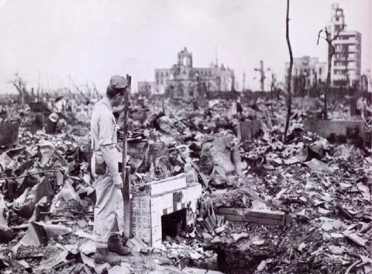
The city of Hiroshima lay in ruins after the US atomic bombing on August 6, 1945.
In addition to the indelible scenes from Hiroshima and Nagasaki and from other cities that have been terror bombed during wartime, with heavy losses of civilians, two pictures are impossible to get of my mind. One is from what happened in New York on September 11, 2001, and the other is from Oslo on July 22, 2011. Read more…
Doctors and Parliamentarians Address Health Impact of Gun Violence at the United Nations

Dr. Okolo speaks at UN panel BMS 5
“On an average day in the United States 86 people are killed by guns,” was one of many alarming facts presented by Dr. Bill Durston, a passionate IPPNW speaker at a June 17th panel conducted by IPPNW, the Parliamentary Forum on Small Arms and Light Weapons and IANSA at the United Nations (U.N.) in New York City. The panel focused on how guns affect health and development around the world, and was a well-attended side event at the U.N. Fifth Biennial Meeting of States to Consider Implementation of the Programme of Action (PoA) on Small Arms and Light Weapons. Read more…
Not One More Mass Shooting

1000 people march across the Brooklyn Bridge to protest gun violence.
This past weekend, on the 18 month anniversary of the Newtown school shootings, I joined 1,000 other people who marched across the Brooklyn Bridge in New York to rally to end gun violence. The event, sponsored by Everytown for Gun Safety and Moms Demand Action for Gun Sense in America, took place at the beginning of the Global Week of Action Against Gun Violence. Twenty U.S. states were represented at the march and rally.
The march also coincided with the opening of the U.N. Biennial Meeting of States on Small Arms, in which I am participating.
After marching across the bridge, several speakers shared their personal connection to gun violence. The daughter of the Sandy Hook Elementary School’s principal spoke on her experience of losing her mother and her fight for tighter gun control in the U.S.
Another speaker was a young man who sustained a gunshot wound to his chest and abdomen. He reminded the participants that the all of society was injured by the bullet, noting it was not only himself that had been shot, but “they shot my mother, father, cousins, other family members, friends and community.”
Mass shootings in the U.S. have risen to 74 since the Newtown, CT, shootings. This event was poignant focusing on the need to work for tighter gun control so there would be “Not One More” shooting.
Burn injuries

Atomic bombing victims suffered terrible burns, for which treatment was largely unavailable and inadequate.
We know that the detonation of a nuclear bomb creates temperatures that cause serious burns in those affected. Even though there have been significant improvements in the treatment and survival of burn victims, burns are very painful, and every second or third degree burn injury that affects more than 10-15 % of the body surface is in acute need of intensive medical care. Read more…
Physicians from 19 IPPNW affiliates have published a critical analysis of a major new UNSCEAR report to the UN General Assembly on the health effects of exposure to ionizing radiation from the nuclear reactor disaster at Fukushima in March 2011. UNSCEAR—the United Nations Scientific Committee on the Effects of Atomic Radiation—published Levels and effects of radiation exposure due to the nuclear accident after the 2011 great east-Japan earthquake and tsunami on April 2, 2014. A summary report was sent to the UNGA in October 2013. Read more…

IPPNW co-president Dr. Bob Mtonga (second from left) represented the Control Arms Coalition at a special signing ceremony at the UN in New York June 3rd, when eight more countries ratified the ATT. Photo credit: Champion Hamilton/Champion Eye Media/Control Arms
United Nations, New York City
A year ago yesterday, the pioneering Arms Trade Treaty (ATT) opened for signature. Although to date 118 countries have signed the Treaty, only 32 had ratified it – before yesterday.
To mark the anniversary of the ATT, eight states including Australia, Austria, Belgium, Burkina Faso, Jamaica, Luxembourg, Samoa and St Vincent and the Grenadines ratified the ATT at a special ceremony at the United Nations headquarters, in New York. This brings the total number of states that have ratified the treaty to 40 – with just ten more to go for the 50 needed for the ATT to enter into force. Read more…
Does war have a future?
National officials certainly assume that war has a future. According to a report by the Stockholm International Peace Research Institute, world military expenditures totaled nearly $1.75 trillion in 2013. Although, after accounting for inflation, this is a slight decrease over the preceding year, many countries increased their military spending significantly, including China, Russia, and Saudi Arabia. Indeed, 23 countries doubled their military spending between 2004 and 2013. None, of course, came anywhere near to matching the military spending of the United States, which, at $640 billion, accounted for 37 percent of 2013’s global military expenditures. Furthermore, all the nuclear weapons nations are currently “modernizing” their nuclear arsenals.
Meanwhile, countries are not only preparing for wars, but are fighting them―sometimes overtly (as in Syria, Iraq, and Afghanistan) and sometimes covertly (as in portions of Africa and the Middle East).
Nevertheless, there are some reasons why war might actually be on the way out. Read more…
After Mexico: Why an “Ottawa Process” for a legal ban of nuclear weapons deserves our enthusiastic support
Guest Editorial
by Alice Slater
The 1970 Non-Proliferation Treaty (NPT), extended indefinitely in 1995 when it was due to expire, provided that five nuclear weapons states which also happened to hold the veto power on the Security Council (P-5)– the US, Russia, UK, France, and China– would “pursue negotiations in good faith” [1] for nuclear disarmament. In order to buy the support of the rest of the world for the deal, the nuclear weapons states “sweetened the pot” with a Faustian bargain promising the non-nuclear weapons state an “inalienable right” [2] to so-called “peaceful” nuclear power, thus giving them the keys to the bomb factory. Every country in the world signed the new treaty except for India, Pakistan, and Israel, which went on to develop nuclear arsenals. North Korea, an NPT member, took advantage of the technological know-how it acquired through its “inalienable right” to nuclear power and quit the treaty to make its own nuclear bombs. Today there are nine nuclear weapons states with 17,000 bombs on the planet, 16,000 of which are in the US and Russia! Read more…

 Bimal Khadka
 Bjorn Hilt
 Charles K. Johnson
 Gunnar Westberg
 IPPNW
IPPNW John Loretz
 Lawrence Wittner
 Maria Valenti
 mollymcgint
 Sue Wareham
 Tilman Ruff
 Tim Wright
 Xanthe Hall


 IPPNW peace and health blog