International trade unions call for ban treaty
The International Trade Unions Confederation (ITUC), an ICAN partner organization, issued a general statement from its World Congress yesterday in Berlin, in which it said world leaders and international institutions “have failed to eliminate nuclear weapons and deliver global peace,” and called for “a treaty to ban the use, manufacture, stockpiling and possession of nuclear weapons as a first step towards their complete eradication.” The ITUC also called for regulation of the small arms trade and said that “hundreds of billions of dollars of military expenditure must be better spent meeting vital needs for sustainable employment and development.”
The language on nuclear weapons was proposed by the Norwegian Confederation of Trade Unions, and ICAN campaigners have been urging their national ITUC chapters to support the call for a ban at this Congress. The statement was adopted unanimously.
This is a major accomplishment for ICAN, which has made engagement with labor groups—and other civil society organizations that have not traditionally focused on the nuclear issues—an important priority.
Appreciating the P5
The P5 are feeling unappreciated about everything they’ve done for nuclear disarmament. They’ve made enormous progress over the years, give or take a few setbacks (and what junkie doesn’t slip on the way to recovery?). If they could only do a better job of telling their story, maybe all this talk about humanitarian consequences and a ban treaty would fade away and they could get back to the step-by-step task of keeping their nuclear weapons safe and reliable for as long as they exist. Which will probably be for another 100 years or so at the pace the P5 are setting, but then Hiroshima wasn’t destroyed in a day. Oh, wait…
 So during a windy, rainy April in New York, the three nuclear-armed States that joined the Non-Proliferation Treaty in 1968 and the two that waited until 1992 made the daunting—and often bewildering—journey to the Trusteeship Council Chamber of the United Nations, like Odysseus returning to Penelope with wondrous tales of monsters slain and order restored to the world. Read more…
By Cesar Jaramillo
It’s hard to tell whether the states questioning the purpose, direction, and convenience of the humanitarian imperative for nuclear disarmament are fully aware of the extent to which the inconsistencies in their positions are apparent to the rest of the international community. Because the contradictions are, well, quite obvious. Read more…
The limits of military power
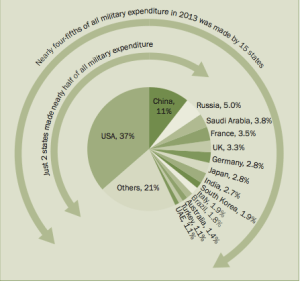
SIPRI Fact Sheet: TRENDS IN WORLD MILITARY EXPENDITURE, 2013
Is overwhelming national military power a reliable source of influence in world affairs?
If so, the United States should certainly have plenty of influence today. For decades, it has been the world’s Number 1 military spender. And it continues in this role. According to a recent report by the Stockholm International Peace Research Institute, the United States spent $640 billion on the military in 2013, thus accounting for 37 percent of world military expenditures. The two closest competitors, China and Russia, accounted for 11 percent and 5 percent respectively. Thus, last year, the United States spent more than three times as much as China and more than seven times as much as Russia on the military. Read more…
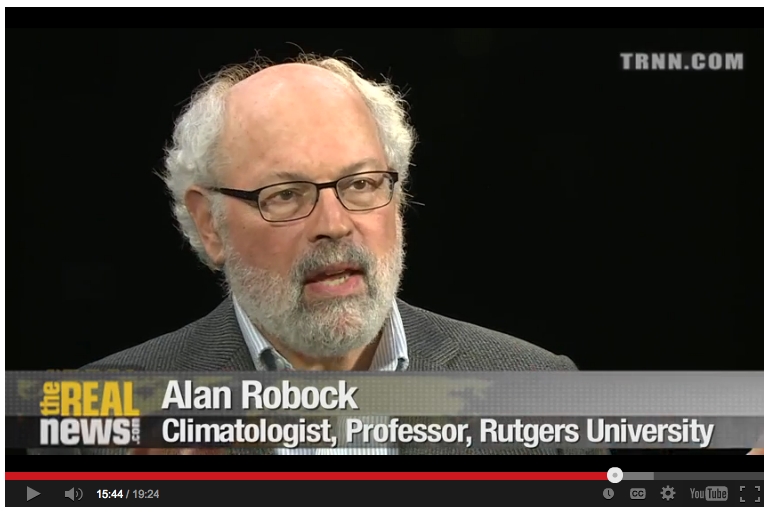 Alan Robock, professor of meteorology at Rutgers University and a science adviser to IPPNW on the climate effects of nuclear war, was interviewed yesterday (May 5) on the The Real News. In a segment called “Reality assert itself,” Prof. Robock told editor Paul Jay that “both [presidents] Reagan and Gorbachev learned about the nuclear winter results from scientists–and I have quotes of both of them saying that helped them decide to change the arms race. And it made people focus on these horrible direct effects of nuclear weapons.
From the interview:
There were two conferences in the last year on the humanitarian impacts of nuclear weapons, one in Oslo in March in 2013, and one in Mexico in February 2014. And 130 to 140 countries came, and came to this conference, including a couple of the nuclear nations–India and Pakistan were there. But the P5, they call them, the permanent members of the Security Council, boycotted it. But the rest of the world understands that a war between the nuclear powers threatens them because it would be a global climate effect. The smoke would go around the world, would last for many years, and it would affect everybody. It doesn’t matter where the bombs are dropped. And so they’re pressuring much more the countries that have nuclear weapons. And they claimed that we’re not going to come because this disrupts from the process that we’re going through to get rid of weapons, of course, which doesn’t exist. And so a third meeting’s going to be held in Vienna, Austria, this fall. And I think this pressure from the rest of the world is really building up pressure on the countries to pay attention to this.”
Watch the whole interview on TheRealNews.com.
Heat as from a thousand suns
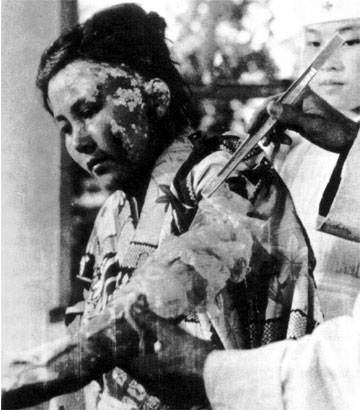
Hiroshima survivor treated for burn injuries
When a nuclear weapon detonates incredible amounts of energy are released in the form of heat, blast, and ionizing radiation. The fireball that is created in the first minute after a nuclear detonation has temperatures as high as those on the sun, leading to intense thermal radiation that spreads in every direction with the speed of light. Therefore, everything that can be ignited within kilometers from the hypocenter ignites before the blast hits. Read more…
The contrast in mood and sense of accomplishment (not to mention purpose) between the Olso and Nayarit conferences and the NPT PrepCom could not be more obvious. Although the PrepCom is still in its first week and cannot be judged fairly yet, the statements in the general debate, with a few exceptions, have hardly broken any new ground. The Member States have danced more or less politely around the fact that there has been little or no progress in implementing the 2010 Action Plan, and the overall feeling of malaise has been hard to ignore. This does not bode well for the Review Conference itself, since a successful outcome depends upon a positive evaluation of the steps that have been taken to implement the Action Plan.
[I’ve hopped over to the ICAN website momentarily, so the rest of this article is there, along with the latest news about ICAN’s participation at the PrepCom.]
Pacific nation challenges nine nuclear-armed states in lawsuits before the world court
Republic of Marshall Islands’ historic lawsuits charge the US, Russia, UK, France, China, Israel, India, Pakistan and North Korea with breaches of international law
The Republic of the Marshall Islands (RMI) today filed unprecedented lawsuits in the International Court of Justice to hold the nine nuclear-armed states accountable for flagrant violations of international law with respect to their nuclear disarmament obligations under the 1968 Nuclear Non-Proliferation Treaty (NPT) and customary international law. Read more…
Japanese physicians demand better post-Fukushima monitoring and public health measures
Physicians Against Nuclear War in Japan has published a statement regarding the Fukushima nuclear disaster that deserves a wider international audience. It protests recent Japanese government pressures for return of displaced people to areas radioactively contaminated from the Fukushima nuclear disaster; continued tolerance of radiation exposures for the general public, which IPPNW has repeatedly condemned as unacceptably high; and transfer of the onus of protection to individuals.
PANW, which was founded in Tokyo in 1987 to work for the abolition of nuclear weapons, expanded its activities to include the health impact of nuclear power plants following the March 2011 nuclear reactor crisis at Fukushima Daiichi. “We protest the recent statements from Japan Nuclear Regulation Authority, Japan Atomic Energy Commission and Nuclear Emergency Response Headquarters, and protest moves by the government to accelerate the return of evacuees to the contaminated areas without sufficient participation of community members as stakeholders.”
The doctors group goes on to make a series of recommendations for more stringent and effective radiation monitoring, more complete and transparent public access to information, and comprehensive health care for those who continue to live in contaminated areas and for displaced populations.
The continuing threat of nuclear weapons
By Barry S. Levy and Victor W. Sidel
Out of sight. Out of mind.
Nine countries, mainly the United States and Russia, possess 17,000 nuclear weapons, many of which are hundreds of times more powerful than the atomic bombs dropped over Hiroshima and Nagasaki almost 70 years ago. An attack and counterattack in which fewer than 1% of these nuclear weapons were detonated could cause tens of millions of deaths and could disrupt climate globally, leading to crop failures and widespread famine. A greater conflagration could cause a “nuclear winter” and threaten the future of life on earth.
– See more at: http://blog.oup.com/2014/04/threat-of-nuclear-weapons-public-health/#sthash.aOgFacBS.dpuf
By Barry S. Levy and Victor W. Sidel
Out of sight. Out of mind.
Nine countries, mainly the United States and Russia, possess 17,000 nuclear weapons, many of which are hundreds of times more powerful than the atomic bombs dropped over Hiroshima and Nagasaki almost 70 years ago. An attack and counterattack in which fewer than 1% of these nuclear weapons were detonated could cause tens of millions of deaths and could disrupt climate globally, leading to crop failures and widespread famine. A greater conflagration could cause a “nuclear winter” and threaten the future of life on earth.
– See more at: http://blog.oup.com/2014/04/threat-of-nuclear-weapons-public-health/#sthash.aOgFacBS.dpuf
By Barry S. Levy and Victor W. Sidel
Out of sight. Out of mind.
Nine countries, mainly the United States and Russia, possess 17,000 nuclear weapons, many of which are hundreds of times more powerful than the atomic bombs dropped over Hiroshima and Nagasaki almost 70 years ago. An attack and counterattack in which fewer than 1% of these nuclear weapons were detonated could cause tens of millions of deaths and could disrupt climate globally, leading to crop failures and widespread famine. A greater conflagration could cause a “nuclear winter” and threaten the future of life on earth.
Dr. Levy is an Adjunct Professor of Public Health at Tufts University School of Medicine. Dr. Sidel is Distinguished University Professor of Social Medicine Emeritus at Montefiore Medical Center and Albert Einstein Medical College, and is a former co-president of IPPNW. Both are past presidents of the American Public Health Association.
Read more at the Oxford University Press’s OUPblog
By Barry S. Levy and Victor W. Sidel
Out of sight. Out of mind.
Nine countries, mainly the United States and Russia, possess 17,000 nuclear weapons, many of which are hundreds of times more powerful than the atomic bombs dropped over Hiroshima and Nagasaki almost 70 years ago. An attack and counterattack in which fewer than 1% of these nuclear weapons were detonated could cause tens of millions of deaths and could disrupt climate globally, leading to crop failures and widespread famine. A greater conflagration could cause a “nuclear winter” and threaten the future of life on earth.
– See more at: http://blog.oup.com/2014/04/threat-of-nuclear-weapons-public-health/#sthash.aOgFacBS.dpuf

 Bimal Khadka
 Bjorn Hilt
 Charles K. Johnson
 Gunnar Westberg
 IPPNW
IPPNW John Loretz
 Lawrence Wittner
 Maria Valenti
 mollymcgint
 Sue Wareham
 Tilman Ruff
 Tim Wright
 Xanthe Hall


 IPPNW peace and health blog