IPPNW statement on crisis in Gaza
[IPPNW’s International Council adopted the following statement on the Gaza crisis at its meeting in Astana, Kazakhstan on August 29.]
Gaza Declaration
IPPNW World Congress
Astana, Kazakhstan
28th August 2014
International Physicians for the Prevention of Nuclear War (IPPNW) received the Nobel Prize in 1985 for creating an awareness of the catastrophic consequences of nuclear war and advocating prevention by abolishing nuclear weapons. It was essentially a universal public health project and an exercise in preventive medicine. IPPNW continues to advocate the same humanitarian principles.
IPPNW is extremely concerned that the ongoing military conflict between the Israelis and the Palestinians in the Gaza Strip is not only undermining nuclear disarmament regionally and globally but also resulting in massive urban destruction and the mounting loss of civilian lives. Unless the root causes of the conflict are addressed, it will recur. Read more…
Wars and peace in Kazakhstan
Guest editorial
by Tony Waterston
[Ed. note: This article was originally published on the BMJ Blog and is reprinted here with permission.]
“What has International Physicians for the Prevention of Nuclear War (IPPNW) achieved anyway?” The question posed at a workshop on primary prevention needed answering, since the 21st IPPNW Congress meeting we were at coincided with major wars in Gaza, Syria, and Ukraine. Not even the most ardent members of IPPNW would expect our organisation to prevent all war, but we did get the Nobel peace prize in 1985 for warning the world about nuclear war. Read more…
IPPNW World Congress issues Astana Declaration
Astana Declaration
IPPNW 21st World Congress
30 August 2014
For more than 50 years, physicians concerned with the medical, environmental and humanitarian impact of nuclear weapons have documented the extreme and unacceptable consequences of their use. The evidence accumulated over the decades since the US atomic bombings of Hiroshima and Nagasaki has convinced us that only the complete and rapid elimination of nuclear weapons from the world can assure us of a future. Even in a world without nuclear weapons, we face severe challenges from unsustainable living patterns, global warming, militarism and armed violence, economic inequalities, resource depletion, and the inexcusable poverty that afflicts billions of people on Earth. Only in a world without nuclear weapons, however, will we have a chance to solve those problems. The renewed awakening to the humanitarian impact of nuclear weapons that is now driving a political initiative for their abolition is the most hopeful development in more than 20 years since the end of the Cold War. Read more…
Statement of IPPNW physicians on the situation in the Ukraine
In 1985, at the height of the Cold War, the International Physicians for the Prevention of Nuclear War (IPPNW) was awarded the Nobel Peace Prize for its East-West cooperation to prevent a nuclear catastrophe. The current crisis in Ukraine requires us to remind President Obama in the USA and President Putin in Russia that there are still thousands of nuclear weapons on high alert, set to launch on warning within minutes.
We know—and have new evidence—that even a small percentage of those weapons, if launched, would kill millions of people immediately, and would alter our climate in ways not seen since the last ice age—quite possibly killing 1-2 billion people. The current arsenals of Russia and the USA, totaling around 15,000 warheads, are sufficient to literally end life on this planet several times over.
The current crisis in Ukraine is of complex origin and of large humanitarian consequence. It may lead to Ukraine re-acquiring nuclear weapons (which they voluntarily renounced in 1991). It threatens to re-ignite the Cold War and risks involving the use of nuclear weapons accidentally or on purpose.
As Russian, American, Ukrainian, and German doctors and leaders of IPPNW, we together call upon the parties to immediately cease the violence and to re-emphasize diplomatic communication between the USA and Russia, to assist Ukraine to resolve the crisis peacefully.
Furthermore, we hope the parties recognize the potential existential threat posed by a return to nuclear-armed antagonism. We call for renewed efforts to finally negotiate an end to the risk of nuclear war by making the historic decision to take the weapons off high alert and then ban and eliminate them. We are living in the most dangerous time since the end of World War II, and this is our joint prescription for our survival.
Vladimir Garkavenko, IPPNW Co-President
Ira Helfand, IPPNW Co-President
Olena Bezsmertna, International Councillor, IPPNW Ukraine
Helmut Lohrer. International Councillor, IPPNW Germany
On behalf of the IPPNW Board and International Council
Pay enough attention and nuclear weapons condemn themselves
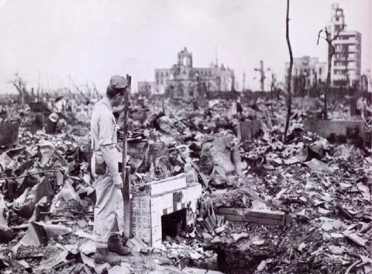
The city of Hiroshima lay in ruins after the US atomic bombing on August 6, 1945—69 years ago this week.
Each year, in August, we are reminded, to our sorrow, about nuclear weapons, the horrors they unleash, and the shame they bring to humankind—first, for having created them at all, and then for having tolerated their existence this long. The US atomic bombings of Hiroshima and Nagasaki, which we commemorate this week, put the world on notice almost 70 years ago that war had reached a point of no return. We woke up to discover that we had weapons powerful enough to end humanity itself. Our response to that dilemma, as we realized even then, would determine for all time whether humanity had been worth the bother. Sadly, the jury is still out. Read more…
I believe in a just peace
 An open letter to the IPPNW community
by Alex Rosen, IPPNW-Germany
Dear friends in Israel and Palestine,
When I say that I believe in a just peace between Israelis and Palestinians you say that I am naive; that I do not know what I’m talking about; that I don’t know the reality on the ground. Read more…
Unimaginable pressure and wind
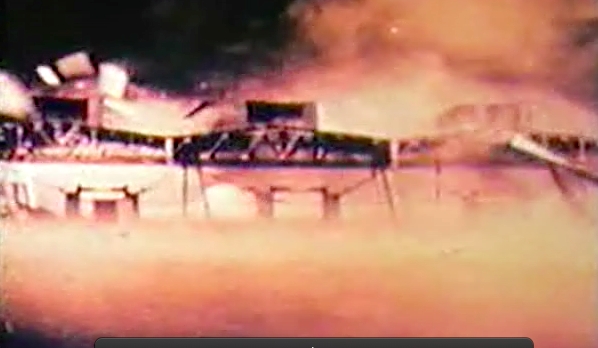 Many of us have experienced strong winds. On the coast of Norway we often have storms and also hurricanes now and then. They can be scary and it seems incredible when roofs are blown off houses and big fishing boats are washed ashore. Along with the blast, the heat, the electromagnetic pulse, and the ionizing radiation, the detonation of a nuclear weapon creates unimaginably strong and destructive winds. Read more…
IPPNW responds to Gaza crisis
The following statement has been issued by the IPPNW Executive Committee:
IPPNW calls for an immediate cease fire between Israel and Hamas. We call on Israel to stop its air strikes and ground invasion of Gaza, and we call on Hamas to stop all rocket attacks on Israel We also call on both sides to allow full access to medical care for all those wounded in the fighting.
IPPNW statement on crisis in Ukraine
[The IPPNW Executive Committee has issued the following statement addressing the conflict in Ukraine:]
IPPNW calls call for an immediate cease fire to the fighting in Ukraine and for all states to refrain from any military intervention in Ukraine. We further call on Ukraine to reaffirm its historic decision to renounce nuclear weapons and for Russia to reaffirm the guarantee of Ukraine’s territorial integrity that accompanied that decision. We further call for urgent UN mediation to achieve a diplomatic solution to the issues involved in this conflict.
Putting an end to war
[This article originally appeared on the Oxford University Press blog.]
Guest Editorial
by Barry S. Levy and Victor W. Sidel
War is hell. War kills people, mainly non-combatant civilians, and injures and maims many more — both physically and psychologically. War destroys the health-supporting infrastructure of society, including systems of medical care and public health services, food and water supply, sanitation and sewage treatment, transportation, communication, and power generation. War destroys the fabric of society and damages the environment. War uproots individuals, families, and often entire communities, making people refugees or internally displaced persons. War diverts human and financial resources. War reinforces the mistaken concept that violence is an acceptable way of resolving conflicts and disputes. And war often creates hatreds that are passed on from one generation to the next. Read more…

 Bimal Khadka
 Bjorn Hilt
 Charles K. Johnson
 Gunnar Westberg
 IPPNW
IPPNW John Loretz
 Lawrence Wittner
 Maria Valenti
 mollymcgint
 Sue Wareham
 Tilman Ruff
 Tim Wright
 Xanthe Hall


 IPPNW peace and health blog