Invisible harm from ionizing radiation
 Besides the terrible effects of the burst of light that causes eye damage, the heat that sets everything flammable on fire, the electromagnetic pulse that knocks out all electronic devices, and the blast that produces winds with ten times the force of a hurricane, demolishing everything, the detonation of nuclear weapons also leads to the emission of large amounts of ionizing radiation, which has serious deleterious effects on humans and many other species. Ionizing radiation is, in fact, a lurking danger as we cannot see it, we cannot smell it, we cannot hear it, and we cannot feel it immediately. But we certainly get harmed from it. Read more…
The health impacts of war and armed conflict
By guest author Jessica Falk (reprinted with permission from Medact)

A child receives a polio vaccination © CIDA-ACDI/Sharif Azami
In 1951, at the height of the Korean War, seven eminent doctors wrote to The Lancet medical journal in a call for disarmament. Their argument? Military spending was impacting upon healthcare provision in the UK, and doctors had a social responsibility to advocate against war. Some dismissed the letter out of hand, its opponents arguing that politics should not be a concern for health professionals. Another letter to The Lancet last year, condemning the summer assault on Gaza, received similar treatment – for how long can we deny that health and conflict are priorities for health professionals? Read more…
Why aren’t the candidates for US President talking about nuclear war?
[The following op-ed by IPPNW co-president Ira Helfand and PSR board member Maureen McCue appeared in the DesMoines Register on 23 November.]
When the Cold War ended, we pretty much stopped worrying about nuclear war, but the weapons didn’t go away. More than 15,000 are left in the world today, 95 percent in the arsenals of the U.S. and Russia. Seven other countries have nuclear arsenals as well.
We know of at least five major incidents in the last 35 years when either Washington or Moscow prepared to launch nuclear war in the mistaken belief that it was under attack by the other side. Now, for the first time in 25 years, rising tensions between the U.S. and Russia have been accompanied by nuclear saber-rattling. In defense circles, concern is growing that we could stumble into a direct armed conflict with Russia. Such a conflict could escalate out of control and nuclear weapons could be used.
Clearly, we should not be complacent about nuclear war. So why aren’t the candidates talking about nuclear war? Here are a few questions we should ask them: Read more…
IPPNW Board joins minute of silence
 At its London meeting [Monday, 16 November], the Board of Directors of IPPNW joined the minute’s silence in remembrance of the victims of terror and war, which was held all across Europe, mindful of the dreadful acts of violence in France.
In our silence, the Board explicitly included all the victims of hostility: in Syria and the whole of the Middle East as well as in France and the rest of the world. We mourn the more than a million victims of the War on Terror as much as we mourn the victims of fanaticism of any kind.
At a time when humanity is confronted with the possibility of its own extinction, not only but predominantly by the threat posed by thousands of nuclear weapons, humankind must now step out of the spiral of bloodshed and violence and live in peace. Humankind can only survive through cooperation, not by violence.
The Conflict over Ukraine
New front-line of nuclear escalation in Europe
The relationship between the US and Russia is at all-time low since end of Cold War, and tensions continue to escalate. The US and Russia are no longer negotiating any arms control agreements. The last one was New START in 2010. Communication between NATO and Russia has broken down. Many previous agreements have been neglected, suspended or are endangered. The conflict in Ukraine has led to this relationship deteriorating even further. Nevertheless, we believe that the conflict is a symptom of this relationship, rather than a cause. The front-line from the Cold War has shifted from a divided Germany to a divided Ukraine today. Read more…
Hospitals are being converted into war zones
IPPNW Vice-President Dr. Angelika Claussen reports from Turkey

With elections approaching, a 15-member delegation including politicians, journalists, doctors, human rights campaigners and trade-union officials from Germany, Austria and the Netherlands visited the cities Diyarbarkir, Cizre, Nusaybin, Silvan and Mardin in Turkey. They were invited by the peace block of Turkey, an alliance of numerous public organisations as well as public figures in both cultural affairs and politics. IPPNW physician Dr Angelika Claußen was a member of the delegation. Read more…
A win for resolve and courage at First Committee
Guest Editorial
by Ray Acheson, Reaching Critical Will of WILPF
[Reprinted from the First Committee Monitor, No.5, 2015, a newsletter published by Reaching Critical Will of WILPF.]
A few days before the vote on the Mexican-led resolution to establish an open-ended working group (OEWG), US Ambassador Wood said: “It will not succeed”. Last Thursday, the 135 states voting in favour of an OEWG that will be open to all but blockable by none proved that his assertion was not only unwise, but simply wrong. The resolutions on the humanitarian consequences of nuclear weapons, humanitarian pledge for the prohibition and elimination of nuclear weapons, and ethical imperatives for a nuclear weapon free world were also adopted, not only by a majority, but by two-thirds of UN member states. It would appear that a great number of states are ready to finally stand up to the nuclear-armed countries and their nuclear allies and take concerted action for nuclear disarmament. Read more…
The danger of nuclear war is not a thing of the past
by Sergey Kolesnikov
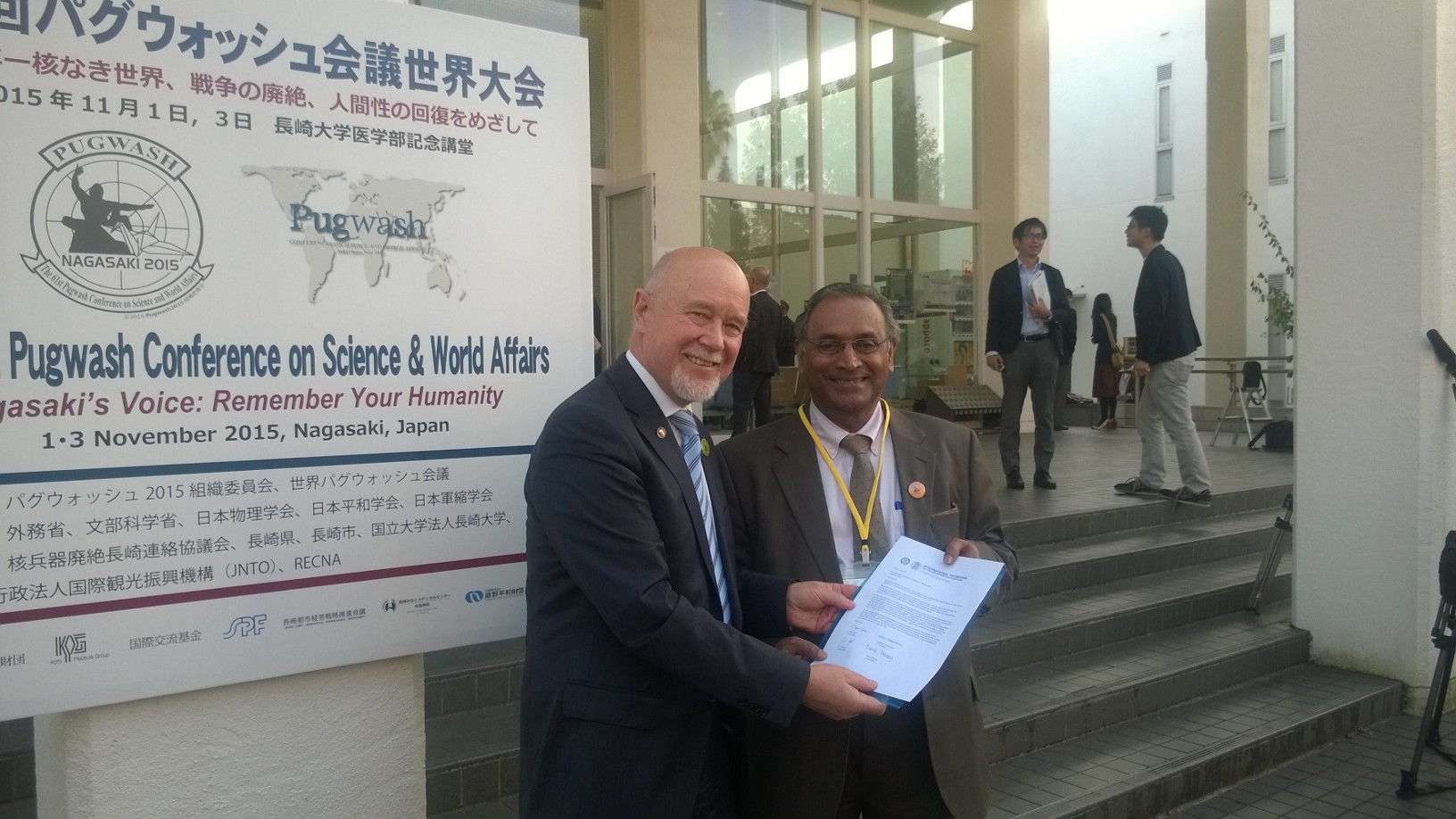
Dr. Kolesnikov (left) with Pugwash president Jayantha Dhanapala in Nagasaki
Physicians and medical scientists were the first who recognized the great dangers of a new type of weapon and 70 years ago alerted the world about its devastating effects. Very soon after the US atomic bombing of Hiroshima, representatives of the International Committee of the Red Cross (ICRC) in Japan informed the international community about the completely destroyed, though formerly prosperous, city. The ICRC—the world’s premier medical-humanitarian organization—first called for nuclear weapons to be banned in September 1945, one month after the atomic bombings of Hiroshima and Nagasaki. Red Cross doctors were among the first to witness the suffering in those two cities.
Since that time, physicians and medical scientists have played a key role in investigations of the dangerous effects of nuclear weapons and other mass destruction weapons, warning governments and the public about the extreme danger of nuclear war. Read more…
A new report by the Institute for Economics & Peace (IEP) defines Positive Peace as the attitudes, institutions and structures which create and sustain peaceful societies. These same factors also lead to many other positive outcomes, such as strong business environments, higher levels of well-being and gender equality. Therefore, Positive Peace describes an optimal environment under which human potential can flourish.”
It goes on to say that, “Negative Peace is the absence of violence or fear of violence — an intuitive definition that many agree with and is more easily measured than other definitions of peace. Measures of Negative Peace are used to construct the Global Peace Index (GPI)” – which measures peace, its causes and its economic value. The 23 GPI indicators are broken into three domains: ongoing conflict, societal safety and security and militarisation.

Infographic by Institute for Economics & Peace
“A more ambitious conceptualisation of peace is Positive Peace, Read more…
Full-spectrum change
Guest Editorial
Ray Acheson
[Reprinted from the First Committee Monitor, No.2, 2015, a newsletter published by Reaching Critical Will of WILPF.]
At some point between the NPT Review Conference in May and the general debate of First Committee, the United States decided to rebrand its preferred “step-by-step approach” to nuclear disarmament as the “full-spectrum approach”. Like before, it contrasts this approach with the pursuit of a treaty banning nuclear weapons, which it says is neither practical nor realistic. At some point during this same period, the US also decided it should make the wild claim that any potential ban treaty would undermine international security so much that it could actually lead to the use of nuclear weapons. Read more…

 Bimal Khadka
 Bjorn Hilt
 Charles K. Johnson
 Dr. Ghassan Shahrour
 Gunnar Westberg
 IPPNW
IPPNW John Loretz
 Lawrence Wittner
 Maria Valenti
 mollymcgint
 Sue Wareham
 Tilman Ruff
 Tim Wright
 Xanthe Hall