ICAN condemns North Korea’s nuclear test, urges nations to pursue global nuclear weapon ban
The International Campaign to Abolish Nuclear Weapons (ICAN), a campaign coalition that includes IPPNW and more than 400 other partner organizations worldwide, has released the following statement in response to today’s nuclear test by North Korea.
 North Korea today confirmed that it had conducted its most powerful nuclear test explosion to date, with an estimated yield of 10 kilotonnes, triggering a magnitude 5.3 earthquake. The International Campaign to Abolish Nuclear Weapons (ICAN) – a coalition of non-government organizations in close to 100 nations – strongly condemned this reckless and destabilizing act, which runs counter to the growing tide of international support for a treaty banning nuclear weapons. Read more…
By Dr. Peter Mburu, Kenya Association of Physicians and Medical Workers for Social Responsibility (IPPNW-Kenya)
Myself and other members of the Kenya Association of Physicians and Medical Workers for Social Responsibility (APMS) held a student workshop recently at Moi University in Eldoret, Kenya, the highland home base of Kenyan athletes. We were invited by the Moi student chapter, and in the APMS tradition, we tackled a theme chosen by the students – in this case, the Sustainable Development Goals (SDGs). Read more…
Ban treaty recommendation on its way to UN First Committee

Support for a ban treaty grew stronger during the final session of the OEWG, despite attempts by Australia and some NATO states to sabotage the outcome.
The world took one step closer to banning nuclear weapons today, when the UN Open-Ended Working Group on nuclear disarmament (OEWG) voted to recommend that the General Assembly mandate negotiations on a ban treaty to commence in 2017 when it meets in New York in October. Read more…
Next stop—First Committee
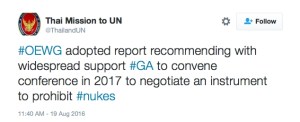
The OEWG has just adopted a report calling for negotiations on a ban treaty to commence in 2017! The vote count — 68 yes, 22 no, 13 abstentions — reflects only those states in the room at the time of the vote. ICAN counts real number of ban supporters participating in OEWG as 107. Even more when all Pledge States are counted. A last-minute attempt by Australia to block the report failed, with the result that opposing states are even more isolated.
Next stop, First Committee!
Majority vote for OEWG report recommending commencement of negotiations on a ban treaty.
71 years on, we’re still dodging bullets while Australia leads the charge to promote nuclear weapons
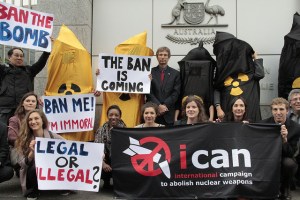
ICAN protest in front of Australian embassy during the OEWG. Photo: ICAN
Early August marks the anniversaries of the atomic bombings on August 6 and 9, 1945, of Hiroshima and Nagasaki, dates which most often come and go with little to offer except a terrifying reminder of humanity’s capacity to destroy ourselves. Nevertheless, we’ve made it to 71 years having tempted fate with tens of thousands of the most destructive devices ever created, escaping within a whisker of global catastrophe more times than bears thinking about. Read more…
Remembering Normand Brissette
By David Rubin
[The following article was originally published in The Boston Globe on August 20, 2005. The author is an emeritus English professor from the University of Massachusetts, Boston.]
Normand Brissette died 60 years ago on Aug. 19, 1945. But who was Normand Brissette, and why should anyone pause to remember his death?
On the morning of Aug. 6, 1945, Brissette, a 19-year-old Navy airman from Lowell, was one of 11 American POWs being held at Chugoku Military Police Headquarters in the center of Hiroshima. All were members of Air Force B-24 or Navy dive-bomber crews who had been captured after parachuting when their planes were shot down by Japanese anti-aircraft fire on July 28. Read more…
 [The following statement was issued by the IPPNW Executive Committee on the 71st anniversary of the Hiroshima bombing.]
Since the US atomic bombings of Hiroshima and Nagasaki in August 1945, we have understood that the use of nuclear weapons would have catastrophic humanitarian effects . Today, thousands of nuclear warheads are still deployed around the world, 50 of them in Turkey at the NATO airbase at Incirlik. These weapons are part of the US nuclear arsenal, but are stationed in Turkey under NATO’s nuclear sharing agreement.
The recent military coup attempt in Turkey has once again raised the question of how secure US nuclear weapons really are, whether based at Incirlik or elsewhere in Europe. An even larger question is how nuclear weapons can be perceived to provide security at all when they are, in fact, the greatest threat to humankind.
IPPNW has long argued that nuclear weapons are the greatest and most urgent threat to the security of everyone on Earth. The US nuclear weapons in Turkey and at other bases in Europe are an immediate threat to the civilian populations in the countries where they are stored and to neighboring countries.
The 50 B-61 bombs at the Incirlik airbase—situated only 110 km from the Syrian-Turkish border—make an already dangerous and tragic situation even more dangerous in the state of emergency declared after the coup attempt. Those weapons should be removed from Turkey immediately.
People living in the other European countries where 130 B-61 bombs are stored[1] are also feeling less secure, as Russia and the NATO states are returning to Cold War posturing over the conflict in Ukraine. The greatest security threat to the European people—and to all of us—is that the United States/NATO and Russia are conducting maneuvers in which nuclear systems are involved, threatening each other with the potential use of nuclear weapons. This constitutes a severe threat to world peace.
The newly elected British Prime Minister, Theresa May, recently declared, without hesitation, that she would order a nuclear strike that would kill hundreds of thousands of people if she thought it were “necessary.” This is not only irresponsible, it provides more evidence that UN Secretary-General Ban Ki-moon was correct when he said “there are no right hands for the wrong weapons.” Frank-Walter Steinmeier, the German foreign minister, has said that nuclear weapons are “absolutely senseless” and are “an inviting target for terrorists.” He and the Secretary-General are both right.
Doctors will be unable to help once nuclear weapons are used. Therefore, IPPNW doctors—and especially those of us living and working in Europe—call on the leaders of all European countries, including Turkey, to join the large majority of non-nuclear-weapon states at the UN Open-Ended Working Group (OEWG) later this month in recommending that the General Assembly mandate negotiations on a new legally binding instrument to prohibit nuclear weapons—a ban treaty that will lead to the complete elimination of nuclear weapons.
We also urge an end to the politics of nuclear deterrence, including extended deterrence. So-called nuclear sharing in NATO countries—particularly Belgium, Germany, Italy, the Netherlands, and Turkey, where US nuclear weapons are stored—exacerbates the dangers to the people in those countries and increases the risk that nuclear weapons will be used. NATO should end this policy.
Nuclear weapons cannot provide security. Our future depends on a new treaty banning nuclear weapons and providing the legal, political, and moral foundation for their elimination by the nine nuclear-armed states that continue to endanger the world with a humanitarian catastrophe from which there can be no recovery.
[1] According to H.M. Kristensen—Belgium: 20 bombs, Germany 20 bombs, Italy : 70 bombs, the Netherlands 20 bombs http://thebulletin.org/upgrades-us-nuclear-bases-europe-acknowledge-security-risk8740
Push to ban weapons advertising at Canberra Airport
by Sue Wareham, vice-president Medical Association for Prevention of War, convenor of No Airport Arms Ads 
Opinion piece reprinted with author’s permission from the Canberra Times 25 July
Have you been to Canberra Airport lately? If not, you would not yet have seen the very welcome images promoting our city – specifically our 100 per cent renewable energy target and our leading educational institutions – that have replaced some of the advertisements depicting Australia’s readiness to go to war. A much better welcome home or welcome to visitors.
The airport must be congratulated, but unfortunately not yet in the “full marks” category. Significant weapons promotions remain, inside and outside the terminal, and with them the question: just who are advertisements for fighter jets, armed drones and submarines aimed at? Most travellers are not really in the market for any of them. Read more…

Executive director Michael Christ (left) welcomes NHK film crew to IPPNW central office.
A team from NHK World TV in Tokyo recently visited IPPNW in connection with a one-hour special they are producing to mark the 71st anniversary of the atomic bombing of Hiroshima. The program will trace the steps of Hiroshima’s legacy and share the experiences of the Hibakusha—those who survived that infamous day. The show will air on August 6 to audiences in 150 countries. Read more…
The superpowers are violent powers
If asked to identify the world’s superpowers today, most people would name the United States, Russia, and China. Although many citizens of these countries maintain that this status is based on the superiority of their national way of life, the reality is that it rests upon their nations’ enormous capacity for violence. Read more…

 Bimal Khadka
 Bjorn Hilt
 Charles K. Johnson
 Dr. Ghassan Shahrour
 Gunnar Westberg
 IPPNW
IPPNW John Loretz
 Lawrence Wittner
 Maria Valenti
 mollymcgint
 Sue Wareham
 Tilman Ruff
 Tim Wright
 Xanthe Hall