Two minutes to midnight
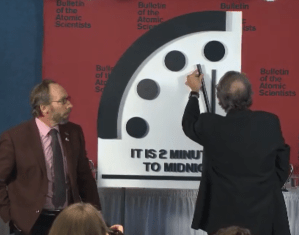
Robert Rosner, the chair of the Bulletin Science and Security Board moves the Doomsday Clock up to 2 minutes to midnight as Lawrence Krauss, the chair of the Board of Sponsors, looks on.
Citing “looming threats of nuclear war,” the Science and Security Board of the Bulletin of the Atomic Scientists has reset the Doomsday Clock to two minutes to midnight—the closest the world has been to catastrophe since 1953.
While the Clock has come to represent the level of a number of global threats, including global warming and emerging technologies, the Bulletin attributed this year’s warning almost entirely to the urgent and growing risk of nuclear war. Read more…
 On April 5, 2009 the newly elected, young, and promising US President Barack Obama made a speech in Prague about nuclear dangers. He said:
“…This matters to all people, everywhere. One nuclear weapon exploded in one city – be it New York or Moscow, Islamabad or Mumbai, Tokyo or Tel Aviv, Paris or Prague – could kill hundreds of thousands of people. And no matter where it happens, there is no end to what the consequences may be – for our global safety, security, society, economy, and ultimately our survival…So today, I state clearly and with conviction America’s commitment to seek the peace and security of a world without nuclear weapons…”
With these words President Obama surprised and impressed the world, and he filled us with hope. For these words, he was awarded the Nobel Peace Prize in 2009.
Did he mean the words he spoke? In retrospect, it’s hard to know. Read more…
This October, the non-partisan Congressional Budget Office (CBO) reported that its estimate of the cost for the planned “modernization” the U.S. nuclear weapons complex over the next three decades has risen to $1,200,000,000,000.00. For those of you not familiar with such lofty figures, that’s $1.2 trillion. Furthermore, when adjusted for inflation, the cost of the program―designed to provide new weapons for nuclear warfare on land, in the sea, and in the air, plus upgraded or new facilities to produce them―grows to $1.7 trillion. Read more…
The “merchants of death” survive and prosper
During the mid-1930s, a best-selling exposé of the international arms trade, combined with a US Congressional investigation of munitions-makers led by Senator Gerald Nye, had a major impact on American public opinion. Convinced that military contractors were stirring up weapons sales and war for their own profit, many people grew critical of these “merchants of death.”
Today, some eight decades later, their successors, now more politely called “defense contractors,” are alive and well. According to a study by the Stockholm International Peace Research Institute, sales of weapons and military services by the world’s largest 100 corporate military purveyors in 2016 (the latest year for which figures are available) rose to $375 billion. US corporations increased their share of that total to almost 58 percent, supplying weapons to at least 100 nations around the world. Read more…
US, UK, France insult Nobel Peace Prize
PSR, Medact, and AMFPGM—national affiliates of IPPNW—have responded jointly to the announcement by the US, UK, and French governments that they will be sending only lower level representatives to the Nobel Peace Prize award ceremony in Oslo on December 10. Their statement follows:
American, British, and French physicians condemn their governments’ protest of the Nobel Peace Prize ceremony
We the undersigned are ashamed that our governments are insulting this year’s Nobel Peace Prize award ceremony in Oslo, Norway on 10th December by sending only junior diplomats. The award is for ICAN, the International Campaign to Abolish Nuclear Weapons, and follows the overwhelming vote of 122 nations at the United Nations General Assembly in July this year to adopt the nuclear weapons ban treaty. Surely we can pause to listen and reflect on the words of Setsuko Thurlow, a survivor of the 1945 atomic bombings of Hiroshima and Nagasaki, who will be addressing that ceremony, and to consider what ICAN, the United Nations and the Nobel Committee are all saying: for the health and safety of all the people of the world, it is time to prohibit and eliminate all nuclear weapons.
Signed
Jeff Carter (Physicians for Social Responsibility, USA)
Elizabeth Waterston (Medact, UK)
Abraham Behar, Association des Médecins Français pour la Prévention de la Guerre Nucléaire (AMFPGM, France)
National affiliates of the International Physicians for the Prevention of Nuclear War.
No place to hide
 Does North Korea have a missile capable of striking the US mainland with a nuclear warhead?
Given the recent surge in the DPRK’s missile tests and nuclear test explosions, and the trash talk between Donald Trump and Kim Jong-un, that’s a legitimate—and worrisome—question. But the preoccupation with answering that question and then deciding how best to disarm North Korea diverts attention from the fact that there are eight other nuclear-armed states that, among them, can target virtually every populated area—and most of the unpopulated ones—on the face of the Earth.
A new graphic created by the team at IR Online, American University’s International Relations online program shows that no one is beyond the reach of a nuclear-armed missile, whether it’s launched from a land-based silo or a submarine deployed by one of the possessor states. While the web of missile paths criss-crossing the world is an approximation based on average ranges for each country’s missiles, the truth it conveys is inescapable: as long as nuclear weapons exist, every one of us is a target, and there is no place to hide.
Are governments impervious to public opinion?
 The reckless threats of nuclear war flung back and forth between the North Korean and US governments remind me of an event in which I participated back in the fall of 1961, when I was a senior at Columbia College.
At the end of August 1961, the Soviet government had announced that it was withdrawing from the US-Soviet-British moratorium on nuclear weapons testing that had halted such tests for the previous three years while the three governments tried to agree on a test ban treaty. Read more…
Should limiting North Korea’s nuclear ambitions be the responsibility of the US government?
In recent months, advances in the North Korean government’s nuclear weapons program have led to a sharp confrontation between the government leaders of the United States and of North Korea. This August, President Donald Trump declared that any more threats from North Korea “will be met with fire and fury like the world has never seen.” In turn, Kim Jong Un remarked that he was now contemplating firing nuclear missiles at the US territory of Guam. Heightening the dispute, Trump told the United Nations in mid-September that, if the United States was forced to defend itself or its allies, “we will have no choice but to totally destroy North Korea.” Soon thereafter, Trump embellished this with a tweet declaring that North Korea “won’t be around much longer.” Read more…
ICAN statement on receiving 2017 Nobel Peace Prize
 [The International Campaign to Abolish Nuclear Weapons has issued the following statement in response to the announcement that the campaign has been awarded this year’s Nobel Peace Prize.]
It is a great honour to have been awarded the Nobel Peace Prize for 2017 in recognition of our role in achieving the Treaty on the Prohibition of Nuclear Weapons. This historic agreement, adopted on 7 July with the backing of 122 nations, offers a powerful, much-needed alternative to a world in which threats of mass destruction 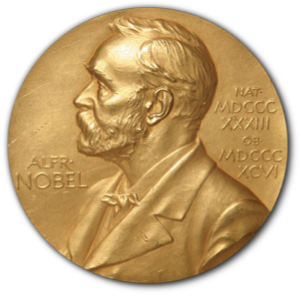 are allowed to prevail and, indeed, are escalating. Read more…
Statement of the Norwegian Nobel Committee
The Norwegian Nobel Committee has decided to award the Nobel Peace Prize for 2017 to the International Campaign to Abolish Nuclear Weapons (ICAN). The organization is receiving the award for its work to draw attention to the catastrophic humanitarian consequences of any use of nuclear weapons and for its ground-breaking efforts to achieve a treaty-based prohibition of such weapons.
We live in a world where the risk of nuclear weapons being used is greater than it has been for a long time. Some states are modernizing their nuclear arsenals, and there is a real danger that more countries will try to procure nuclear weapons, as exemplified by North Korea. Nuclear weapons pose a constant threat to humanity and all life on earth. Through binding international agreements, the international community has previously adopted prohibitions against land mines, cluster munitions and biological and chemical weapons. Nuclear weapons are even more destructive, but have not yet been made the object of a similar international legal prohibition.
Through its work, ICAN has helped to fill this legal gap. An important argument in the rationale for prohibiting nuclear weapons is the unacceptable human suffering that a nuclear war will cause. ICAN is a coalition of non-governmental organizations from around 100 different countries around the globe. The coalition has been a driving force in prevailing upon the world’s nations to pledge to cooperate with all relevant stakeholders in efforts to stigmatise, prohibit and eliminate nuclear weapons. To date, 108 states have made such a commitment, known as the Humanitarian Pledge.
Furthermore, ICAN has been the leading civil society actor in the endeavour to achieve a prohibition of nuclear weapons under international law. On 7 July 2017, 122 of the UN member states acceded to the Treaty on the Prohibition of Nuclear Weapons. As soon as the treaty has been ratified by 50 states, the ban on nuclear weapons will enter into force and will be binding under international law for all the countries that are party to the treaty.
The Norwegian Nobel Committee is aware that an international legal prohibition will not in itself eliminate a single nuclear weapon, and that so far neither the states that already have nuclear weapons nor their closest allies support the nuclear weapon ban treaty. The Committee wishes to emphasize that the next steps towards attaining a world free of nuclear weapons must involve the nuclear-armed states. This year’s Peace Prize is therefore also a call upon these states to initiate serious negotiations with a view to the gradual, balanced and carefully monitored elimination of the almost 15,000 nuclear weapons in the world. Five of the states that currently have nuclear weapons – the USA, Russia, the United Kingdom, France and China – have already committed to this objective through their accession to the Treaty on the Non-Proliferation of Nuclear Weapons of 1970. The Non-Proliferation Treaty will remain the primary international legal instrument for promoting nuclear disarmament and preventing the further spread of such weapons.
It is now 71 years since the UN General Assembly, in its very first resolution, advocated the importance of nuclear disarmament and a nuclear weapon-free world. With this year’s award, the Norwegian Nobel Committee wishes to pay tribute to ICAN for giving new momentum to the efforts to achieve this goal.
The decision to award the Nobel Peace Prize for 2017 to the International Campaign to Abolish Nuclear Weapons has a solid grounding in Alfred Nobel’s will. The will specifies three different criteria for awarding the Peace Prize: the promotion of fraternity between nations, the advancement of disarmament and arms control and the holding and promotion of peace congresses. ICAN works vigorously to achieve nuclear disarmament. ICAN and a majority of UN member states have contributed to fraternity between nations by supporting the Humanitarian Pledge. And through its inspiring and innovative support for the UN negotiations on a treaty banning nuclear weapons, ICAN has played a major part in bringing about what in our day and age is equivalent to an international peace congress.
It is the firm conviction of the Norwegian Nobel Committee that ICAN, more than anyone else, has in the past year given the efforts to achieve a world without nuclear weapons a new direction and new vigour.
Oslo, 6 October 2017

 Bimal Khadka
 Bjorn Hilt
 Charles K. Johnson
 Dr. Ghassan Shahrour
 Gunnar Westberg
 IPPNW
IPPNW John Loretz
 Lawrence Wittner
 Maria Valenti
 mollymcgint
 Sue Wareham
 Tilman Ruff
 Tim Wright
 Xanthe Hall