‘Able’ nuclear test, 1 July 1946
Eighty years ago today, the first post-World War II nuclear test took place over the Bikini Atoll in the Marshall Islands.
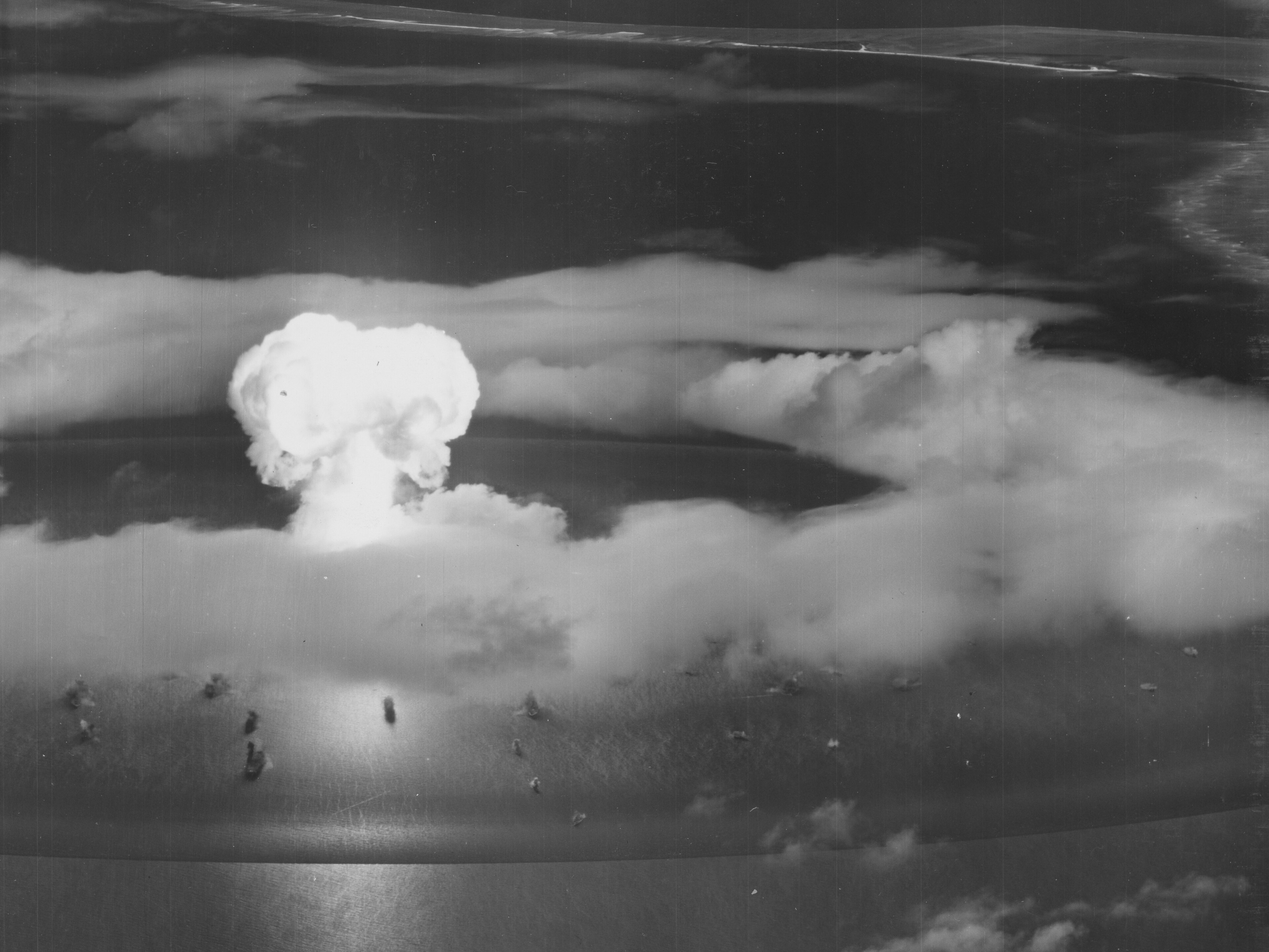
Image: Library of US Congress/ public domain
The ‘Able’ nuclear test was one of two tests conducted by the United States as part of ‘Operation Crossroads’. It took place on 1 July 1946 and was the first nuclear explosion to be carried out after the atomic bombings of Hiroshima and Nagasaki in August 1945. It was the first of 21 bombs that were detonated at Bikini Atoll, Marshall Islands, in the Pacific Ocean, over a period of twelve years, totalling about 75 megatons of TNT. Between 1946 and 1962 altogether 106 nuclear tests were carried out in the Marshall Islands.
Originally three tests were planned: an aerial one scheduled for 15 May, a surface test for 1 July, and an underwater test in early 1947. However, the first of the test series was postponed, ostensibly to allow more members of the US Congress to officially observe. Probably the Secretary of State, James Byrnes, was behind the postponement, as he wanted more time for international talks on controlling nuclear weapons.
The purpose of the test was to study the effect of a nuclear bomb on enemy naval vessels, their structure and equipment on board. In the lagoon, a target array of 93 ships and submarines – ships captured from the Germans and Japanese during World War II, and out-of-service US ships – were anchored in the shallow water, some with tanks, cars, or even planes, on board. Previous speculation during the bomb’s development had led to a desire to test the first atomic bombs on the Japanese Navy at Truk Island, but this idea was shelved in favour of bombing cities. In 1946, it was seen as a priority because of military fears that the atomic bomb would render the navy obsolete. There was also a heightened interest in ship survivability and what defensive measures or changes in a ship’s design could be surmised from the results of the test.
Bikini chosen as site
Bikini was chosen as the site – preferred over Galapagos Islands – because of its size (32 x 16 km) and location, as it was thought to be far enough away from fishing areas and steamer lanes. The US had taken over control of all Pacific islands taken from the Japanese. It was also near enough to Kwajalein which was chosen to be the base from where the planes could take off. Weather conditions were found to be suitable, but not ideal, winds were predictable, as were the ocean currents.
Bikini had a small indigenous population that was held by the US to be moveable, so the US forces evacuated the 167 islanders. They were persuaded that it was for the “good of mankind and to end all world wars”. An oral agreement was made with their leader, and they were resettled on Rongerik Atoll, about 200 km east of Bikini, with some food and water for a few weeks, but then left to starve, as there wasn’t sufficient food, fish or shellfish to sustain them. They were unable to return to the atoll which has remained uninhabited to this day.
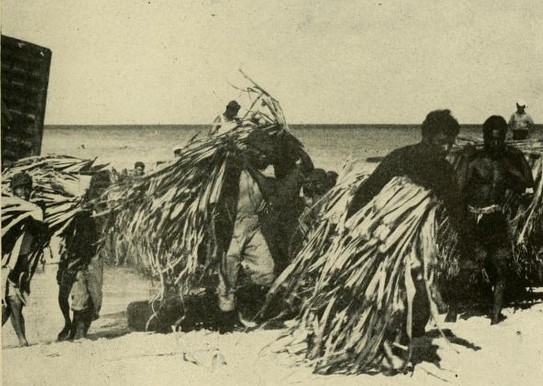
To prepare for the target array a channel was blasted through the reef into the lagoon, so the ships could be brought in, without explanation to the islanders. The coral heads in the lagoon were dynamited in preparation for the tests as they obstructed navigation. More than 100 tons of dynamite were used to destroy the coral.
In the event, only two tests were actually carried out, aerial (‘Able’) and underwater (‘Baker’). ‘Able’ was staged as a grand public relations event, but behind the scenes there was much political and scientific debate about the effect of international relations, the displacement of indigenous people from their island home, environmental concerns, and public denial of radiation hazards.
The ‘Shot’
The Mark III atomic bomb, code-named Gilda, was dropped from a B-29 Superfortress aeroplane, ‘Dave’s Dream’, and detonated about 150 m over the Bikini Atoll in the South Pacific, with a yield of 23 kilotons. The bomb missed its aim target, the ship ‘Nevada’ – although painted bright orange to be easily recognised – by about 650 m, so there was less damage than expected. Five ships were sunk and 14 were seriously damaged.
Animals – 146 pigs, 176 goats, 3,030 rats, 109 mice, and 57 guinea pigs – were placed on 22 of the target ships to study the effects of the bomb on them. Pigs were chosen because of the comparability to human skin and hair; goats because their weight resembled humans. Some goats were coated with protective salves, others were shaven. Blood counts were made in the haematology laboratory for all animals and checked for radiation effects. 35% of these animals died or were put down after the test. 10% of the total number were killed by blast, 15% by radiation several days later. Animals that survived the Able test were not used again for subsequent tests.
About 42,000 military personnel participated in the organisation of the nuclear test, called Joint Task Force One (JTF1), commanded by Vice Admiral William H. P. Blandy. Added to this was a media contingent of 166 newsmen, some of whom covered the story from the air. Photographers pooled their photos, freely usable by all pool members after being checked for security considerations. Ten Congressmen and four Senators travelled to Bikini to observe, and there was also an observer group from the United Nations Atomic Commission, including Soviet scientists. Many of the military personnel were required to measure the effects of the test from photographic planes that flew by the test, but also before the test, so that the island could be documented in its original condition before the detonation.
All people attending the test were required to be vaccinated against local diseases, such as typhus, tetanus, and smallpox. The island was sprayed regularly with DDT to eradicate all germs in the hope of keeping contagious disease to a minimum. At this time, the dangers of DDT itself were unknown. The supplies needed to sustain this large number of people (about 20,000 kg of meat, 45,000 kg of vegetables, 19,000 kg of fruit, 35,000 candy bars, 15,000 cigarettes, etc.) all had to be shipped in prior to the test.
There was some awareness after the atomic bombings in Japan, that radiation was a safety issue, so that Geiger counters were installed and samples of sea water measured for radioactivity. However, the effects of radioactive contamination were played down publicly. After the test, military personnel were sent onto the ships to assess their damage, and to scrub them down. After decontamination was unsuccessful, the ships were scuttled in the Pacific. Typically, the levels of contamination that servicemen were exposed to during a two week service during Operation Crossroads could be anything up to 600 mSv (equivalent of about 30,000 chest x-rays). However, before 1955, not all servicemen were issued with dosimetry badges to measure their exposure to radiation. Sometimes the badges were not exchanged daily but worn for up to nine days during decontamination of the ships.
A Defense Nuclear Agency report from 1982, that examined external radiation doses through reconstruction of Operation Crossroads, claimed that no fallout entered the water from the ‘Able’ nuclear test because it was an airburst. However, given what we know today, this is unlikely to be completely accurate. While there is minimal heavy fallout, radioactive materials suspended in the rising cloud will fall into the water below in time and contaminate it.
Opposition
There was opposition to the nuclear test, notably from scientists and politicians. It was argued that further testing would be dangerous to the environment and was deemed unnecessary. There were warnings about the health effects to servicemen of high levels of radiation, and concerns that the seawater would be badly contaminated. Animal rights activists also protested.
The leading Manhattan Project scientist, J. Robert Oppenheimer, wrote to US President Truman on 3 May 1946, withdrawing his participation at the ‘Able’ test and expressing his doubts, arguing that model tests and calculations combined with laboratory testing could provide more accurate information, at less cost. He also believed that studying the use of nuclear bombs on ships was of little interest, as they would primarily be used on cities. He added that the test would undermine the peace process and questioned “the appropriateness of a purely military test of atomic weapons at a time when our plans for effectively eliminating them from national armaments are in their earliest beginnings.”
Secretary of State James F. Byrnes also argued that the nuclear test would exacerbate tensions with the Soviet Union and scupper the Acheson-Lilienthal Plan for international control to prevent the spread of nuclear weapons, saying: “from the standpoint of international relations it would be helpful if the test could be postponed or never held at all.”
Sources
“Operation Crossroads: The Effect of the Atomic Bomb on Naval Power”, Bulletin of the Atomic Scientists, vol. 1, no. 5, February 15, 1946, Chicago, p. 1, 1946
Defense Nuclear Agency: Analysis of Radiation Exposure for Naval Units of Operation Crossroads, Vol. 1, Basic Report, 3 Mar 1982
IPPNW: Bikini and Eniwetok, Marshall Islands, Hibakusha Worldwide, 2024
ORAU Team Dose Reconstruction Project for NIOSH: Summary Site Profile for the Pacific Proving Ground (Rev.02), p.16, 23 July 2018
Shurcliff W A: Operation Crossroads: The Official Pictorial Record, New York: William H. Wise and Co , 1946
Weisgall J: Operation Crossroads: The Atomic Tests at Bikini Atoll, Annapolis, Maryland: Naval Institute Press, 1994.
Whitmore J: The Bikini Project, accessed on 1 July 2026

 Bimal Khadka
 Bjorn Hilt
 Charles K. Johnson
 Dr. Ghassan Shahrour
 Gunnar Westberg
 IPPNW
IPPNW John Loretz
 Lawrence Wittner
 Maria Valenti
 mollymcgint
 Sue Wareham
 Tilman Ruff
 Tim Wright
 Xanthe Hall


 IPPNW peace and health blog
Xanthe,
Thank you for this research! Many details here are new to me.
Gunnar