Failure Not an Option: Success as an Action Item Not a Checkmark at the 11th NPT RevCon
by Libby Flatoff, Policy and Program Associate and the Arms Control Association, and Molly McGinty, Program Director at IPPNW
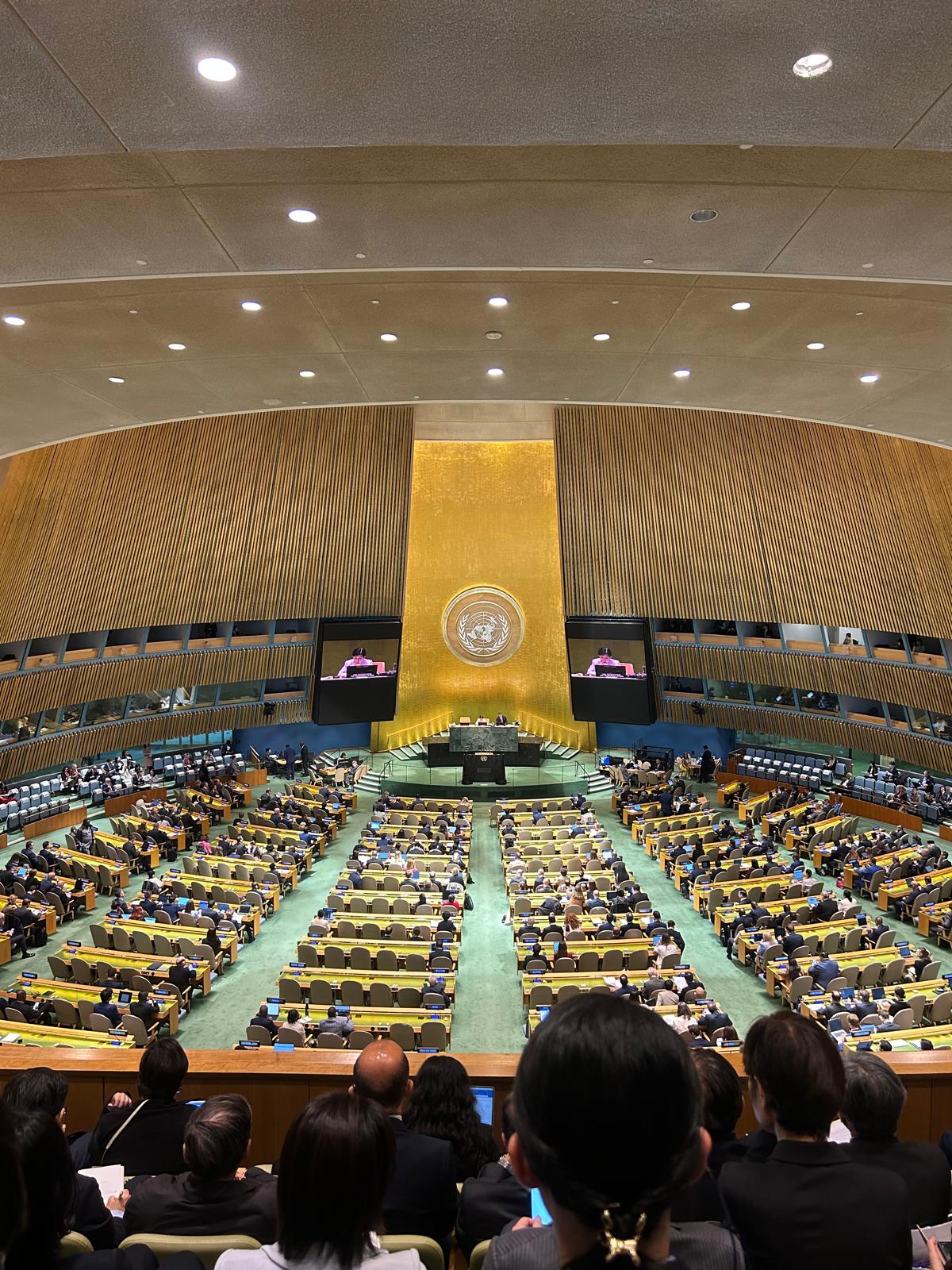
The 1970 Nuclear Nonproliferation Treaty (NPT) is often referred to as the cornerstone of the global nuclear disarmament movement, to give up on it or resign to another probable failure at this year’s Review Conference (RevCon) would be a mistake. But so would continuing to treat its mere existence as a success.
As the 11th NPT RevCon opens April 27 – May 22 at the United Nations Headquarters in New York, world leaders are struggling to see a path toward any meaningful outcome amid an era of unprecedented obstacles.. Each of the three pillars of the NPT, nonproliferation, disarmament, and peace use of nuclear energy are simultaneously under strain, as is the Treaty itself.
Though the case for another failure is strong, we should not resign ourselves to thinking of this conference as another failed result in a string of failing treaties, norms, and taboos, but rather as a chance for hope and reestablishment of goodwill.
Consensus After Failure
Ten RevCons have preceded this one. Five of them – in 1980, 1990, 2005, 2015, and 2022 – ended without a consensus outcome document, often referred to as “failed” RevCons. This 11th RevCon is facing an unprecedented two consecutive failed RevCons in 2015 and 2022, as well as the failure of its three preparatory meetings to produce a factual summary or recommendations.
The pattern of failures is well-documented. Differing views on Article VI, the NPT’s legally binding obligation on nuclear weapon states to pursue disarmament negotiations in good faith, was a cited conflict in 1980, 1990, and 2005. In 2015 the outcome document was blocked over language on the Middle East Nuclear Weapons Free Zone at the behest of Israel, a non-NPT nuclear-armed state. In 2022, Russia vetoed the final text over references to nuclear attacks to the Zaporizhzya nuclear power plant.
While this paints a bleak picture for this RevCon, the pattern holds that after failed RevCons, states have historically regrouped and found consensus.
After the failure of the 1990 RevCon, the 1995 RevCon was largely successful. It not only extended the Treaty indefinitely, but it also adopted a resolution calling for a Middle East Nuclear Weapons Free Zone, and strengthened the review process with the introduction of the preparatory committee structure.
After the 2005 RevCon failed to reach consensus, the 2010 RevCon was, again, largely successful. It created a 64-point Action Plan for implementing the NPT, 22 of which addressed the disarmament pillar of the NPT. While this is a substantial step in the right direction, it is worth noting that this proves that there is no binary of “success” and “failure” in the NPT, as nuclear armed states have largely not adhered to the action plan. There can be no true success until nuclear weapon states move beyond words and meaningfully take action toward disarmament.
Current Day Stressors
It would be dishonest to say that the geopolitical backdrop of this year’s RevCon resembles those of 1995 or 2010.
All five of the recognized nuclear weapon states are acting counter to their obligations under the NPT and, in some cases, to international law in its entirety. Russia’s war in Ukraine continues into its 4th year, the United States and Israel continue to attack Iran, all 5 nuclear weapon states continue to modernize and expand their arsenals, military spending is at an all time high, norms against nuclear testing are eroding, proliferation risks are rising across the world, and confidence is at an all time low, even between supposed allies like NATO. At the same time, nuclear-armed states outside the NPT – India, Israel, North Korea, and Pakistan – continue to operate without treaty obligations.
The list of challenges is large but important. They shouldn’t be avoided but faced head on as a catalyst to demand bold action. Delegates should go into this process with tangible action plans rather than accepting the P-5’s nuclear-backed impunity.
History shows us that progress can happen at the most volatile of times, including times when it seems the furthest from possible. At the height of the Cold War, the United States and former Soviet Union reduced their arsenals by 80%. There is no reason to believe that we are not at a similar inflection point today.
Action Demanded
If the 2026 RevCon fails to produce a consensus outcome document, it will be the third consecutive failure. This will be a structural breakdown of the 50-year non-proliferation regime.
And yet, the risk of settling for success for the sake of success is equally as damning. A consensus outcome document that papers over the P-5’s Article VI failures and doesn’t have time-bound and verifiable actions should not be celebrated. We must learn from the 2010 action plan and the follow-on RevCon in 2015 which collapsed, in part, because non-nuclear weapon states demanded accountability for commitments that had been made and ignored.
The nuclear weapon states have a responsibility to take clear and decisive action during this RevCon. They must re-affirm and build upon past commitments, with nothing short of time-bound, verifiable plans toward their Article VI obligations without delay. Non-nuclear states must take this opportunity to hold the nuclear weapons states feet to the fire and demand action. Non-nuclear states have already found strength in numbers through the Treaty on the Prohibition of Nuclear Weapons, which will have its first Review Conference at the UN Headquarters this November. Through the successful first three Meetings of States Parties, they have made a clear statement that nuclear weapons are illegal and should be dismantled now, not on the decades-long timeline of the nuclear weapons states. If they hold strong to this messaging, success can be found in this RevCon through the recommitment in the disarmament regime and steadfast faith in international law. Non-nuclear weapon states should not give up any concessions in the name of “success” through an empty consensus document.
A true failure of this RevCon does not lay with a failed consensus document, but with states unwilling to fight for meaningful commitments to disarmament. With the risk of nuclear war rising every day, we must demand nothing less.

 Bimal Khadka
 Bjorn Hilt
 Charles K. Johnson
 Dr. Ghassan Shahrour
 Gunnar Westberg
 IPPNW
IPPNW John Loretz
 Lawrence Wittner
 Maria Valenti
 mollymcgint
 Sue Wareham
 Tilman Ruff
 Tim Wright
 Xanthe Hall


Trackbacks