How the international community obtained a nuclear weapons-free agreement with Iran―and lost it thanks to Donald Trump
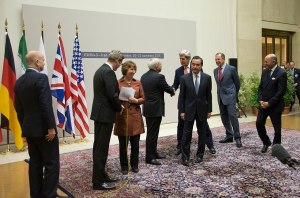
If the objective of the U.S. war upon Iran is to ensure that that country does not develop nuclear weapons, that goal was attained more than a decade ago through a far different approach than the one now being followed by the Trump administration.
Iran, as a signer of the Nuclear Nonproliferation Treaty of 1970, had agreed to forgo the development of nuclear weapons. Even so, fears grew during the early 21st century that Iran’s uranium enrichment program, used for peaceful purposes, might be diverted to the development of the Bomb, thereby throwing the volatile Middle East into yet another crisis, including a frenzied nuclear arms race.
As a result, the five permanent members of the UN Security Council (the United States, Russia, China, Britain, and France) and Germany began lengthy negotiations with Iran, offering it various incentives to halt uranium enrichment. A key incentive was the lifting of international sanctions, which were having a severe impact on sales of Iran’s oil and, thus, its economy. After the election in 2013 of an Iranian reformer, Hassan Rouhani, as president, the negotiators came to a preliminary accord to guide their talks toward a comprehensive nuclear agreement.
The final agreement, formally known as the Joint Comprehensive Plan of Action, was negotiated by the five permanent members of the UN Security Council, Germany, and the European Union. Signed in July 2015, it granted Iran sanctions relief in exchange for significant restrictions on its nuclear program. These included Iran’s agreement to ban production of highly enriched uranium or plutonium, ensure that its key nuclear facilities pursued only civilian work, and limit the numbers and types of centrifuges that it could operate. In addition, Iran agreed to allow inspectors from the International Atomic Energy Agency (IAEA), the UN’s nuclear watchdog, unfettered access to its nuclear facilities and undeclared sites.
In the United States, the Iran nuclear agreement was strongly supported by the Obama administration, which played a key role in securing it, and by Democrats, but denounced by Republicans. Jeb Bush, then a leading presidential contender, called it “dangerous, deeply flawed, and short-sighted,” while U.S. Senator Lindsey Graham claimed that it was a “death sentence for the state of Israel.” Indeed, Benjamin Netanyahu, Israel’s Prime Minister, lobbied ferociously against U.S. acceptance of the Iran agreement, furiously attacking it as a “historic mistake.”
Despite the opposition, the agreement went into effect in January 2016 and, initially, had smooth sailing. The IAEA certified that Iran was keeping its commitments, nations repealed or suspended their sanctions, Iran’s oil exports surged, and the United States and European nations unfroze about $100 billion of Iran’s frozen assets.
In May 2018, however, Donald Trump, Obama’s successor as President, breaking with America’s European allies, unilaterally withdrew the U.S. government from the Iran agreement and announced the reimposition of oil and banking sanctions. “It is clear to me that we cannot prevent an Iranian nuclear bomb under the decaying and rotten structure of this deal,” Trump announced. Assailing the Iran agreement as “defective to its core,” Trump condemned it for failing to deal with Iran’s ballistic missile program and its proxy warfare in the Middle East, as well as for the agreement’s 10-year sunset provision.
In response, Iranian President Rouhani, stating that the U.S. government had failed to “respect its commitment,” declared that he had “ordered the Atomic Energy Organization of Iran to be ready for action if needed, so that if necessary we can resume our enrichment on an industrial level without any limitations.” Even so, he promised, he would wait to speak about this with allies and the other signatories to the agreement.
Thereafter, things went downhill. Although France, Germany, and Britain sought to keep the agreement alive by evading the U.S. banking sanctions through a barter system, this effort eventually collapsed. Meanwhile, Trump got into a verbal brawl with Rouhani, threatening Iran with what he called “CONSEQUENCES THE LIKES OF WHICH FEW THROUGHOUT HISTORY HAVE EVER SUFFERED BEFORE.” Ultimately, Iran began exceeding the agreed-upon limits to its stockpile, enriching uranium to higher concentrations, and developing new centrifuges.
Although Joe Biden, as a 2020 presidential candidate, promised to rejoin the Iran nuclear agreement and “to work with our allies to strengthen and extend it,” by the time he was in office the relationship with Iran had deteriorated too far to make this feasible. Coming under a new, more reactionary leadership, the Iranian regime grew more repressive, as well as more distant from the United States and more politically toxic. As a result, a new agreement was increasingly out of reach.
In retrospect, are there any lessons that can be learned from these events?
One is that, to the degree that the development of nuclear weapons by Iran is a currently a problem, it is a problem of Trump’s making. Or as Biden put it years ago, Trump’s pullout from the 2015 Iran nuclear agreement was “a self-inflicted disaster.”
Another is that getting a country to forgo nuclear weapons development is easier to accomplish through international―and especially UN Security Council―action than through unilateral action. A threat from one nation to another can easily be viewed and dismissed as bullying. But pressure from a worldwide organization representing the community of nations has greater impact.
More generally, if nations are going to be asked (or pressured) to forgo development of nuclear weapons, it is useful to have a framework that treats nations equally. The Nuclear Nonproliferation Treaty fosters this equality through a bargain, in which the non-nuclear nations forgo building nuclear weapons in exchange for the nuclear nations eliminating their own nuclear arsenals. The next time Donald Trump and Benjamin Netanyahu threaten to annihilate Iranian civilization, someone might remind them of that.Lawrence S. Wittner (https://www.lawrenceswittner.com/ ) is Professor of History Emeritus at SUNY/Albany and the author of Confronting the Bomb (Stanford University Press).

 Bimal Khadka
 Bjorn Hilt
 Charles K. Johnson
 Dr. Ghassan Shahrour
 Gunnar Westberg
 IPPNW
IPPNW John Loretz
 Lawrence Wittner
 Maria Valenti
 mollymcgint
 Sue Wareham
 Tilman Ruff
 Tim Wright
 Xanthe Hall


 IPPNW peace and health blog