The abolition of nuclear weapons is an essential part of respecting and protecting all living things
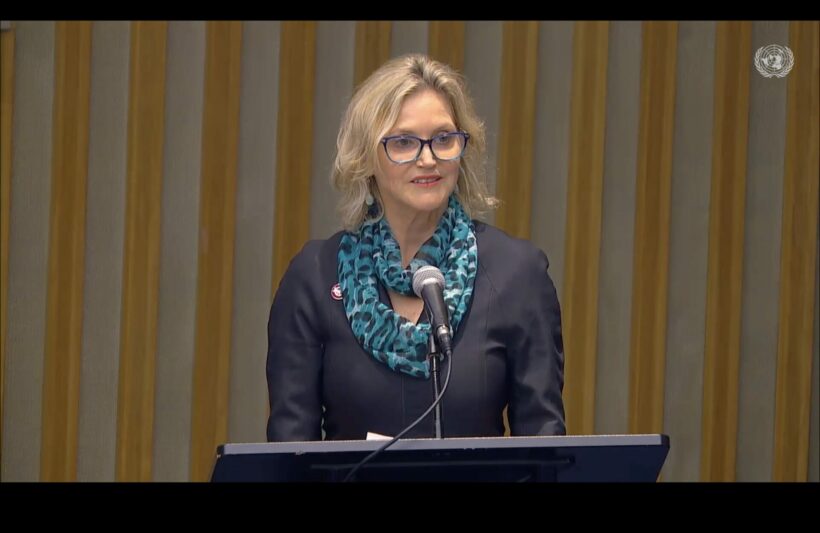
A conversation with ICAN Executive Director Melissa Parke
[Melissa Parke is a lawyer and parliamentarian who has worked with the United Nations on international humanitarian and human rights issues in several conflict areas. She’s a former Minister for International Development and a former member of Parliament for the Labour Party in Australia. She was the Australian chair of Parliamentarians for Global Action and was founding chair of the Australia United Nations Parliamentary Group. She’s been deeply involved with nuclear issues since the 1990s, campaigning against the establishment of a global nuclear waste dump in her home state of western Australia. More recently, Ms. Parke has served as an ambassador for ICAN Australia, promoting the Treaty on the Prohibition of Nuclear Weapons (TPNW) since its adoption by the UN in 2017. On 1 September, Ms. Parke took a new position as executive director of ICAN, the International Campaign to Abolish Nuclear Weapons.
What led you to focus on the elimination of nuclear weapons at this point in your career?
Through my UN experience working in places like Kosovo, Gaza, Lebanon, and Yemen, I came to see firsthand the impact of war on civilians. I’ve had involvement with nuclear issues throughout my life, including most recently as a parliamentarian and as an ICAN Australia ambassador. Right now, this is a really scary and dangerous time for the world. We are seeing rising tensions, mounting conflict, the renewal of nuclear threats. It’s never been more important or urgent for the world to take action to eliminate nuclear weapons. And we’ve seen just last month or two months ago, the UN Secretary General issued his new agenda for peace, in which the number one recommendation was the elimination of nuclear weapons. But rather than condemning nuclear threats and dismantling their arsenals—as nuclear-armed states are required to do under the Non-Proliferation Treaty (NPT), they have instead been modernizing and expanding their nuclear arsenals.
So we have a great challenge ahead of us, but also I think a great opportunity to bring people together, to let them know there is another way through diplomacy and dialogue, and through the UN Treaty on the Prohibition of Nuclear Weapons, which provides a clear pathway to disarmament.
For the past five years, ICAN has focused on the signature and ratification process in order to grow the treaty’s membership, and on practical work to implement specific prohibitions and obligations such as financial divestment from nuclear weapons activities, victim assistance, and environmental remediation. What do you see as ICAN’S priorities for the next, say, two to five years?
ICAN has grown into this amazing civil society movement made up of more than 670 organizations. I really want to see that we emphasize the interconnectedness of nuclear weapons with many other issues, including development, health, human rights, and the environment. We are seeing billions being spent on modernizing and expanding nuclear arsenals at the cost of investment in genuine human security, including development, disarmament, diplomacy, and environmental protection. And, of course, we saw, in August, more than 150 medical journals from around the world, including the Lancet, putting out a joint call for action to eliminate nuclear weapons as a public health priority. They referenced the Nature Food journal study, which concluded that even a limited nuclear war involving, say, India and Pakistan would kill 120 million people outright and put two billion people at risk from global climate disruption. And a major nuclear war would put something like at least five billion people at risk.
Can there be any greater infringement of human rights than nuclear weapons? I don’t think there are any rights—the right to life, the right to health, the right to family, the right to a healthy environment—that are not infringed by nuclear weapons. We’d like to see other organizations that are involved in these issues include nuclear weapons in their statements, including the UN High Commissioner for Human Rights and the World Health Organization.
In terms of the environment, I am very keen for ICAN to build a greater alliance with the climate and biodiversity movements, given that nuclear weapons have an impact on both of those other existential threats. We know that nuclear war may become far more likely due to a climate crisis driven by resource scarcity and conflict. Science has established that a nuclear winter caused by a nuclear war would have a devastating impact upon all life on earth, because the soot that would go into the upper atmosphere would block out the sunlight and cause mass crop failure and mass starvation.
The abolition of nuclear weapons is an essential part of respecting and protecting the planet, the climate, humanity, and all living things.
In August, we had another failed meeting of the member states of the NPT, which many people consider the cornerstone of nuclear disarmament and arms control. Yet the disarmament obligations within the NPT never seem to get implemented. The NPT process itself has become very stagnant and dysfunctional. On the other hand, the TPNW is coming up for its second meeting of states parties in November. What does ICAN want to see on the agenda of this meeting, and what would you like to see as the outcome?
Mexico will be chairing the second meeting of states parties, which goes from 27 November to 1 December. Mexico will set the agenda in consultation with other states, but also in consultation with ICAN. We are very strongly recommending that the meeting continue to highlight the humanitarian and environmental consequences of nuclear weapons. We know that ambassadors and diplomats for different countries change quite frequently, and so it’s important that everyone has the opportunity to hear about and understand the impact of nuclear weapons use and testing on human beings, and why it can never be allowed to happen again.
The meeting of states parties will also hear from the coordinators of the various working groups that were set up after the first meeting in Vienna last year, under what’s called the Vienna Action Plan. That includes working groups on universalization, complementarity, verification, and victim assistance and remediation, as well as a scientific advisory group. There is quite a significant contrast between the NPT and the TPNW processes. The NPT process is stalled; mired in division. We haven’t seen any progress on disarmament for decades.
By contrast, the TPNW is the place where disarmament action is happening. The number of states parties is growing, and we fully expect that by the time of the second meeting of states parties, we’ll have more than half the countries of the world having signed up to the treaty. The TPNW gives a powerful voice to those countries and to peoples and individuals who have traditionally been marginalized and sidelined. It’s a participatory process that hears from experts and survivors of nuclear weapons use and testing. Civil society has a place at the table and is a member of the coordinating committee for the treaty. That’s not a frequent occurrence. So that’s a really great achievement for this treaty.
We expect the meeting to call on all states to abandon the nuclear deterrence theory and to condemn nuclear sharing and testing. That’s quite a topical matter right now, with Russia looking into whether it will withdraw from the Comprehensive Test Ban Treaty. And, of course, we’re urging that they not do that.
[The NPT and the TPNW] should work together. The TPNW actually says that it is complementary to the NPT; it builds on the NPT and provides the disarmament verification mechanism that the NPT doesn’t actually have. Frankly, it strengthens the NPT.
We’ve got an ongoing war in Ukraine that has really exacerbated the confrontation between nuclear-armed states in Europe, Russia and the US. Now we have the outbreak of war between a nuclear-armed Israel and Hamas in the Middle East. All of the nuclear-armed states, as you’ve mentioned, are spending massive amounts of money on new nuclear weapons systems in nearly every region of the world. Could you reflect a little bit on the problem of public engagement as it relates to ICAN’s goals, because the public voice in all of this can tend to get a bit lost.
The war in Ukraine, and now elsewhere as we’ve seen just this last week—rising tensions on the Korean Peninsula as well—have really brought the issue of nuclear weapons back into public consciousness. I think the big challenge for our campaign in terms of public consciousness is the propaganda from the nuclear-armed states and their allies, with the enthusiastic participation of the mainstream media, I might add, regarding the inevitability of war, the need to prepare for war, the vital role of nuclear deterrence. That’s the drumbeat that we are getting from most of the media.
We need to see this as an opportunity to point out the contradictions and inconsistencies in their arguments. They all have policies supporting nuclear disarmament and a nuclear-weapons-free world. If they think that nuclear weapons are a recipe for global stability, then why do they have those policies? Why aren’t they encouraging everyone to have nuclear weapons? But instead, they maintain that their possession of nuclear weapons—but not anyone else’s—is essential for global stability and keeps us all safe. Whereas we know the reality is that nuclear weapons do not keep us safe. They make the world infinitely more dangerous, threaten life on earth every moment, with thousands of nuclear weapons being kept on high alert. There could be a mistake or a miscalculation at any time. We’re also seeing the increased role of artificial intelligence in the military, which raises the stakes around nuclear weapons, reduces the time available for nuclear decision making.
We need smart social media campaigns using horror, hope, and humor, tailored to different countries. And we should try to get some other UN agencies on board more than they are now—the office of the High Commissioner for Human Rights, High Commissioner for Refugees, the UN Environment Programme, the World Health Organization, the UN Development Program, and others.
In closing, what is it that excites you the most about the prospect of working with this really motivated group of nuclear abolitionists?
Yes—this is an incredibly dedicated group of people all around the world, with more and more young people getting engaged in the issue. And that’s really exciting. You’ve got enlightened governments and civil society coming together and I think we can achieve miracles. I don’t think anyone actually thought that the treaty would get ever get see the light of day. And now we have a treaty. It’s an amazing achievement. Everything seems impossible until it happens. You just have to keep inspiring more people to realize that they can do something to help—that every individual can play a role.
I saw this wonderful quote from the American activist for children and civil rights, Marian Wright Edelman, who said “it’s important not to become apathetic or cynical by telling ourselves that nothing works or makes a difference. Every day light your small candle.” So we all, each of us, can light our small candle. And when many people do that, we end up with a world full of light.

 Bimal Khadka
 Bjorn Hilt
 Charles K. Johnson
 Dr. Ghassan Shahrour
 Gunnar Westberg
 IPPNW
IPPNW John Loretz
 Lawrence Wittner
 Maria Valenti
 mollymcgint
 Sue Wareham
 Tilman Ruff
 Tim Wright
 Xanthe Hall


Comments are closed.