Japan’s Nuclear Nightmare: Lessons for Malaysia
by Ronald S. McCoy
[Dr. McCoy, a former Co-President of IPPNW, presented the following paper at a public forum called “Eleven Days After Japan’s Nuclear Fallout: Selangor’s Perspective,” organized by the Selangor state government on March 22, 2011.]
 For the past eleven days, Japan has been reeling from an unprecedented human disaster of awesome proportions. First, a record-breaking earthquake, 8.9 on the Richter scale, off the north-eastern coast of the Japanese island of Honshu. Then, a towering ten-metre tsunami which killed tens of thousands of people, destroyed almost everything in its path, and wrecked the cooling systems of a nuclear power plant.
The earthquake automatically shut-down the six nuclear reactors of the Fukushima Dai-Ichi nuclear power plant. But it also knocked out the power grid, forcing operators to use back-up generators to keep coolant flowing into hot reactor cores. Then the tsunami swept in, knocked out the generators, cut off power, and finally knocked out the plant’s cooling systems. All at once, four out of its six nuclear reactors were in dire trouble from overheating and in danger of emitting radioactive particles into the environment. Three reactors are threatening a meltdown and a fourth reactor’s spent fuel storage pool on fire and threatening to release deadly radiation into the environment.
Latest reports indicate that significant levels of radioactive iodine-131 have been detected in Tokyo’s tap water and caesium-137 in soil 40 km from Fukushima.
Radioactivity is the spontaneous emission of particles from the unstable nuclei of atoms, such as uranium. There are three main types of radioactivity, easily distinguished by their different penetrating powers. They are alpha, beta and gamma particles.
There are few environmental dangers more lasting or more fearsome than radiation from a nuclear accident. We have experienced such dangers at Three Mile Island and Chernobyl. The truth of Murphy’s Law has been revealed once again at Fukushima: “If something can go wrong, sooner or later it will go wrong.” Read more…
Peace Boat promotes Middle East NWFZ
A few weeks ago, members of IPPNW’s Mediterranean Commission, including Andi Nidecker of Switzerland, Maria Sotiropolou of Greece, and Hillel Schenker of Israel, joined peace activists from Egypt, Lebanon, Jordan, Palestine, India, Japan, and the US aboard the Peace Boat—an oceanliner that makes two or three worldwide cruises each year under the auspices of a Japanese NGO of the same name.
The March cruise, called “Horizon 2012,” was in part a strategy meeting on ways civil society groups can support progress toward a nuclear-weapon-free zone in the Middle East.”

Participants in Peace Boat's "Horizon 2012" cruise included Andi Nidecker and Maria Sotiropoulo (2nd and 3rd from left) and Hillel Schenker (2nd from right)
A Middle East NWFZ was a high priority recommendation of the 2010 Non-Proliferation Treaty Review Conference, which called for an international conference on an agreement to create such a zone in 2012. No specific plans to organize such a conference have been made to date.
Peace Boat organizers report that “the main focus of the discussions was the general interest in the 2012 conference on a ‘zone free of weapons of mass destruction.’ In the conference meetings, members pondered how NGOs could potentially contribute successfully to the proposed international conference, including how to encourage respective government bodies to take action. Although the conference hopefully will indeed take place in 2012, political leaders have not begun preparing adequately for the meeting.”
Akira Kawasaki, a Peace Boat coordinator and a Vice Chair of ICAN—the International Campaign to Abolish Nuclear Weapons—said that the NGO plans to organize a series of civil society roundtables that can engage professionals, academics, journalists, and others in efforts to build public support for the conference and to facilitate confidence building among different constituencies in the region.
Target Tallin
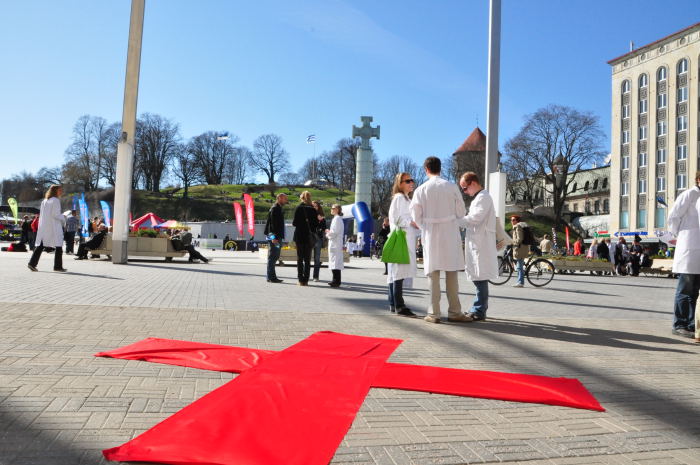 On April 24, at the conclusion of the European Student Congress, IPPNW medical students held another Target X installation in Tallinn, Estonia. Students and young doctors took to the streets of the Estonian capital, handing out leaflets about the ongoing dangers posed by nuclear weapons and reiterating our central messages: doctors have no meaningful medical response to a nuclear catastrophe and cities are not targets!
IPPNW students have organized a total of 56 Target X installations in more than 20 countries, including India, the US, Russia, France, the UK, Iran, Germany, Italy and the Netherlands. Reports and photos from all these events can be found on the medical student website.
This post is not about the Royal Wedding, nor is it about the killing of Osama Bin Laden (or a photo of such). Having said that, you may wonder what else there is in the world to talk about. Certainly you might have got the impression lately that one issue fell neatly off the world agenda: the topic of “tactical” nuclear weapons (TNW) in Europe.
However, IKV/Pax Christi in the Netherlands was determined to stop that happening. About a month ago they published a report entitled “Withdrawal Issues” (note the addiction pun). The report was really a snapshot of NATO member state positions at the time of the debate on a new Strategic Concept. These positions were anything but hard and fast and have invariably altered somewhat since the Concept was agreed upon, and in light of the report itself. But the general message that the report gave was this: that the remaining 180 US TNW in Europe were no longer of value and that most countries would be in favour of withdrawal if certain conditions were met. The problem was that there was, and is, no agreement on what those conditions should be.
Last week I attended a small – but very good – meeting in Helsinki, organised by the Finnish Peace Union and BASIC, entitled “NATO Nuclear Deterrence and Defence: A Nordic Perspective”. It was an informal dinner and a seminar with government representatives from the Baltic States, Scandinavia, Eastern and Central Europe, think tanks and NGOs. Gunnar Westberg and I were there for IPPNW. The meeting was “behind closed doors”, so I can’t attribute any comments to anyone in particular, but I can tell you a little about what I gleaned from the discussion. Read more…
Physicians for Social Responsibility Cites Flawed Evacuation Zones, Nuclear’s Health Risks on Chernobyl Anniversary
Physicians for Social Responsibility (PSR), the US affiliate of IPPNW, today cited gross inadequacies in evacuation zones around nuclear reactors and underscored the ongoing health risks of nuclear energy to the public. The 25th anniversary of Chernobyl and the continuing crisis at Fukushima—both Level 7 nuclear disasters—are clear reminders that standard evacuation zones cannot protect the public from a nuclear accident. One-third of the population of the United States (over 111 million people) lives within 50 miles of a nuclear reactor. Given the consequences of the Chernobyl and Fukushima disasters, PSR is calling for a major reassessment of contingency plans for nuclear accidents, as well as a full and fair accounting of the data on the impact to public health and the environment.
 PSR unveiled a new interactive Evacuation Zone Map at a press conference today held jointly with the Institute for Policy Studies’ Robert Alvarez. The map shows a person’s residence in relation to a nuclear reactor and an evacuation zone.
“The original evacuation zone around the Fukushima reactors and the current 10-mile evacuation zone mandated in the US are insufficient,” said Jeff Patterson, DO, immediate past president of Physicians for Social Responsibility. “We must reevaluate our contingency plans for protecting the public from these dangerous reactor sites. The nuclear industry, and our government, continues to put innocent lives at risk by ignoring the real dangers of nuclear accidents to public health. As we have seen in nuclear testing, the Kyshtym explosion, Chernobyl and now in Fukushima, when catastrophic releases of radiation happen, they quickly affect not just populations nearby but the whole world, spreading long-lived radioactive pollution everywhere.” Read more…
Children of Fukushima need our protection
 By Tilman Ruff
[Originally published in Kyodo News.]
I was dismayed to learn that the Ministry of Education, Culture, Sports, Science and Technology earlier this week increased the allowable dose of ionizing radiation for children in Fukushima Prefecture.
The dose they set, 3.8 microsieverts per hour, equates to more than 33 millisieverts (mSv) over a year. This is to apply to children in kindergartens, nursery, primary and junior high schools. Let me try to put this in perspective.
Widely accepted science tells us that the health risk from radiation is proportional to the dose — the bigger the dose the greater the risk, and there is no level without risk.
The International Commission on Radiological Protection recommends that all radiation exposure be kept as low as achievable, and for the public, on top of background radiation and any medical procedures, should not exceed 1 mSv per year.
For nuclear industry workers, they recommend a maximum permissible annual dose of 20 mSv averaged over five years, with no more than 50 mSv in any one year.
In Japan the maximum allowed annual dose for workers, 100 mSv, was already higher than international standards. This has been increased in response to the Fukushima disaster to 250 mSv.
The U.S. National Academy of Sciences BEIR VII report estimates that each 1 mSv of radiation is associated with an increased risk of solid cancer (cancers other than leukemia) of about 1 in 10,000; an increased risk of leukemia of about 1 in 100,000; and a 1 in 17,500 increased risk of dying from cancer.
But a critical factor is that not everyone faces the same level of risk. For infants (under 1 year of age) the radiation-related cancer risk is 3 to 4 times higher than for adults; and female infants are twice as susceptible as male infants.
Females’ overall risk of cancer related to radiation exposure is 40 percent greater than for males. Fetuses in the womb are the most radiation-sensitive of all.
The pioneering Oxford Survey of Childhood Cancer found that X-rays of mothers, involving doses to the fetus of 10-20 mSv, resulted in a 40 percent increase in the cancer rate among children up to age 15.
In Germany, a recent study of 25 years of the national childhood cancer register showed that even the normal operation of nuclear power plants is associated with a more than doubling of the risk of leukemia for children under 5 years old living within 5 kilometers of a nuclear plant.
Increased risk was seen to more than 50 km away. This was much higher than expected, and highlights the particular vulnerability to radiation of children in and outside the womb.
In addition to exposure measured by typical external radiation counters, the children of Fukushima will also receive internal radiation from particles inhaled and lodged in their lungs, and taken in through contaminated food and water.
A number of radioactive substances are concentrated up the food chain and in people. As a parent, as a physician, the decision to allow the children of Fukushima to be exposed to such injurious levels of radiation is an unacceptable abrogation of the responsibility of care and custodianship for our children and future generations.
Tilman Ruff is Regional Vice President for Southeast Asia and the Pacific; chair of the International Campaign to Abolish Nuclear Weapons; and associate professor at the Nossal Institute for Global Health at the University of Melbourne, Australia.
Nuclear weapons are a “scourge that can be prevented”
ICAN chair and IPPNW regional vice president Tilman Ruff spoke on March 29 about the urgency of nuclear disarmament at Social Policy Connections, a Christian social justice forum in Australia. Reflecting on the disaster at the nuclear power station in Fukushima, Japan, Dr. Ruff said there were common aspects to both nuclear weapons and nuclear energy technology that raise profound moral and ethical questions about human stewardship on Earth. Watch a video excerpt below, or listen to a podcast of Dr. Ruff’s entire lecture here.
Setting sights on 2012
By Hillel Schenker
The 2012 conference, which is to be organized by the secretary-general of the United Nations, the United States, United Kingdom and the Russian Federation, was the subject of a three-day conference held recently on the Japanese Peace Boat − a unique Japanese NGO based on an ocean liner.
Given that their country is the only one to have suffered a nuclear strike, the Japanese are particularly sensitive about this topic, and the current mayors of Hiroshima and Nagasaki have been at the forefront of activity to promote a nuclear-weapons-free world.
With their thoughts on the Fukushima reactor and their families back home, the Japanese arrived in the Mediterranean Sea in mid-March to convene an onboard conference with civil-society representatives from Israel, Palestine, Egypt, Jordan, Lebanon and India, as well as leaders of International Physicians for the Prevention of Nuclear War (winners of the 1985 Nobel Peace Prize) from Greece and Switzerland, and the UN. Read more…
An antinuclear “rock symphony” from Canada
As a musician who is also an activist, I’ve always appreciated the ways other musicians have blended their beliefs about peace and war, social justice, and the environment into their work.
One of the first songs I remember hearing that was overtly about nuclear war (a few years before Randy Newman’s caustic “Political Science”: “let’s drop the big one now”) was The Byrds eerie “I Come and Stand at Every Door,” the appeal of a Hiroshima victim for peace. Dylan had recorded “A Hard Rain’s A-Gonna Fall” before that, but I discovered that one later. A list of topical songs, ranging from the relentlessly mainstream (“Blowin’ in the Wind”) to the truly obscure (ever heard Rod MacDonald’s “The Unearthly Fire?”) would fill many pages, and that’s not my purpose here.
Benefit concerts have been another big way in which musicians have put their values to work to support organizations and causes. George Harrison started it all with the Concert for Bangladesh. Jackson Browne, Bonnie Raitt, and Graham Nash organized the giant “No Nukes” concert right after the Three Mile Island disaster (highlights with explicit antinuclear lyrics were Gil Scott-Heron’s “We Almost Lost Detroit” and Browne’s “Before the Deluge”).
I was an unabashed fan when James Taylor played at a fundraiser for Women’s Action for Nuclear Disarmament in the 1980s, and several years later when Crosby, Stills and Nash, Bruce Cockburn and others did the same for IPPNW at the 1988 World Congress in Montreal. I believe in that same year IPPNW-Germany started a long-standing series of classical concerts for peace, with a four-city performance of Beethoven’s “Missa Solemnis.” I jumped into the act in a small way during the scary Reagan years, playing at local peace rallies as part of a duo called “New Clear Music.” (I’d be relieved to find out we did not invent that contrived play on words, but I have the sinking feeling we did. Anyone who can document a usage before the summer of 1982 is up for a serious reward.)

Diatessaron's antinuclear rock symphony is called "Monument"
In any case, I didn’t start this piece as an exercise in nostalgia, so if you’ve followed along this far, I’m here to report that a new band has embraced the cause of nuclear abolition, has composed an antinuclear “rock symphony,” and has come to IPPNW with offers of support. The band is called Diatessaron, they hail from Canada, their album is called “Monument,” and you can learn more about it and listen to part of it here.
Diatessaron singer Si Tj told us that “Monument” “is dedicated to the victims of the nuclear weapons dropped on Hiroshima and Nagasaki. We are firmly committed to this cause and would like to share our message through our music with as wide an audience as possible. We hope to create a lasting impression, especially with younger audiences, that will raise awareness about the dangers of atomic weapon stockpiling, testing and deployment.”
It’s a proud tradition with a long bloodline, Simon. Welcome to the family.
Global day of action against military spending
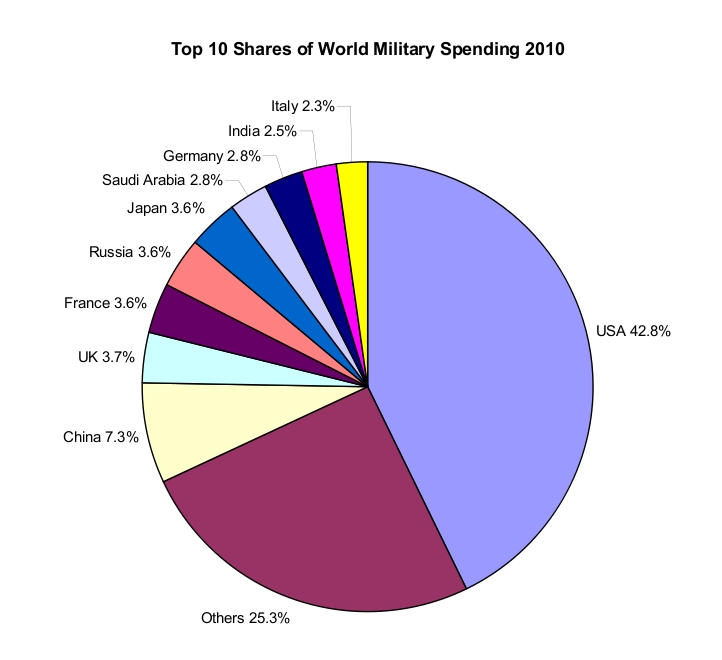 Last year, the world spent a staggering $4.38 billion dollars every day on war and preparations for war.
According to a new report released today by the Stockholm International Peace Research Institute (SIPRI), world military expenditures grew to a record $1,600 billion in 2010.
The United States was responsible for the lion’s share of spending. The Pentagon budget is currently $693 billion, accounting for more than all other US discretionary spending combined. The wars in Afghanistan and Iraq alone cost more than $300,000 every minute.
“The US has increased its military spending by 81 per cent since 2001, and now accounts for 43 per cent of the global total, six times its nearest rival China,” stated Dr. Sam Perlo-Freeman, head of the SIPRI Military Expenditure Project.
The figures stand in sharp contrast to spending on efforts to create a more peaceful and healthy planet.
Some 1.7 billion people live on the edge of subsistence without the basic necessities of life. Yet two tenths of world military spending is all that is needed to achieve the UN Millennium Goals, including ending poverty and ensuring that everyone has access to clean water, food, clothing, shelter, healthcare and education.
Today, on this Global Day of Action Against Military Spending, IPPNW joins hundreds of other groups, and millions of people around the globe, in calling for a re-ordering of priorities away from armament and war. It is time instead to focus attention and resources on unmet human needs.
What would you do with $1,600,000,000,000 dollars? Click here to consider the possibilities.

 Bimal Khadka
 Bjorn Hilt
 Charles K. Johnson
 Gunnar Westberg
 IPPNW
IPPNW John Loretz
 Lawrence Wittner
 Maria Valenti
 mollymcgint
 Sue Wareham
 Tilman Ruff
 Tim Wright
 Xanthe Hall


 IPPNW peace and health blog