What will it take to prevent global violence?
Dr. Etienne Krug of the WHO Department of Injury and Violence Prevention challenged participants to “go home and decide how you will help move violence prevention forward” at the conclusion of the two-day 5th Milestones of a Global Campaign for Violence Prevention meeting held September 6-7 in Cape Town, South Africa. He had opened the meeting noting that it was fitting we were in South Africa because it was this country that brought the resolution on violence as a leading worldwide public health problem to the 1996 World Health Assembly that helped create the groundwork for this campaign.
IPPNW Aiming for Prevention activists Robert Mtonga (Zambia), Daniel Bassey (Nigeria), Andrew Winnington (New Zealand) and I joined more than 250 others at the meeting that was designed to review progress on international violence prevention efforts, and help create a blueprint for progress over the next several years.
What will it take? That was the topic of discussions both formal and informal during this meeting, including at the business meeting of the WHO Violence Prevention Alliance of which IPPNW is an active member. Ideas have ranged from sharing and twinning best practices to linking violence to the social determinants of health in more concrete ways, but the overarching theme was that we need to actively promote the concept that ” violence is preventable.”
A multitude of ways to accomplish this were presented by researchers, educators, advocates and others, from improving child welfare to education on conflict resolution, but there seemed to be a consensus that until violence is seen as an impediment to health and development and prioritized by both states and NGOs we will not move forward fast enough. We need political traction and a deeper understanding that health, wellness and progress cannot be achieved in unsafe and violent environments.
IPPNW delegates left the meeting headed for research projects, organizing, and political action, our ongoing way of answering the call from Dr. Krug.
Kansas City Here It Comes: A New Nuclear Weapons Plant!
Should the U.S. government be building more nuclear weapons? Residents of Kansas City, Missouri don’t appear to think so, for they are engaged in a bitter fight against the construction of a new nuclear weapons plant in their community.
The massive plant, 1.5 million square feet in size, is designed to replace an earlier version, also located in the city and run by the same contractor: Honeywell. The cost of building the new plant—which, like its predecessor, will provide 85 percent of the components of America’s nuclear weapons—is estimated to run $673 million. Read more…
International Day Against Nuclear Tests: Translating Words Into Action
Prepared Statement of Nongovernmental Organization Representative
Coordinated and Delivered by Daryl G. Kimball, Executive Director, Arms Control Association
On behalf of the many nongovernmental organizations with an interest in ending nuclear testing and achieving a nuclear weapons free world, I would like to thank the organizers of this year’s meeting—including the office of the United Nations Secretary General and the Foreign Ministry of Kazakhstan—for granting NGOs a seat at this table.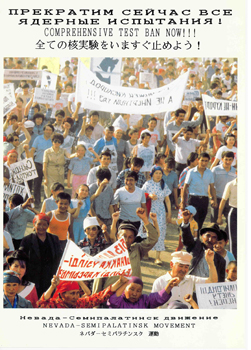
It is important to recognize the pivotal role of nongovernmental organizations—and ordinary people the world over—in the long struggle to end nuclear testing.
For example, beginning in the 1950s, American pediatricians and civil society activists documented the presence of strontium-90 in the deciduous teeth of young children, prompting a large and effective public outcry against atmospheric nuclear testing. These protests had a direct impact on the negotiation and adoption of the Partial Test Ban Treaty of 1963.
In fact, civil society organizations have played a vital role in ensuring that the evidence compiled by physicians and scientists about the health and environmental consequences of nuclear test explosions—regardless of whether they are conducted in the atmosphere or aboveground—has consistently been put forward as an essential reason to ban testing permanently.
Nongovernmental organizations played a catalyzing role in more recent efforts to halt nuclear testing. Some twenty years ago, a popular movement in Soviet-controlled Kazakhstan forced Moscow’s communist regime to halt nuclear weapons testing at proving grounds in their homeland where more than 456 explosions had contaminated the land and its people.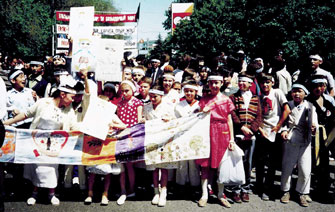
In February 1989, the renowned poet Olzhas Suleimenov called upon his fellow citizens to meet in Alma Ata to discuss how to respond to fresh reports of radioactive contamination at the Soviet’s Semipalatinsk Test Site. Five-thousand people responded and collectively issued a call for closing the test site, ending nuclear weapons production, and a universal ban on testing. The movement, which became known as Nevada-Semipalatinsk, grew and held demonstrations throughout Kazakhstan and later in Russia.
On August 6, 1989, 50,000 people attended one of its rallies, which was the largest independent event of its type in the former Soviet Union. Eventually over a million people signed its antinuclear weapons testing petition.
In August 1989, Suleimenov pushed the Supreme Soviet to adopt a resolution calling for a U.S.-Soviet test moratorium. The movement also worked to prevent Moscow from simply shifting all Soviet nuclear testing to the Novaya Zemlya site in northern Russia. To appease the growing protests, Moscow would later acknowledge it had cancelled 11 out of 18 planned nuclear tests.
In May 1990, the International Physicians for the Prevention of Nuclear War (IPPNW) and the Nevada-Semipalatinsk movement teamed up for an International Citizens Congress that brought together 300 delegates, including downwinders and disarmament leaders, from 25 countries to Alma Ata. A crowd of 20,000 gathered in support. Before the conference convened, Dr. Bernard Lown of IPPNW and Suleimenov met with Soviet Foreign Minister Shevardnadze to reinstitute an earlier Soviet test moratorium.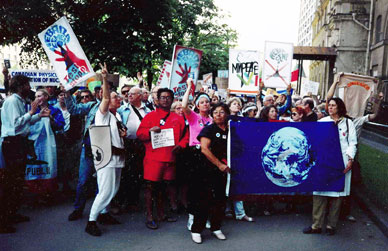
Under pressure from President Nazarbayev, the people of Kazakhstan, and the international disarmament community, then-Soviet leader Mikhail Gorbachev would authorize only one more test (in Russia) and then declare a moratorium on October 5, 1991, prompting U.S. legislators to introduce nuclear test moratorium legislation in Congress.
With strong grassroots support in the United States, the legislation, which mandated a 9-month U.S. testing halt and negotiations on a CTBT, gathered strong support and was approved in September 1992. The last U.S. nuclear test explosion was conducted on September 23, 1992. Read more…
IPPNW to Prime Minister Kan: “Place public health above all other interests” at Fukushima
IPPNW has sent a letter to Japanese Prime Minister Naoto Kan expressing concern about the ongoing nuclear reactor crisis at Fukushima Daiichi and calling on the government to take a number of specific steps to ensure that the health and safety of populations affected by releases of radiation from the crippled reactors are placed “unequivocally…above other interests.”
The letter, signed by the federation’s three co-presidents—Sergey Kolesnikov of Russia, Vappu Taipale of Finland, and Robert Mtonga of Zambia—conveys IPPNW’s “heartfelt sympathy” for the victims of the disaster, which began on March 11 when a massive earthquake damaged the large nuclear power station, eventually leading to meltdowns of three of the reactor cores.
“From the earliest weeks of the crisis,” the physicians wrote, “we have expressed our regret that the Japanese public and the international community do not seem to have been fully informed about the nature and extent of radioactive emissions from the crippled reactors; that affected populations may not have been monitored adequately for exposure to radiation; that residents may not have been evacuated from a wide enough area around the reactors; and that exposure limits seem to fall short of what is needed to protect the Japanese people—in particular vulnerable populations such as children and pregnant women—according to international best practice.”
Welcoming the fact that the Japanese and Fukushima prefectural governments, the National Institute of Radiological Sciences, and Fukushima Medical, Hiroshima, and Nagasaki Universities have recently begun to collaborate on comprehensive population health checks of people in Fukushima, IPPNW called for a number of other measures to ensure “a comprehensive, consistent, best-practice approach to radiation protection and care for the population in areas significantly contaminated.”
Included among these are ongoing long-term monitoring, a comprehensive population register of residents and workers, significant reductions in non-medical radiation exposure limit for the general population to 1 mSv per year, additional evacuations during “the period of highest environmental radioactivity,” relocation assistance for those who must be evacuated, and increased public education about how to reduce radiation exposure.
“We believe that these measures are medically necessary for safeguarding as much as possible the health of those exposed to Fukushima’s radioactive fallout, and future generations who will also be at risk,” the letter concluded.
The complete text of the letter from IPPNW to Prime Minister Kan, dated August 22, 2011, is available here.
The letter in Japanese is also available.
The role of public health in a robust arms treaty
by Robert Mtonga
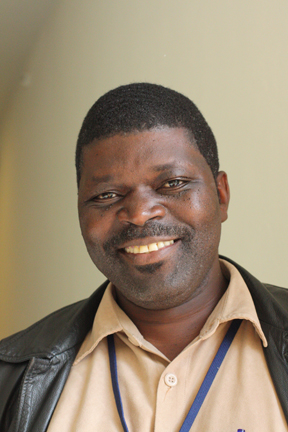
IPPNW Co-President Dr. Bob Mtonga. Photo by Aki Morizono
In 1996, the 49th World Health Assembly (WHA-the governing body of the World Health Organization {WHO}) Resolution WHA49.25 declared violence a leading public health problem worldwide and urged states to assess its extent. Subsequently, the WHO developed the landmark document Small Arms and Global Health prepared for the first UN Conference on Illicit Trade in Small Arms and Light Weapons in 2001. In it the WHO states that “Violence is…..an important health problem – and one that is largely preventable. Public health approaches have much to contribute to solving it.” For this reason the WHO made securing treaties such as the ATT one of its nine priority recommendations in the landmark 2002 WorldReport on Violence and Health, that is “to seek practical, internationally agreed responses to the global drugs trade and the global arms trade.”[i]
Public health groups work with many sectors of society in public/public as well as public/private partnerships promoting a variety of measures that can reduce the frequency and severity of armed violence. The methods used are ones that have been developed and refined in preventing infectious and chronic diseases and injuries including polio, smallpox, and automobile fatalities in many countries. The same approach can also reduce deaths and injuries from armed violence. Although it is only one of many risk factors, we know that regions with more restrictive firearms policies tend to experience lower levels of firearm violence.[ii] Read more…
How to Save a Quarter of a Trillion Dollars
By Lawrence Wittner
In the midst of the current stampede to slash federal spending, Congress might want to take a look at two unnecessary (and dangerous) “national security” programs that, if cut, would save the United States over a quarter of a trillion dollars over the next decade.
The first of these is the Obama administration’s plan to spend at least $185 billion in the next ten years to “modernize” the U.S. government’s nuclear weapons arsenal. At present, the U.S. government possesses approximately 8,500 nuclear warheads, and it is hard to imagine that this country would be safer from attack if it built more nuclear weapons or “improved” those it already possesses. Indeed, President Barack Obama has declared — both on the 2008 campaign trail and as President – that he is committed to building a world without nuclear weapons. This seems like a perfectly sensible position — one favored by most nations and, as polls show, most people (including most people in the United States). Therefore, the administration should be working on securing further disarmament agreements — not on upgrading the U.S. nuclear arsenal in preparation for future nuclear confrontations and nuclear wars.
In late June of this year, Archbishop Desmond Tutu, a Nobel Peace Prize laureate, wrote: “It is deeply troubling that the US has allocated $185 billion to augment its nuclear stockpile over the next decade, on top of the ordinary annual nuclear-weapons budget of more than $50 billion.” Not only has the International Court of Justice affirmed that nations “are legally obliged to negotiate in good faith for the complete elimination of their nuclear forces,” but “every dollar invested in bolstering a country’s nuclear arsenal is a diversion of resources from its schools, hospitals, and other social services, and a theft from the millions around the globe who go hungry or are denied access to basic medicines.” He concluded: “Instead of investing in weapons of mass annihilation, governments must allocate resources towards meeting human needs.”
Another project worth eliminating is the national missile defense program. Thanks to recent Congressional generosity, this Reagan era carryover, once derided by U.S. Senator Edward Kennedy as “Star Wars,” is currently slated for an increase in federal spending, which will provide it with $8.6 billion in fiscal 2012.
The vast and expensive missile defense program — costing about $150 billion since its inception — has thus far produced remarkably meager results. Indeed, no one knows whether it will work. As an investigative article in Bloomberg News recently reported: “It has never been tested under conditions simulating a real attack by an intercontinental ballistic missile deploying sophisticated decoys and countermeasures. The system has flunked 7 of 15 more limited trials, yet remains exempted from normal Pentagon oversight.”
Carl Levin, the Michigan Democrat who chairs the Senate Armed Services Committee, reported that his committee was “deeply concerned” about the test failures of the nation’s missile defense program. He also implied that, given the disappearance of the Soviet Union, the United States might not need such a system to deter its potential enemies, which have a far inferior missile capability. “The threat we have now is either a distant threat or is not a realistic threat,” he remarked.
Why, then, do other nations — for example, Russia — fiercely object to the deployment of a U.S. missile defense system near their borders? Perhaps they fear that, somehow, U.S. scientists and engineers will finally figure out how to build a system, often likened to hitting a bullet with a bullet, that makes the United States invulnerable while they are left vulnerable. Or perhaps they think that, one day, some U.S. government officials might believe that the United States actually is invulnerable and launch a first strike against their own nations. In any case, their favorite solution to the problem posed by U.S. national missile defense — building more nuclear-armed missiles of their own — significantly undermines the security of the United States.
Projecting the current annual cost of this program over the next decade, the United States would save $86 billion by eliminating it.
Thus, by scrapping plans for nuclear weapons “modernization” and for national missile defense — programs that are both useless and provocative — the United States would save $271 billion (well over a quarter of a trillion dollars) in the next ten years. Whether used to balance the budget or to fund programs for jobs, healthcare, education, and the environment, this money would go a long way toward resolving some of the nation’s current problems.
[Dr. Wittner, Professor of History at the State University of New York/Albany, spoke about the impact of civil society on nuclear policy at IPPNW’s World Congress in Basel this past August. His latest book is Confronting the Bomb: A Short History of the World Nuclear Disarmament Movement (Stanford University Press).]
Nagasaki Peace Declaration 2011
The mayor of Nagasaki, Tomihisa Taue , read the following statement this morning, on the 66th anniversary of the US atomic bombing of that city on August 9, 1945.
This March, we were astounded by the severity of accident at the Fukushima Daiichi Nuclear Power Station operated by the Tokyo Electric Power Company, Inc., after the occurrence of the Great East Japan Earthquake and ensuing tsunami. With some of the station’s reactors exposed to the open air due to explosions, no residents are now to be found in the communities surrounding the station. There is no telling when those who have been evacuated because of the radiation can return home. As the people of a nation that has experienced nuclear devastation, we continued the plea of “No More Hibakusha!” How has it come that we are threatened once again by the fear of radiation?
Have we lost our awe of nature? Have we become overconfident in the control we wield as human beings? Have we turned away from our responsibility for the future? Now is the time to discuss thoroughly and choose what kind of society we will create from this point on.
No matter how long it will take, it is necessary to promote the development of renewable energies in place of nuclear power in a bid to transform ourselves into a society with a safer energy base. Read more…
Reflections on Hiroshima, Nagasaki, and Fukushima: Are we witnessing the beginning of the end of the nuclear age?
Masao Tomonaga, MD

Masao Tomonaga
The 66th anniversary of the atomic bombings of Hiroshima and Nagasaki arrives as Japan tries to recover from the ongoing nuclear power plant disaster at Fukushima Daiichi, which has exposed almost two million people to chronic low dose radiation.
On March 11, a powerful tsunami in northeast Japan, triggered by a devastating earthquake, struck the electric supply apparatus at Fukushima and induced meltdowns in two of the plant’s reactors, along with hydrogen explosions in the reactor buildings. During the next two weeks, high levels of radioactive iodine and cesium were released into the air. The soil of Fukushima Prefecture was widely contaminated with radioactive nuclides, as were coastal waters. Residents, including a few hundred thousand children, were chronically exposed to low-dose radiation. More than 20,000 residents were evacuated from their home towns, where the estimated annual exposure dose exceeds 20 millisieverts (mSv). Many farmers abandoned their cattle. Five months after the onset of the disaster, a prefecture-wide mass medical survey has been started to determine the health impact on the two million residents of Fukushima.
This new nuclear tragedy now forms the backdrop of Japan’s first terrible experience with the destructive forces of the nuclear age, commemorated each year at this time. Read more…
Hiroshima Peace Declaration — August 6, 2011
On August 6, 1945, the United States exploded an atomic bomb over Hiroshima. A single blast unleashed heat, fires, winds, and radiation that killed 70,000 people instantly (another 70,000 would be dead from injuries and radiation by the end of the year), destroyed the entire city, and changed the world forever. Three days later, on August 9, the US dropped a second bomb on Nagasaki, killing 75,000. The medical, environmental, social, and political repercussions of the most inhumane weapons ever built have persisted to this day.
The survivors of the first nuclear war—the hibakusha—have traveled the world to tell their stories and to appeal for the abolition of nuclear weapons. The mayors of Hiroshima and Nagasaki, who share the leadership of the international network Mayors for Peace, speak to the world each year, on the anniversary of the atomic bombings, about the need to work for peace and to ensure that what happened to their cities can never be repeated.
The recently elected mayor of Hiroshima, Kazumi Matsui, read the following statement this morning in Hiroshima’s Peace Park.
Peace Declaration
August 6, 2011
Sixty-six years ago, despite the war, the people of Hiroshima were leading fairly normal lives. Until that fateful moment, many families were enjoying life together right here in what is now Peace Memorial Park and was then one of the city’s most prosperous districts. A man who was thirteen at the time shares this: “August fifth was a Sunday, and for me, a second-year student in middle school, the first full day off in a very long time. I asked a good friend from school to come with me, and we went on down to the river. Forgetting all about the time, we stayed until twilight, swimming and playing on the sandy riverbed. That hot mid-summer’s day was the last time I ever saw him.” Read more…
The revolution begins in Tel Aviv
by Hillel Schenker
[Originally published in Palestine-Israel Journal]
Two young people who caught my eye in the endless stream of people in Tel Aviv last night were wearing proudly wearing t-shirts with the slogan “Revolution!” stamped on the front. No busses, no organized political mobilizations, just endless streams of people, marching in the heart of Tel Aviv – near the heart of the Israeli military-industrial complex – the Kirya (Israeli Pentagon), the huge office and apartment towers, with the three Azrieli Towers looming in the distance. 100,000 people in Tel Aviv alone, 150,000 throughout the country.
They were mainly young, secular and Ashkenazi, but also groups with signs representing South Tel Aviv, the Hatikva Quarter, Jaffa, all predominantly Sephardi neighborhoods. And Russians proudly carrying signs in Russian proclaiming that we are here too. And some young Ethiopian girls, whooping it up. And Arabs from Jaffa, even a smattering of ultra-Orthodox Haredim. Someone was carrying a placard which looked like the ghost of Che Guevera. And someone else wore a t-shirt with a picture of Gandhi on the back.
The predominant slogan was “The people demand social justice!” And periodically, a loud rumbling cry emerged from sections of the crowd, like a wave – people simply feeling their strength and empowerment. Read more…

 Bimal Khadka
 Bjorn Hilt
 Charles K. Johnson
 Gunnar Westberg
 IPPNW
IPPNW John Loretz
 Lawrence Wittner
 Maria Valenti
 mollymcgint
 Sue Wareham
 Tilman Ruff
 Tim Wright
 Xanthe Hall


 IPPNW peace and health blog