Home Stretch of ATT Negotiations
by Bob Mtonga MD and Don Mellman MD MPH
“We are on the home stretch. The finish tape is in sight, but it is blurred.”
-Bob Mtonga, MD, Co-President, IPPNW, July 21, 2012
Comments from Bob Mtonga MD
I have been working hard these past weeks including as a member of the Zambian delegation to help successfully conclude the Arms Trade Treaty (ATT) next Friday, July 27. (Bob is a true leader in this process, and has brought very favorable recognition to himself and IPPNW. – dlm) Some of what I have done:
- Worked behind the scenes with Norway and Sweden to mobilize 73 states to issue a common statement that emphasized the three things that must be included in the ATT without negotiation:
- Small arms and light weapons, and ammunition,
- “Gender-based violence,” and
- Specific reference to International Humanitarian Law and Human Rights Law. (N.B. IHL is the law of war that relates to the treatment of those not in the fighting, “hors de combat.” To be “hors de combat,” one must be in the power of an adverse Party, clearly expresses an intention to surrender, has been rendered unconscious or is otherwise incapacitated by wounds or sickness, and therefore is incapable of defending himself; provided that in any of these cases he abstains from any hostile act and does not attempt to escape. Human Rights Law is the law of peacetime and refers to the treatment of the citizens of a state by its government or non-states actors. dlm and Wikipedia)
(The actual statement can be found below the comments.) Read more…
While the Arms Trade Treaty Diplomatic Conference moves into its last week of month-long negotiations at the UN in New York and state delegates work to draft a treaty text, IPPNW members continue to actively participate with hundreds of other NGOs to urge for a strong and humanitarian-based ATT, which we hope will ultimately save lives and improve health worldwide.
At the same time, IPPNW doctors around the world are working on the ground to save lives and improve health today through a number of projects on armed violence prevention. Read more…
By Donald Mellman MD MPH, IPPNW member and delegate to the Arms Trade Treaty Diplomatic Conference at the United Nations, New York City
(N.B.: The described events are as I perceived them. All opinions are my own, and are (probably) not those of anyone else. – dlm)
Some thoughts
- The ATT is like a four- act play, one act per week, with a cast of hundreds – many of whom are at a distance, such as in a capital. This first week was notable for:
- Intrigue: the proceedings were delayed for a day and a half asEgypt attempted to elevate the status ofPalestine within the UN for these negotiations. The resolution: The Holy See was not allowed to participate (I don’t understand it either.). Rumors abounded; including Hillary Clinton calling Egypt and the EU calling Ramallah
- Tragedy: The Chair, Garcia Moritán from Argentina, presented his thoughts in a paper as suggestions for a starting point for the negotiations. The paper was felt by many in the NGO community to be watered-down from that of July of last year. Ambassador Moritán said people may not like it – he was right. Read more…
IPPNW board member and Nigerian leader Dr. Ogebe Onazi joined with representatives from Parliamentarians for Global Action and other colleagues from the Control Arms Coalition at a high level event with Secretary General Ban Ki-moon today at the United Nations to deliver petition signatures calling for a strong and humanitarian-based ATT. Dr. Onazi delivered IPPNW’s Medical Alert for a Strong ATT containing over 1700 signatures from 58 countries. Others delivered petitions from parliamentarians, religious leaders and citizens. Read more…
Middle East should be disarmed, not armed
 An exception doesn’t prove the rule, it weakens it. Germany is violating its international obligations and its own rules by delivering a nuclear-capable submarine to Israel. Moreover, it risks damaging the conference on a zone free of weapons of mass destruction in the Middle East, planned to take place at the end of this year. The delivery conveys the impression that arming Israel is the way to more peace, rather than regional disarmament. Read more…
Do nuclear weapons really deter aggression?
It’s often said that nuclear weapons have protected nations from military attack.
But is there any solid evidence to bolster this contention? Without such evidence, the argument that nuclear weapons prevented something that never occurred is simply a counter-factual abstraction that cannot be proved.
Ronald Reagan — the hardest of military hard-liners — was not at all impressed by airy claims that U.S. nuclear weapons prevented Soviet aggression. Kenneth Adelman, a hawkish official in the Reagan administration, recalled that when he “hammered home the risks of a nuclear-free world” to the president, Reagan retorted that “we couldn’t know that nuclear weapons had kept the peace in Europe for forty years, maybe other things had.” Adelman described another interchange with Reagan that went the same way. When Adelman argued that “eliminating all nuclear weapons was impossible,” as they had kept the peace in Europe, Reagan responded sharply that “it wasn’t clear that nuclear weapons had kept the peace. Maybe other things, like the Marshall Plan and NATO, had kept the peace.” (Kenneth Adelman, The Great Universal Embrace, pp. 69, 318.) Read more…
This week the Violence Prevention Alliance (VPA), of which IPPNW is an active member, launched the Global Campaign for Violence Prevention (GCVP)2012-2020. The VPA is a network of WHO Member States, international agencies and civil society organizations working to prevent violence. This Plan aims to unify the efforts of the main actors in international violence prevention and identify a small set of priorities for the field. It was developed in response to a need for a plan of action identified by hundreds of violence prevention experts who convened at the September 2011 Fifth Milestones in a Global Campaign for Violence Prevention Meeting in Cape Town, South Africa and the April 2012 Violence Prevention Alliance meeting in Munich, Germany. Read more…
Should NATO be handling world security?
The North Atlantic Treaty Organization (better known as NATO) is in the news once again thanks to a NATO summit meeting in Chicago over the weekend of May 19-20 and to large public demonstrations in Chicago against this military pact.
NATO’s website defines the alliance’s mission as “Peace and Security,” and shows two children lying in the grass, accompanied by a bird, a flower and the happy twittering of birds. There is no mention of the fact that NATO is the world’s most powerful military pact, or that NATO nations account for 70 percent of the world’s annual $1.74 trillion in military spending.
The organizers of the demonstrations, put together by peace and social justice groups, assailed NATO for bogging the world down in endless war and for diverting vast resources to militarism. According to a spokesperson for one of the protest groups, Peace Action: “It’s time to retire NATO and form a new alliance to address unemployment, hunger, and climate change.” Read more…
My words fly up
my deeds remain below,
Words without deeds
never to heaven go
(After Shakespeare, Hamlet)
So this NPT PrepCom is over. The words were mostly hopeful, the promises of action feeble. At many NPT Revs and NPT PrepComs words have to a degree been aggressive. So a better atmosphere this time. Mostly because the NPT Rev in 2010 was felt to have been such a positive event, compared to NPT Rev 2005, and this PrepCom did build on 2010.
Most good words were on the need to avoid the terrible humanitarian catastrophe that even a “limited” nuclear war would cause – a limited war with unlimited, global consequences, as was learned from the “side event” on the global climate disasters after a nuclear war between India and Pakistan. These words on the humanitarian consequences seemed to irritate the nuclear weapon states, who as usual wanted to talk about ways to keep their nuclear weapon oligopoly. But the nuclear weapons addicts did not want to attack the Red Cross and could not attack the climate scenario, so they fell back on their usual tactics of pretending to plan for nuclear disarmament, but “not in our lifetime”.
Watch out, the nukes may end your lifetime, maybe even by mistake. That the Still-not-Nuclear-Weapon-Free States—SNNWFS—intend to remain in their state of non-compliance is shown by their refusal to take nukes off High Alert and by their very active nuclear weapons modernization program , “Mutual Assured Destruction for Ever”. They MADE MAD perennial.
The good words seem to be pinned to the upcoming conference in Norway next year. The SNNWFS do not want to use their considerable influence to make real the Helsinki Conference on a Middle East free of Weapons of Mass Destruction, and seem to have given up this very important opportunity.
So we in the Nuclear-Weapons-Free States, and you in the SNNWFS who want to free the world of this yoke, must try hard to make substantial concrete moves towards a Nuclear Weapon Free World—NWFW—at that conference in Oslo. Again, High Alert is Russian roulette for mankind and we must never accept that. And we should repeat again and again: Why High Alert? Maybe the SNNWFS could limit the Hair Trigger Alert to one single nuclear missile targeted on the adversary’s capital?
And why do you go on with your modernization program if you intend to free yourselves of all nuclear weapons? In this era of recurring financial crises, when a generation of young people are bereaved of the hope of employment, it must be possible to make the taxpayer see the light: A billion spent in the social sector gives many times more jobs than in the weapons sector.
Good words must be followed by good acts. Let’s see to that.
NPT: Nuclear Non-proliferation Treaty, in force since 1970.
NPT Rev: The NPT is reviewed every five years.
NPT PrepCom: NPT Preparatory Committee meeting, preparing for the next NPTRev, in 2015.
MAD: Mutual Assured Destruction, the so called Peace through Deterrence during the Cold War, still official doctrine.
SNNWFS: The Nuclear Weapon states pledged in 1970 in the NPT Art. VI to abolish their all their nuclear weapons, thus they are Still-Non-Nuclear-Weapons-Free States, but keep the world hostage to total destruction.
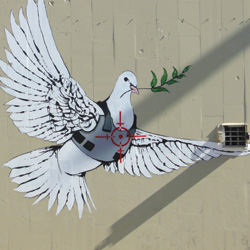 It is hard to imagine a nuclear weapon-free world from where we stand today. It reminds me of early 1989 in Berlin, when the editor of an english-speaking magazine that I wrote for suggested that we run a feature on “After the Wall”. No one took the idea seriously, we laughed and went on with our lives, not knowing that only months later the Wall would actually come down. We did not anticipate, nor did we believe it would happen. But that did not stop Germans wanting it or calling for it to happen. Indeed, much of the ground was prepared for it to happen.
History is like that. All of a sudden, the conditions are ripe for a change to occur, sometimes only coincidentally. If that change is desired, then we have to prepare for such a precipitous moment thoroughly beforehand so that nothing stands in the way when the time comes. In order to arrive at a nuclear weapon-free world, we have to give some thought to how we can achieve the right security conditions necessary for it to happen. Read more…




 IPPNW peace and health blog