A new divestment campaign with old roots
“Don’t Bank on the Bomb,” the new report released this week by the International Campaign to Abolish Nuclear Weapons (ICAN), exposes the complex web of relationships among banks, investment funds, other private financial institutions, and the corporations that manufacture and maintain a large share of the world’s nuclear weapons. The report is a remarkable piece of research on its own terms, but its real value lies in the foundation it provides for local and national divestment campaigns in some 30 countries.
Tim Wright, the director of ICAN-Australia and the lead author of the report, said on this blog today, “Any person with a bank account or pension fund has the power to choose not to invest in nuclear arms makers.” Read more…
Nuclear divestment: the medical case
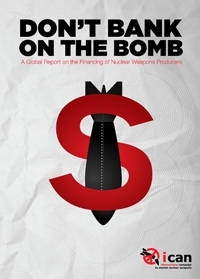 This week the International Campaign to Abolish Nuclear Weapons launched a major study on the global financing of nuclear weapons producers. The 180-page report argues that banks, pension funds, insurance companies and asset managers should divest from companies involved in the manufacture, maintenance and modernization of nuclear forces. By investing in these companies, financial institution are in effect facilitating the build-up of nuclear arsenals and heightening the risk that these ultimate weapons of mass destruction will be used again.
The report provides details of financial transactions with 20 companies that are heavily involved in the US, British, French and Indian nuclear programs. They include BAE Systems and Babcock International in the United Kingdom, Lockheed Martin and Northrop Grumman in the United States, Thales and Safran in France, and Larsen & Toubro in India. Financial institutions invest in these companies by providing loans and purchasing shares and bonds. The report found that more than 300 financial institutions in 30 countries have substantial investments in nuclear weapons companies. Read more…
700 prominent Australians call for nuclear abolition
From the February 16, 2012 edition of the National Catholic Reporter:
More than 700 prominent Australians — including former prime ministers, defense ministers, and Catholic bishops and priests — have signed onto a statement calling on their country’s government to adopt a “nuclear-weapons-free” defense posture and to take steps to initiate a global treaty to abolish nuclear arsenals.
The statement, which was put together by Australians for a Nuclear Weapons Convention and announced Jan. 25, includes signatures from 713 Australians who have received the Order of Australia, an honor granted by Queen Elizabeth II to note achievement or “meritorious service” and similar to a knighthood in the United Kingdom. Read more…
IPPNW promotes role of public health and civil society in monitoring ATT
By Hakeem Ayinde, MD
Wednesday, the 15th of February was definitely the biggest day for IPPNW at the ongoing 4th Arms Trade Treaty PrepCom. We had a double header of hosting a side event and addressing the states delegates during the NGO presentations right after that.
The side event focused on the role of public health and civil society in monitoring the Arms Trade Treaty (ATT). This topic was especially pertinent, as some states have sought to limit the participation of NGOs in the negotiations for a robust Arms treaty. Read more…
From time to time on this blog, I’ve stated that substantial cuts in the US and Russian nuclear arsenals—to levels of 500 each or fewer—would not only represent a serious “down payment” on a world without nuclear weapons, but would also take away the last remaining excuse for the other nuclear-weapon states to come to the table and commence negotiations on a nuclear weapons convention. Two years ago, I pointed to an even more dramatic proposal, made by US Air Force strategists no less, for cuts to a little more than 300 weapons, which they said the US could safely do regardless of whether Russia and the other nuclear-weapons states followed suit.
I’ve also expressed disappointment that the New START agreement between the US and Russia did little more than codify the Bush-Putin era cuts in a real treaty, rather than the overly casual SORT. (I called the latter “deeply flawed,” instead of “phony,” in a rare moment of self-restraint.) The Obama administration’s subsequent commitment to a hyper-inflated program to rebuild the US nuclear weapons infrastructure in order to modernize and refocus a smaller, but apparently permanent, START-level arsenal, left most of us wondering what was left of the bold vision of a world without nuclear weapons President Obama embraced in Prague in 2009.
Over the last couple of weeks, however, two things have happened that suggest the Prague vision—or at least some slightly more ambitious version of it than we’ve seen in the past three years—may be guiding the administration’s actions after all. Read more…
IPPNW Joins Nobel Laureates Panel at United Nations ATT Meeting

Dr. Oscar Arias Sanchez, former president of Costa Rica with IPPNW's co-president, Dr. Robert Mtonga.
“Listen to your doctor – we can achieve a strong and humanitarian-based ATT,” were Dr. Bob Mtonga’s closing words as he joined Dr. Oscar Arias Sanchez and others on a Nobel Laureates side panel today at the ATT talks.
In 1997 Dr. Arias, former president of Costa Rica, convened in New York a group of Nobel Peace prize winners, including IPPNW, to call for an International Code of Conduct on arms trade to stem the tide of injuries and death from unregulated arms flow. Another speaker today who also attended that same meeting was Susan Waltz, Amnesty International US board member. The Albert Schweitzer Institute was also at the meeting nearly 15 years ago, and was represented today by David Ives, the current Executive Director. Read more…
IPPNW participates in Arms Trade Treaty talks
By Dr. Ogebe Onazi, IPPNW Nigeria

Members of the IPPNW delegation to the ATT PrepCom (left to right), Shannon Gearhart, Hakeem Ayinde, Chukwuemeka Okolo, Maria Valenti, and Omolade Oladejo.
As a Nigerian doctor active with IPPNW, I am pleased to participate for a second time in twelve months in the Arms Trade Treaty (ATT) Preparatory Committee talks at the United Nations in New York. I am part of the IPPNW delegation that includes Drs. Robert Mtonga (IPPNW Co-President from Zambia), Vic Sidel, Donald Mellman, Cathey Falvo, Shannon Gearhart, and Hakeem Ayinde (IPPNW USA), Omolade Oladejo and Chukwuemeka “Emeka” Okolo (IPPNW Nigeria), and Maria Valenti (Aiming for Prevention Director).
We are joining with more than 100 civil society participants from all continents to attend the meeting as members of the Control Arms Coalition. IPPNW serves on the steering board of this organization, a major NGO alliance working for a “bulletproof” Arms Trade Treaty that was recently nominated for the 2012 Nobel Peace Prize. The delegation includes Nobel laureates, parliamentarians, armed violence survivors, lawyers, activists, policy experts, and we health professionals. Read more…
Conservative politicians often portray the United Nations as a powerful monster, poised to gobble up the United States and other countries and put them under alien rule.
The reality, of course, is quite different. When it comes to international peace and security, the United Nations is notably lacking in power. Its resolutions along these lines are often ignored or go unenforced. Frequently, they are not even adopted. This situation leaves nations free to pursue traditional practices of power politics and, occasionally, much worse. Read more…
No military action will prevent nuclear proliferation
[The following statement was issued today by IPPNW’s Executive Committee.]
International Physicians for the Prevention of Nuclear War (IPPNW) opposes all military action against Iran’s nuclear program. Attacking Iranian facilities will cause widespread devastation, increase the risk of nuclear proliferation, and halt the chances for peace in the region.
IPPNW urges all nations, and Israel and the United States in particular, to refrain from launching military strikes against Iran, and to work with the international community to resolve, through the many diplomatic and non-violent pathways that remain open, the legitimate concerns that Iran may be developing a nuclear weapons capability.
IPPNW also calls upon Iran to reestablish full and transparent relations with the IAEA, and to provide IAEA inspectors with the comprehensive access and information they need to assure the international community that Iran is in compliance with its obligations under the Non-Proliferation Treaty and is not engaged in weapons development activities.
An Israeli military strike against Iranian facilities, with or without the support of the US and its other allies, would almost certainly provoke violent retaliation and cause potentially significant releases of radioactivity. The human cost would be enormous and would threaten regional and international peace and security. Such a conflict could escalate into a regional war, and could ultimately lead to the use of nuclear weapons — the very thing the entire world most needs to prevent.
There is no military solution to the problem of nuclear weapons proliferation anywhere in the world, particularly in the Middle East.
IPPNW supports regional and international efforts to negotiate a nuclear-weapons-free Middle East, and urges all States in the region, including Israel and Iran, to participate in good faith in the United Nations-sponsored conference that will be hosted by Finland to prepare the foundations for such an agreement.
The only way to ensure that nuclear weapons will never be used again, however, is to negotiate and complete a Nuclear Weapons Convention that will eliminate all existing nuclear weapons and prevent all states from acquiring or reacquiring them in the future.
Changes in the air in DPRK, Part 2
Yes, the changes we felt in North Korea during our visit there in October are sensed by others. In a recent issue of Science (Vol. 334, Dec 23 2011, p 1624-1625) there is a report from the new Pyongyang University of Science and Technology, PUST, by the scientific journalist Richard Stone.
This institution is founded and supported by evangelical Christians in the USA! More than half the staff of 29 foreign faculty members are from the USA. The teaching is entirely in English. The students have access to the Internet, although they have to log the sites they visit. Twenty graduate students will visit universities in China at the end of their studies. Cooperation with the Erasmus university exchange program in Europe is expected.
At this university there are 267 students – all male – from the Democratic People’s Republic of Korea, DPRK. They study such traditional subjects within the area of technology as chemistry and computer programming but also international finance.
The leaders in DPRK do understand that there is a need for scientific exchange with other countries. Five hundred IT specialists from the country have been sent to Europe and hundreds to China in recent years.
The report in Science is really very encouraging. There is apparently backing from the government of DPRK, although with close supervision by a parallel faculty from the Kim Il Sung University. However, the future development of the institution is uncertain. The building of the university was supported from South Korea, but that support has dwindled as the present South Korean government has taken a harder line against North Korea. The founding president of the university now has to travel around the world to obtain economic support for the university. There is very little equipment in the university to be used for laboratory studies.
In the present uncertain situation in DPRK after the demise of the “Dear Leader” we do not know who or what group is going to be the strong force in the country. Now there may be a chance to open contacts with young people there and show what the rest of the world is like.
Here is a chance not to be missed. People of DPRK know next to nothing about democracy and about the open society. If a few thousand of the future leaders of the country could come abroad to study, that might be important in the future.
The PUST University is in a difficult economic situation and the future is uncertain. How unreasonable, that when we spend billions of dollars on military defence against the perceived threat from North Korea, we can not find a few millions for this investment in the future! There is plenty of money in EU coffers for such purposes, even today!
In IPPNW we have been able to bring a few doctors from North Korea to Europe for short-term medical training. Can we do more? Can we find EU money for a greater exchange? Do we have the contacts and the resources, and the will?

 Bimal Khadka
 Bjorn Hilt
 Charles K. Johnson
 Gunnar Westberg
 IPPNW
IPPNW John Loretz
 Lawrence Wittner
 Maria Valenti
 mollymcgint
 Sue Wareham
 Tilman Ruff
 Tim Wright
 Xanthe Hall


 IPPNW peace and health blog