Progress in preventing nuclear terrorism
Terrorists who wanted to kill 100,000 people and destroy a city could build a simple nuclear bomb, without much difficulty, by obtaining some Highly Enriched Uranium (HEU). As little as 20 kg of HEU would provide the fuel for a possible bomb to even a fairly unsophisticated terrorist group. I probably could do it myself with the help of a few engineers and someone who understands how to use explosives.
The simplest way to get access to HEU is to steal the stuff from a research reactor or a reactor that makes isotopes for medical use. Many of these reactors are guarded by a couple of guys with semiautomatic rifles, who could be overpowered or bribed. Obtaining fuel in this way would more likely lead to a usable weapon than stealing a bomb, which could not be made to work without codes and, usually, a critical gadget for ignition. Read more…
IPPNW Austria and IPPNW Zambia are engaged in a research project in Lusaka, Zambia designed to improve care and support for victims of interpersonal violence in Zambia, and suggest guidelines for best practice for other sub-Saharan African countries.
30 Austrian medical students are participating in the project in Zambia along with their Zambian medical student counterparts. Training and supervision are being conducted by senior Austrian and Zambian medical leaders. The one year project has been underway since August 2012. Preliminary findings suggest widespread lack of awareness of social and other support services that are available to victims. An upcoming communications outreach program to hopefully improve this will soon take place with all medical and social service partners closely involved. Read more…
Is it time to improve nuclear disaster preparedness?
The International Federation of Red Cross and Red Crescent Societies (IFRC) proposes to do just that, following a consultation among 16 national member societies more than a year after the Fukushima nuclear reactor disaster.
The world’s largest humanitarian organization announced in May that it would establish “a resource centre offering specialist advice on nuclear disaster preparedness, along with chemical and biological hazards.” The center, the IFRC said, will consider “how national Red Cross and Red Crescent societies can be active in helping to protect communities, by raising awareness, helping to manage evacuation if needed and providing psychosocial support and health monitoring in the event of a nuclear disaster.”
The IFRC decided to take this initiative, according to its President, Tadateru Konoé, because people “cannot rely solely on governments and on the nuclear industry, which has a vested interest in telling them that everything is safe and nothing can go wrong. It has and it could again, anywhere and at any time.” Read more…
Ecocide – a catastrophic consequence of nuclear weapons
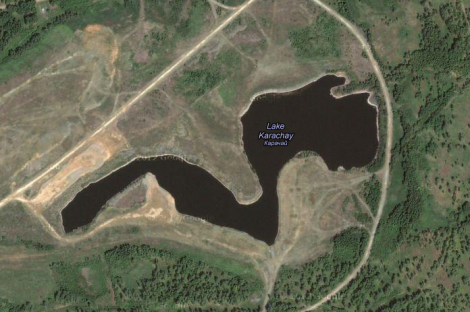
“Killer” Lake Karachay, known as the most polluted place on Earth, near the Mayak nuclear plant in Chelyabinsk, reportedly has enough radiation in it to kill a human being in an hour. Image: Google
Over the many years that we have been trying to educate the public on the catastrophic consequences of nuclear weapons we have mostly concentrated on the destruction of human life and health, not surprisingly, as we are a physician’s organisation.
Recently, IPPNW has begun to focus on the environmental effects, particularly on the climate, of a nuclear war, limited to one region but affecting the whole world and the knock-on effects for human life and health. The work with climatologists Alan Robock and Brian Toon has enabled us to show that a relatively “small” nuclear exchange could cause millions of people to die from starvation – this we have termed “nuclear famine”. Read more…
First Committee hears humanitarian call for nuclear abolition
by Ira Helfand
The campaign to build support for a nuclear weapons convention took a big step forward at the UN Monday when a group of 34 nations and the Holy See released a joint statement calling for nuclear abolition.
The statement said, in part:
The only way to guarantee (that nuclear weapons are never used) is the total, irreversible and verifiable elimination of nuclear weapons, under effective international control, including through the full implementation of Article VI of the NPT. All States must intensify their efforts to outlaw nuclear weapons and achieve a world free of nuclear weapons. Civil society plays a crucial role in raising the awareness about the devastating humanitarian consequences as well as the critical IHL [International Humanitarian Law] implications of nuclear weapons.”
What motivates me to campaign for the ATT
by Bob Mtonga
 Here are four scenarios that I have lived through that have motivated me to campaign for an Arms Trade Treaty (ATT) to control the deadly trade in weapons.
Picture a boy, aged 13 years and full of naiveté; he did not know his father’s firearm was unsecured and loaded. He called three of his friends and asked them to line-up so that they could do enact a mock “007” James Bond scene. He asked them to duck when he pulled the trigger. One of the three chickened out and he was labeled as a coward. The boy with the gun pulled the trigger and before he knew it one of his peers was dead. Read more…
Local governments and national security policy

Sign in Berkeley, California proclaiming the city to be a nuclear-free zone. Credit: Flickr/dotpolka.
Can local governments in the United States influence national security policy? Congress has the power to appropriate funds for military purposes and to declare war. But local governments sometimes have something to say about this — especially when national policy has significant effects upon them.
In recent years, as Congress has poured trillions of dollars into the Iraq and Afghanistan wars and into an escalating Pentagon budget, well over half of U.S. federal discretionary spending has been devoted to funding the U.S. military. Meanwhile, federal spending on domestic programs has been sharply curtailed, leaving many cities, counties, and states hard-pressed to cover the costs of education, housing, health care, parks, and other social services. Read more…
Nobel Committee does it again
They did it again.
The Nobel Peace Prize to the European Union.
The Norwegian Nobel Prize committee has again decided to award the Nobel Peace Prize award to a recipient with the intention to encourage the awardee to work for peace, rather than to reward an accomplishment.
The European Union was by its founders seen as a peace organization, but has since done little to promote peace or to achieve disarmament. Most important, the EU has not at all worked to diminish the greatest threat to mankind: nuclear war. Two of the dominant members of the EU are nuclear weapon states, which have shown no intention to work to prevent a nuclear Armageddon. The EU has rather discouraged work by its member states against nuclear weapons. The two European countries who have been most active for nuclear abolition, Switzerland and Norway, are not members of the EU.
The Nobel Peace Prize committee members are appointed by the Norwegian Parliament. The Parliament has chosen to appoint mostly politicians. Maybe that is the reason the members keep rewarding politicians and political organisations. There should be members from peace research institutes, peace organisations, and respected non-political members of the community.
The European Union does not meet the requirements of a Nobel Peace laureate, according to the testament of Alfred Nobel, the one who shall have done the most or the best work for brotherhood between peoples, for the abolition or reduction of standing armies, and for the promotion of peace congresses.
Think Big: Making Peace with the Cookie Monster
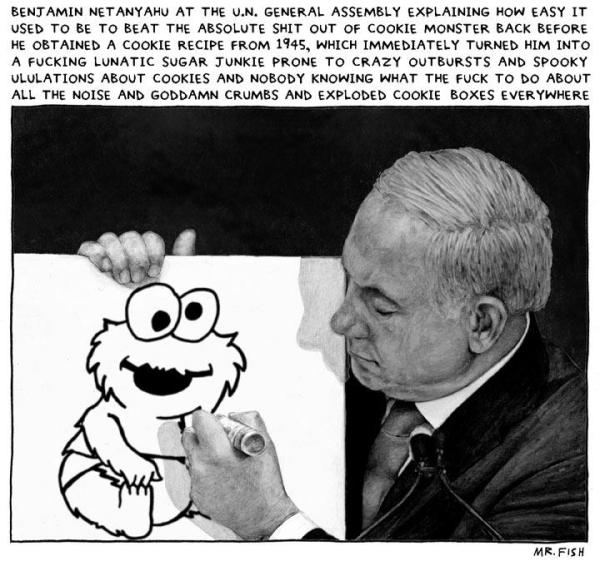
Reproduced with permission from Mr. Fish
Its not often that we have opportunity to laugh at Benjamin Netanyahu’s rhetoric about Iran and what the consequences may be, but his show at the UN on September 27 really took the biscuit (or the cookie, Mr. Fish might say). Holding up a large cartoon bomb, Bibi explained to us where exactly that “red line” should be that he has been demanding Barack Obama define. Read more…
“The Path to Zero: Dialogues on Nuclear Dangers”
 About a third of the way through The Path to Zero, David Krieger, one of the authors, suggests a Zen koan — a mind-bending riddle designed to foster enlightenment — that runs as follows: “What casts a dark shadow when dormant and a fiery cloud of death when brought to life?” The answer is nuclear weapons, the subject of this book.
It is certainly a crucial subject. The contradiction between the potential of nuclear weapons to destroy the world and the determination of nations to possess them is a central dilemma of modern times. More than sixty-seven years after U.S. atomic bombs killed much of the population of two Japanese cities, some 20,000 nuclear weapons — thousands of them on alert — remain housed in the arsenals of nine countries. Read more…

 Bimal Khadka
 Bjorn Hilt
 Charles K. Johnson
 Gunnar Westberg
 IPPNW
IPPNW John Loretz
 Lawrence Wittner
 Maria Valenti
 mollymcgint
 Sue Wareham
 Tilman Ruff
 Tim Wright
 Xanthe Hall


 IPPNW peace and health blog