“The proposition that nuclear weapons can be retained in perpetuity and never used — accidentally or by decision — defies credibility”
This unanimous statement was published by the Canberra Commission in 1996. Among the commission members were internationally known former ministers of defense and of foreign affairs and generals.
The nuclear-weapon states do not intend to abolish their nuclear weapons. They promised to do so when they signed the Nuclear Non-Proliferation Treaty (NPT) of 1970. Furthermore, the International Court in The Hague concluded in its advisory opinion more than 20 years ago that these states were obliged to negotiate and bring to a conclusion such negotiations on complete nuclear disarmament. The nuclear-weapon states disregard this obligation. On the contrary, they invest enormous sums in the modernization of these weapons of global destruction. Read more…
The more we know, the worse it looks
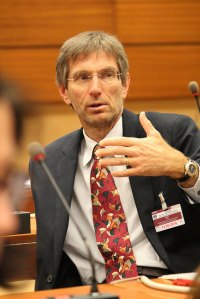
IPPNW co-president Tilman Ruff
[Co-president Tilman Ruff addressed the Open-Ended Working Group on nuclear weapons on May 13 in Geneva, on behalf of IPPNW’s Australian affiliate, MAPW, and ICAN. His remarks follow.]
Given some views expressed here in recent days, I feel a medical responsibility to highlight for representatives in this room some crucial evidence on the weapons under discussion.
Public policy should be based on evidence—especially in relation to the most acute existential threat that has ever lain in human hands. Read more…
Divergence and consensus at the OEWG
Understanding the code words of diplomacy
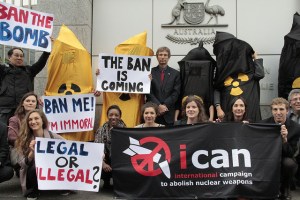
ICAN protest in front of Australian embassy during the OEWG. Photo: ICAN
Those of you who attempted to follow the discussion in real-time over the last two weeks at the Open-Ended Working Group (OEWG) at the United Nations in Geneva may have been non-plussed at the language in the speeches, especially if you were reading in the 140 character condensed form of Twitter posts. Those of us commenting and reporting from the “front-line” do our best not to overdo the acronyms and use plain speech, but it is easy to get sucked into diplo-speak. So here are a few personal definitions to help you understand what lies behind some of the frequently used code words in the many statements and in over sixty working papers submitted to the May session of the OEWG. Read more…
The right side of history
 The gavel has come down on the May meetings of the UN Open-Ended Working Group (OEWG) on nuclear disarmament and, to paraphrase our friend and colleague Carlos Umana, if democracy has anything to do with it, we’re only one or two steps away from negotiations on a treaty banning nuclear weapons. Read more…
Democracy has come to nuclear disarmament
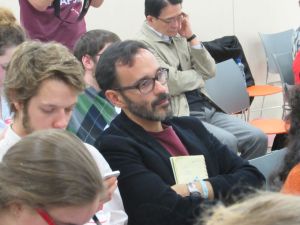
Carlos Umana of Costa Rica, at the ICAN campaigners meeting in Geneva preceding the OEWG.
[Carlos Umana, the president of IPPNW’s Costa Rican affiliate, spoke on behalf of IPPNW and ICAN at today’s meeting of the Open-Ended Working Group on nuclear disarmament at the United Nations in Geneva.]
Mr. Chairman,
Thank you for permitting me to take the floor. I speak on behalf of IPPNW Costa Rica, a partner organization of ICAN.
This OEWG attests to the fact that democracy has, indeed come to nuclear disarmament, as it is clear that the majority of nations are unsatisfied with the status quo and are ready to pursue truly effective measures conducive to nuclear disarmament. Echoing Jamaica’s statement today, “Yes, we can take forward multilateral negotiations.” Nuclear disarmament is feasible, if we work for it. And that is what we are here to do. Read more…
[IPPNW co-president Tilman Ruff delivered the following remarks to the UN Open-Ended Working Group taking forward multilateral nuclear disarmament negotiations, meeting in Geneva on May 4, 2016.]
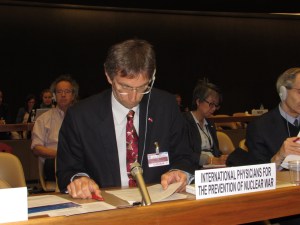
IPPNW co-president Tilman Ruff addresses OEWG meeting in Geneva
The World Health Assembly is the global body of all your Ministers of Health or their most senior officials entrusted to safeguard the health of the population of every country in the world. When considering the first landmark World Health Organisation report on the effects of nuclear war on health and health services in 1983, they concluded that “nuclear weapons constitute the greatest immediate threat to the health and welfare of [hu]mankind”. That was 33 years ago. Read more…
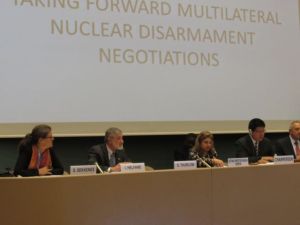
IPPNW co-president Ira Helfand (second from left) addresses the Open-Ended Working Group in Geneva
[IPPNW co-president Ira Helfand was an expert panelist on the humanitarian impact of nuclear weapons at the UN Open-Ended Working Group (OEWG) taking forward multilateral nuclear disarmament negotiations. Following are his opening remarks during the OEWG session on May 4, 2016, which began with remarks by Hiroshima survivor Setsuko Thurlow.]
Thank you Setsuko for your moving testament to the vast human suffering that the detonation of a nuclear weapon will produce.
And thank you, Mr. Chairman, for the opportunity to review with you today the medical consequences that will result from nuclear war. It is the belief of the International Physicians for the Prevention of Nuclear War, the World Medical Association, the World Federation of Public Health Associations and the International Council of Nurses that a full understanding of the humanitarian impact of nuclear weapons, an understanding of what nuclear weapons will actually do when they are used, must lie at the core of policy discussion about what to do with these most dangerous of all weapons of mass and indiscriminate destruction. Read more…
Global health federations issue collective appeal for prohibition and elimination of nuclear weapons
The leading international federations representing the world’s physicians, public health professionals, and nurses have told a special UN working group that the medical and scientific evidence about the consequences of nuclear weapons requires urgent action to prohibit and eliminate them as “the only course of action commensurate with the existential danger they pose.”
International Physicians for the Prevention of Nuclear War (IPPNW), the World Medical Association (WMA), the World Federation of Public Health Associations (WFPHA), and the International Council of Nurses (ICN) have submitted a joint working paper—“The health and humanitarian case for banning and eliminating nuclear weapons”—to the UN Open-Ended Working Group (OEWG), which meets in Geneva this week and next to decide what new legal measures are needed to achieve nuclear disarmament. The OEWG will report back to the UN General Assembly later this year. Read more…
Zambians to Zambia leaders – Ratify the ATT!
BY Dr. Robert Mtonga, Zambian Healthworkers for Social Responsibility
The inertia-laden Zambian bureaucracy got a push recently from IPPNW-Zambia, Control Arms coalition partners and members of Zambian civil society to ratify the Arms Trade Treaty (ATT). Read more…
By Bimal Khadka, Nepal, IPPNW International Student Representative
Young doctors and medical students from throughout Asia overcame vast geographical boundaries, cultural barriers and financial difficulties to bring their ideas and energy to the first Asian IPPNW Youth Congress in Patna, India in March. 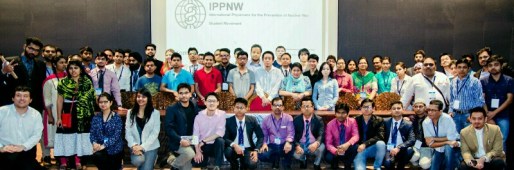
We came from Nepal, Bangladesh, Indonesia, Kazakhstan, Philippines, Mongolia, and Japan to join our Indian colleagues to discuss how we can use our medical expertise to advance heath through peace throughout the region. We were supported by observers from IPPNW Germany and many members of Indian doctors for Peace and Development (IDPD) who were involved in smooth and fruitful discussions on many IPPNW topics. Read more…

 Bimal Khadka
 Bjorn Hilt
 Charles K. Johnson
 Dr. Ghassan Shahrour
 Gunnar Westberg
 IPPNW
IPPNW John Loretz
 Lawrence Wittner
 Maria Valenti
 mollymcgint
 Sue Wareham
 Tilman Ruff
 Tim Wright
 Xanthe Hall