The International Red Cross and Red Crescent Movement has urged all States to join the fight in ensuring a nuclear free world at the Prohibition and Elimination of Nuclear Weapons conference in Nagasaki, Japan. The conference that was co-sponsored by Australian Red Cross also congratulated those 132 States that were already taking part in historic UN negotiations to prohibit nuclear weapons that started earlier this year.
IPPNW statement on Korea crisis
The persistent tensions on the Korean peninsula are rapidly escalating into a crisis fueled by mutual fears, provocations, and the volatile temperaments of two unpredictable, nuclear-armed heads of state. The current US administration seems determined to “resolve” the situation through shows of force and military threats. The government of Kim Jong-un is accelerating its efforts to test and build nuclear weapons and missiles, while promising “massive” retaliation should the US follow through on those threats. Read more…
In recent weeks, the people of the world have been treated to yet another display of the kind of nuclear insanity that has broken out periodically ever since 1945 and the dawn of the nuclear era.
On April 11, Donald Trump, irked by North Korea’s continued tests of nuclear weapons and missiles, tweeted that “North Korea is looking for trouble.” If China does not “help,” then “we will solve the problem without them.” North Korean leader Kim Jong Un responded by announcing that, in the event of a U.S. military attack, his country would not scruple at launching a nuclear strike at U.S. forces. In turn, Trump declared: “We are sending an armada, very powerful. We have submarines, very powerful, far more powerful than the aircraft carrier. We have the best military people on earth.” Read more…
Indian doctors “Health through Peace” campaign 2017
By Dr Arun Mitra, IDPD
 The Central Council of Indian Doctors for Peace and Development (IDPD) met at Gandhi Peace Foundation, New Delhi on 2 April 2017 and agreed to launch another nationwide campaign for “Health through Peace.” IDPD will conduct events around India including seminars, lectures, and demonstrations involving medical and other students. Read more…
Kenyan medical students remember Garissa massacre
By Kelvin Kibet, Kenyan Medical Students for Social Responsibility
 Medical Peace Work graduates from Kenyatta University (KU) together with the KU Christian Union commemorated the anniversary of the horrific attack in 2015 by heavily armed terrorists on Garissa University College in northeastern Kenya where 147 were killed and another 79 injured. Most of those murdered were students. The memories of that day live on after two years.
Ban treaty here we come
by Tilman Ruff
March 31

Tilman Ruff prepares to address the ban treaty conference on March 28
The first negotiating session of the historic conference to negotiate a treaty to ban and provide for the elimination of nuclear weapons has just finished. In content, process and significance, it was extraordinary. The number of states participating was 132—even more than the 123 that voted for the UN resolution mandating these negotiations. Read more…
Clearing the path to the ban
Day 4 of ban treaty negotiations
 Something extraordinary happened yesterday. What started as an informal discussion of the proposals and divergent viewpoints that had emerged earlier in the week turned into a collective working session among the State and civil society participants in coming to terms with those differences. It was one of the most productive, energized, and energizing exchanges most of us have ever experienced inside a UN conference room. Read more…
Family values update

Moms for Nukes to close up shop after protests from children?
I got an e-mail from one of our Australian doctors who said he was “horrified” by US ambassador Nikki Haley’s comments (exact phrase redacted) Monday.
“I told my seven-year-old son that the US wanted to keep nuclear weapons ‘for their children.’ He asked me whether anyone had asked the children whether they wanted them, because he doesn’t! Out of the mouths of babes…..”
Digging into the negotiating details
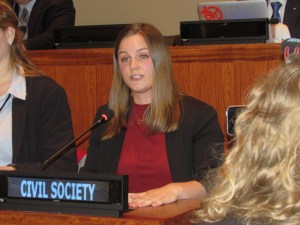
Thea Katrin Mjelstad presents ICAN’s views on core ban treaty prohibitions.
Ban treaty negotiations day 3:
Ray Acheson summed up the principal goal of the ban treaty yesterday in WILPF’s statement to the ban treaty negotiators: “In order to be effective as a prohibition treaty that leads to the elimination of nuclear weapons, the core prohibitions of the treaty should be as clear and comprehensive as possible.” Read more…
The ban treaty is transformative
Women’s International League for Peace and Freedom (WILPF)
Statement to the UN conference to negotiate a legally binding instrument to prohibit nuclear weapons, leading to their elimination, Topic 2
Delivered by Ray Acheson, Director of Reaching Critical Will
29 March 2017
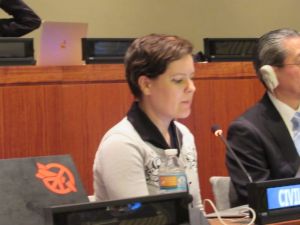
Ray Acheson urges the conference to produce the strongest possible prohibition
Thank you Madame President,
Thank you for this opportunity to address this conference. WILPF has prepared a paper on principles, prohibitions, and positive obligations of a treaty banning nuclear weapons. After listening closely to interventions from delegations this morning, I would like to comment on a few of the prohibitions and positive obligations. Read more…

 Bimal Khadka
 Bjorn Hilt
 Charles K. Johnson
 Dr. Ghassan Shahrour
 Gunnar Westberg
 IPPNW
IPPNW John Loretz
 Lawrence Wittner
 Maria Valenti
 mollymcgint
 Sue Wareham
 Tilman Ruff
 Tim Wright
 Xanthe Hall